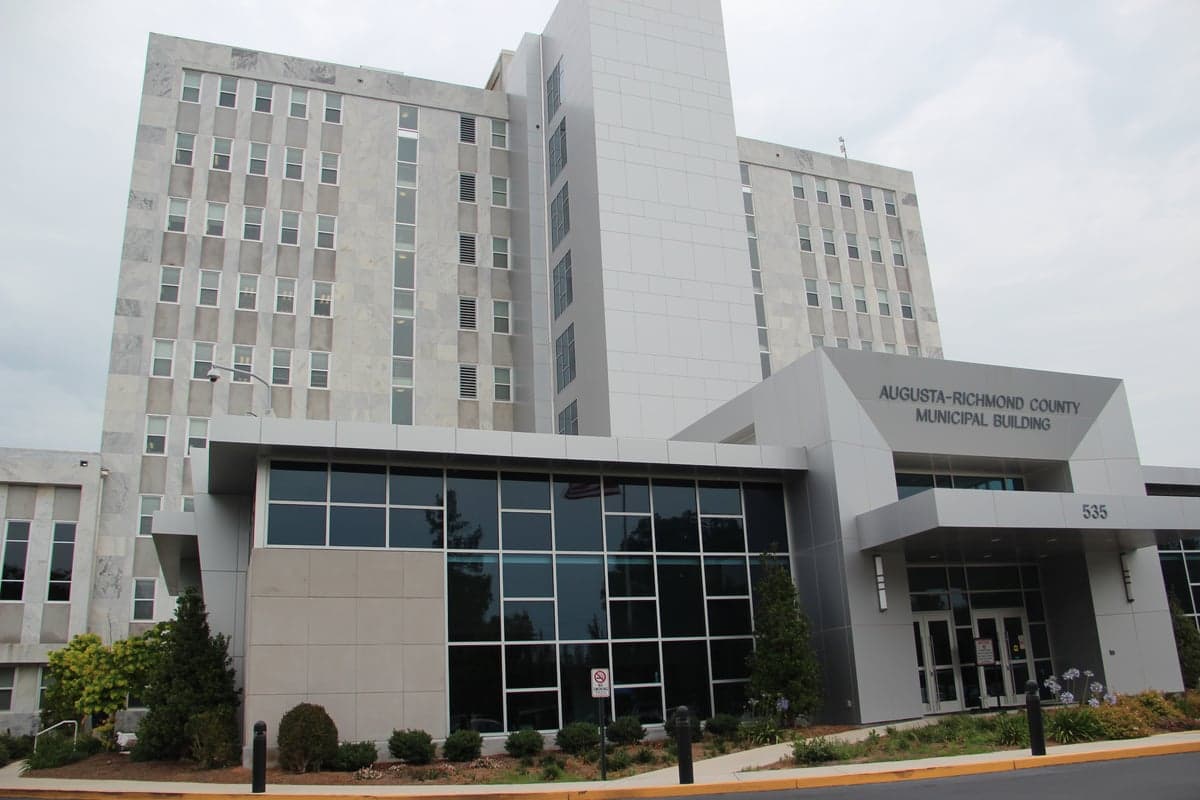
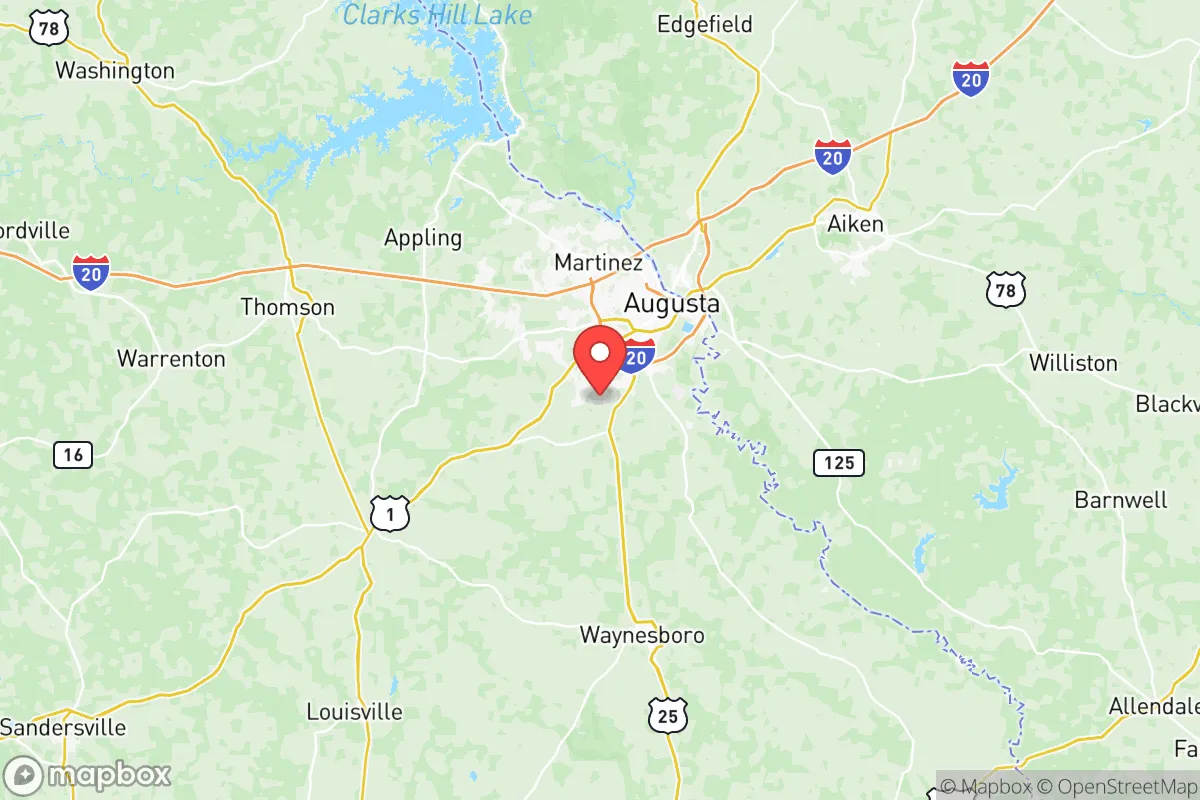
Photo: Wikipedia
Demographics of Richmond County
Affluence Level in Richmond County
A below-average socioeconomic profile. Incomes, home values, and educational attainment trail the U.S., with higher poverty and unemployment.
People of Richmond County
Richmond County, Georgia, anchored by its county seat and central city of Augusta, is a majority-Black, historically rooted community of just over 206,000 residents. The county’s population is defined by a deep African American heritage, a comparatively small but stable White population, and very low foreign-born share (1.6%), giving it a distinctly native-born, Southern character. With a college attainment rate of 24.1% and a modest Hispanic presence of 5.6%, the area remains economically and culturally tied to its historic institutions—Fort Eisenhower, the Medical College of Georgia, and the Savannah River Site—rather than to large-scale immigration or high-tech migration.
Settlement & growth (pre-1960)
The earliest inhabitants of what is now Richmond County were indigenous peoples of the Mississippian culture, followed by the historic Creek and Cherokee nations. European contact began with Spanish explorers in the 16th century, but sustained settlement by Anglo colonists did not begin until the mid-18th century, when the British established Fort Augusta in 1736 as a trading post and frontier garrison. The region was contested between the British, Spanish, and French, but British settlement prevailed. After the American Revolution, Richmond County was officially created in 1777 from the colonial parish of St. Paul, with Augusta serving as the county seat and a key inland port on the Savannah River.
The first major wave of American settlers were English and Scots-Irish planters who established cotton and tobacco plantations worked by enslaved Africans. The enslaved population grew rapidly; by 1790, roughly one-third of the county’s inhabitants were Black, and by 1860, the enslaved majority exceeded 60%. Augusta became a thriving commercial hub for the cotton trade, with a sizable free Black community as well. The construction of the Augusta Canal in the 1840s powered mills and factories, drawing Irish immigrants to work on the canal and later in textile mills. These Irish workers settled primarily in the Harrisburg and Turknett Trail areas of Augusta.
After the Civil War and Emancipation, freedmen and freedwomen concentrated in Augusta’s inner city neighborhoods—notably the Laney-Walker and Bethlehem areas—and in rural communities like Hephzibah and Blythe. The 1870s to 1920s saw a modest influx of European immigrants, including Greek and Jewish families, who established small businesses in Augusta’s downtown Broad Street corridor. However, Richmond County never received the large-scale immigrant waves that transformed other Southern cities. The Great Migration (1910–1970) saw tens of thousands of Black residents leave Richmond County for Northern industrial cities, reducing the Black share of the population from a post-Reconstruction peak of nearly 70% to roughly 53% by 1970. Meanwhile, White residents migrated into new suburban developments in the western part of the county, especially around the West Augusta and National Hills neighborhoods, as well as into Martinez and Evans in neighboring Columbia County after World War II.
The 1950s brought the establishment of Fort Gordon (now Fort Eisenhower) and the Savannah River Project (later Savannah River Site), which drew a military and scientific workforce—mostly White, college-educated professionals—to the area. Suburbanization accelerated, with much of the new development bypassing Richmond County’s core for Columbia and Aiken counties. By 1960, Richmond County’s population was roughly 47% Black and 52% White, with small enclaves of Jewish, Greek, and Italian families in Augusta’s historic Summerville district.
Modern era (post-1965)
The 1965 Hart-Cellar Act had a muted effect on Richmond County compared to the nation as a whole. The county’s foreign-born population has never exceeded 2.5%, and the vast majority of post-1965 newcomers have been domestic migrants rather than immigrants. The most significant demographic shift since the 1960s has been the steady increase in the Black population share, driven by both natural increase and the return migration of Black families from the North (the Reverse Great Migration). By 2000, Richmond County was 55% Black, and by 2020 it had risen to roughly 57%. Today the Black share stands at 55.3%, with the White share at 31.9%—a dramatic decline from 1960.
Hispanic residents, though still a small share (5.6%), have grown noticeably since the 1990s, primarily settling in Augusta’s southern and western neighborhoods—particularly near the Peach Orchard Road corridor and in the Meadowbrook area. This growth has come from both domestic migration (e.g., Mexican-origin workers moving from Texas and California) and some direct immigration from Central America. The East/Southeast Asian community (1.4%) is small but concentrated near the Medical College of Georgia and Fort Eisenhower, with many Vietnamese and Filipino families employed in healthcare or the military. The Indian-subcontinent population (0.3%) is even smaller, mostly professionals associated with the medical schools.
Domestic migration patterns have reshaped the county’s internal geography. Since the 1980s, affluent White and middle-class Black families have moved to the western reaches of Richmond County (the area around Guthrie and across the line into Columbia County) or to the suburban towns of Evans and Martinez. This has left Augusta’s urban core with higher poverty rates and a predominantly Black population, while the county’s rural outposts—Hephzibah, with its small Black-majority population, and Blythe, a quiet crossroads village—retain their traditional character. The countywide college-attainment rate of 24.1% masks a sharp divide: the medical and military corridor near Augusta University and Fort Eisenhower has a highly educated minority, while much of the rest of the county lags behind state and national averages.
Suburbanization also accelerated the racial and economic sorting of neighborhoods. The city of Augusta itself has become more predominantly Black, while the county’s unincorporated areas—especially west of I-520—have become more diverse but still majority-White. The lack of significant immigration means that Richmond County’s ethnic fabric remains essentially two-group (Black and White), with small but growing Hispanic and Asian threads.
The future
Demographic projections for Richmond County suggest a continued slow decline in the White population share, a stable Black majority, and gradual growth among Hispanic and Asian residents. The foreign-born share is likely to rise modestly as the healthcare sector expands and Fort Eisenhower attracts military families from diverse backgrounds, but it will remain far below national averages. The county’s population is aging—median age is roughly 36—and natural increase (births minus deaths) is slowing, meaning future growth will depend heavily on domestic in-migration.
New communities are concentrating not within Richmond County itself but in the suburban rings of Columbia and Aiken counties. However, there are signs of a modest urban revival in Augusta’s downtown, which has seen apartment development and the revitalization of historic Broad Street, potentially attracting young professionals and empty nesters of all races. The county’s cultural identity is likely to remain strongly Southern and Black, with the annual Masters Tournament, the Augusta National Golf Club, and the city’s role as a medical hub serving as anchor institutions. For a new resident—especially a family or individual with a conservative leaning—Richmond County offers a low-cost, relatively stable environment with a strong sense of local history, but with limited ethnic diversity and a population that is slowly dispersing outward.
Bottom line: Richmond County is becoming a more clearly Black-majority community with a shrinking White population and very gradual Hispanic and Asian growth. Its future will be defined not by immigration-driven transformation but by the internal dynamics of the Black Belt, suburban flight to neighboring counties, and the ongoing economic role of its military and medical anchors. For someone moving in now, the county offers deep roots, affordable living, and a clear sense of place—but little of the ethnically diverse, rapidly changing character seen in other Sun Belt metros.

* Values derived from national, state, county, city and local statistics and may differ in a specific area. Last updated: 2026-06-25T10:45:44.000Z
Narrative content on this page is AI-generated and may contain mistakes. Verify any details that matter before acting on them.
ReloMaps may earn a commission from affiliate links at no extra cost to you.

