
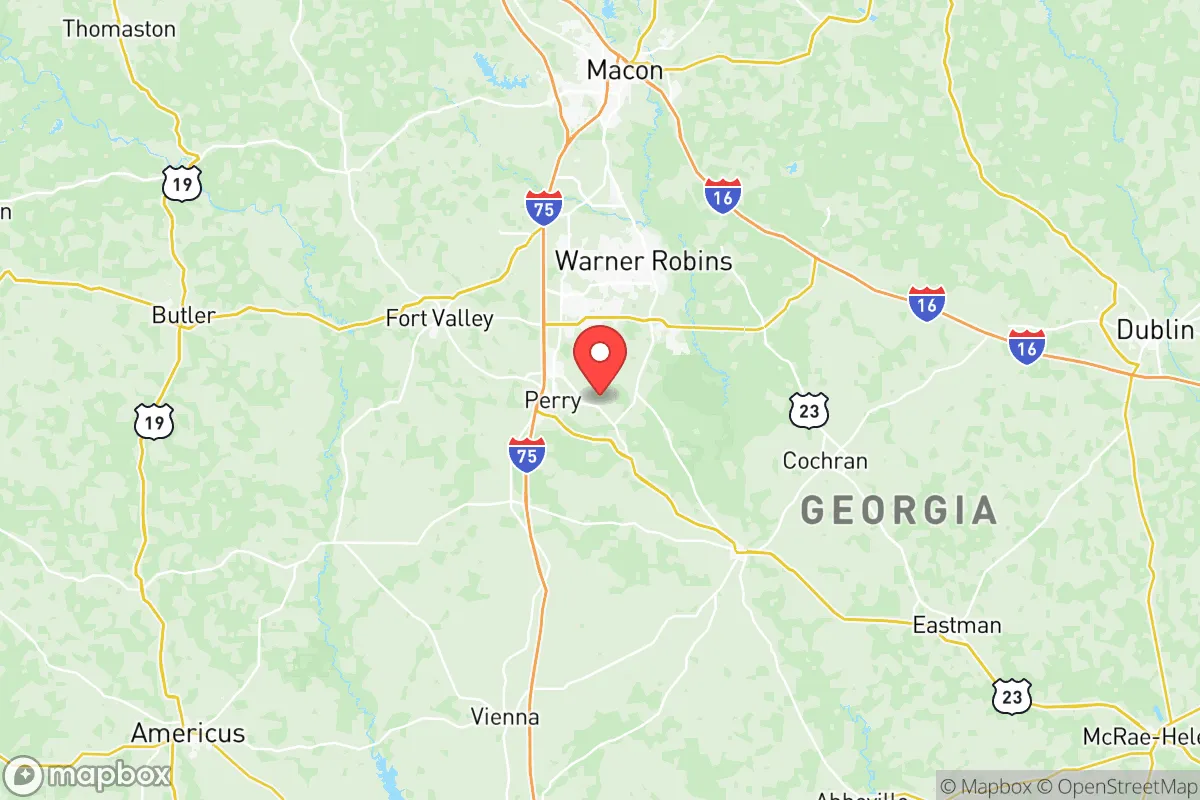
Photo: Wikipedia
Political ClimatePolitical Climate in Houston County
Showing district-level results — no local-only data available.
Local Political AnalysisPolitical Analysis of Houston County
Houston County, Georgia, is a reliably Republican stronghold with a Cook Partisan Voting Index of R+15, meaning it votes about 15 points more Republican than the national average. The county has trended redder over the past decade, driven by population growth in exurban subdivisions and a strong military-affiliated conservative base around Robins Air Force Base. While the state of Georgia as a whole has become a competitive battleground—flipping blue for Biden in 2020 and electing two Democratic senators—Houston County has moved in the opposite direction, with GOP margins widening from about 12 points in 2016 to 18 points in 2024.
How it compares
Houston County’s R+15 rating places it among the most conservative counties in Georgia’s middle-Georgia region, comparable to neighboring Peach County (R+14) and more Republican than Bibb County (Macon, R+8). The county’s political geography is not monolithic, however. The city of Warner Robins, the county seat and largest city, leans Republican overall but contains several precincts that are competitive or even lean Democratic, particularly around the older neighborhoods near Watson Boulevard and the areas closer to Robins Air Force Base’s civilian workforce. Perry, the second-largest city, is more uniformly conservative, with precincts routinely delivering 65-70% of the vote for GOP candidates. The unincorporated areas north of Bonaire and along the Kathleen corridor are the most reliably red, often exceeding 75% Republican. The swing precincts are concentrated in central Warner Robins, where a mix of military families, younger professionals, and long-time residents create a more balanced electorate—these areas typically split 50-55% Republican, making them the only places where Democrats can be competitive in local races.
What this means for residents
For conservative residents, Houston County’s political climate means local policies align closely with their values: the county commission and school board are solidly Republican, taxes remain low (the county’s millage rate is among the lowest in the region), and Second Amendment protections are strong. For liberal residents, the reality is more nuanced. While they are a clear minority, they are not isolated—Warner Robins has a visible Democratic presence, with active local groups and a few elected officials at the city level. The county’s growth has brought in younger, more diverse populations (the county is about 40% non-white), which has slowly shifted some precincts leftward, but the overall trend remains red. Practical implications: conservative residents can expect their votes to carry weight in local primaries, while liberal residents may find more influence in city-level races in Warner Robins than in countywide contests.
Culturally, Houston County is distinct from both the Atlanta metro and rural south Georgia. The presence of Robins Air Force Base infuses the area with a transient, military-connected population that tends to be more moderate on social issues than the surrounding rural counties. This creates a unique blend: the county votes like a deep-red rural area but has the infrastructure and diversity of a mid-sized city. Policy-wise, the county has resisted some of the more aggressive conservative measures seen elsewhere—for example, it has not pursued sanctuary city ordinances (which would be moot anyway under state law) but also has not enacted the kind of strict local zoning or social policies found in more rural counties. The result is a place where the political climate is reliably conservative but not culturally insular, offering a middle ground for residents who want Republican governance without the intensity of deep-red rural Georgia.

State Political ClimatePolitical Climate in Georgia
State Political AnalysisPolitical Environment in the State
Georgia has transformed from a reliably Republican stronghold into the nation’s premier political battleground, a shift that has accelerated dramatically since 2020. The state’s partisan lean is now a razor-thin toss-up at the presidential level—Joe Biden won it by just 0.23% in 2020, and Donald Trump lost it by a similar margin in 2024—while state-level offices remain firmly in GOP hands. Over the past two decades, the dominant coalition has moved from a solidly conservative, rural-and-suburban base to a deeply divided state where the explosive growth of metro Atlanta’s diverse, college-educated suburbs now nearly offsets the overwhelming Republican margins in the rest of the state. For a relocator, this means you’re moving into a place where your vote genuinely counts, but where the practical experience of daily life depends heavily on whether you settle in the Atlanta metro, a midsize city like Augusta or Savannah, or a small town in south Georgia.
Urban vs. rural divide
The political map of Georgia is a study in stark contrasts. Metro Atlanta—encompassing Fulton, DeKalb, Cobb, Gwinnett, and Clayton counties—is the engine of Democratic growth. Fulton County (Atlanta proper) routinely delivers 70-75% of its vote to Democrats, while DeKalb and Clayton are even more lopsided. The real story, though, is the suburban shift: Gwinnett County, which voted Republican by 12 points in 2012, flipped to Biden by 18 points in 2020, and Cobb County followed a similar trajectory. Outside the I-285 perimeter, the state is deeply red. Rural south Georgia counties like Brooks, Irwin, and Telfair routinely vote 75-80% Republican. The midsize cities are mixed: Augusta (Richmond County) leans Democratic but is surrounded by deep-red counties, while Savannah (Chatham County) has trended blue but remains more moderate. Columbus (Muscogee County) is a swing area that has drifted left. The real political fault line runs through the exurbs—places like Forsyth County, once a byword for racial tension, is now a reliably Republican, fast-growing suburb, while Henry County south of Atlanta has flipped from red to purple to light blue in just a decade.
Policy environment
Georgia’s state-level policy environment is unmistakably conservative, even as the state’s overall electorate becomes more competitive. The state has a flat income tax rate of 5.49% (down from 6% in 2022, with further cuts scheduled), and a homestead exemption that keeps property taxes relatively low for owner-occupied homes. There is no state-level rent control, and zoning is largely a local affair, though the state has preempted local governments from enacting certain land-use restrictions. On education, Georgia has a robust school choice landscape: the state offers both a tax-credit scholarship program and, as of 2024, a universal Education Savings Account (ESA) program that allows any K-12 student to use state funds for private school, tutoring, or homeschooling expenses. Healthcare policy is more mixed: the state has not expanded Medicaid under the Affordable Care Act, leaving a coverage gap for low-income adults, but it has a thriving telehealth industry and a relatively competitive insurance marketplace. Election laws have been a flashpoint: the 2021 Election Integrity Act (SB 202) added a photo ID requirement for absentee ballots, limited drop box locations, and restricted third-party ballot collection, while also expanding early voting hours in most counties. Gun laws are permissive: Georgia is a permitless carry state (since 2022), with no state-level red flag law, no waiting period, and no universal background check requirement for private sales.
Recent policy direction
The last five years have seen Georgia’s legislature move decisively on several fronts that matter to relocators. On gun and self-defense law, the 2022 passage of permitless carry (SB 319) means any legal gun owner can carry a concealed firearm without a license, though a license is still available for reciprocity with other states. The state also has a strong Stand Your Ground law. On parental and education rights, the 2024 ESA expansion (SB 233) is the biggest shift: any Georgia student can now receive roughly $6,500 per year in state funds for private school tuition or homeschooling expenses, a policy that has drawn families from states with weaker school choice. On speech and privacy, Georgia has no state-level equivalent of a “bathroom bill” targeting transgender individuals, but the legislature has passed laws restricting instruction on gender identity in K-3 classrooms (HB 1084, 2022). On medical and bodily autonomy, Georgia’s 2019 “Heartbeat Law” (HB 481) bans abortion after a fetal heartbeat is detected (around six weeks), with exceptions for rape, incest, and medical emergencies; the law was blocked by courts for years but took effect after the Dobbs decision in 2022. Property rights are generally strong, with no state-level rent control and a relatively straightforward eminent domain process. On voting and ballot access, the 2021 law (SB 202) made absentee voting more restrictive but also expanded in-person early voting hours; voter turnout actually increased in the 2022 midterms, suggesting the law’s practical effect has been debated.
Civil unrest & political movements
Georgia has been a focal point for political activism on both sides. The 2020 election cycle saw massive protests in Atlanta following the murder of George Floyd, with the city becoming a center of the Black Lives Matter movement. The 2021 election law (SB 202) sparked corporate backlash—Major League Baseball moved the 2021 All-Star Game out of Atlanta—and ongoing activism from voting rights groups like Fair Fight, founded by Stacey Abrams. On the right, the state has seen a surge in grassroots conservative activism, particularly around school board meetings and library boards, where debates over book bans and curriculum have been intense. Immigration politics are a live issue in the Atlanta suburbs, particularly in Gwinnett and Cobb counties, where the foreign-born population has grown rapidly; the state has no sanctuary city policies, and local law enforcement generally cooperates with federal immigration authorities. Election integrity remains a charged topic: the 2020 election in Georgia was recounted three times (including a hand recount), and while no widespread fraud was found, a significant portion of Republican voters remain skeptical. A new resident would notice the political energy most visibly in yard signs, bumper stickers, and the sheer volume of campaign mailers during election season—Georgia is one of the most heavily targeted states for political advertising in the country.
Projection
Over the next five to ten years, Georgia’s political trajectory points toward continued competitiveness, with a slight edge toward Democrats at the presidential level and continued Republican dominance at the state level. The key demographic driver is the Atlanta metro’s growth: Gwinnett, Cobb, and Forsyth counties are adding tens of thousands of new residents each year, many of them from blue states and from diverse backgrounds. This will likely push the statewide presidential margin even closer, possibly making Georgia a lean-Democratic state in presidential years by 2032. However, the state legislature is gerrymandered to protect Republican majorities, and the rural vote is not shrinking as fast as the urban vote is growing. A relocator moving in now should expect to live in a state where the governor and legislature will remain Republican for the foreseeable future, but where the political conversation is increasingly shaped by the needs of a diverse, fast-growing metro area. The practical effect: taxes will likely continue to be cut modestly, school choice will expand further, and social policy will remain conservative at the state level, but local governments in metro Atlanta will continue to chart a more progressive course on issues like housing, transit, and policing.
For a new resident, the bottom line is that Georgia offers a unique blend of conservative state governance and a dynamic, increasingly diverse economy. If you’re a conservative, you’ll find a state that generally aligns with your values on taxes, guns, and education, but you’ll also live in a place where your vote is genuinely contested and where the political culture is not monolithic. If you’re a liberal, you’ll find a vibrant, growing metro area in Atlanta that feels like a blue island, but you’ll also contend with state laws on abortion, voting, and guns that may not match your preferences. The key is to choose your location carefully: a family moving to a suburb like Peachtree City or a small town like Thomasville will have a very different political experience than one settling in Decatur or Athens. Georgia is no longer a place where you can assume the politics of your neighbors—it’s a state where the conversation is still being written, and your move will be part of that story.
* Values derived from national, state, county, city and local statistics and may differ in a specific area. Last updated: 2026-06-16T18:42:19.000Z
Narrative content on this page is AI-generated and may contain mistakes. Verify any details that matter before acting on them.
ReloMaps may earn a commission from affiliate links at no extra cost to you.

