Political ClimatePolitical Climate in Hall County
Showing district-level results — no local-only data available.
Local Political AnalysisPolitical Analysis of Hall County
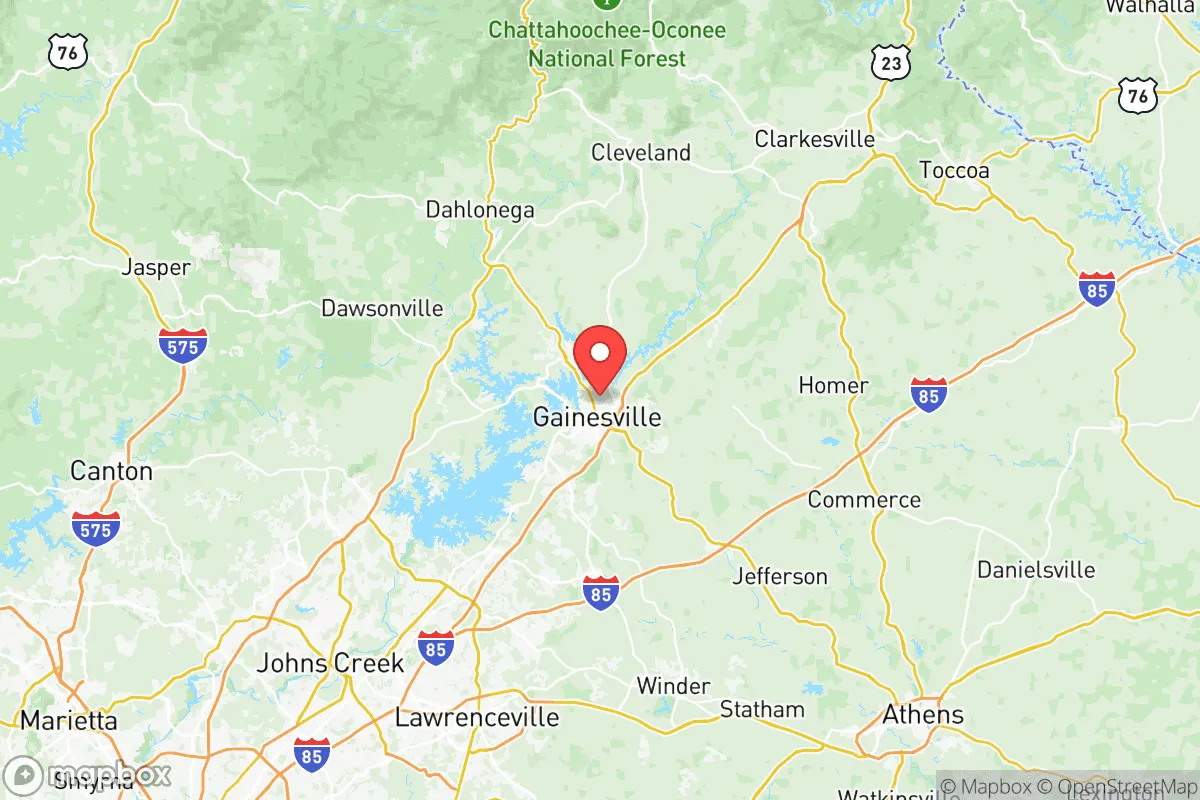
Hall County, Georgia, is a reliably Republican stronghold with a Cook PVI of R+17, meaning it votes about 17 points more conservative than the nation as a whole. The county has been trending redder over the past decade, driven by population growth in its more rural and exurban areas, even as the city of Gainesville has seen a modest Democratic shift. In the 2024 presidential election, Hall County gave Donald Trump roughly 72% of the vote, a margin that has widened slightly since 2020, reflecting the broader rightward movement of Georgia's northern suburbs.
How it compares
Compared to the state of Georgia as a whole, Hall County is significantly more conservative. Georgia statewide is a competitive swing state—it voted for Joe Biden in 2020 by a razor-thin margin and flipped back to Trump in 2024 by about 2 points—but Hall County is far from that battleground status. The county's R+17 PVI places it among the most Republican counties in the Atlanta metro region, alongside Forsyth and Cherokee counties. Within Hall County itself, there is notable variation: the city of Gainesville is the most Democratic area, with precincts near the downtown and the historic district often voting 55-60% Democratic in recent cycles. In contrast, the northern and eastern parts of the county—towns like Clermont, Lula, and Gillsville—are deeply red, routinely delivering 80% or more of the vote to Republican candidates. The swing precincts are mostly in the southern part of the county, around Oakwood and Flowery Branch, where newer subdivisions have attracted a mix of young families and retirees from more diverse political backgrounds.
What this means for residents
For conservative residents, Hall County's political climate means their values are broadly reflected in local governance. The county commission and school board are reliably Republican, and issues like low taxes, Second Amendment rights, and limited regulation are generally prioritized. For liberal residents, the reality is more nuanced. While they are a clear minority, they are not without representation—Gainesville's city council has a Democratic member, and the local Democratic party is active and growing. The county's political lean also means that certain state-level policies, like the 2019 "heartbeat" abortion ban and the 2022 election law changes, are popular here, even as they remain contentious statewide. One practical distinction: Hall County has avoided the kind of intense partisan conflict seen in some metro Atlanta counties over issues like library book bans or election administration, largely because the Republican majority is so solid that there is little incentive for performative battles.
Culturally, Hall County's politics are intertwined with its identity as a hub for the poultry industry and Lake Lanier recreation. The county is home to a large and growing Hispanic community, which has added a layer of political complexity—while many Hispanic voters lean conservative on social issues, they have also been a key part of the Democratic coalition in Gainesville. The local GOP has made outreach efforts, but the county's political landscape remains largely defined by its white, rural, and exurban base. Looking ahead, the county's trajectory is likely to stay red, though the margins could narrow slightly as Gainesville continues to grow and diversify. For now, Hall County remains a place where the political temperature is warm but not boiling, and where most residents—regardless of party—find common ground around the lake and the high school football field.

State Political ClimatePolitical Climate in Georgia
State Political AnalysisPolitical Environment in the State
Georgia has transformed from a reliably Republican stronghold into the nation’s most competitive swing state over the past two decades, with a partisan lean that now sits at roughly R+3 in a neutral national environment. The state’s political identity is a tug-of-war between a rapidly diversifying, urbanizing metro Atlanta and a deeply conservative, rural interior that still holds significant legislative power. The 2020 and 2024 presidential elections saw margins under 0.5%, cementing Georgia as the epicenter of American political realignment.
Urban vs. rural divide
The political map of Georgia is defined by a stark urban-rural split. Metro Atlanta, home to nearly 60% of the state’s population, is the engine of Democratic growth. Fulton County (Atlanta), DeKalb County, and Cobb County have become reliably blue, with Cobb flipping from red to blue in 2016 and staying there. Meanwhile, Gwinnett County—once a conservative suburban bastion—has shifted dramatically, voting for Biden by 18 points in 2020. Outside the metro, the story is different. North Georgia (Pickens, Gilmer, Fannin counties) and South Georgia (Colquitt, Thomas, Lowndes) are deeply Republican, often voting 70-80% for GOP candidates. The Augusta area (Richmond County) and Savannah (Chatham County) are blue-leaning urban islands surrounded by red rural territory. The Columbus area (Muscogee County) has trended purple, while Macon (Bibb County) remains a Democratic holdout in middle Georgia. The result is a state where control of the legislature is gerrymandered to favor rural Republicans, even as statewide races are toss-ups.
Policy environment
Georgia’s policy environment reflects its divided government: a Republican-controlled legislature and governor’s mansion, but with a Democratic-leaning electorate that keeps things competitive. The state has a flat income tax rate of 5.39%, set to drop to 4.99% by 2029 under HB 1437. Sales tax is capped at 4% state-level, but local options push it to 7-8% in most areas. Property taxes are moderate, with a $2,000 homestead exemption that increases with inflation. Education policy is a flashpoint: Georgia has a robust school choice program (SB 47) that expanded vouchers for low-income students, but also maintains some of the South’s strongest teacher tenure protections. Healthcare is a mixed bag—the state did not expand Medicaid under the ACA, leaving roughly 300,000 Georgians in the coverage gap, but it has a thriving telehealth sector and a growing number of direct-primary care clinics. Election laws are among the most debated in the nation. SB 202 (2021) added voter ID requirements for absentee ballots, limited drop box locations, and reduced the runoff window from 9 weeks to 4 weeks. It also made it a crime to hand out food or water to voters waiting in line—a provision that drew national criticism and was later clarified. The law has survived multiple court challenges, but litigation continues.
Recent policy direction
Georgia’s recent legislative trajectory is a study in conservative governance tempered by competitive electoral pressure. On gun rights, Georgia is a constitutional carry state (HB 218, 2022), allowing permitless carry for anyone 21 or older who can legally possess a firearm. The state also has a strong Stand Your Ground law with no duty to retreat. On parental rights, the legislature passed HB 1178 (2023), which allows parents to challenge school library materials and requires schools to notify parents of any changes to a student’s health or well-being—a law that has been both praised by conservative groups and criticized by LGBTQ+ advocates. Medical and bodily autonomy is sharply divided: Georgia’s Living Infants Fairness and Equality (LIFE) Act (HB 481, 2019) bans abortion after a fetal heartbeat is detected (around 6 weeks), with exceptions for rape, incest, and medical emergencies. The law was blocked by courts for months but reinstated by the Georgia Supreme Court in 2022. On property rights, Georgia has a strong right-to-farm law that protects agricultural operations from nuisance lawsuits, and it is a low-regulation state for land use, with no statewide zoning code. Privacy and surveillance are relatively light—Georgia has no comprehensive data privacy law, though a bill (HB 1030) is pending. Voting and ballot access remains the most contested arena: the state’s automatic voter registration at the DMV and no-excuse absentee voting (with ID) are still in place, but the 2021 law added restrictions that critics say disproportionately affect urban and minority voters.
Civil unrest & political movements
Georgia has been a focal point for political activism on both sides. The 2020 election aftermath saw massive protests in Atlanta over the death of George Floyd, as well as sustained activism from groups like Fair Fight Action, founded by Stacey Abrams, which focused on voter access. On the right, the Georgia Republican Party has been riven by internal fights between establishment conservatives and Trump-aligned populists, with the 2022 primary featuring a contested governor’s race and a secretary of state race that saw incumbent Brad Raffensperger (who refused to overturn the 2020 election) survive a challenge from a Trump-backed opponent. Immigration politics are active but not as heated as in border states: Georgia passed HB 87 (2011), which allowed police to check immigration status of suspects and penalized those who harbored undocumented immigrants, but parts were struck down in court. There are no sanctuary cities in Georgia, and the state has a cooperative agreement with ICE. Election integrity remains a live issue: the 2024 election saw over 100,000 challenges to voter registrations filed by conservative groups, though most were rejected by county boards. The State Election Board, now controlled by Trump-aligned appointees, has been the site of ongoing battles over rule changes, including a controversial 2024 rule requiring hand-counting of ballots that was later blocked by a judge. A new resident would notice the intensity of political signage, the prevalence of campaign mailers, and the frequency of local election-related news—especially in metro Atlanta.
Projection
Over the next 5-10 years, Georgia is likely to remain a competitive swing state, but with a slight Democratic lean at the presidential level due to continued in-migration of diverse, college-educated voters to the Atlanta suburbs. The 2020 and 2024 margins suggest a state that will be decided by turnout and candidate quality, not structural advantage. The 2026 gubernatorial election will be a key test: if Democrats can hold the governor’s mansion (currently held by Brian Kemp, term-limited), it would signal a permanent shift. However, the legislative maps are likely to remain gerrymandered in favor of Republicans through the 2030s, meaning policy will stay conservative even if statewide elections tighten. The rural exodus continues—small towns in South Georgia are losing population—while the Atlanta metro grows by roughly 100,000 people per year. This demographic trend favors Democrats, but the party’s ability to turn out its base in non-presidential years remains unproven. A new resident moving in now should expect a state that is politically exhausting but stable—no secession talk, no militia standoffs, but constant low-grade conflict over voting rules, education, and abortion access.
Bottom line for a new resident: If you’re conservative, you’ll find a state that largely aligns with your values on taxes, guns, and regulation, but you’ll need to accept that your vote for president may not count for much in a close race. If you’re liberal, you’ll find a vibrant, growing urban core with strong community organizing, but you’ll face a state government that is actively hostile to many of your policy preferences. Either way, Georgia is a place where your vote genuinely matters—and where the political climate will keep you engaged, whether you like it or not.
* Values derived from national, state, county, city and local statistics and may differ in a specific area. Last updated: 2026-07-02T23:05:23.000Z
Narrative content on this page is AI-generated and may contain mistakes. Verify any details that matter before acting on them.
ReloMaps may earn a commission from affiliate links at no extra cost to you.

