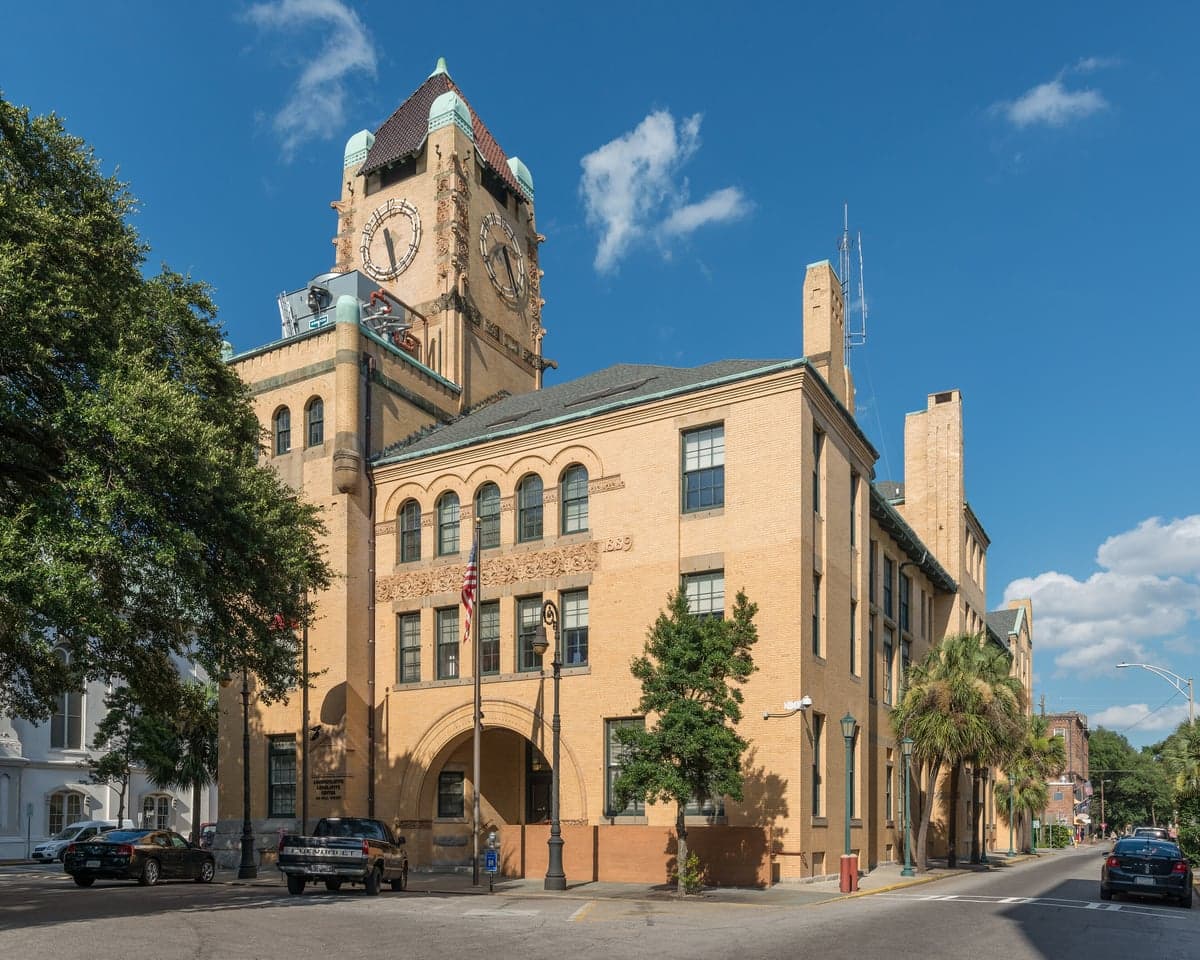
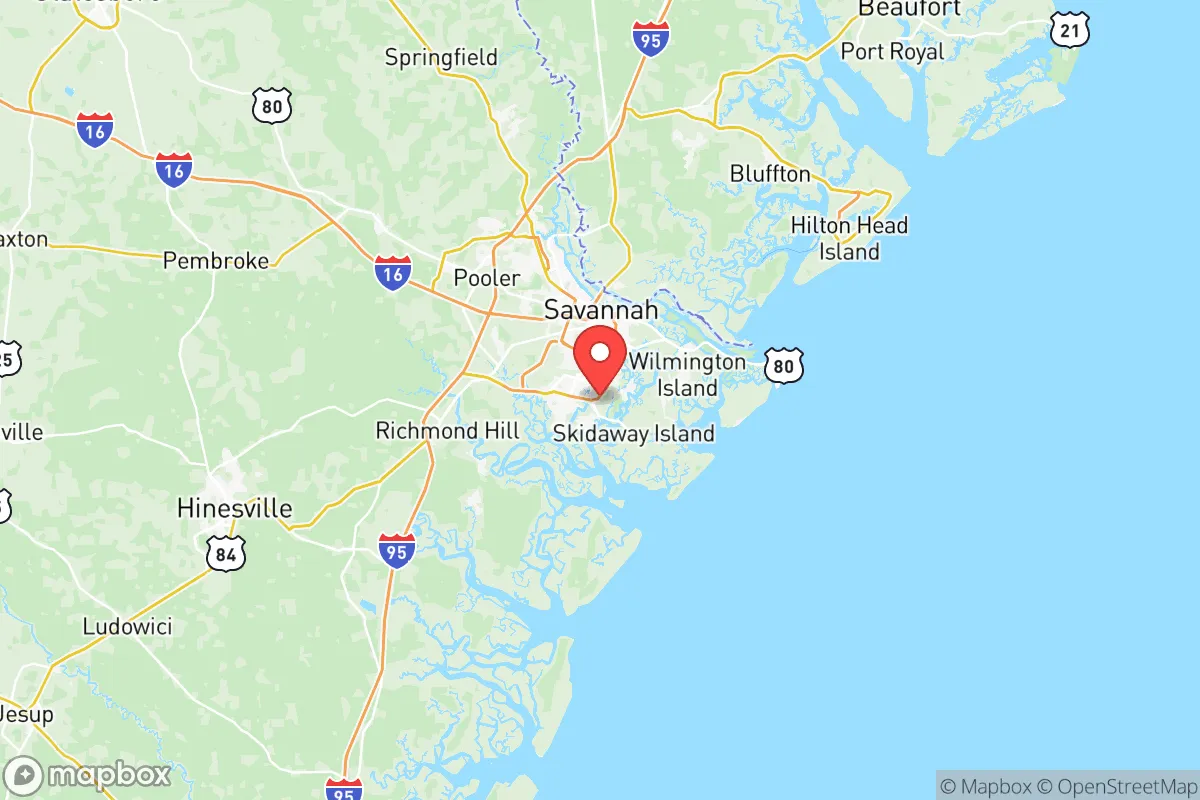

Photo: Wikipedia
Political ClimatePolitical Climate in Chatham County
Showing district-level results — no local-only data available.
Local Political AnalysisPolitical Analysis of Chatham County
Chatham County, anchored by Savannah, is a classic Georgia swing county that has been drifting leftward even as the state around it has become more competitive. The county’s Cook Partisan Voting Index (PVI) of R+8 might sound solidly Republican, but that number masks a fast-changing reality: in 2020, Joe Biden won Chatham by about 3 points, and in 2024, Kamala Harris carried it by a similar margin. That’s a dramatic shift from 2012, when Mitt Romney won the county by 4 points. The real story is the growing urban-suburban divide within the county itself.
How it compares
Georgia as a whole has a PVI of R+3, meaning Chatham County is still slightly more Republican-leaning than the state average—but the gap is closing fast. The key difference is that Chatham’s blue vote is concentrated and growing, while the red vote is more diffuse. In Savannah proper, precincts like the Historic District and Ardsley Park routinely deliver 70-80% Democratic margins, fueled by young professionals, Black voters, and transplants from bluer states. Meanwhile, the suburban and exurban towns tell a different story. Pooler,

State Political ClimatePolitical Climate in Georgia
State Political AnalysisPolitical Environment in the State
Georgia has undergone a dramatic political transformation over the past two decades, evolving from a reliably red Sunbelt stronghold into a competitive swing state that narrowly backed Joe Biden in 2020 and saw Democrats capture both U.S. Senate seats in the 2021 runoffs. That shift wasn’t a fluke — it’s the product of explosive suburban growth around Atlanta, an increasingly diverse electorate, and the steady migration of out-of-state professionals into metros like Alpharetta and Sandy Springs. While the state’s default partisan lean is still right-of-center — Republicans control the governor’s mansion, the legislature, and most statewide offices — the margin has compressed from double-digit GOP wins in 2012 and 2016 to a dead heat in 2024, where the presidential race was decided by roughly one percentage point. For a relocator, that means you’re moving into a place where both parties can win, and where your vote genuinely matters.
Urban vs. rural divide
The political map of Georgia splits along a classic urban-rural axis, but the story is really about the suburbs. Metro Atlanta — a 7-million-person behemoth that sprawls across 29 counties — has become the Democratic engine of the state. Core counties like Fulton (Atlanta), DeKalb, and Clayton vote overwhelmingly blue, often by 70-point margins. The real shift, though, has been in the formerly conservative northern suburbs: Cobb County, Gwinnett County, and Henry County all flipped from red to blue between 2016 and 2020, driven by college-educated white voters and growing minority populations. Meanwhile, rural south Georgia — places like Tifton, Valdosta, and the peanut-growing belt — remain deeply Republican, with some counties voting 80% GOP. The divide isn’t just metro versus country; it’s also the I-75 corridor versus everywhere else. The exurbs like Forsyth County (north of Atlanta) and Houston County (around Warner Robins) are still solidly red, but they’re filling up fast, and as they densify, they’re starting to show signs of suburban drift.
Policy environment
Georgia’s policy landscape is conservative but pragmatic. The state income tax is a flat 5.49%, with a push underway to lower it further — multiple bills in 2024 sought a 4.99% or even a flat 4.5% rate by 2026. Sales taxes vary by county, typically around 8% including local options. Property taxes are relatively low, especially outside metro Atlanta, though they’ve been rising as home values climb. On education, Georgia has a robust school choice system: the state offers a tax credit scholarship program (up to $6,500 per student for private school) and has expanded its charter school network significantly since 2020. The Georgia Promise Scholarship Act, passed in 2024, creates education savings accounts for students in low-performing schools. Healthcare is a mixed bag: Georgia is one of the holdout states that has not expanded Medicaid under the ACA, but the state did implement its own “Georgia Pathways” program in 2023 with work requirements, though enrollment has been anemic. Election laws were tightened in 2021 with SB 202, which added voter ID requirements for absentee ballots, limited drop boxes, and restricted mobile voting — a flashpoint that drew major national attention and corporate backlash from Delta and Coca-Cola.
Recent policy direction
The past five years have seen Georgia push in a distinctly conservative direction on several fronts, even as the state’s electoral competitiveness has increased. Gun policy: Georgia is a constitutional carry state as of 2022, meaning no permit is needed to carry a concealed handgun in public. The “Safe Carry Protection Act” (SB 319) also allows firearms in many government buildings and churches, though private property rights still govern most businesses. Parental and education rights: The “Parents’ Bill of Rights” (SB 449) passed in 2022 and requires schools to notify parents of any medical or counseling services offered to students, and prohibits classroom discussion of “divisive concepts” like race-based stereotypes. Medical and bodily autonomy: Georgia’s heartbeat abortion ban (HB 481) took effect in 2022 after a court battle, banning most abortions after roughly six weeks. There is no exception for rape or incest, only for medical emergencies. Property rights: The state is generally pro-developer, with limited zoning controls outside of metro Atlanta’s core. Eminent domain is rarely a local flashpoint. Privacy/surveillance: Georgia has no statewide ban on employer social media password requests, but it did pass a data breach notification law in 2023. Tax policy direction: The legislature passed a bill in 2024 to automatically trigger state income tax rate cuts as revenues grow, aiming for a 4.99% flat rate by 2027. That’s a meaningful long-term trend for anyone calculating cost of living.
Civil unrest & political movements
Georgia has been a stage for major political flashpoints over the past decade. The 2020 election and its aftermath remain raw: the “Stop the Steal” movement was particularly active in Atlanta’s suburbs, with protests at the State Capitol and a heavily publicized hand-recount of the presidential ballots. The Fulton County election interference case against Donald Trump and 18 co-defendants (2023) keeps election integrity in the local headlines daily. On the left, the killing of Rayshard Brooks in 2020 by Atlanta police sparked weeks of summer protests and led to a state-level police reform law (HB 286) that bans no-knock warrants for most drug cases — one of the tougher reform measures in the South. Immigration politics are less explosive than in border states, but Georgia’s HB 87 (2011) was one of the earliest state-level immigration enforcement laws, allowing police to check immigration status of suspects. Some counties like Cobb and Gwinnett have declared themselves “sanctuary counties” in symbolic opposition, but state law preempts local non-cooperation measures. A new resident will notice the Confederate monument debates in smaller towns like Rome and LaGrange, and the occasional protest on the Georgia State Capitol’s steps.
Projection
Over the next five to ten years, Georgia is likely to remain a swing state, but the terrain will keep shifting. Demographic trends favor Democrats: the Atlanta metro continues to absorb domestic and international migrants; the Asian and Hispanic populations are rapidly growing in Gwinnett and Cobb, while college-educated white voters in Macon’s outer-ring suburbs are trending left. However, the counterweight is migration from other red states into the exurbs of Cherokee and Forsyth counties, plus the rural-urban divide sharpening. By 2030, expect the governor’s race to be decided by less than two points every cycle. For a relocator, that means you’re moving into a state where every election feels high-stakes, and where your vote counts in both primaries and general elections. The conservative policy direction — lower taxes, school choice, gun rights — may slow if Democrats win the governor’s mansion, but the structural tilt of the state means major reversals are unlikely without a decade of sustained Democratic control.
The bottom line for a new resident: Georgia is a genuinely competitive two-party state with a conservative policy floor and a demographic ceiling. If you’re conservative, you’ll find a welcome policy environment in state government for the foreseeable future, especially on taxes, guns, and education. If you’re liberal, you’ll find a burgeoning blue base in Atlanta’s suburbs and a real chance to flip seats in 2026 and beyond. But no matter where you stand, expect the political temperature to run hot during election seasons, with national attention focused on Georgia every cycle. That’s the price — and privilege — of living in a state that actually decides presidential elections.
* Values derived from national, state, county, city and local statistics and may differ in a specific area. Last updated: 2026-06-29T01:31:10.000Z
Narrative content on this page is AI-generated and may contain mistakes. Verify any details that matter before acting on them.
ReloMaps may earn a commission from affiliate links at no extra cost to you.

