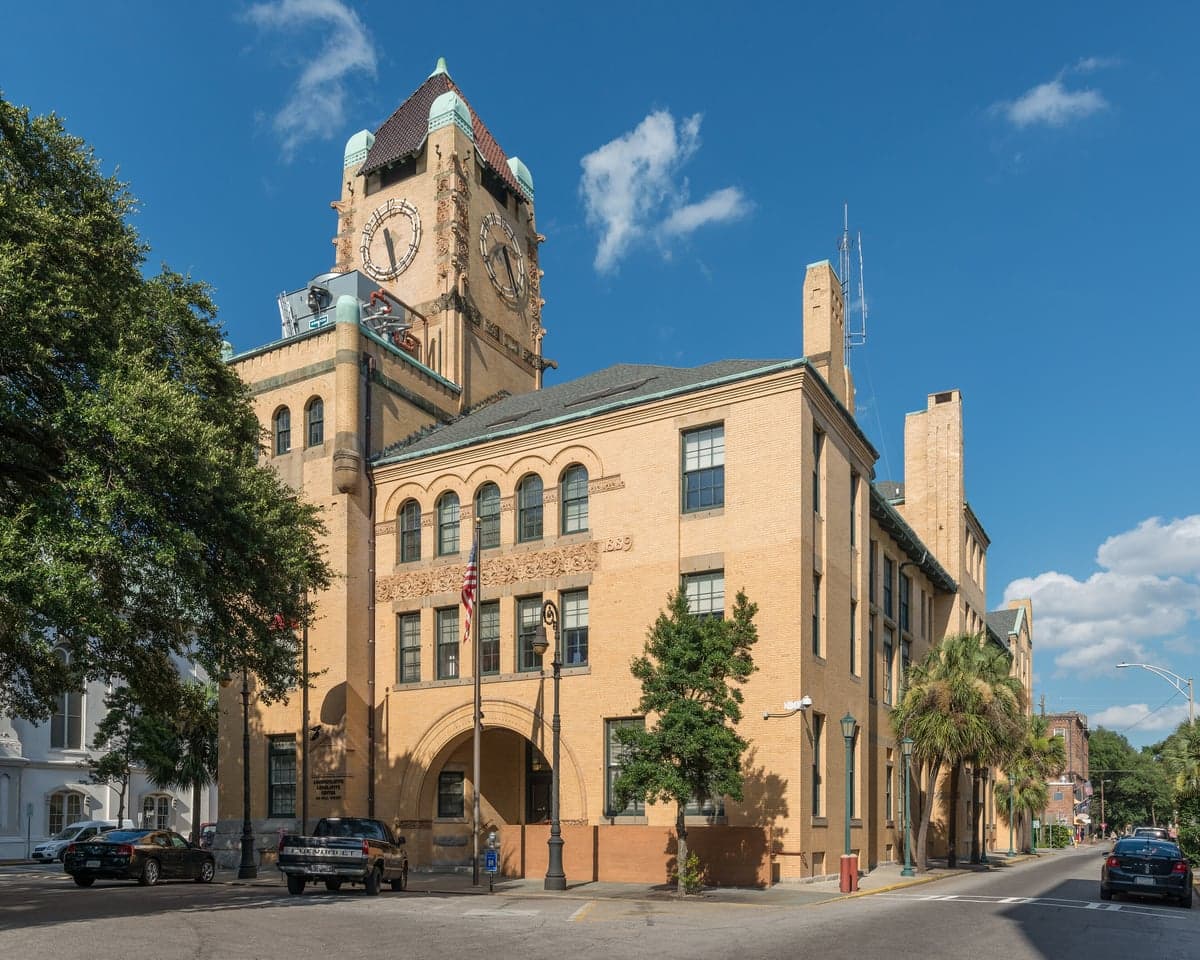
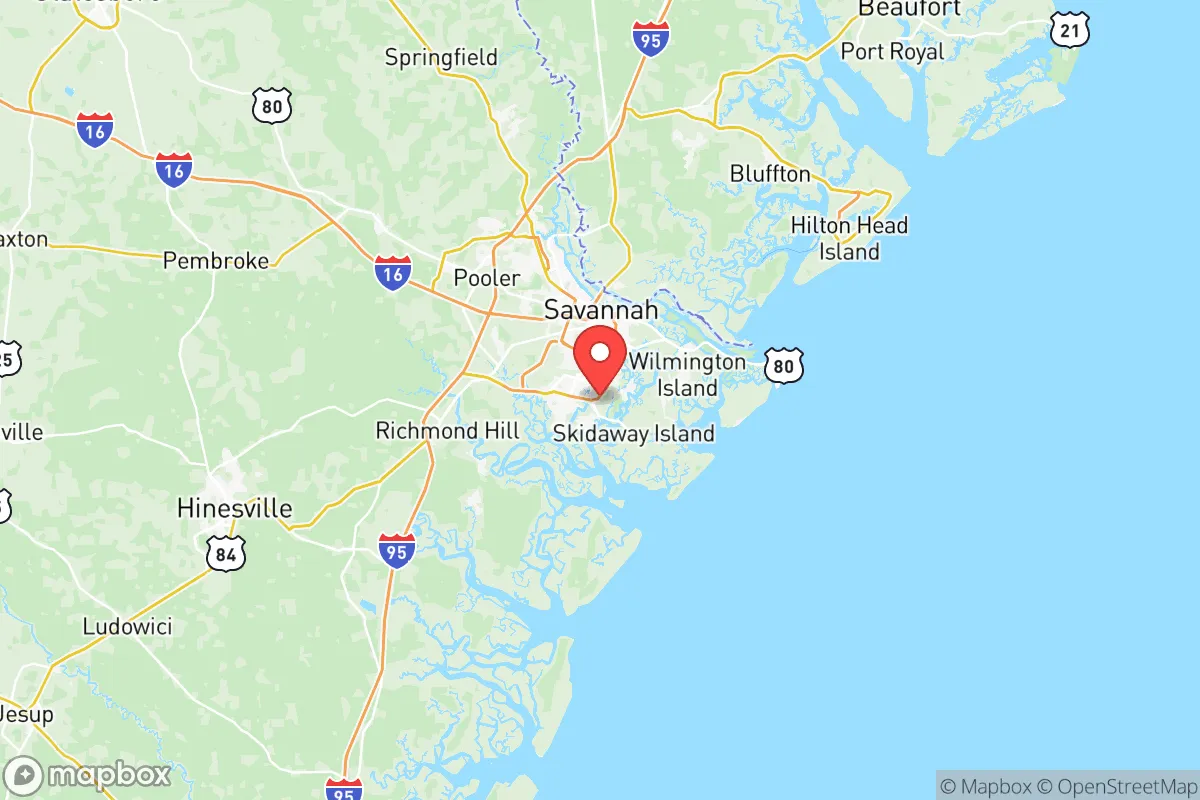
Photo: Wikipedia
Demographics of Chatham County
Affluence Level in Chatham County
A middle-class area roughly in line with national averages across income, home values, education, and employment.
People of Chatham County
Today, Chatham County, anchored by Savannah, is Georgia’s fifth-most populous county with a population of 298,143, characterized by a nearly equal split between its Black (38.8%) and White (45.7%) populations and a growing Hispanic community (8.0%). It is a historically coastal, biracial Southern county that has evolved from a plantation economy into a hub for logistics, tourism, and the military, yet retains a strong sense of place through its preserved historic districts and deep-rooted Gullah-Geechee heritage. The county’s identity is one of layered history—where 18th-century squares and colonial-era homes sit alongside modern suburban subdivisions, and where a relatively low foreign-born rate (3.9%) reflects a population shaped more by domestic migration and generational roots than by recent international arrivals. For residents and newcomers, Chatham County feels both old and new: a place where family surnames can trace back centuries, yet the fastest-growing areas are master-planned communities in the southwestern corridor around Pooler and Richmond Hill.
Settlement & growth (pre-1960)
The human history of Chatham County begins with the indigenous Guale people, a Muskogean-speaking group whose villages lined the coastal islands and tidal creeks for thousands of years before European contact. Spanish Franciscans established the mission of Santa Catalina de Guale on St. Catherines Island in the late 16th century, and after the Spanish withdrew, the region became a contested buffer zone between English South Carolina and Spanish Florida. British General James Oglethorpe founded the city of Savannah in 1733 as the capital of the Georgia colony, deliberately recruiting a mix of English, German-speaking Protestants from Salzburg, and Highland Scots. The Salzburgers—Lutheran refugees from present-day Austria—established the settlement of Ebenezer (modern-day Effingham County, just north of Chatham) in 1734, while Highland Scots settled along the Altamaha River south of Savannah, but their cultural influence remains strongest in the city’s early civic framework and street names. Savannah’s design—the famous grid of 24 squares—was Oglethorpe’s plan for a disciplined, egalitarian colony, but the land-grant system quickly gave way to large rice and cotton plantations worked by enslaved Africans, who by 1775 already outnumbered European colonists in the county. The Gullah-Geechee people, descendants of enslaved West and Central Africans, developed a distinct language and culture in the Sea Islands and lowcountry, and communities like Pin Point (an unincorporated Gullah settlement near Savannah) and Sandfly (on the Isle of Hope) remain enduring centers of that heritage today.
After the Civil War and Reconstruction, Chatham County’s economy slowly diversified. Ex-Confederate soldiers and freedmen alike sought work in Savannah’s thriving port and railroad industries. The late 19th and early 20th centuries brought a modest wave of Irish immigrants who settled in the city’s low-lying ward neighborhoods—particularly around Forsyth Park and the Victorian District—working as dockhands, domestics, and laborers. A small but prominent Jewish community, largely of German and Eastern European origin, established congregations in Savannah as early as the 1850s, with their descendants central to the city’s commercial and civic life. But the defining 20th-century population shift was the Great Migration (1910–1970), during which tens of thousands of Black rural Georgians left sharecropping for urban Savannah, tripling the county’s Black population and transforming neighborhoods like Cuyler-Brownsville and Yamacraw into vibrant Black districts with their own businesses, schools, and cultural institutions. Meanwhile, white Savannahians increasingly moved east toward the beaches of Tybee Island and north into the nascent suburbs of Garden City (incorporated 1939) and Port Wentworth, spurred by the opening of the Talmadge Memorial Bridge in 1953 and the expansion of the Georgia Ports Authority. World War II brought a permanent military presence with the construction of Hunter Army Airfield (now Hunter Army Airfield) and the adjacent Fort Stewart, drawing in uniformed families from across the country and anchoring a defense-sector workforce that remains a major demographic force.
Modern era (post-1965)
The 1965 Hart-Cellar Act had a muted effect on Chatham County compared to metro Atlanta—the county’s foreign-born population remains just 3.9%—but it did introduce small but visible new communities. East and Southeast Asian residents (2.3%) arrived in two main phases: a post-1975 wave of Vietnamese refugees, many sponsored by local churches and settling in midtown Savannah and the Georgetown corridor near Hunter Army Airfield, and a later influx of Korean and Filipino professionals drawn to the medical and port sectors, now concentrated in the Wilshire area and the southside near Abercorn Street. The Indian-subcontinent population (0.5%), though tiny, is heavily composed of doctors, engineers, and hoteliers who arrived after 1990, with a small cluster near the Savannah–Hilton Head International Airport in Pooler. Hispanic growth (8.0%) is the most notable post-1965 shift, driven overwhelmingly by Mexican and Central American immigrants working in construction, landscaping, hospitality, and poultry processing. This community has concentrated in the city of Savannah’s West Chatham neighborhoods— particularly on the western fringes near I-16 and the Chatham Parkway corridor—as well as in Pooler and Bloomingdale, where affordable housing and proximity to industrial and service jobs have drawn families. Unlike Atlanta, Chatham County’s Hispanic population is less defined by a single enclave and more spread across the county, with its fastest growth in the southwestern suburbs. The post-1965 domestic migration story, however, is far larger than international immigration. Since 1970, the white population has suburbanized dramatically, with the city of Savannah losing 30% of its white residents between 1970 and 2000, while the unincorporated Southside and the towns of Pooler and Richmond Hill (actually in Bryan County, but functionally tied) boomed. Black middle-class families, too, moved outward from historic urban neighborhoods into the Rainbow Road area and White Oak subdivisions on the south side. The Sun Belt influx from the 1980s onward brought retirees and remote workers from the Northeast and Midwest, attracted by Savannah’s climate, historic charm, and lower cost of living. This group, overwhelmingly white and often college-educated (36.8% of county residents hold a bachelor’s or higher), has settled in the historic downtown and the Victorian District, as well as in gated communities near The Landings on Skidaway Island, a planned retirement and golf community. The result is a county that is more economically and spatially stratified than ever: wealthy professionals and retirees in historic neighborhoods and exclusive islands, working-class and poor Black families in older urban corridors and newer subdivisions, and a growing Hispanic workforce filling the service gaps in between.
The future
Chatham County is projected to become more diverse, but the nature of that diversity is shifting. The white non-Hispanic share (45.7%) will continue to fall as the population ages and younger, more diverse cohorts replace older ones; in 2020 it was 49.5%, meaning the county already crossed the 50% threshold. The Black share (38.8%) is likely to stabilize or decline slightly, as Black out-migration to other Southern metros and to the Atlanta suburbs continues, while Hispanic and East/Southeast Asian populations will grow, albeit from small bases. The county’s foreign-born cohort, currently below 4%, is expected to double or triple by 2040, driven largely by family reunification and continued demand for labor in port logistics, healthcare, and hospitality. Geographically, the growth will concentrate overwhelmingly in the southwestern corridor—Pooler specifically will likely absorb the majority of new residential development, with its population already doubling since 2010 and showing no signs of slowing. The historic downtown and Victorian District will continue to attract affluent migrants, pushing up property values and altering the character of what was once a more mixed-income urban core. The Gullah-Geechee settlements like Pin Point and Sandfly face intense development pressure as suburban sprawl encroaches, and preserving those communities—and the cultural identity they anchor—will be a defining challenge. Culturally, the county is shedding its older “Savannah vs. the rest” divide and becoming more uniformly suburbanized, with shopping centers, car-dependent subdivisions, and chain retail replacing the dense, walkable character that once defined the area. For a conservative-leaning audience, this means a county that remains politically moderate—Chatham has voted Democratic in every presidential election since 2008 but by narrower margins than Atlanta—with strong military, port, and tourism sectors that anchor a stable economy.
What this means for someone moving in now: Chatham County offers a rare mix of authentic historic fabric (the nation’s largest National Historic Landmark District) and fast-growing, family-oriented suburbs, but the two worlds rarely mix. Your experience will depend heavily on whether you choose downtown Savannah, a master-planned community in Pooler, a waterfront enclave on Skidaway, or a working-class neighborhood on the south side. The county is becoming more diverse and more suburban by the year, and the cultural identity that once felt so distinct is softening into a more generic Sun Belt format—while the Gullah-Geechee, Black neighborhoods, and historic squares that gave it character face increasing economic pressure. For families seeking good schools, low regulation, and proximity to the coast and port economy, the southwestern suburbs are the logical choice. For those who value walkability, historic architecture, and a slower pace of life, the city itself remains one of the best preserved in the South—but it comes with higher housing costs and a more liberal social environment.

* Values derived from national, state, county, city and local statistics and may differ in a specific area. Last updated: 2026-06-29T01:31:10.000Z
Narrative content on this page is AI-generated and may contain mistakes. Verify any details that matter before acting on them.
ReloMaps may earn a commission from affiliate links at no extra cost to you.

