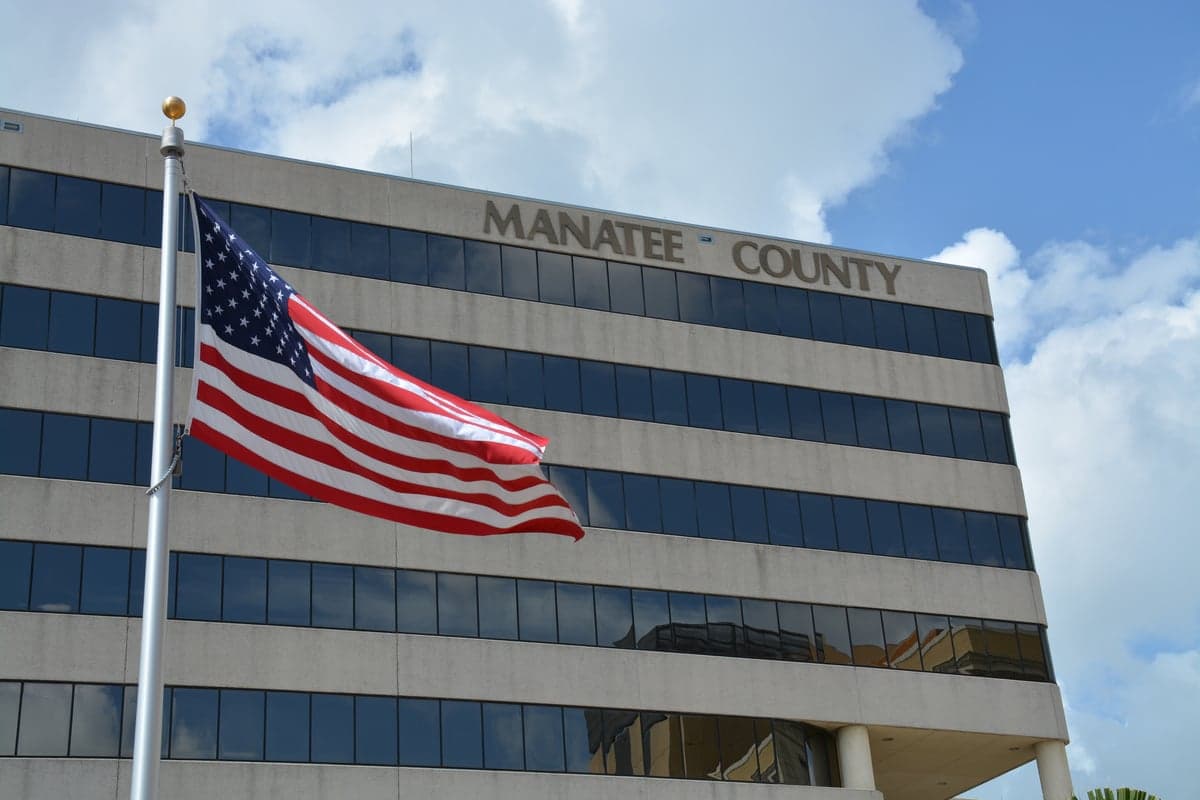
Photo: Wikipedia
Political ClimatePolitical Climate in Manatee County
Showing district-level results — no local-only data available.
Local Political AnalysisPolitical Analysis of Manatee County
Manatee County has shifted from a classic swing county to a reliably Republican stronghold, carrying a Cook PVI of R+7 — meaning it votes about seven points more Republican than the national average. That’s a notable rightward move from the 2000s and early 2010s, when the county was regularly decided by single digits and both parties poured money into it. Today, the political center of gravity sits firmly with the GOP, but the county is not a monolith; the coastal cities and the inland rural stretches tell very different stories.
How it compares
Compared to Florida as a whole, Manatee County is noticeably more conservative. The state’s overall Cook PVI is not officially rated, but Florida has trended Republican in recent cycles — voting for Donald Trump by about 3 points in 2020 and by a larger margin in 2024. Manatee’s R+7 rating puts it roughly in line with neighboring Sarasota County (also R+7) but well to the right of the Tampa Bay metro core. The county’s Republican edge is driven by two forces: the rapid growth of retirement communities in the northern and eastern parts of the county, and the influx of transplants from the Midwest and Northeast who tend to vote red on taxes and regulation. The city of Bradenton, the county seat, is the one real blue pocket — its precincts around the historic downtown and the Riverwalk consistently vote Democratic, though they’re outnumbered by the surrounding suburban and rural precincts. Palmetto, just north of Bradenton, leans slightly Democratic but has been trending red in recent cycles. The swing precincts are in the unincorporated areas between Bradenton and Lakewood Ranch, particularly around State Road 70 and the Parrish corridor — these are the fast-growing subdivisions where new residents are often registering as Republicans but voting more moderately on local issues like school funding and growth management.
What this means for residents
For conservative residents, the R+7 lean means their votes carry real weight in county commission races and state legislative contests. The county commission is solidly Republican, and the local GOP controls the supervisor of elections office, the sheriff’s department, and the school board majority. Property taxes remain relatively low, and the county has taken a pro-development stance, approving large master-planned communities like Lakewood Ranch and the new Waterside development in Parrish without the kind of growth moratoriums seen in more liberal counties. For liberal residents, the reality is that local elections are often decided in the Republican primary, not the general election. Democratic candidates rarely run competitive countywide races, and when they do, they typically lose by 10 to 15 points. That said, Bradenton’s city council races are nonpartisan and competitive, and Democratic voters can still influence school board races if they turn out in the city precincts. The practical effect is that progressives often focus their energy on state-level races or on specific ballot initiatives, like the 2024 amendment on abortion rights, which passed in Manatee with 55% support even as the county voted for Trump — a reminder that the county’s Republican lean doesn’t always translate to straight-ticket voting on social issues.
Culturally, Manatee County feels more like the Old South than the new Florida in some ways — the annual Bradenton Rodeo, the DeSoto National Memorial, and the heavy presence of retired military veterans give it a traditional, flag-waving character. But the growth of Lakewood Ranch, with its wealthy, educated newcomers, has introduced a more suburban, country-club Republicanism that’s less about culture war and more about tax rates and HOA rules. The county’s political trajectory is likely to stay red for the foreseeable future, but the flavor of that red is changing — from the agrarian conservatism of the eastern ranches to the development-friendly, business-first conservatism of the coast. For anyone moving here, the takeaway is simple: if you’re conservative, you’ll feel at home; if you’re liberal, you’ll find your people in Bradenton’s old neighborhoods, but you’ll need to accept that countywide politics will rarely go your way.

State Political ClimatePolitical Climate in Florida
State Political AnalysisPolitical Environment in the State
Florida has shifted from a perennial battleground to a solidly Republican state over the last decade, with the GOP now holding a roughly 1.2 million voter registration advantage over Democrats as of 2025. The state’s trajectory is unmistakable: in 2008, Barack Obama carried Florida by nearly 3 points, but by 2024, Donald Trump won it by over 13 points, a swing of roughly 16 points in 16 years. That realignment is driven by a massive influx of domestic migrants from blue states, a surge in Hispanic voter realignment toward the GOP, and a state GOP machine that has out-organized and out-messaged Democrats at nearly every level.
Urban vs. rural divide
The political map of Florida is a tale of three distinct regions. The urban cores of Miami, Tampa, Orlando, and Jacksonville remain Democratic strongholds, but their influence has been diluted by explosive growth in the suburbs and exurbs. The I-4 corridor between Tampa and Orlando is the classic swing zone, but it has trended right in recent cycles — in 2024, Trump won both Hillsborough and Orange counties by narrower margins than in 2020, and he actually flipped Miami-Dade County, the state’s largest, for the first time since 1988. That Miami-Dade flip is the single most important political story in Florida: the county’s Cuban-American, Venezuelan-American, and Nicaraguan-American communities, concentrated in places like Hialeah and Doral, have abandoned the Democratic Party over its leftward shift on socialism, crime, and cultural issues. Meanwhile, the rural Panhandle — think Pensacola, Panama City, and Tallahassee’s surrounding counties — votes 70-80% Republican, while the interior ranchland and small towns like Ocala and Sebring are deep red. The suburbs of Naples and Fort Myers on the Gulf Coast have become GOP strongholds as wealthy retirees and remote workers from the Northeast and Midwest settle in.
Policy environment
Florida’s policy environment is defined by a simple formula: low taxes, light regulation, and a muscular executive branch. There is no state income tax, which is a major draw for high-earners and retirees. The corporate tax rate is 5.5%, and the state has a constitutional amendment requiring a two-thirds supermajority in the legislature to raise taxes. Property taxes are set at the local level but capped by the Save Our Homes amendment, which limits annual increases on homesteaded properties to 3%. The regulatory posture is aggressively pro-business — Florida is a right-to-work state, and the legislature has repeatedly preempted local ordinances on everything from minimum wage to heat protections for outdoor workers. Education policy has shifted sharply rightward: the state has expanded school choice through the Family Empowerment Scholarship and the Universal School Choice program, which now allows every student to use state funds for private or homeschool expenses. Healthcare is a mixed bag — Florida did not expand Medicaid under the Affordable Care Act, and the state has restricted abortion to six weeks with limited exceptions. Election laws have been tightened since 2020, with stricter voter ID requirements, limits on drop boxes, and a new election police unit within the Department of State.
Recent policy direction
The last five years have produced a legislative agenda that is unmistakably conservative, and it touches nearly every area of life a relocator might weigh. On guns and self-defense, Florida passed constitutional carry in 2023, allowing residents to carry concealed firearms without a permit, and it maintains a strong Stand Your Ground law. On parental and education rights, the Parental Rights in Education Act (HB 1557, often called the “Don’t Say Gay” law) restricts classroom instruction on sexual orientation and gender identity through third grade, and the Stop WOKE Act restricts mandatory diversity training in schools and workplaces. On speech and privacy, the state has banned TikTok on government devices and passed a law requiring age verification for social media accounts under 16. On medical and bodily autonomy, the Heartbeat Protection Act bans abortion after six weeks, and the state has restricted gender-affirming care for minors. On property rights, the Live Local Act preempts local zoning to fast-track affordable housing development, and the state has strengthened protections against squatters. On taxation, the legislature has repeatedly cut the corporate tax rate and expanded the sales tax holiday calendar. On voting, the state has enacted some of the strictest ballot access laws in the country, including felony penalties for ballot harvesting and a requirement that mail-in ballots be requested every election cycle.
Civil unrest & political movements
Florida has seen its share of political flashpoints, but they are less about street protests and more about institutional clashes. The most visible movement in recent years has been the organized opposition to COVID-19 mandates — Governor Ron DeSantis suspended local emergency orders, banned vaccine passports, and called a special session to pass a law prohibiting private employers from requiring vaccines. That fight drew national attention and turned Jacksonville and Tampa into rally points for anti-mandate activists. On the left, the Parkland school shooting in 2018 spawned the March for Our Lives movement, which organized massive demonstrations in Miami and Fort Lauderdale and briefly pushed gun control to the top of the state agenda. Immigration politics are a constant undercurrent: Florida passed the strongest anti-sanctuary law in the country in 2019, requiring all law enforcement to cooperate with federal immigration authorities, and the state has bused migrants to Democratic-run states as a political statement. Election integrity controversies have been persistent — the 2020 recount in Broward and Palm Beach counties was a national story, and the state’s new election police unit has been criticized by Democrats as voter intimidation. A new resident would notice the political energy at the grassroots: conservative clubs are active in every county, and the state GOP has built a permanent volunteer infrastructure that Democrats have struggled to match.
Projection
Over the next 5-10 years, Florida is likely to become more Republican, not less. The demographic tailwinds are powerful: the state gains roughly 1,000 new residents per day, and the plurality of them are coming from high-tax, high-regulation states like New York, New Jersey, and California. These migrants are not uniformly conservative, but they are disproportionately older, wealthier, and more concerned about taxes and crime than the average voter. The Hispanic realignment is likely to continue — younger Cuban-Americans and Venezuelan-Americans are registering Republican at rates that would have been unthinkable a decade ago. The state GOP has also benefited from a structural advantage: Republicans control the governorship, both chambers of the legislature, and all three cabinet positions, which allows them to draw legislative maps that lock in their majority. The wildcard is climate change — rising sea levels and hurricane risk could eventually slow in-migration to coastal areas like Miami Beach and Key West, but for now, the state’s growth shows no signs of abating. A person moving to Florida in 2026 should expect to live in a state where the Republican Party is the dominant political institution, and where the policy agenda will continue to move rightward on education, immigration, and cultural issues.
For a new resident, the bottom line is this: Florida is a state where conservative policies are the default, and where the political culture rewards self-reliance, low taxes, and a hands-off government. If you are a conservative, you will find a state that is actively implementing your priorities — school choice, gun rights, and a business-friendly climate. If you are a liberal, you will find a state where your vote is unlikely to change the outcome of statewide elections, but where local governments in Miami, Tampa, and Orlando still provide a counterweight on issues like minimum wage and tenant protections. The practical takeaway is that Florida is no longer a swing state — it is a red state with blue cities, and anyone moving here should understand that reality before they arrive.
* Values derived from national, state, county, city and local statistics and may differ in a specific area. Last updated: 2026-10-19T10:11:26.000Z
Narrative content on this page is AI-generated and may contain mistakes. Verify any details that matter before acting on them.
ReloMaps may earn a commission from affiliate links at no extra cost to you.

