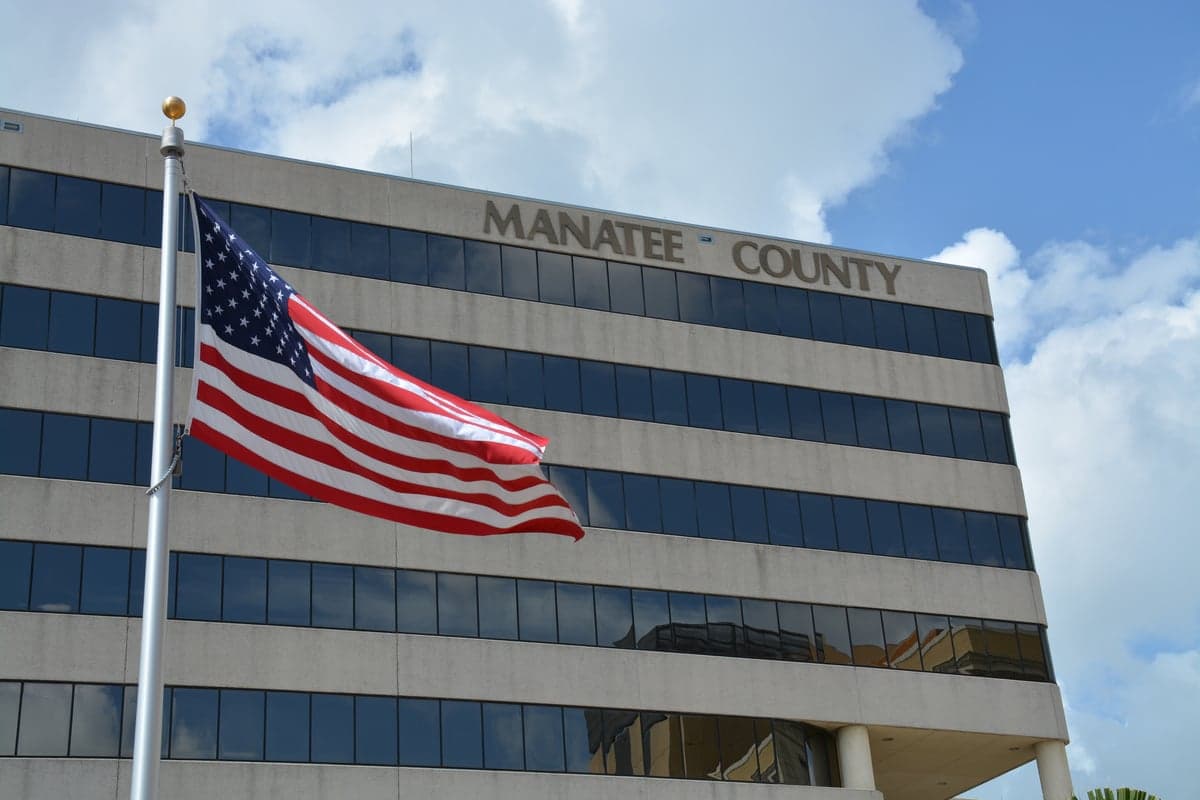
Photo: Wikipedia
Personal Sovereignty in Manatee County
Viable for self-reliance. Generally workable, though some barriers may limit total independence.
What does Personal Sovereignty tell us?
Personal Sovereignty measures your capacity for self-reliance and independence with minimal government friction. Higher scores mean fewer barriers between you and the way you want to live... but it assumes you have the space you need and good neighbors.
What does this tell us?
Personal Sovereignty measures your capacity for self-reliance and independence with minimal government friction. Higher scores mean fewer barriers between you and the way you want to live... but it assumes you have the space you need and good neighbors.
State Policy
Energy independence: Importer (10% of energy produced in-state)
Personal Liberty
Homesteading

Personal Liberty Analysis
Manatee County, Florida, offers a notably strong personal sovereignty environment compared to much of the coastal Southeast, driven by Florida’s lack of a state income tax, broad preemption of local gun ordinances, and a regulatory culture that leans toward individual discretion rather than municipal micromanagement. For a single individual or family weighing relocation, the county’s autonomy profile is shaped less by county-wide uniformity and more by sharp contrasts between its urbanized eastern corridor and its rural agricultural west and north. The practical question isn’t whether Manatee respects personal freedom — it largely does — but which specific township or unincorporated district best matches your preferred balance of convenience and self-reliance.
Tax burden and regulatory posture: how Manatee County compares to the rest of Florida
Florida’s constitutional prohibition on a state personal income tax is the single largest driver of personal sovereignty in Manatee County, leaving residents with only property taxes, sales tax, and local fees to fund government. The county’s combined sales tax rate is 7.5% (6% state plus 1.5% county), which is mid-range for Florida and slightly below the 8%+ rates common in Miami-Dade or Broward. Property taxes in Manatee average around 0.85% of assessed home value, roughly in line with the state median, but with a notable wrinkle: the county’s Save Our Homes amendment caps annual assessed value increases at 3% for homesteaded properties, meaning long-term residents often pay dramatically less than newcomers for comparable homes. That creates a de facto incentive for stability over mobility — a trade-off worth understanding before buying.
Regulatory posture in Manatee is generally light-touch, but it varies by jurisdiction. The city of Bradenton and the more densely developed areas around Lakewood Ranch enforce conventional zoning and permitting, while unincorporated areas east of Interstate 75 — including Parrish, Myakka City, and Duette — operate under county-level land-use rules that are considerably more permissive. Building permits in unincorporated Manatee are processed through the county’s Building and Development Services department, and for straightforward residential projects, approval timelines typically run 2-4 weeks, faster than the 2-3 months common in Sarasota County to the south. There is no county-wide rent control, no plastic bag ban, and no local minimum wage ordinance — all of which are preempted by state law, keeping the regulatory floor relatively low and predictable.
Self-defense and gun law specifics: what Florida’s preemption means for Manatee residents
Florida’s constitutional carry law, effective July 1, 2023, allows any legal resident 21 or older to carry a concealed firearm without a permit, and Manatee County fully operates under this framework. The county has no local gun registration, no assault weapons ban, and no magazine capacity limits — all such measures are explicitly preempted by Florida Statute 790.33, which subjects local officials to fines up to $5,000 for attempting to enact firearm ordinances. This preemption is not theoretical; in 2021, the city of Bradenton repealed a local “gun-free zone” ordinance after facing legal pressure, and no Manatee municipality has since attempted to re-regulate firearms.
For self-defense law, Florida’s “Stand Your Ground” statute (F.S. 776.013) applies uniformly across Manatee County, meaning there is no duty to retreat in any place where you have a legal right to be. Castle Doctrine protections extend to vehicles and workplaces, not just residences. The practical effect for residents is that defensive firearm use is treated with broad legal deference, though it’s worth noting that Manatee County’s State Attorney’s Office has a reputation for careful case-by-case review rather than blanket immunity. Shooting ranges are accessible within the county — the Manatee Gun and Archery Club in Myakka City is one of the largest outdoor ranges in the region — and firearm training businesses operate without special county licensing beyond standard business registration.
Self-reliance and homesteading viability: lot sizes, zoning, and off-grid feasibility
Homesteading in Manatee County is genuinely viable, but only in specific geographic pockets. The eastern half of the county — particularly Myakka City, Duette, and the Parrish agricultural zone — offers 1-to-10-acre residential lots with agricultural zoning that permits livestock, barns, and accessory structures without special use permits. In Myakka City, for example, the minimum lot size in the Rural/Agricultural zoning district is 5 acres, and county code allows chickens, goats, pigs, and up to two horses per acre without a conditional use permit. Duette, the county’s most sparsely populated community, has no municipal water or sewer service, and residents rely on private wells and septic systems — a de facto off-grid arrangement that the county permits without penalty.
Off-grid solar is legal throughout unincorporated Manatee County, though the regulatory friction varies. Florida’s net metering rules require utilities like Florida Power & Light (FPL) to credit excess solar generation, but the county’s building department requires a standard electrical permit and inspection for grid-tied systems. For fully off-grid setups — no utility connection at all — the county has no explicit prohibition, but lenders and insurers may complicate financing. Rainwater harvesting is legal and encouraged; the county’s stormwater division actually promotes cistern installation. The western, more urbanized areas like Bradenton and Palmetto are far less homestead-friendly, with typical lot sizes under 0.25 acres and homeowner association covenants that restrict livestock and external structures. If self-reliance is the priority, the eastern corridor is the clear choice.
Personal liberties: parental rights, medical autonomy, speech, and property
Florida’s Parental Rights in Education Act and the broader Parents’ Bill of Rights (F.S. 1014) give Manatee County parents explicit statutory authority over their children’s education, healthcare decisions, and moral instruction. The School District of Manatee County, which covers all public schools in the county, maintains a curriculum transparency portal that allows parents to review instructional materials, and the district’s policy requires parental notification for any health services provided at school. Homeschooling is lightly regulated — parents file a notice of intent with the district and maintain a portfolio, but there are no standardized testing requirements for homeschooled students. The county also has a robust network of private and religious schools, particularly around Lakewood Ranch and Parrish, for families seeking alternatives to public education.
Medical autonomy in Manatee is shaped by Florida’s broader legal framework. The state’s medical marijuana program, established under Amendment 2 in 2016, is fully operational in Manatee County, with dispensaries in Bradenton and Palmetto. Vaccine mandates are prohibited for most private employers under Florida law, and the county’s public health department does not impose local vaccination requirements beyond state minimums. On speech and property, Manatee County has no local “truth in advertising” ordinances beyond state consumer protection law, and there are no county-level restrictions on political signage beyond standard setback rules. Property rights are reinforced by Florida’s Bert J. Harris Jr. Private Property Rights Protection Act, which allows landowners to seek compensation if government action reduces property value by more than 50% — a statute that has been invoked successfully in Manatee County land-use disputes.
Relative to the rest of Florida, Manatee County sits comfortably in the upper tier of personal sovereignty, comparable to neighboring Sarasota County but with a more permissive rural fringe. The county’s lack of local income tax, constitutional carry, agricultural zoning in the east, and statutory protections for parental and property rights create a coherent environment where individual discretion is the default. The main caveat is geographic: the urbanized west and the suburban Lakewood Ranch area carry more HOA restrictions and municipal oversight, while the eastern communities of Myakka City, Duette, and Parrish offer the fullest expression of self-reliant living. For a relocation decision, the county’s sovereignty is less a question of whether it exists and more a question of which mile marker you choose to call home.

* Values derived from national, state, county, city and local statistics and may differ in a specific area. Last updated: 2026-10-19T10:11:26.000Z
Narrative content on this page is AI-generated and may contain mistakes. Verify any details that matter before acting on them.
ReloMaps may earn a commission from affiliate links at no extra cost to you.

