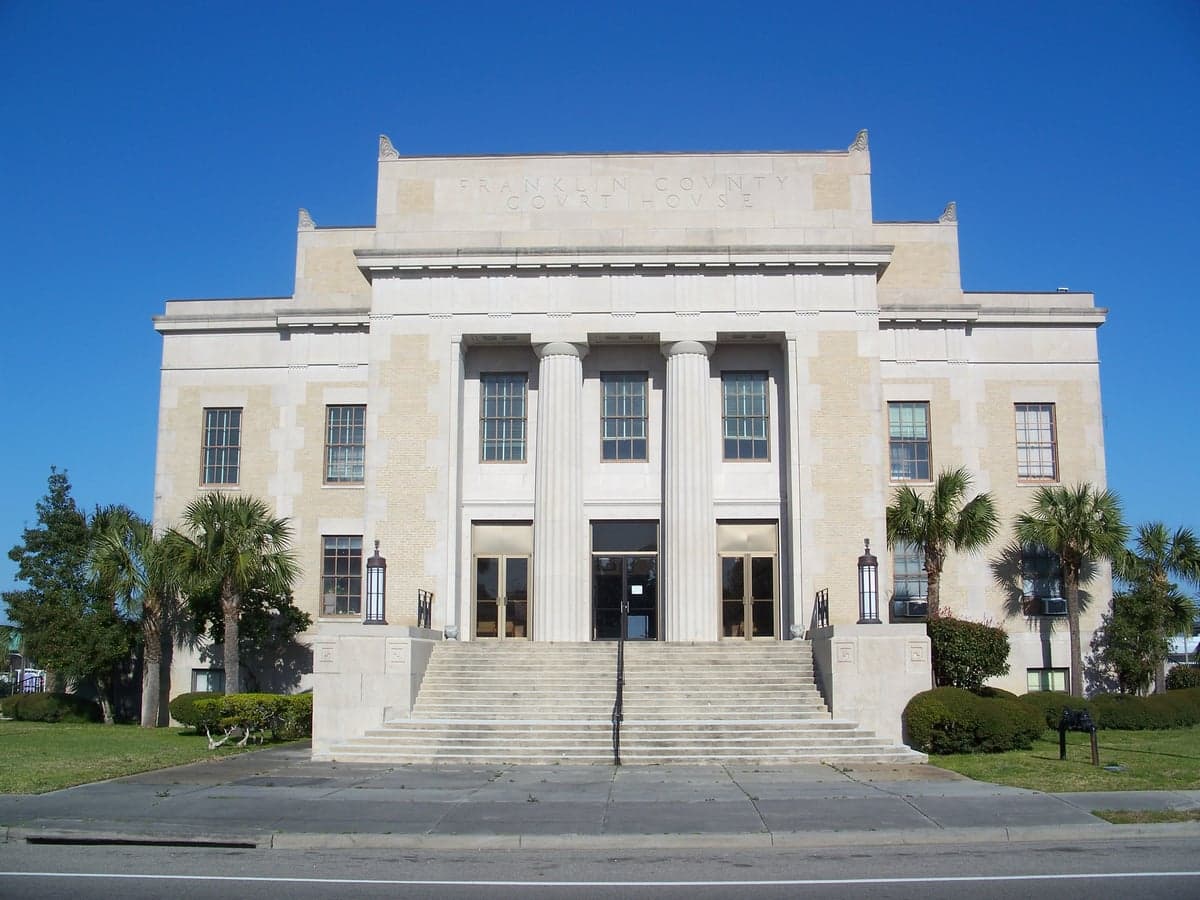
Photo: Wikipedia
Political ClimatePolitical Climate in Franklin County
Showing county-level results — no local-only data available.
Lean and PVI are calculated from this county’s 2020 and 2024 presidential results, Cook-style.
Political rankings in Florida
- Most Conservative Cities in Florida
- Most Liberal Cities in Florida
- Best Liberal-Leaning Towns in the South
- Safest Liberal-Leaning Towns in the South
- Safest Conservative-Leaning Towns in the South
- Safest Liberal-Leaning Towns on the East Coast
- Safest Conservative-Leaning Towns on the East Coast
- Affordable Small Towns for Conservatives
- Most Conservative Counties in Florida
- Most Liberal Counties in Florida
Local Political AnalysisPolitical Analysis of Franklin County
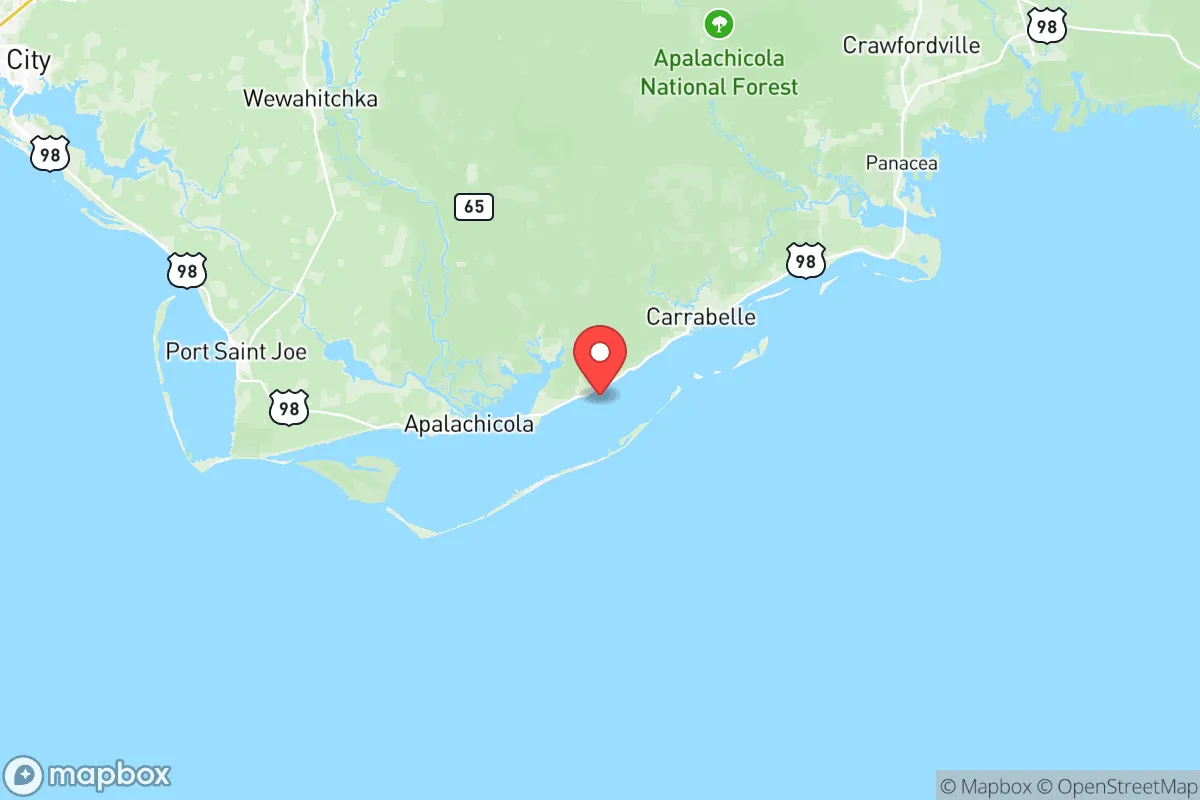
Franklin County, Florida, is a reliably conservative area with a Cook Partisan Voting Index of R+21, meaning it votes about 21 points more Republican than the national average. This rural panhandle county, with its small towns like Apalachicola, Carrabelle, and Eastpoint, has a political DNA shaped by a mix of traditional Southern conservatism, a strong seafood industry, and a growing retiree population. While the county as a whole leans heavily red, there are subtle variations—Apalachicola, with its historic district and tourism focus, tends to be slightly more moderate, while Carrabelle and Eastpoint are solidly conservative. The overall trajectory is stable, with no signs of a major shift, though the influx of out-of-state retirees could nudge things slightly toward the center over the next decade.
How it compares
Compared to the state of Florida as a whole, Franklin County is significantly more conservative. Florida's overall Cook PVI is not publicly available in the same format, but the state is generally considered a swing state that has trended rightward in recent cycles, with a lean of roughly R+3 to R+5 in presidential elections. Franklin County's R+21 rating places it among the most Republican counties in the state, alongside other rural panhandle counties like Liberty and Calhoun. In the 2024 presidential election, Franklin County voted for Donald Trump by a margin of about 68% to 31%, a stark contrast to the statewide margin of roughly 51% to 48%. This means that while Florida as a whole is a competitive battleground, Franklin County is a deep-red stronghold where Democratic candidates rarely break 35% of the vote. The county's political isolation from the state's urban centers—Tallahassee is 70 miles north, and Jacksonville is 200 miles east—reinforces its distinct conservative identity.
What this means for residents
For conservative residents, Franklin County offers a political environment where their views are the clear majority. Local government, from the county commission to the school board, is dominated by Republicans, and policy decisions—such as low taxes, limited regulation on fishing and development, and a focus on Second Amendment rights—reflect that. For liberal residents, the reality is more nuanced. While they are a distinct minority, they often find a welcoming community in Apalachicola, where the arts scene and tourism industry attract a more diverse crowd. However, they may feel out of step on issues like environmental regulation (the oyster industry has clashed with conservation groups) or social policies. The key takeaway is that political disagreements here are usually civil, rooted in a shared love for the area's natural beauty and small-town pace, rather than the heated partisanship seen in bigger cities.
Culturally, Franklin County stands apart from much of Florida. It lacks the theme parks, high-rise condos, and sprawling suburbs of the state's southern half. Instead, its identity is tied to the Apalachicola River and Bay, the seafood industry, and a slower, more self-reliant way of life. Policy-wise, the county has been a battleground over water rights and environmental protections, with local officials often pushing back against state-level regulations on oyster harvesting and coastal development. This creates a unique dynamic where residents, regardless of party, tend to prioritize local autonomy over state mandates—a sentiment that bridges some of the political divide. For anyone moving here, the political climate is less about red vs. blue and more about preserving a way of life that feels increasingly rare in modern Florida.

State Political ClimatePolitical Climate in Florida
State Political AnalysisPolitical Environment in the State
Florida is a purple state that has shifted decisively red over the past decade, with Republicans now holding a supermajority in both legislative chambers and a trifecta in state government. The state voted for Donald Trump by 3.4 points in 2020 and by a wider margin in 2024, a stark contrast from its perennial swing-state status in 2000 and 2008. This rightward drift is driven by a combination of domestic migration from blue states, a growing Hispanic electorate that leans conservative in South Florida, and a disciplined legislative agenda that has made Florida a national laboratory for conservative governance.
Urban vs. rural divide
The political map of Florida is a study in stark contrasts. The major urban centers — Miami-Dade County, Orlando (Orange County), and Tampa (Hillsborough County) — are Democratic strongholds, but their margins have been shrinking. Miami-Dade, once a Democratic fortress, flipped to Trump in 2020 and again in 2024, driven by Cuban-American and Venezuelan voters who prioritize anti-socialism messaging. Meanwhile, the sprawling suburbs of Jacksonville (Duval County) and Fort Myers (Lee County) are reliably red, with Lee County voting +20 points for Trump in 2024. The rural Panhandle — places like Panama City and Tallahassee's surrounding counties — is deeply conservative, while the I-4 corridor from Tampa to Daytona Beach remains the state's most competitive battleground, though it has trended right since 2016. The key shift: Miami-Dade and Palm Beach County are no longer reliable Democratic anchors, making statewide races increasingly difficult for Democrats to win.
Policy environment
Florida's policy environment is defined by low taxes and a light regulatory touch. There is no state income tax, which is a major draw for relocators. The corporate tax rate is a flat 5.5%, and property taxes are capped by the Save Our Homes amendment, limiting annual increases for homesteaded properties. Education policy has been a flashpoint: the state has expanded school choice through the Family Empowerment Scholarship and the Florida Tax Credit Scholarship, making it one of the most robust voucher systems in the country. Governor Ron DeSantis signed the Parental Rights in Education Act (HB 1557), which restricts classroom instruction on sexual orientation and gender identity in early grades. Healthcare policy is mixed — the state did not expand Medicaid under the Affordable Care Act, but it has a competitive private insurance market. Election laws were tightened in 2021 (SB 90), requiring stricter voter ID, limiting drop boxes, and restricting third-party ballot collection. The state also passed a 15-week abortion ban in 2022 (HB 5), later tightened to six weeks in 2023 (HB 7), with no exceptions for rape or incest.
Recent policy direction
The last three years have seen a cascade of legislation that defines Florida's current trajectory. On gun rights, Florida became a permitless carry state in 2023 (HB 543), allowing concealed carry without a license. On education, the "Stop WOKE Act" (HB 7) restricts workplace and classroom discussions about race and gender, while the "Don't Say Gay" law (HB 1557) has been expanded to cover all grades. On speech and privacy, the state passed a law (SB 2580) that bans social media platforms from deplatforming political candidates, and another (HB 3) that restricts minors' access to social media and adult content. On property rights, the state has preempted local governments from enacting rent control and has limited local authority over short-term rentals (like Airbnb). On medical and bodily autonomy, the six-week abortion ban is among the strictest in the nation, though it includes exceptions for the life of the mother and fatal fetal abnormalities. On voting, the state has enacted strict signature-matching requirements and limited mail-in ballot requests to one election cycle. The overall direction is toward a state that maximizes individual economic freedom while restricting certain social and educational liberties, particularly around gender and race.
Civil unrest & political movements
Florida has seen its share of political flashpoints. The 2020 Black Lives Matter protests in Miami and Orlando were large but largely peaceful, though they sparked a backlash that fueled the "law and order" messaging of the 2022 gubernatorial race. Immigration politics are intense, particularly in South Florida, where the state has bused migrants to Democratic-led states like California and Massachusetts as a protest against federal border policy. There is no sanctuary city policy in Florida; in fact, the state passed a law (SB 1718) in 2023 that requires hospitals to ask about immigration status and makes it a felony to transport undocumented immigrants into the state. Election integrity controversies have been a persistent theme, with the state creating a new Office of Election Crimes and Security in 2022, which has prosecuted several cases of alleged voter fraud. On the left, groups like the Florida Rising and the Dream Defenders organize around voting rights and racial justice, while on the right, the Florida Parental Rights in Education movement has been highly effective at mobilizing school board elections. A new resident would notice the heavy presence of political signage, especially during election season, and the active role of local sheriff's offices in immigration enforcement.
Projection
Over the next 5-10 years, Florida is likely to become more conservative, not less. The in-migration is heavily skewed toward red-leaning retirees and remote workers from high-tax states like New York, New Jersey, and California. The Hispanic electorate, particularly in Miami-Dade and Tampa, is trending Republican, and the state's Republican Party has a deep bench of leadership. However, there are countervailing forces: the growing population of young, college-educated voters in Orlando and Tampa could shift the I-4 corridor back toward the center. The state's housing affordability crisis, driven by skyrocketing insurance costs and property taxes, could become a political liability for the ruling party. But for now, the trajectory is clear: Florida will remain a red-leaning state with a conservative policy agenda, though the margin of control may narrow as the electorate diversifies. A relocator moving in now should expect a state where Republican governance is the norm, with little chance of a Democratic trifecta in the near term.
For a new resident, the bottom line is that Florida offers a low-tax, business-friendly environment with a strong emphasis on parental rights and school choice, but with significant restrictions on abortion access and certain classroom discussions. The political climate is active and polarized, but the state's governance is stable and predictable. If you lean conservative, you will find a government that reflects your values. If you lean liberal, you will find a state where your voice is heard but your policy preferences are unlikely to prevail. Either way, the weather is warm, the beaches are public, and the state income tax is zero — that's the trade-off.
* Values derived from national, state, county, city and local statistics and may differ in a specific area. Last updated: 2026-11-13T17:13:36.000Z
Narrative content on this page is AI-generated and may contain mistakes. Verify any details that matter before acting on them.
ReloMaps may earn a commission from affiliate links at no extra cost to you.

