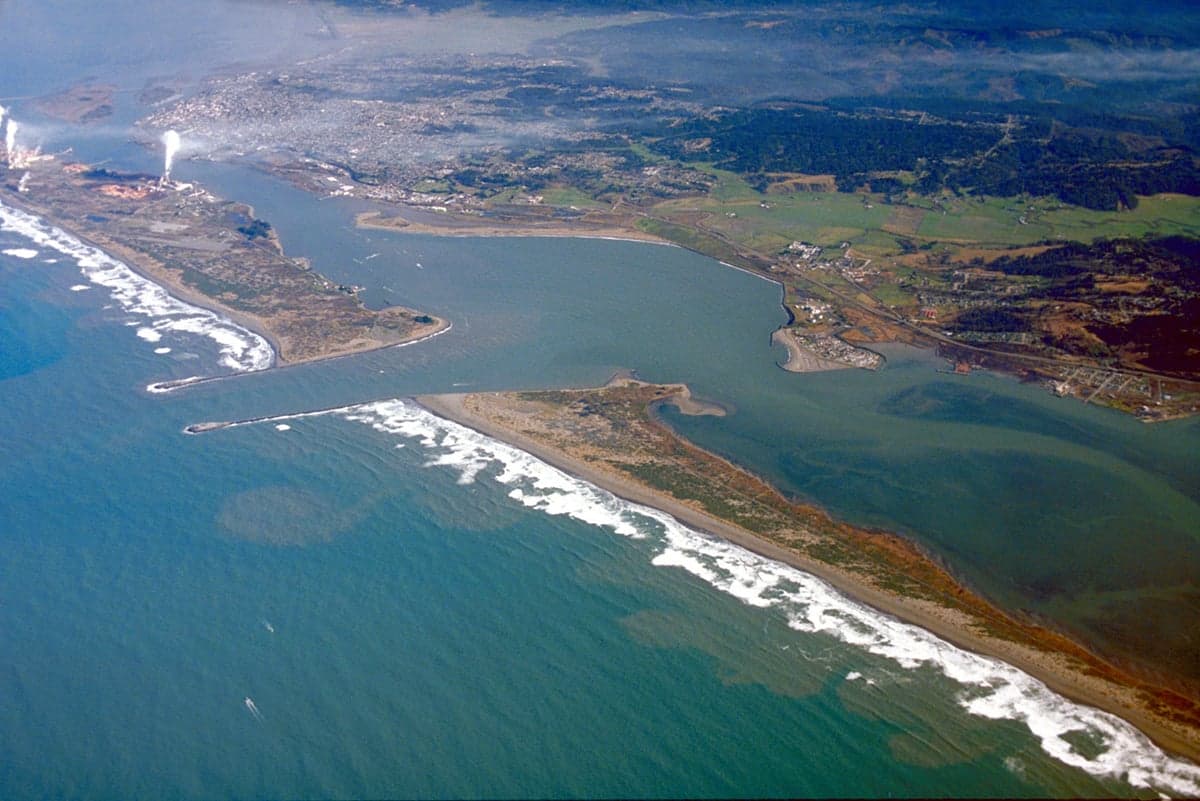
Photo: Wikipedia
Political ClimatePolitical Climate in Eureka, CA
District shown is the primary district for this city’s centroid. Cities may span multiple districts.
Inherited from parent state — no local data available.
Local Political AnalysisPolitical Analysis of Eureka, CA
Eureka sits in a political bubble within Humboldt County, leaning solidly Democratic in a region that has voted blue for decades, though the city itself is more progressive than its rural outskirts. The county backed Joe Biden by roughly 40 points in 2020, and Eureka’s city council has been dominated by left-leaning members for years, with a strong environmental and social-justice streak shaping local policy. That said, the surrounding areas—places like Fortuna, Rio Dell, and the unincorporated communities along the Eel River—vote much more conservatively, creating a sharp urban-rural split that defines the region’s politics.
How it compares
Compared to California as a whole, Eureka is actually to the left of the state average, which is saying something given California’s reputation as a Democratic stronghold. While the state’s Cook PVI is technically unknown in the latest data, statewide races typically see Democrats winning by 20-30 points, and Humboldt County often outperforms that margin. In the 2022 gubernatorial race, Gavin Newsom carried Humboldt with over 70% of the vote, slightly ahead of his statewide total. The real contrast isn’t between Eureka and California—it’s between Eureka and its own backyard. Drive 20 minutes south to Fortuna, and you’ll find a city that voted for Donald Trump in 2020, with signs for conservative candidates and a working-class, timber-industry identity that feels a world away from Eureka’s craft-coffee shops and bumper stickers about saving the salmon.
What this means for residents
For liberal residents, Eureka is a comfortable place to live politically—the city council regularly passes climate resolutions, supports homeless services (sometimes controversially), and the local Democratic Party is well-organized. You’ll find progressive activism around issues like cannabis regulation, coastal protection, and affordable housing, and it’s not unusual to see mutual-aid groups operating openly. For conservative residents, the experience is more isolating. They’re a clear minority in city limits, often feeling talked over at council meetings, but they’re not powerless—the county’s rural vote keeps the Board of Supervisors more balanced than you’d expect, and issues like timber harvesting, water rights, and property taxes give conservatives real leverage. The practical reality is that Eureka’s politics are more about local land-use fights than national culture wars; everyone, regardless of party, has to deal with the fog, the housing shortage, and the fact that the nearest Costco is a two-hour drive away.
Cultural and policy distinctions
The biggest distinction between Eureka and the rest of California is the region’s fierce independence on resource issues. This is a place where the marijuana industry, legal since 2016, has reshaped the local economy and politics in ways that don’t map neatly onto partisan lines—many growers are libertarian-leaning, while the city’s social services are funded by cannabis taxes. There’s also a strong strain of environmental radicalism here, from the timber wars of the 1990s to current fights over offshore wind development, which some locals support as green energy and others oppose as a threat to fishing. The trajectory is toward a younger, more progressive population moving in for the natural beauty and remote-work possibilities, which will likely push Eureka further left over the next decade, even as the surrounding county holds its conservative ground. It’s a politically fascinating place to live—not because it’s divided, but because the divisions are so geographically close and so deeply rooted in the land itself.

State Political ClimatePolitical Climate in California
State Political AnalysisPolitical Environment in the State
California is a solidly Democratic state, with a partisan lean of roughly D+20 in statewide races and a 2024 presidential margin of about 20 points for Kamala Harris. The state hasn't voted Republican for president since George H.W. Bush in 1988, and the GOP's share of registered voters has fallen below 24%, while Democrats hold a 20-point registration advantage. Over the last 15 years, the shift has been one of consolidation rather than conversion — the coastal metros have become more uniformly liberal, while the interior has gotten redder, but the sheer population weight of the Bay Area and Los Angeles basin keeps the state firmly out of reach for Republicans.
Urban vs. rural divide
The political map of California is a tale of two states. The coast — from San Francisco down through Oakland, San Jose, and Los Angeles — is the engine of Democratic dominance. San Francisco County votes about 85% Democratic, and Los Angeles County, with 10 million residents, delivers roughly a quarter of all Democratic votes in the state. The Central Valley, by contrast, is the red heartland: Fresno, Bakersfield, and Modesto are conservative strongholds, with Bakersfield's Kern County voting about 60% Republican in 2024. The Inland Empire — Riverside and San Bernardino counties — is the true battleground within the state; these counties have swung from reliably red to competitive, with San Bernardino going blue by only 5 points in 2024. Orange County, once the GOP's suburban fortress, flipped decisively blue in 2018 and has stayed there, with Irvine and Anaheim now represented by Democrats in Congress. The state's rural north — places like Redding and Yreka — is deeply conservative, with some counties voting 70%+ Republican, but these areas hold less than 5% of the state's population.
Policy environment
California's policy environment is defined by its tax structure and regulatory posture. The state has the highest top marginal income tax rate in the nation at 13.3%, and a 7.25% base sales tax that local jurisdictions push well above 10% in cities like Los Angeles and Oakland. Property taxes are capped at 1% of assessed value under Proposition 13, which keeps longtime homeowners' bills low but creates a two-tier system where new buyers pay significantly more. The regulatory environment is the most extensive in the country: the California Environmental Quality Act (CEQA) allows virtually anyone to sue to block development, which has driven housing costs to astronomical levels — the median home price in San Francisco is over $1.3 million. Education policy is centralized in Sacramento, with the state's teachers union wielding enormous influence; school choice is limited, with only about 10% of students in charter schools. Healthcare is heavily regulated, with the state running its own insurance exchange (Covered California) and expanding Medi-Cal to cover all low-income adults regardless of immigration status. Election laws are among the most permissive in the nation: universal mail-in voting was made permanent in 2021, same-day voter registration is available, and felons on parole can vote.
Recent policy direction
The last five years have seen California double down on its progressive trajectory. On gun policy, the state has some of the strictest laws in the nation — a 2024 law banned carrying firearms in most public places, and the state restricts magazine capacity to 10 rounds and bans most semi-automatic rifles with "assault weapon" features. On parental rights, the state passed a 2024 law requiring schools to notify parents if a student changes their gender identity, but also prohibits schools from mandating parental notification for LGBTQ+ student groups. On speech, the state has enacted laws targeting hate speech on social media platforms, though these face First Amendment challenges. Privacy law is robust — the California Consumer Privacy Act (CCPA) gives residents the right to know what data companies collect and to demand deletion. On medical autonomy, the state is a sanctuary for abortion and gender-affirming care, with laws protecting providers from out-of-state prosecution. Property rights are heavily constrained by rent control (expanded statewide in 2019 to cap annual increases at 5% plus inflation) and tenant protections that make eviction difficult. On taxation, the state passed a 2024 ballot measure creating a new wealth tax on billionaires, though it faces legal challenges. Voting access has been expanded to the maximum: automatic voter registration through the DMV, ballot drop boxes everywhere, and post-election curing of signature mismatches.
Civil unrest & political movements
California has a long history of political protest, and the last decade has been no exception. The 2020 George Floyd protests in Los Angeles and Oakland were among the largest in the nation, with property damage in the tens of millions. The state's sanctuary policies — the 2017 California Values Act limits local law enforcement's cooperation with federal immigration authorities — have made it a flashpoint in national immigration politics. Sacramento and Los Angeles have declared themselves "sanctuary cities," and the state has spent over $1 billion on legal defense for undocumented immigrants. On the right, the state has seen a growing secessionist movement — the "Calexit" campaign has qualified for ballot measures multiple times, though it has never come close to passing. The rural north has seen organized resistance to state mandates, including a 2021 recall effort against Governor Gavin Newsom that gathered over 1.6 million signatures but failed at the ballot box. Election integrity has been a persistent controversy: the state's universal mail-in voting system has been criticized by Republicans, though multiple audits have found no evidence of widespread fraud. A new resident would notice the visible homelessness crisis in every major city — Los Angeles alone has over 75,000 unhoused residents — which has become a political flashpoint between advocates for more services and residents demanding enforcement of public camping bans.
Projection
Over the next 5-10 years, California's political trajectory is likely to remain firmly Democratic, but with some interesting shifts. The state's population declined by about 500,000 between 2020 and 2024, with net out-migration concentrated among lower-income and moderate voters leaving for Texas, Arizona, and Nevada. The people moving in — largely international immigrants and young professionals from other states — tend to be more liberal. The Central Valley is likely to become more competitive as Latino voters, who have historically leaned Democratic, show signs of shifting right — Kern County and Fresno County both moved toward Trump in 2024. The Inland Empire is the key swing region: if Riverside and San Bernardino counties continue their rightward drift, the state could become more competitive in down-ballot races, though not at the presidential level. The housing crisis will likely force some moderation on land-use policy — even progressive cities like San Francisco have begun to allow more density and streamline permitting. The state's fiscal situation is a wildcard: a projected $68 billion budget deficit in 2024 could force cuts to the social programs that define the state's identity, potentially creating political backlash from the left.
For a new resident, the bottom line is this: California is a place where the political culture is overwhelmingly progressive, and that shapes everything from the tax code to the speed of government services. If you're conservative, you'll find like-minded communities in the Central Valley, the Inland Empire, and the rural north, but you'll be living under a state government that is actively hostile to many of your priorities — from gun rights to school choice to property rights. If you're liberal, you'll find a state that is genuinely trying to implement your vision, but you'll also contend with the consequences: high taxes, a housing crisis, and a homelessness problem that no amount of spending has solved. The state is not going to flip anytime soon, but it is changing — the question is whether the changes will make it more livable or less.
* Values derived from national, state, county, city and local statistics and may differ in a specific area. Last updated: 2026-10-29T07:36:53.000Z
Narrative content on this page is AI-generated and may contain mistakes. Verify any details that matter before acting on them.
ReloMaps may earn a commission from affiliate links at no extra cost to you.

