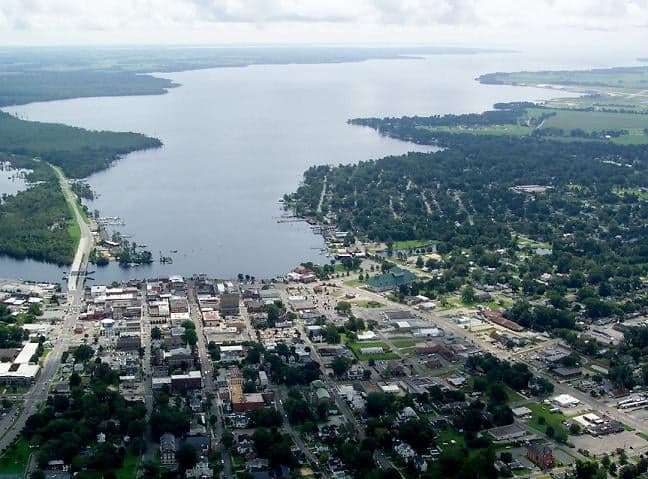
Photo: Wikipedia
Political ClimatePolitical Climate in Elizabeth City, NC
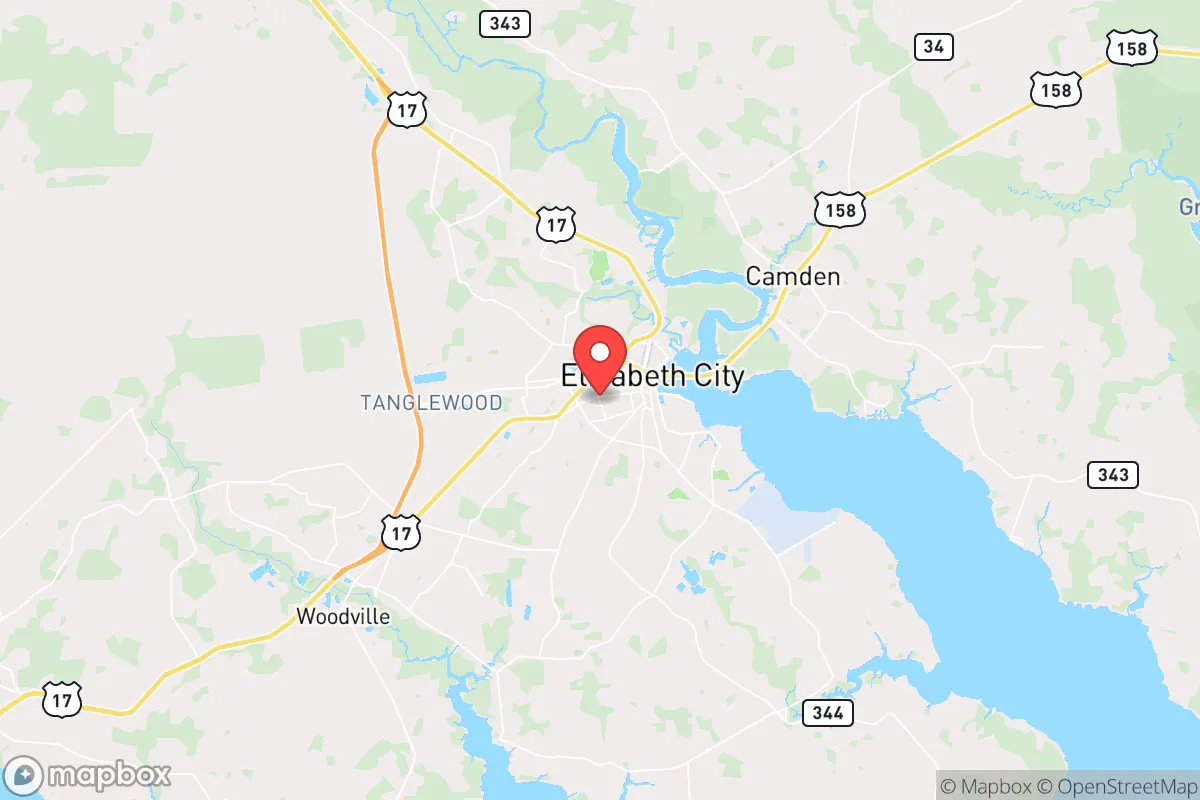
District shown is the primary district for this city’s centroid. Cities may span multiple districts.
Local Political AnalysisPolitical Analysis of Elizabeth City, NC
Elizabeth City sits in a political sweet spot that’s shifted noticeably over the past decade. The city itself and surrounding Pasquotank County have a Cook PVI of R+1, matching the statewide North Carolina average of R+1, but that number masks a more interesting local story. Back in 2012, the county went for Romney by about 4 points; by 2020, Trump carried it by just under 2 points, and in 2024 the margin tightened further to roughly 1 point. That slow drift toward the center reflects a mix of new residents from the Hampton Roads metro area, a growing student population at Elizabeth City State University, and a stable base of rural conservative voters in the surrounding farm country. The area is genuinely competitive — not a deep-red stronghold like Currituck County to the east, nor a blue-leaning enclave like Edenton to the south.
How it compares
Compared to the rest of North Carolina, Elizabeth City is a microcosm of the state’s broader political tension. The R+1 rating is identical to the statewide figure, but the local dynamics are distinct. In the 2024 governor’s race, Pasquotank County voted for the Democratic candidate by about 3 points, while the state as a whole went Republican by a similar margin — a split that shows Elizabeth City is slightly more Democratic-leaning than its PVI suggests in down-ballot races. Nearby towns like Hertford (Perquimans County) and Edenton (Chowan County) are more reliably Republican, often voting +10 to +15 points red in recent cycles. Meanwhile, the city of Elizabeth City itself, with its historic downtown and university influence, tends to vote more Democratic than the surrounding county, creating a classic urban-rural divide within a small geographic area. The contrast is sharpest when you drive 20 minutes east to Camden County, which voted +25 for Trump in 2024 — a reminder that the R+1 label for Pasquotank is an average of two very different voting blocs.
What this means for residents
For conservative residents, the political reality is that Elizabeth City is not a place where Republicans can take victory for granted. Local school board and city council races are often decided by a few hundred votes, and the county commission has swung between parties over the past decade. That said, conservative voices are well-represented in local government and in the region’s cultural life — gun rights are widely respected, church attendance is high, and the area’s agricultural economy leans Republican. For liberal residents, the environment is more welcoming than in most of northeastern North Carolina. Elizabeth City State University provides a progressive anchor, and the city’s growing arts scene and waterfront development have attracted younger, more diverse residents. However, progressive policy proposals — like zoning changes or public transit expansions — often face uphill battles at the county level, where rural commissioners are more skeptical of government spending. Both sides find that local politics is less about national culture wars and more about practical issues: infrastructure, school funding, and economic development along the U.S. 17 corridor.
Culturally, Elizabeth City stands apart from much of northeastern North Carolina because of its history as a river port and its connection to the Coast Guard base. The city has a more outward-looking, maritime identity than inland towns like Ahoskie or Windsor, which lean more heavily conservative and rural. Policy-wise, the area has seen a modest but real shift on environmental issues — the Pasquotank River cleanup and waterfront revitalization have bipartisan support, even as the region’s agricultural community remains wary of regulations. The long-term trajectory points toward continued competitiveness: as the Hampton Roads sprawl pushes south and the university grows, Elizabeth City is likely to become slightly more Democratic over the next decade, but not dramatically so. It’s a place where the national R+1 label actually feels accurate — a community that votes like the rest of North Carolina, but with its own distinct local flavor.

State Political ClimatePolitical Climate in North Carolina
State Political AnalysisPolitical Environment in the State
North Carolina is the quintessential swing state in 2026, with a Cook PVI of R+1 that barely hints at the internal tension. Over the last 20 years, the state has shifted from a reliably Republican stronghold in presidential elections to a true battleground, driven by explosive growth in the Research Triangle (Raleigh-Durham-Chapel Hill) and Charlotte. While Republicans still hold the state legislature and most statewide offices, the margins have shrunk to a knife's edge, and the state's political identity is a constant tug-of-war between its rural, traditionalist eastern and piedmont regions and its rapidly diversifying, college-educated urban centers.
Urban vs. rural divide
The political map of North Carolina is a story of two worlds. The urban crescent stretching from Charlotte through the Triad (Greensboro, Winston-Salem, High Point) and into the Triangle is the engine of Democratic growth. Mecklenburg County (Charlotte) and Wake County (Raleigh) alone account for a massive chunk of the state's Democratic vote, and both have been trending bluer for a decade. Meanwhile, the rural east—places like Robeson, Pitt, and Wayne counties—and the mountain west, including heavily Republican Buncombe County (Asheville) which is an island of blue in a sea of red, anchor the GOP's base. The real battlegrounds are the fast-growing suburban exurbs like Union County (southeast of Charlotte) and Johnston County (southeast of Raleigh), which have historically been ruby red but are showing signs of softening as new residents arrive from other states. A relocator moving to Charlotte or Raleigh will find themselves in a politically mixed environment, while a move to Wilmington or Fayetteville will land them in more conservative-leaning, but still competitive, territory.
Policy environment
North Carolina's policy environment reflects its divided government. The state has a flat income tax rate of 4.5%, which is scheduled to decline further to 3.99% by 2027 under legislation passed by the Republican supermajority. The corporate income tax is also being phased down to zero by 2030. Sales tax is around 4.75% at the state level, with local options pushing it higher. On education, the state has a robust school choice program, including Opportunity Scholarships that can be used for private school tuition, and a strong charter school sector. The University of North Carolina system remains a crown jewel, though it has been a flashpoint for culture war debates over diversity initiatives and academic freedom. Healthcare policy is a mixed bag: the state did not expand Medicaid until late 2023, making it one of the last holdouts, but the expansion now covers hundreds of thousands of low-income adults. Election laws have been a perennial battleground, with the GOP legislature passing voter ID requirements and stricter absentee ballot rules, which have been upheld by the courts. For a conservative relocator, the tax trajectory and school choice environment are clear draws; for a liberal one, the urban centers offer a progressive counterweight with local ordinances on non-discrimination and environmental policy.
Recent policy direction
The last few years have seen North Carolina move decisively in a conservative direction on several fronts, even as the state's overall electorate inches leftward. In 2023, the Republican supermajority overrode Governor Roy Cooper's veto to pass a 12-week abortion ban, with exceptions for rape, incest, and fetal anomalies, but no exceptions for fatal fetal diagnoses after 12 weeks. This was a major shift from the previous 20-week ban and has become a central issue in every election. On gun rights, the state enacted permitless carry (constitutional carry) in 2023, allowing any adult who can legally possess a firearm to carry it concealed without a permit. This was a long-sought goal for gun rights advocates. On parental rights, the legislature passed the "Parents' Bill of Rights" in 2023, requiring schools to notify parents about instructional materials related to sexuality and to obtain parental consent before a child's name or pronouns can be changed in school records. On property rights, the state has strong protections against eminent domain abuse, and there is no state-level property tax on intangible personal property. On voting, the state has implemented strict photo ID requirements for in-person voting, which were in effect for the 2024 elections. For a relocator weighing these issues, the state offers a clear conservative tilt on guns, education, and abortion, while maintaining a relatively low-tax, business-friendly posture.
Civil unrest & political movements
North Carolina has a history of visible political activism on both sides. The Moral Monday protests of the 2010s, led by the NAACP, were a defining feature of the state's political landscape, drawing thousands to the state capitol in Raleigh to protest Republican policies on voting rights, education, and healthcare. More recently, the state has seen significant organizing around abortion rights, with large rallies in Raleigh and Charlotte following the 2023 ban. On the right, the "Moms for Liberty" movement has been active in school board meetings, particularly in suburban counties like Wake and Mecklenburg, pushing for book removals and curriculum transparency. Immigration politics are less heated than in border states, but there is a persistent debate over sanctuary policies, with the legislature passing a law in 2015 requiring sheriffs to honor ICE detainers, though some urban sheriffs have resisted. Election integrity remains a live issue, with the GOP-controlled State Board of Elections and the courts frequently clashing over absentee ballot rules and gerrymandering. A new resident in Asheville will encounter a very different political culture than someone in Fayetteville or Greenville, with the former being a hub for progressive activism and the latter two reflecting more traditional, conservative values.
Projection
Over the next 5-10 years, North Carolina is likely to become even more competitive, with a real chance of flipping to a lean-Democratic or toss-up status at the presidential level. The in-migration from blue states like New York, California, and New Jersey is accelerating, particularly into the urban crescent and the mountain towns. These new residents tend to be more educated and more liberal, and they are slowly diluting the state's traditional conservative base. However, the Republican legislature has shown a willingness to entrench its power through gerrymandering and preemption of local ordinances, which could slow the pace of political change. The state's economy remains strong, with growth in tech, finance, and manufacturing, which will continue to attract a diverse population. A relocator moving in now should expect to see the state's political center of gravity shift leftward over the next decade, but with a persistent conservative counterweight in the legislature and rural areas. The culture war battles over education, abortion, and LGBTQ rights will likely intensify before they resolve.
For someone choosing North Carolina today, the practical takeaway is that you are moving to a state where your vote will genuinely matter, and where the political environment will depend heavily on which county you settle in. If you are a conservative, you will find a state government that largely shares your values on taxes, guns, and school choice, but you will be living in a state that is becoming more purple by the year. If you are a liberal, you will find vibrant urban communities that are fighting for your values, but you will be living under a state government that is actively working against many of them. The bottom line: North Carolina offers a high quality of life, low taxes, and beautiful geography, but it is not a politically settled place—it is a state in the middle of a long, slow realignment, and every election feels like a referendum on its future direction.
* Values derived from national, state, county, city and local statistics and may differ in a specific area. Last updated: 2026-10-21T18:42:18.000Z
Narrative content on this page is AI-generated and may contain mistakes. Verify any details that matter before acting on them.
ReloMaps may earn a commission from affiliate links at no extra cost to you.

