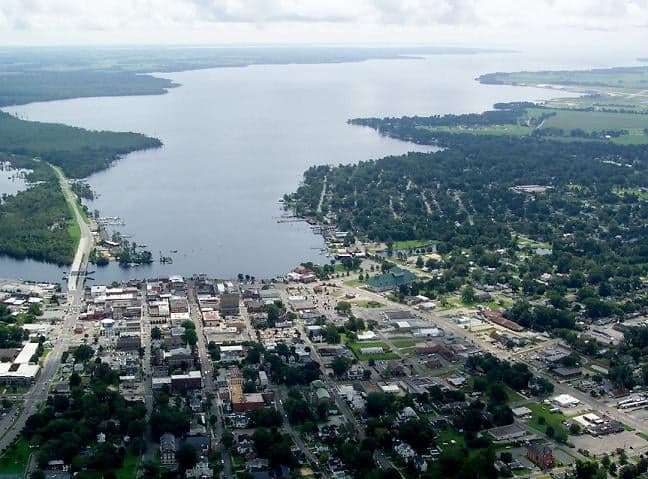
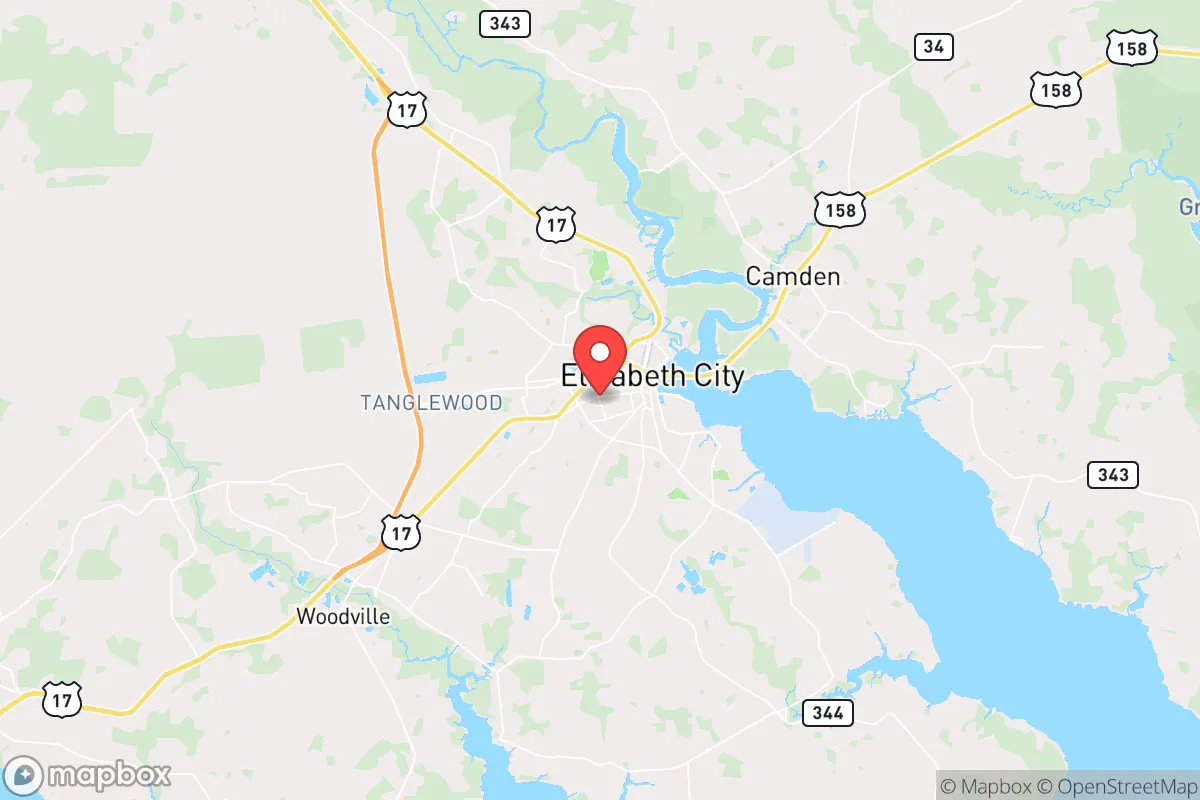
Photo: Wikipedia
Demographics of Elizabeth City, NC
Affluence Level in Elizabeth City, NC
A below-average socioeconomic profile. Incomes, home values, and educational attainment trail the U.S., with higher poverty and unemployment.
People of Elizabeth City, NC
Elizabeth City, North Carolina, is a city of 18,740 residents where Black or African American residents make up the largest single group at 49.0%, followed by White residents at 36.7%, and a growing Hispanic population at 7.7%. The city is notably less diverse in foreign-born residents than the national average, with only 2.0% born outside the United States, and its college attainment rate of 28.0% sits below the state average. The population is characterized by deep generational roots, a strong African American cultural heritage, and a modest but steady influx of new residents drawn to the region's lower cost of living and proximity to the Outer Banks and Hampton Roads.
How the city was settled and grew
Elizabeth City was established in 1794 as a port town on the Pasquotank River, part of the Intracoastal Waterway. Its early population was composed primarily of English and Scottish settlers who arrived via the Albemarle Sound, drawn by the region's fertile farmland and access to maritime trade. The city grew slowly through the 19th century as a center for shipbuilding, lumber, and fishing, with the Dismal Swamp Canal (completed 1805) connecting it to the Chesapeake Bay and boosting commerce. The African American population expanded significantly after the Civil War, as formerly enslaved people moved to the city for work in the maritime and agricultural industries. Many settled in the Riverside and Pine Grove neighborhoods, which remain predominantly Black communities today. The early 20th century brought a wave of White migration from rural eastern North Carolina, drawn by the opening of the Elizabeth City Shipyard (1917) and the establishment of the U.S. Coast Guard Air Station Elizabeth City (1940). These workers and their families concentrated in the Westover and Halstead neighborhoods, which developed as predominantly White, middle-class areas during the mid-20th century.
Modern era (post-1965)
The post-1965 period saw significant demographic shifts in Elizabeth City, driven by the broader national trends of suburbanization and the decline of manufacturing. The city's White population peaked in the 1970s and has since declined steadily, while the Black population has grown both in absolute numbers and as a share of the total. The Hispanic population began to grow noticeably in the 1990s, primarily driven by immigrants from Mexico and Central America who found work in agriculture, construction, and the seafood processing industry. These newer residents have concentrated in the Southgate area and along the U.S. 17 corridor, where affordable housing and proximity to farm labor drew families. The East/Southeast Asian population remains small at 1.0%, with a handful of families employed at the local hospital and university. The Indian subcontinent population is negligible at 0.2%. The city's Black population is heavily concentrated in the historic Riverside and Pine Grove neighborhoods, while White residents are more dispersed across the Westover, Halstead, and newer subdivisions on the city's western edge. The city's overall population has been relatively stable since 2000, hovering between 18,000 and 19,000, with modest growth in the Hispanic share offsetting a slow decline in the White share.
The future
The population of Elizabeth City is projected to become more diverse over the next 10-20 years, though the pace of change is likely to be slow. The Hispanic share is expected to continue growing, potentially reaching 10-12% by 2040, driven by both domestic migration from other parts of North Carolina and continued immigration from Latin America. The Black population is likely to remain the largest group, though its share may decline slightly as the city attracts more White and Hispanic residents from the Hampton Roads metro area, where housing costs are significantly higher. The foreign-born share is expected to rise from its current 2.0% but will likely remain well below the national average. New residential development is concentrated on the city's western and southern edges, particularly around the U.S. 17 bypass and near the Elizabeth City State University campus, which is drawing a younger, more diverse population. The city's cultural identity is evolving from a historically Black and White Southern town toward a more multiethnic community, though the pace of change is tempered by the region's relatively slow economic growth and limited job opportunities outside of government, education, and healthcare.
For someone moving to Elizabeth City today, the city offers a stable, affordable community with deep historical roots and a clear sense of place. The population is predominantly Black and White, with a small but growing Hispanic presence, and the city's cultural life is shaped by its African American heritage, its coastal location, and its role as a regional hub for the northern Outer Banks. New residents will find a community that is welcoming but not rapidly changing, where the cost of living is low and the pace of life is slower than in the nearby Hampton Roads metro area. The city's demographic future points toward gradual diversification, but the core character of Elizabeth City as a small, historically grounded Southern town is likely to persist for the foreseeable future.

* Values derived from national, state, county, city and local statistics and may differ in a specific area. Last updated: 2026-10-21T18:42:18.000Z
Narrative content on this page is AI-generated and may contain mistakes. Verify any details that matter before acting on them.
ReloMaps may earn a commission from affiliate links at no extra cost to you.

