
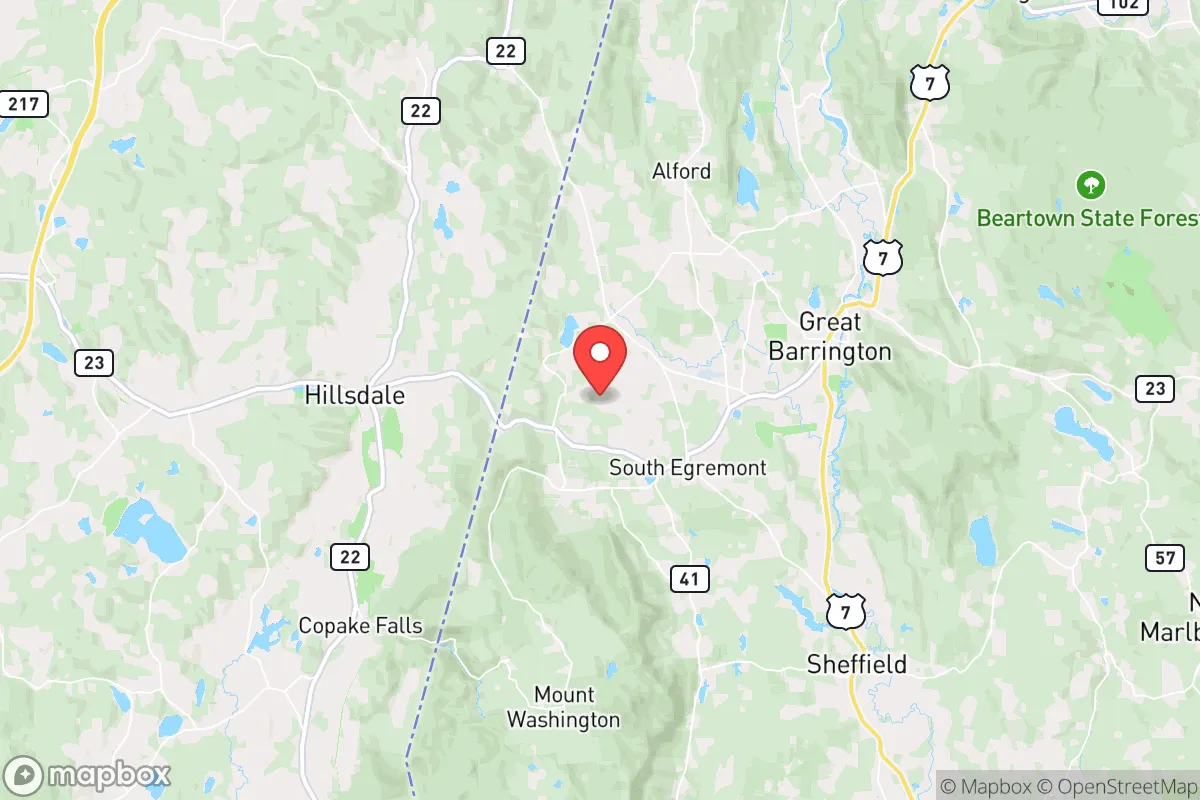
Photo: Wikipedia
Political ClimatePolitical Climate in Egremont, MA
District shown is the primary district for this city’s centroid. Cities may span multiple districts.
Local Political AnalysisPolitical Analysis of Egremont, MA
Egremont, Massachusetts leans solidly Democratic, but it’s a quieter shade of blue than the state as a whole. With a Cook PVI of D+8, the town is less liberal than Massachusetts’ statewide D+15 rating, meaning you’ll find a more moderate, independent streak here than in Boston or Cambridge. This isn’t a place where politics dominates every conversation—it’s more about local land use, school budgets, and keeping the character of the southern Berkshires intact. The trajectory has been steadily Democratic over the past two decades, but the shift has been slower and less dramatic than in urban centers, with a stubborn minority of conservative voters who’ve been here for generations.
How it compares
Egremont’s D+8 PVI puts it about seven points to the right of Massachusetts as a whole, which is a meaningful gap in a state where Democrats hold every statewide office and both U.S. Senate seats. To get a feel for the contrast, look at nearby Great Barrington (D+12) or Stockbridge (D+14)—both are more liberal, with higher concentrations of second-home owners and arts professionals. Head east to Sheffield (D+6) or north to Alford (D+4), and you’ll find towns that lean Democratic but with a stronger libertarian or independent flavor. The real contrast is with rural towns like Sandisfield or Monterey, which are closer to D+5 or D+3, where hunting, farming, and a “leave me alone” attitude still hold sway. In Egremont, you’ll see more Trump signs per acre than in Lenox or Williamstown, but they’re still outnumbered by Harris or Biden signs in any given election cycle.
What this means for residents
For liberal residents, Egremont feels comfortable but not suffocating. You can attend a town meeting where zoning for a solar farm gets debated for two hours, and no one calls you a socialist. For conservatives, it’s a place where you can voice your opinions without being shouted down, but you’ll rarely win a local election. The practical effect is that town government tends to be pragmatic—budgets pass, roads get plowed, and the library gets funded—without the ideological battles you’d see in a more polarized suburb. Property taxes are moderate for the region, and there’s little appetite for big spending increases. The school district, which Egremont shares with other southern Berkshire towns, is a frequent flashpoint: liberal residents push for more diversity and inclusion programs, while conservative ones focus on costs and local control. Neither side dominates completely, so decisions often land in the middle.
One cultural distinction that sets Egremont apart is its strong tradition of land conservation and environmentalism, which crosses party lines. Both liberal and conservative residents tend to support open-space purchases and agricultural preservation, a rare point of unity. You won’t find the same intensity around social issues as in the eastern part of the state—abortion and gun rights are discussed, but they don’t dominate local politics the way they do in Springfield or Boston. In practice, this means a conservative resident can live here without feeling like an outcast, but they’ll need to accept that the town’s political center of gravity is left of center. For liberals, it’s a place where you can enjoy the cultural amenities of the Berkshires—Tanglewood, the Clark Art Institute, Jacob’s Pillow—without the high cost and congestion of the more liberal enclaves. The long-term trend is likely a slow drift leftward as new residents from New York and Boston move in, but Egremont’s independent character should keep it from becoming a mirror of the state’s urban liberalism.

State Political ClimatePolitical Climate in Massachusetts
State Political AnalysisPolitical Environment in the State
Massachusetts is one of the most reliably Democratic states in the country, with a Cook PVI of D+15, meaning it votes about 15 points more Democratic than the national average in presidential elections. The state hasn’t voted for a Republican presidential candidate since 1984, and Democrats hold every statewide office, supermajorities in both legislative chambers, and all 11 U.S. House seats. Over the last 10-20 years, the shift has been toward a more uniformly blue electorate, driven by the consolidation of liberal voters in the Boston metro area and the steady decline of the once-competitive Republican base in the western and central parts of the state. For a conservative-leaning relocator, this means you’re moving into a place where your political views will be in the minority, but the degree of that minority status varies dramatically depending on where you land.
Urban vs. rural divide
The political map of Massachusetts is a classic urban-rural split, but with a twist: the urban core is so dominant that it overwhelms the rest of the state. Greater Boston, including Boston proper, Cambridge, Somerville, and the inner suburbs like Newton and Brookline, is the engine of the state’s Democratic lean. These areas vote 80-90% Democratic in most elections. The western part of the state, particularly Berkshire County and the hill towns of Franklin and Hampshire counties, also leans heavily blue, but for different reasons—smaller, more progressive enclaves mixed with a declining industrial base. The real Republican strongholds are in the central and southeastern parts of the state, places like the towns of Plymouth, Wrentham, and Norfolk in the Boston exurbs, and the more rural areas of Worcester County and Bristol County. Fall River and New Bedford, old mill cities, have a more working-class, culturally conservative Democratic base that sometimes breaks for Republicans in local races. The Cape and Islands (Barnstable, Nantucket) are swingy—they vote Democratic at the presidential level but often elect moderate Republicans locally. The bottom line: if you’re a conservative, you’ll find your people in the outer suburbs and small towns, not in Boston or the college towns.
Policy environment
Massachusetts has a high-tax, high-regulation policy environment that reflects its Democratic supermajority. The state income tax is a flat 5% (down from 5.15% after a 2022 ballot measure), and the sales tax is 6.25%. Property taxes are high, but they’re set locally—towns like Weston and Dover have rates around 1.1%, while cities like Boston and Cambridge are closer to 0.6-0.7%. There’s no estate tax exemption below $1 million, which hits families hard. On the regulatory side, Massachusetts has some of the strictest gun laws in the country—an assault weapons ban, a 10-round magazine limit, and a licensing system that gives local police chiefs broad discretion to deny permits. The state also has a strong “blue” law environment: universal health insurance (the model for the ACA), a $15 minimum wage, paid family and medical leave, and a robust public education system that consistently ranks #1 in the nation. Election laws are very liberal—same-day voter registration, no-excuse mail-in voting, and early voting by mail. For a conservative, the policy environment feels like a wall of progressive priorities, but the trade-off is high-quality public services and infrastructure.
Recent policy direction
The last five years have seen Massachusetts accelerate in a progressive direction on several fronts. In 2022, the legislature passed the Work and Family Mobility Act, allowing undocumented immigrants to obtain driver’s licenses. In 2023, the state enacted a gun reform law that expanded the existing assault weapons ban, required safe storage, and created a new “red flag” law for extreme risk protection orders. On education, the state passed the Student Opportunity Act in 2019, pouring billions into underfunded school districts, and in 2024, the legislature banned the use of Native American mascots in public schools. On the tax front, the 2022 ballot measure that cut the income tax to 5% was a rare win for fiscal conservatives, but it was paired with a new millionaire’s tax (a 4% surcharge on income over $1 million) that passed the same year. Parental rights have been a flashpoint: the state’s anti-bullying law and gender identity protections in public accommodations mean schools generally affirm a student’s chosen name and pronouns without parental notification, which has sparked lawsuits and local school board battles. On property rights, the state has a strong Chapter 40B law that allows developers to bypass local zoning in towns with less than 10% affordable housing, a major source of tension in wealthy suburbs. Voting access has been expanded with permanent mail-in voting and early voting, making it one of the easiest states to vote in. For a conservative, the direction is clearly toward more government involvement in daily life, but the pace is slower than in states like California or New York.
Civil unrest & political movements
Massachusetts has a long history of political activism, but it’s generally more institutional and less confrontational than in other states. The Black Lives Matter protests in 2020 were large and sustained in Boston, but they were largely peaceful. The state’s sanctuary policy is not a formal law but a 2017 executive order from then-Governor Charlie Baker that limits state police cooperation with federal immigration enforcement—it’s been a point of contention, with some towns like Uxbridge and Dudley passing resolutions to declare themselves “non-sanctuary.” On the right, the Massachusetts Fiscal Alliance and local Second Amendment groups are active but have limited legislative success. The 2020 election integrity debate was muted here compared to swing states—Massachusetts has automatic voter registration and paper ballots, so there were no major controversies. The most visible flashpoint for a new resident might be the school committee meetings in towns like Lexington and Needham, where debates over curriculum, critical race theory, and transgender policies have been heated but civil. There’s also a small but vocal secession movement in Western Massachusetts, where some residents feel ignored by the Boston-centric legislature, but it’s more of a symbolic gesture than a real political force.
Projection
Over the next 5-10 years, Massachusetts will likely become even more Democratic, but the margin of change will be small—it’s already near the ceiling. The biggest demographic shift is the continued influx of young, educated professionals into Boston and its inner suburbs, which reinforces the state’s liberal lean. The out-migration of older, more conservative residents to Florida, New Hampshire, and the Carolinas will continue, but it’s not enough to flip any districts. The real action will be in the suburbs: towns like Marlborough and Franklin are growing and becoming more diverse, which could push them from swing to solid blue. The state’s housing crisis—driven by strict zoning and high demand—will be the defining political issue, and it will likely lead to more state preemption of local control, which will anger suburban conservatives. For a conservative moving in now, expect to see a state that remains a Democratic stronghold, but with a more active and organized conservative minority in the exurbs and small towns. The policy environment will continue to lean left, but the state’s fiscal discipline (it has a AAA bond rating) and high-quality public services will remain a draw for families of all political stripes.
For a conservative relocator, the bottom line is this: Massachusetts is a blue state that works well if you can afford it. You’ll pay high taxes and live under laws you likely disagree with, but you’ll also get excellent schools, low crime, and a stable economy. The key is picking the right town—look at the outer suburbs of Worcester County or the South Shore, where you’ll find like-minded neighbors and a more moderate local government. If you’re moving for a job in Boston or Cambridge, be prepared for a daily environment where your political views are the minority, but the state’s culture of civility and pragmatism means you won’t be ostracized for them. It’s not a place for someone who wants to fight the culture war every day, but it’s a great place to raise a family if you can navigate the policy landscape.
* Values derived from national, state, county, city and local statistics and may differ in a specific area. Last updated: 2026-09-29T17:14:46.000Z
Narrative content on this page is AI-generated and may contain mistakes. Verify any details that matter before acting on them.
ReloMaps may earn a commission from affiliate links at no extra cost to you.

