
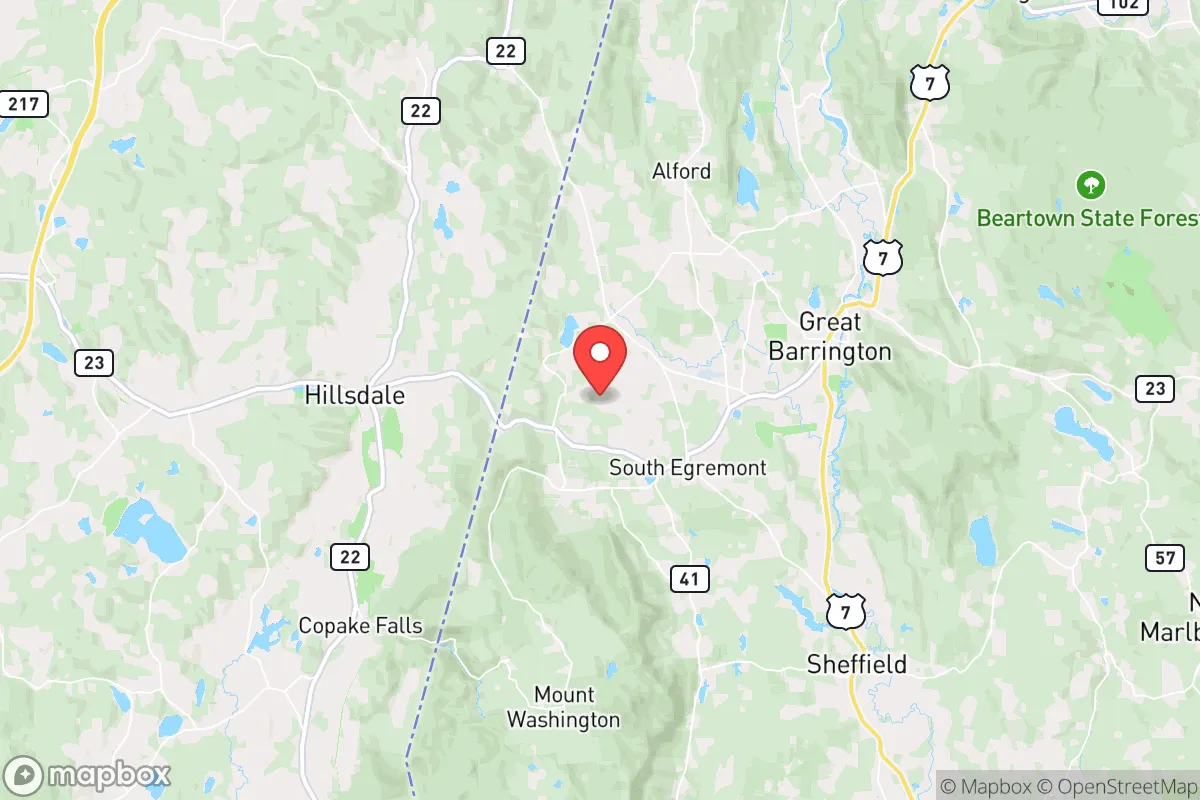
Photo: Wikipedia
Personal Sovereignty in Egremont, MA
Moderate friction. Expect trade-offs in some aspect of personal liberty and independence.
What does Personal Sovereignty tell us?
Personal Sovereignty measures your capacity for self-reliance and independence with minimal government friction. Higher scores mean fewer barriers between you and the way you want to live... but it assumes you have the space you need and good neighbors.
What does this tell us?
Personal Sovereignty measures your capacity for self-reliance and independence with minimal government friction. Higher scores mean fewer barriers between you and the way you want to live... but it assumes you have the space you need and good neighbors.
State Policy
Energy independence: Importer (5% of energy produced in-state)
Personal Liberty
Homesteading

Personal Liberty Analysis
Egremont, Massachusetts, presents a nuanced personal sovereignty environment that balances deep-rooted New England traditions of self-governance with the state's broader regulatory framework. For a conservative-leaning individual or family prioritizing autonomy, the town offers a distinctly lighter touch than many Massachusetts communities, particularly in its rural character and local governance, but operates within a state context that imposes notable constraints on tax burden, self-defense law, and certain personal liberties. The key to understanding Egremont's sovereignty landscape lies in recognizing where local culture and zoning provide breathing room, and where state-level mandates create friction for those seeking maximum independence.
Tax burden and regulatory posture in a rural Berkshire town
Egremont's tax burden is moderate by Massachusetts standards, but the state's overall posture is high-tax and regulatory-heavy, which directly impacts residents. The town's property tax rate hovers around $14.50 per $1,000 of assessed value, which is competitive within Berkshire County but significantly higher than many states in the South or Midwest. Massachusetts imposes a flat 5% state income tax, and the state sales tax is 6.25%, with no local option to reduce it. The regulatory environment is shaped by the Massachusetts Department of Environmental Protection (MassDEP) and local conservation commissions, which enforce strict wetland protection and building codes. For a homeowner, this means any construction near water bodies or significant land alteration requires permits and often public hearings. However, Egremont's small-town government—with a population under 1,200—means fewer layers of bureaucracy than in larger communities. The town has no local meals or rooms tax, and its zoning bylaws are relatively permissive for agricultural and residential uses, though commercial development is tightly controlled. The overall regulatory posture is best described as moderate-to-heavy at the state level, but light at the local level, with most day-to-day interactions being with town boards that are accessible and pragmatic.
Self-defense and gun law specifics in Massachusetts
Massachusetts has some of the most restrictive gun laws in the United States, and Egremont residents must navigate this state-level framework carefully. The state requires a License to Carry (LTC) for both open and concealed carry, which is issued by the local police chief—in Egremont's case, the Berkshire County Sheriff's Office handles this through a municipal process. The LTC process includes a background check, fingerprinting, a firearms safety course, and a fee of around $100. The state's "may issue" standard has been effectively converted to "shall issue" by court rulings, but chiefs retain discretion to deny for "suitability" reasons, which can be a hurdle. Massachusetts bans "assault weapons" by name and feature, limits magazine capacity to 10 rounds, and requires all firearm transfers to go through a licensed dealer, even private sales. Self-defense law in Massachusetts follows a "duty to retreat" standard in public spaces, meaning a person must attempt to avoid a confrontation before using deadly force, unless they are in their home (the Castle Doctrine applies). Stand Your Ground laws do not exist. For a conservative-leaning resident, this means self-defense options are legally constrained compared to states like New Hampshire or Vermont. However, Egremont's rural setting—with low crime rates and a strong community ethos—means that the practical need for defensive firearms is lower than in urban areas, though the legal restrictions remain a significant consideration for those prioritizing the right to bear arms.
Self-reliance and homesteading viability: lot sizes, zoning, and off-grid feasibility
Egremont offers strong potential for self-reliance and homesteading, driven by its rural zoning and agricultural heritage. Minimum lot sizes in the town's residential zones are typically 2 acres, with many parcels exceeding 5 or 10 acres, providing ample space for gardens, livestock, and small-scale farming. The town's zoning bylaws explicitly allow for "agricultural uses" as of right, including keeping horses, cows, sheep, goats, and poultry, with no special permits required for standard operations. Beekeeping is also permitted. For off-grid living, the feasibility is moderate: Massachusetts requires all dwellings to be connected to the electrical grid or have an approved alternative energy system (solar with battery storage is common), and the state's building code mandates compliance with Title 5 septic systems for wastewater. Completely disconnecting from the grid is not legally straightforward, as the state requires a minimum level of utility service for health and safety. Rainwater collection is allowed for non-potable uses (irrigation, livestock) but not for drinking without a permit. Wood heating is common and unregulated at the local level, though the state's Department of Environmental Protection has outdoor hydronic heater regulations. The town's rural character means that noise, odor, and light ordinances are minimal, allowing for activities like chainsaw work, tractor operation, and outdoor projects without neighbor complaints. For a family seeking to grow food, raise animals, and reduce reliance on external systems, Egremont is one of the more accommodating towns in Massachusetts, though the state's energy and waste regulations impose some limits on full off-grid autonomy.
Personal liberties: parental rights, medical autonomy, speech, and property
Personal liberties in Egremont are shaped by a mix of local culture and state mandates. Parental rights are generally strong in the town's schools—the Southern Berkshire Regional School District—which emphasizes local control and parental involvement. However, Massachusetts state law mandates comprehensive sex education in public schools (the 2023 "Healthy Youth Act"), requires LGBTQ+ inclusive curricula, and has strict vaccine requirements for school attendance (no philosophical exemptions, only medical and religious). Medical autonomy is significantly constrained at the state level: Massachusetts has universal healthcare mandates, requires health insurance, and has some of the strictest vaccine mandates in the country for healthcare workers and schoolchildren. The state also has a "right to repair" law for medical devices, but overall, individual medical choice is limited compared to states with fewer mandates. Free speech is protected under the First Amendment, and Egremont's small-town atmosphere means that political expression is generally tolerated, though Massachusetts has a strong anti-discrimination law that can limit certain forms of speech in public accommodations. Property rights are robust at the local level: the town has no rent control, no inclusionary zoning, and no short-term rental restrictions (as of 2026), though the state is considering a bill to regulate Airbnb-style rentals. Property taxes are the primary constraint on ownership freedom, as they are based on assessed value and can rise with market appreciation. For a conservative-leaning resident, the balance is that local governance in Egremont respects individual property and family decisions, but state-level mandates on health, education, and medical choice create a heavier regulatory environment than in many other parts of the country.
Overall, Egremont offers a relatively high degree of personal sovereignty within the context of Massachusetts—a state that ranks among the most regulated in the nation. The town's rural zoning, agricultural permissiveness, and small-government ethos provide genuine breathing room for self-reliance, homesteading, and property rights. However, the state's tax burden, restrictive gun laws, medical mandates, and education requirements create a ceiling on autonomy that cannot be ignored. For a reader prioritizing personal freedom, Egremont is a moderate-to-strong choice within the Northeast, but it does not compare favorably to states like New Hampshire, Texas, or Idaho, where tax burdens are lower, gun laws are more permissive, and medical and educational mandates are fewer. The best fit is for someone who values a rural, community-oriented lifestyle with local control, and is willing to accept state-level constraints in exchange for the natural beauty and cultural richness of the Berkshires.

* Values derived from national, state, county, city and local statistics and may differ in a specific area. Last updated: 2026-09-29T17:14:46.000Z
Narrative content on this page is AI-generated and may contain mistakes. Verify any details that matter before acting on them.
ReloMaps may earn a commission from affiliate links at no extra cost to you.

