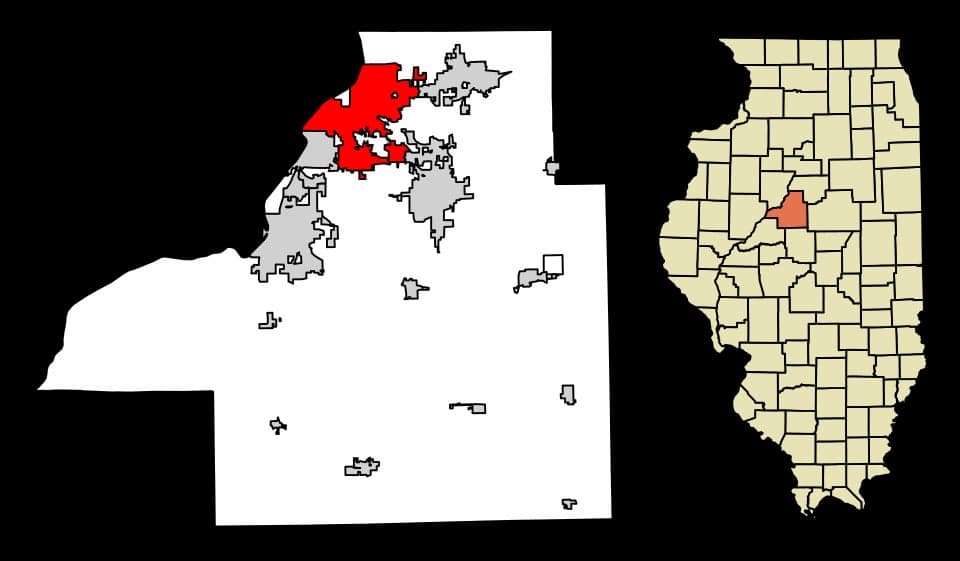
Photo: Wikipedia
Personal Sovereignty in East Peoria, IL
Viable for self-reliance. Generally workable, though some barriers may limit total independence.
What does Personal Sovereignty tell us?
Personal Sovereignty measures your capacity for self-reliance and independence with minimal government friction. Higher scores mean fewer barriers between you and the way you want to live... but it assumes you have the space you need and good neighbors.
What does this tell us?
Personal Sovereignty measures your capacity for self-reliance and independence with minimal government friction. Higher scores mean fewer barriers between you and the way you want to live... but it assumes you have the space you need and good neighbors.
State Policy
Energy independence: Importer (45% of energy produced in-state)
Personal Liberty
Homesteading

Personal Liberty Analysis
East Peoria, Illinois, offers a mixed personal sovereignty environment where state-level constraints on taxes, self-defense, and regulatory autonomy are partially offset by local practical freedoms, particularly for those seeking self-reliance and lower-density living. While Illinois is not a top-tier state for personal sovereignty due to its progressive tax structure and firearm regulations, East Peoria's position in Tazewell County provides a more conservative, less restrictive local culture than neighboring Peoria County. For single individuals and families prioritizing independence, the city presents a workable balance: state-level burdens are real, but local zoning, property rights, and community norms allow for meaningful autonomy in daily life.
Tax burden and regulatory posture in East Peoria
Illinois imposes a relatively high tax burden on residents, and East Peoria is no exception. The state's flat income tax rate is 4.95%, and combined state and local sales tax in East Peoria reaches 8.25%, which is moderate for the region but higher than many Midwestern states. Property taxes are the most significant concern: Tazewell County's effective property tax rate averages around 2.1% of assessed home value, placing it among the higher tiers nationally. This directly impacts homeowners' financial autonomy, as annual tax bills can run $4,000–$6,000 on a median-priced home. However, the regulatory posture at the local level is relatively light-touch. East Peoria's municipal code does not impose overly burdensome business licensing or home occupation restrictions compared to larger Illinois cities. Zoning is conventional but not punitive; homeowners can operate small businesses from their residences with a simple permit, and there are no city-level rent control or wage mandates that would constrain property owners. The state's regulatory environment is heavier in areas like environmental permitting and vehicle emissions testing, but for most daily activities—home maintenance, vehicle ownership, small-scale entrepreneurship—the local regulatory footprint is manageable and predictable.
Self-defense and gun law specifics in East Peoria
Illinois has some of the most restrictive firearm laws in the Midwest, which directly affects personal sovereignty for self-defense-minded residents. The state requires a Firearm Owner's Identification (FOID) card to possess any firearm or ammunition, a process that involves a background check and can take weeks. For concealed carry, a Concealed Carry License (CCL) is mandatory, requiring 16 hours of training and a separate application. Illinois is a "may-issue" state in practice, though the standard is now shall-issue following court rulings; local sheriffs in Tazewell County, including East Peoria, are generally cooperative with lawful applicants. Open carry is prohibited statewide. Magazine capacity is limited to 10 rounds for long guns and 15 rounds for handguns under state law, and the state maintains a registry of firearm purchases. Stand-your-ground laws do not exist in Illinois; instead, a duty to retreat applies outside the home, though the Castle Doctrine protects use of force inside one's residence. For East Peoria residents, the practical effect is that lawful firearm ownership is possible but requires administrative effort and compliance with state mandates. Local gun culture is strong, with several ranges and retailers in the area, and law enforcement in Tazewell County is generally supportive of Second Amendment rights within the legal framework. Compared to states like Texas or Florida, the regulatory burden is significant, but for those willing to navigate the FOID and CCL process, self-defense autonomy is achievable.
Self-reliance and homesteading viability in East Peoria
East Peoria offers moderate viability for self-reliance and homesteading, largely due to its suburban-to-rural transition zones and permissive local zoning. Within city limits, standard residential lots range from 0.15 to 0.5 acres, which limits large-scale homesteading but allows for substantial vegetable gardens, small fruit orchards, and backyard poultry. The city code permits up to six hens on residential lots without a special permit, though roosters are prohibited. Beekeeping is allowed with registration. For those seeking more land, unincorporated areas of Tazewell County just outside East Peoria offer parcels of 1 to 10 acres at relatively affordable prices—typically $10,000–$20,000 per acre. Zoning in these areas is agricultural or rural residential, permitting livestock such as goats, sheep, and horses without special use permits. Off-grid feasibility is limited by state building codes and utility requirements; Illinois does not legally require grid connection, but most lenders and insurers mandate it for financed properties. Rainwater collection is unrestricted, and composting is legal. Solar panels are permitted with standard electrical permits, and net metering is available through Ameren Illinois, though at a reduced rate. The growing season in central Illinois runs approximately 170 days, from mid-April to mid-October, supporting a wide range of vegetables and fruits. For families serious about self-reliance, the key is to locate just outside city limits where lot sizes increase and zoning restrictions loosen significantly.
Personal liberties in East Peoria: parental rights, medical autonomy, speech, and property
Illinois law provides a mixed landscape for personal liberties that directly affect families and individuals in East Peoria. Parental rights are generally respected in Tazewell County, with school districts like East Peoria Community High School District 309 and Central District 51 maintaining conservative policies on parental notification for health services and curriculum transparency. Illinois state law mandates comprehensive sex education in public schools, but parents can opt their children out. Medical autonomy is more restricted: Illinois has broad vaccine mandates for school attendance, and the state's medical marijuana program is well-established but does not allow home cultivation for patients. Recreational cannabis is legal for adults 21+, with home cultivation limited to five plants per household. Free speech protections are robust under both the U.S. and Illinois constitutions, and East Peoria has no local ordinances restricting expressive activity beyond standard time-place-manner regulations. Property rights are strong at the local level; Tazewell County does not have rent control, and there are no county-level short-term rental bans, though East Peoria requires a permit for Airbnb-style rentals. Eminent domain is rarely exercised for private development. For families, the most relevant liberty is the ability to make educational choices: homeschooling is legal with minimal state oversight (registration with the regional superintendent is recommended but not strictly enforced), and several private and parochial schools operate in the area. Overall, personal liberties in East Peoria are constrained by state-level mandates but largely unencumbered by local overreach.
Compared to other Midwestern relocation destinations, East Peoria occupies a middle tier for personal sovereignty. It is significantly more restrictive than rural Indiana or Missouri on firearms and taxes, but notably freer than Cook County or the Chicago suburbs on property rights, homeschooling, and local regulatory burden. For a conservative-leaning individual or family willing to accept Illinois' state-level constraints, East Peoria offers a practical, community-oriented environment where local governance is light, self-reliance is feasible on the outskirts, and personal liberties are respected in daily life. The trade-off is clear: accept higher taxes and firearm regulation in exchange for affordable land, strong property rights, and a local culture that values independence.

* Values derived from national, state, county, city and local statistics and may differ in a specific area. Last updated: 2026-10-11T13:01:13.000Z
Narrative content on this page is AI-generated and may contain mistakes. Verify any details that matter before acting on them.
ReloMaps may earn a commission from affiliate links at no extra cost to you.

