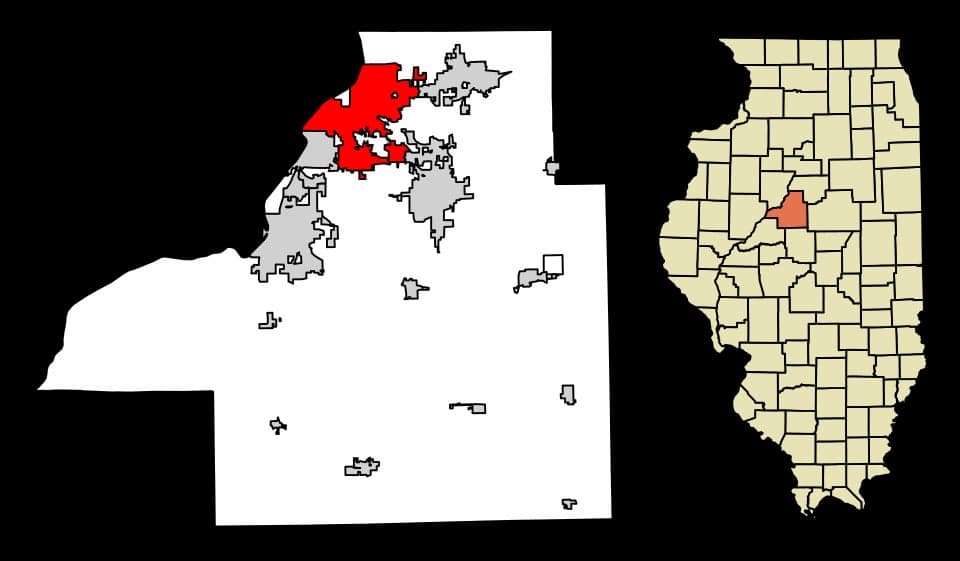
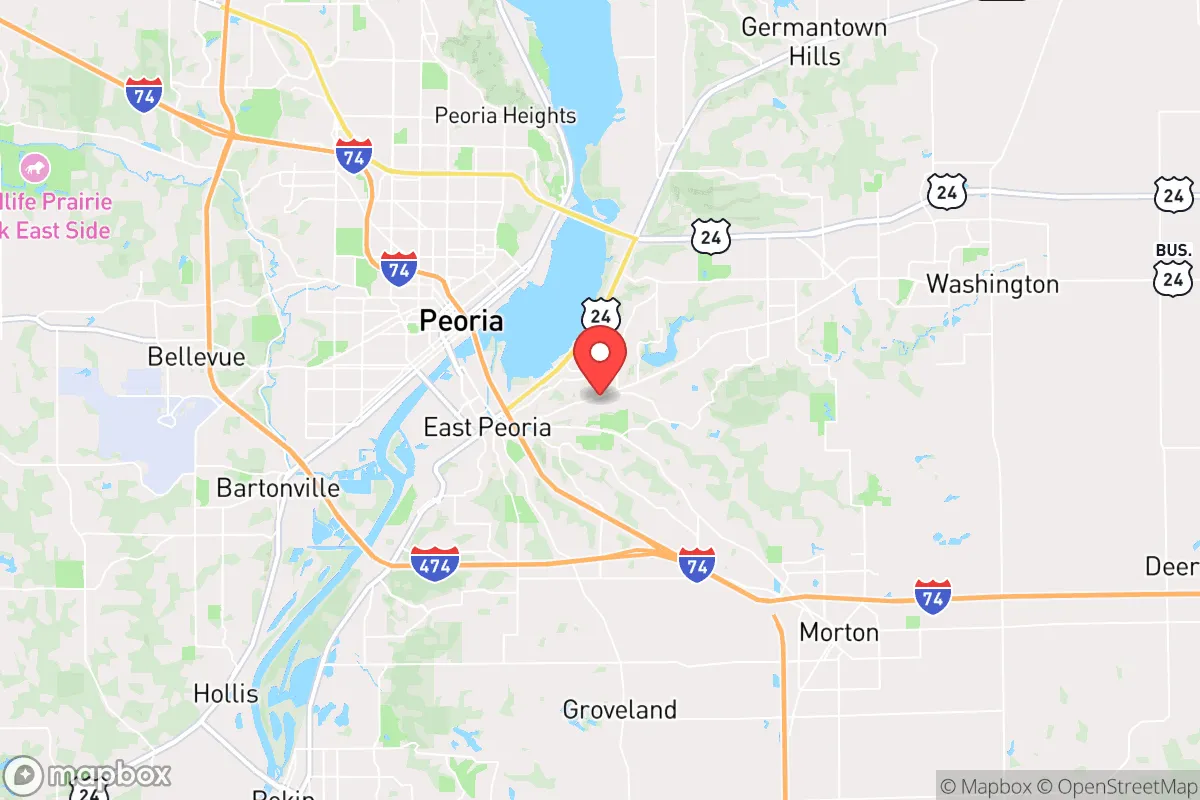
Photo: Wikipedia
Political ClimatePolitical Climate in East Peoria, IL
District shown is the primary district for this city’s centroid. Cities may span multiple districts.
Local Political AnalysisPolitical Analysis of East Peoria, IL
East Peoria leans solidly Republican, with a Cook PVI of R+11 that places it well to the right of the rest of Illinois, which carries a D+7 rating. That 18-point gap isn't just a number on a map—it reflects a community that has voted reliably red in presidential and most statewide races for decades, even as the state as a whole has trended blue. The trajectory here is fairly stable: East Peoria hasn't swung dramatically in either direction over the past few cycles, though the surrounding metro area's suburban and rural precincts have hardened their Republican lean while the city of Peoria proper has moved left.
How it compares
Drive ten minutes west across the Illinois River into Peoria proper, and you're in a very different political world. Peoria city precincts tend to vote Democratic by comfortable margins, reflecting a more urban, diverse electorate. Head south toward Morton or Washington, and you'll find communities that are also Republican-leaning but often less intensely so than East Peoria. The contrast is sharpest in state-level races: East Peoria consistently sends Republicans to Springfield, while Peoria's state representatives are Democrats. That split means the area's political conversation is genuinely two-sided—you can have a neighbor who works at Caterpillar's headquarters in Peoria and votes blue, and another who works at the same plant and votes red, and both feel their views are represented somewhere in local government.
What this means for residents
For conservative residents, East Peoria's lean means local offices—city council, school board, county positions—are almost always held by Republicans, and policy tends to reflect that: lower property tax levies relative to Peoria, fewer zoning restrictions, and a general preference for limited government. For liberal residents, the reality is that you'll likely be in the minority in local elections, but you're still within a short drive of Peoria's Democratic stronghold, so progressive candidates and causes aren't invisible. The practical effect is that political arguments here tend to be civil by national standards—people know their neighbors across the river, and the shared identity of being "from the Peoria area" softens the edges. You won't see many yard signs for statewide Democratic candidates in East Peoria, but you also won't see the kind of intense partisan polarization you'd find in, say, Chicago suburbs.
Culturally, East Peoria's Republican tilt shows up in things like the local approach to development—more permissive toward industrial and commercial growth, less emphasis on public transit expansions—and in the general tone of public meetings, which tend to prioritize fiscal caution. The city's annual Festival of Lights and its riverfront redevelopment projects are points of pride that transcend party lines, and most residents, regardless of affiliation, will tell you the biggest local issues are infrastructure and flood control, not culture wars. That's the East Peoria way: reliably red, but with a pragmatic streak that keeps things functional rather than ideological.

State Political ClimatePolitical Climate in Illinois
State Political AnalysisPolitical Environment in the State
Illinois is a solidly Democratic state with a Cook PVI of D+7, meaning it votes about seven points more Democratic than the national average in presidential elections. Over the last 10-20 years, the state has shifted leftward at the state level, driven overwhelmingly by the Chicago metro area, while downstate regions have moved sharply in the opposite direction. The result is a state where statewide Democrats win by comfortable margins, but the political reality on the ground varies wildly depending on whether you're in Cook County, the collar counties, or the rural south and central regions.
Urban vs. rural divide
The political map of Illinois is a textbook case of urban-rural polarization. Chicago and its inner suburbs in Cook County produce massive Democratic margins — often 70-80% of the vote — that swamp the rest of the state. The collar counties (DuPage, Lake, Kane, Will, McHenry) have been trending Democratic for a decade, with once-Republican strongholds like Naperville and Schaumburg now reliably blue in most races. Meanwhile, downstate Illinois — places like Effingham, Marion, and Quincy — votes as Republican as any rural area in the country. The divide is stark: in 2020, Joe Biden won Cook County by over 1.4 million votes, while Donald Trump won the rest of the state by about 200,000. This geographic split means that a conservative moving to rural Illinois will find a deeply red community, while a liberal moving to Chicago will find one of the most progressive environments in the Midwest.
Policy environment
Illinois has a progressive policy framework that is among the most liberal in the Midwest. The state has a flat income tax rate of 4.95% (after a failed attempt to switch to a progressive rate in 2020), but property taxes are among the highest in the nation — averaging over 2% of home value statewide, with Cook County often exceeding 2.5%. Sales tax rates vary by locality but can exceed 10% in Chicago. The regulatory posture is business-friendly in some respects (Chicago is a major corporate hub) but heavily regulated in areas like labor law, environmental standards, and consumer protection. Education policy is dominated by strong teachers' unions, and the state has a well-funded but inequitable school system, with wealthy suburbs like Hinsdale and Winnetka spending far more per pupil than downstate districts. Healthcare is broadly accessible, with Medicaid expansion and strong protections for pre-existing conditions under state law. Election laws are among the most accessible in the country: no-excuse mail voting, automatic voter registration, and early voting are standard.
Recent policy direction
Over the past five years, Illinois has moved decisively left on a range of issues. On gun and self-defense law, the state passed a ban on assault weapons and high-capacity magazines in 2023, and it maintains a Firearm Owners Identification (FOID) card system that is one of the strictest in the nation. Concealed carry is legal but requires a license, and Illinois does not recognize out-of-state permits. On parental and education rights, the state has expanded LGBTQ+ inclusive curriculum requirements and mandates that schools allow transgender students to use facilities matching their gender identity — a flashpoint for conservative families. On speech and privacy, Illinois has strong biometric privacy protections (the Biometric Information Privacy Act) but has also seen debates over library privacy and book bans, with the state generally siding with library autonomy. On medical and bodily autonomy, Illinois is a safe haven for abortion access, with no gestational limits and protections for providers and patients traveling from other states. Recreational marijuana is legal and taxed. On property rights, the state has seen controversy over property tax assessment practices and tenant protections, including a 2024 law limiting rent increases. On taxation, the failed progressive income tax amendment in 2020 was a major political battle, and the issue is likely to return. On voting and ballot access, Illinois has expanded mail voting and same-day registration, but election integrity debates have flared over the use of drop boxes and the state's voter roll maintenance practices.
Civil unrest & political movements
Illinois has a history of visible political activism on both sides. Chicago saw significant protests during the 2020 George Floyd demonstrations, with some property damage and a heavy police response that remains a point of contention. The city also hosts large annual protests around the Democratic National Convention and other national events. On the right, downstate Illinois has seen the growth of county-level "sanctuary county" resolutions opposing state gun laws, and there is a small but vocal secession movement in parts of southern Illinois (the "New Illinois" or "Illinois Exit" movement), though it has no realistic path to success. Immigration politics are a major flashpoint: Illinois is a sanctuary state, with state law limiting local law enforcement cooperation with federal immigration authorities. This has led to tensions between the state and some downstate sheriffs who have publicly refused to comply. Election integrity controversies have been relatively muted compared to swing states, but there have been disputes over the state's handling of mail ballots and the accuracy of voter rolls in Cook County.
Projection
Over the next 5-10 years, Illinois is likely to remain a solidly Democratic state, but the margin may narrow slightly as population loss in Cook County (driven by high taxes and crime concerns) continues, while downstate and collar county growth remains modest. The state's Democratic lean is structurally reinforced by Chicago's size, but the city's population decline — down about 80,000 since 2020 — could slowly erode the statewide margin. The collar counties are likely to remain competitive but trending Democratic, while rural areas will become even more Republican. The biggest wildcard is whether the state can address its massive unfunded pension liability (over $140 billion) and high property taxes, which are the primary drivers of out-migration. A conservative moving to Illinois should expect to live in a state with progressive governance on most social and economic issues, but with significant local variation — a move to Peoria or Springfield will feel very different from a move to Chicago or Evanston.
For a new resident, the bottom line is that Illinois offers a deeply polarized political environment where your experience will depend almost entirely on where you live. If you're conservative, you can find like-minded communities in the suburbs and downstate, but you will be living under state laws that may conflict with your values on guns, taxes, and education. If you're liberal, you'll find a state that is broadly aligned with your views, especially in Chicago and the collar counties, but you'll also face high taxes and a state government that is often gridlocked by its own fiscal problems. The practical takeaway: choose your county carefully, because in Illinois, local politics matters as much as state policy.
* Values derived from national, state, county, city and local statistics and may differ in a specific area. Last updated: 2026-10-11T13:01:13.000Z
Narrative content on this page is AI-generated and may contain mistakes. Verify any details that matter before acting on them.
ReloMaps may earn a commission from affiliate links at no extra cost to you.

