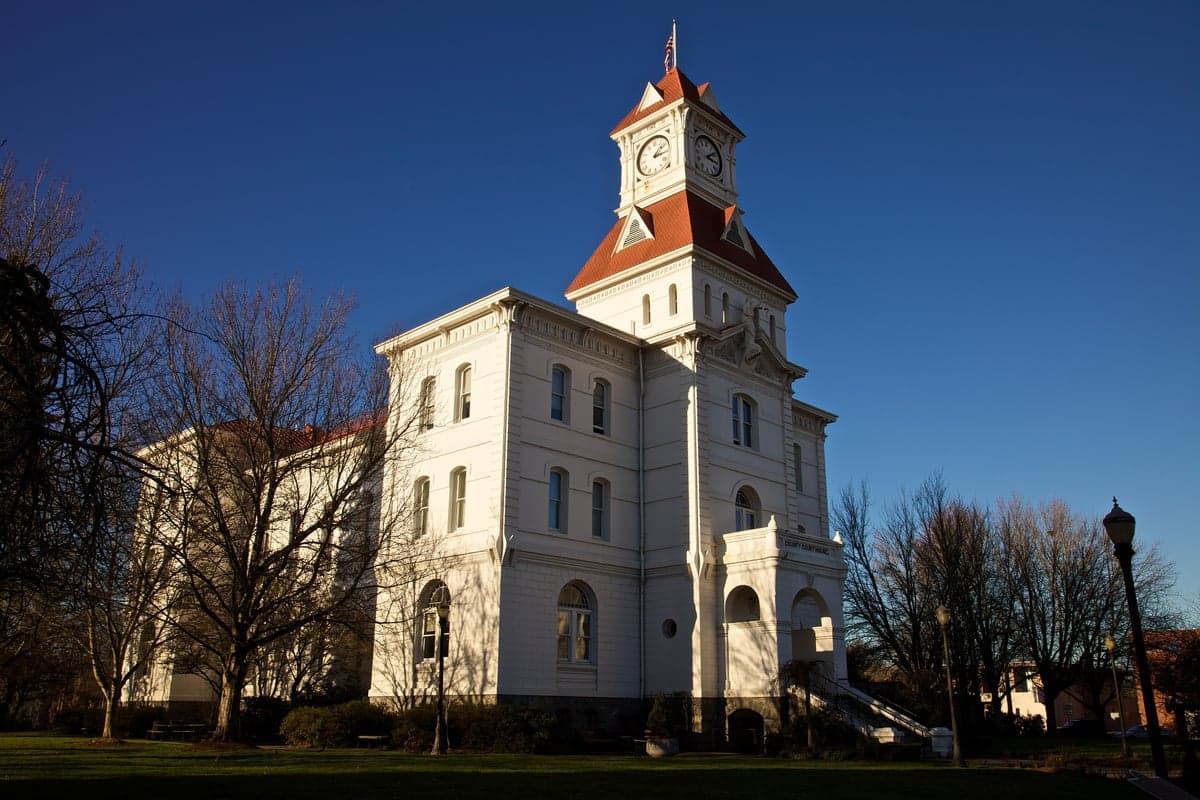
Photo: Wikipedia
Political ClimatePolitical Climate in Corvallis, OR
District shown is the primary district for this city’s centroid. Cities may span multiple districts.
Local Political AnalysisPolitical Analysis of Corvallis, OR
Corvallis leans solidly Democratic, with a Cook PVI of D+6, though it is slightly less blue than Oregon as a whole, which sits at D+8. The city has long been a progressive stronghold in the mid-Willamette Valley, driven by the presence of Oregon State University and a sizable population of academics, researchers, and environmental advocates. Over the past decade, the political trajectory has been stable—Corvallis has not swung dramatically toward either party, but its Democratic lean has deepened incrementally, mirroring national trends in college towns. In the 2024 presidential election, Benton County, which includes Corvallis, voted for the Democratic candidate by a margin of roughly 20 points, consistent with its recent history.
How it compares
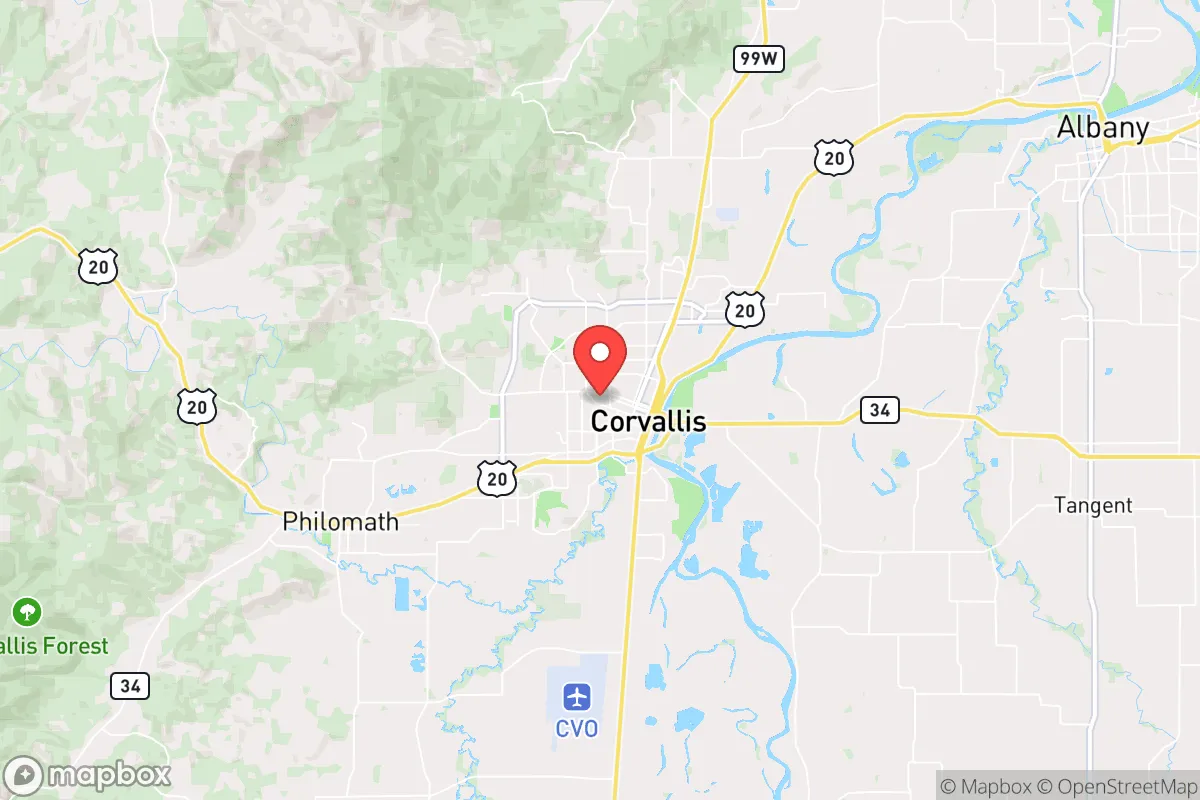
Compared to Oregon’s statewide PVI of D+8, Corvallis is actually a touch more moderate—or at least less uniformly liberal—than the Portland metro area or Eugene. The D+6 rating reflects a community where progressive policies dominate local governance, but where a noticeable minority of conservative and libertarian-leaning residents still have a voice, particularly in the surrounding rural areas. Drive just 15 minutes south to Philomath, and the political vibe shifts noticeably; Philomath is more mixed, with a stronger libertarian streak and a higher share of voters who split tickets. Head 20 minutes north to Albany, and you’ll find a more conservative-leaning working-class town that often votes red in statewide races. This creates a kind of political buffer zone around Corvallis, where the city itself is reliably blue but the broader region is a patchwork of purple and red. In practice, this means Corvallis residents experience a bubble of progressive consensus on issues like climate action, public transit, and housing policy, while the county as a whole still elects some moderate Republicans to local offices.
What this means for residents
For liberal residents, Corvallis feels like a comfortable fit: city council meetings focus on bike infrastructure, urban growth boundaries, and sustainability initiatives, and there’s broad support for rent control measures and public investment in social services. Conservative residents, while a minority, are not marginalized—they tend to cluster in the more affordable outskirts and in neighborhoods near the airport, and they reliably turn out for school board and city council races where fiscal conservatism and property rights are debated. The practical reality is that local elections are often decided in the Democratic primary, so the most heated political battles happen within the left, between moderate Democrats and more progressive factions. On the ground, this means that property taxes and land-use regulations are the most tangible political issues for homeowners and renters alike, with the city’s strict urban growth boundary keeping housing supply tight and prices high. For both sides, the most visible policy distinction from the rest of Oregon is Corvallis’s aggressive climate action plan, which mandates net-zero emissions by 2040—a goal that has broad support but sparks debate over implementation costs.
Culturally, Corvallis stands apart from much of Oregon because of its university-town DNA. The city’s political identity is deeply tied to OSU’s research mission, which attracts a transient population of students and faculty who tend to be younger and more left-leaning than the state average. This creates a dynamic where local politics can feel more insular and academic than in, say, Salem or Eugene, with a heavy emphasis on data-driven policy and long-term planning. The downside is a certain homogeneity of opinion in social circles—it’s easy to go weeks without hearing a dissenting political view if you stick to campus-area coffee shops and farmers’ markets. But for those who want a more balanced perspective, the nearby towns of Philomath and Albany offer a quick reality check, and the city’s own rural fringe provides a reminder that Oregon’s political landscape is far from monolithic. In the long term, Corvallis will likely remain a D+6 to D+7 city, buffered by the university’s steady enrollment but never quite reaching the deep-blue intensity of Portland’s core.

State Political ClimatePolitical Climate in Oregon
State Political AnalysisPolitical Environment in the State
Oregon has a Cook PVI of D+8, making it one of the more reliably Democratic states in the Pacific Northwest, but that number masks a deep and growing chasm. The state’s political center of gravity is the Portland metro area—Multnomah, Washington, and Clackamas counties—which alone delivers enough votes to carry statewide elections for Democrats. Over the past 20 years, the state has shifted leftward on social and environmental issues, but the margins have tightened in the last two cycles as rural and exurban areas have swung hard to the right. A relocator should understand that Oregon is not a monolithic blue state; it’s a state where the Willamette Valley and the coast vote one way, and the rest of the state votes another, with the divide growing sharper every election.
Urban vs. rural divide
The political map of Oregon is essentially a story of three regions. The Portland metro area—including Portland, Gresham, Beaverton, and Hillsboro—is the engine of Democratic dominance, with Multnomah County routinely delivering 75-80% of its vote to Democratic presidential candidates. Bend in Deschutes County has been a notable swing area; it voted for Obama twice, then flipped to Trump in 2016 and 2020, though the county as a whole remains competitive. Eugene and Corvallis are solidly Democratic, driven by the University of Oregon and Oregon State University populations. Meanwhile, the rural eastern and southern parts of the state—Medford, Grants Pass, Klamath Falls, Pendleton, and Baker City—vote Republican by margins of 30-40 points. The I-5 corridor from Portland to Eugene is the Democratic stronghold; everything east of the Cascades and south of Douglas County is deep red. The 2022 gubernatorial race saw Democrat Tina Kotek win by just 3.5 points, a sign that the urban-rural polarization is squeezing the middle.
Policy environment
Oregon’s policy environment is shaped by its Democratic trifecta (governor, House, Senate) and a strong initiative system that lets voters bypass the legislature. The state has no sales tax, which is a major draw for conservatives, but it has one of the highest combined state and local income tax rates in the country—top marginal rate is 9.9%—and property taxes are moderate but vary widely by county. The regulatory posture is among the most aggressive in the nation: Oregon has strict land-use laws (Urban Growth Boundaries), a statewide plastic bag ban, and some of the toughest environmental regulations on timber and agriculture. Education policy is progressive: the state funds full-day kindergarten and has a $10 billion K-12 budget, but test scores lag behind national averages. Healthcare is heavily regulated, with a state-run insurance exchange (Cover Oregon) and expanded Medicaid under the Oregon Health Plan. Election laws are among the most accessible in the country: Oregon was the first state to vote entirely by mail (1998), and it automatically registers voters when they get a driver’s license. There is no voter ID requirement, which is a point of contention for conservatives.
Recent policy direction
Oregon’s recent legislative sessions have pushed the state further left on several fronts, but with notable exceptions. In 2023, the legislature passed the Right to Repair Act and a ban on flavored tobacco, but the biggest flashpoint was Measure 110 (2020), which decriminalized possession of small amounts of all drugs and redirected tax revenue to treatment. That law has been widely criticized for exacerbating the fentanyl crisis and public drug use in Portland and Salem, and in 2024 the legislature partially rolled it back, re-criminalizing public use. On guns, Oregon passed Measure 114 in 2022, which requires a permit to purchase a firearm and bans magazines over 10 rounds; it is currently tied up in court. On parental rights, the state passed the Student Success Act (2019) which increased education funding but also expanded LGBTQ+ inclusive curriculum, drawing backlash from conservative parents. On property rights, Oregon’s land-use system remains a flashpoint: Measure 37 (2004) and Measure 49 (2007) created a compensation system for landowners whose property values are reduced by zoning, but the system remains complex and litigious. On privacy, Oregon has a strong biometric privacy law and a data broker registry, but no comprehensive consumer privacy law yet. On voting, the state has automatic voter registration and same-day registration, making it one of the easiest states to vote in—and one of the hardest to challenge election results.
Civil unrest & political movements
Oregon has a long history of political activism, from the 1934 West Coast waterfront strike to the 2020 racial justice protests in Portland, which drew national attention for their duration and intensity. The Portland protests of 2020-2021 were the largest in the state’s modern history, with nightly demonstrations for months, federal intervention, and property damage that led to a conservative backlash. The Patriot Prayer and Proud Boys groups held counter-protests, and the city became a national symbol of political polarization. Since then, the intensity has cooled, but organized activist groups remain active on both sides: the Oregon Firearms Federation is a powerful gun-rights lobby, while Portland Tenants United and Sunrise Movement PDX push for housing and climate action. Immigration politics are a live issue: Oregon is a sanctuary state (1987 law, expanded in 2019), meaning local law enforcement cannot cooperate with federal immigration authorities. This has led to tensions in rural counties like Linn and Douglas, where some sheriffs have publicly refused to enforce the sanctuary law. Election integrity controversies are muted compared to other states, but the 2020 election saw Antifa and Boogaloo groups clash in Portland, and there were scattered claims of ballot harvesting in rural areas, though no evidence of widespread fraud. The Greater Idaho movement—a secessionist effort to move 20 rural Oregon counties into Idaho—has gained traction, with several counties voting in favor of the idea, though it remains a symbolic protest rather than a realistic policy change.
Projection
Over the next 5-10 years, Oregon’s political trajectory points toward continued polarization, but with a potential shift in the suburbs. The Portland metro area is growing more diverse and younger, which solidifies Democratic dominance there. But the exurban ring—places like Canby, Sandy, and Estacada—is filling with people leaving Portland for lower costs and more conservative politics, which could flip some legislative districts. The Willamette Valley is seeing in-migration from California and Washington, which tends to lean Democratic, but also from conservative retirees moving to Bend and Medford. The Greater Idaho movement will likely remain a fringe issue, but it could gain momentum if the state legislature continues to pass progressive policies that rural counties oppose. The biggest wildcard is housing: Oregon’s land-use restrictions and high construction costs are driving a housing crisis that could push more people to rural areas, accelerating the political realignment. A conservative relocator should expect that Portland and the I-5 corridor will remain solidly Democratic, but that the state’s overall lean could shift to D+5 or D+6 by 2030 as rural areas become more Republican and the suburbs become more competitive.
For a new resident, the bottom line is that Oregon offers a mix of progressive governance and rugged individualism, but the political climate is deeply divided by geography. If you live in Portland, Eugene, or Corvallis, you’ll be in a Democratic bubble with high taxes and strong regulations. If you live in Medford, Grants Pass, or Pendleton, you’ll be in a Republican stronghold with lower costs but less access to state services. The state’s lack of a sales tax and its natural beauty are universal draws, but the policy environment—especially on guns, drugs, and land use—will feel very different depending on where you land. The best advice is to visit the specific city or county you’re considering, talk to locals, and understand that Oregon’s political reality is not one state but several, stitched together by a ballot box and a lot of mutual frustration.
* Values derived from national, state, county, city and local statistics and may differ in a specific area. Last updated: 2026-06-13T19:02:48.000Z
Narrative content on this page is AI-generated and may contain mistakes. Verify any details that matter before acting on them.
ReloMaps may earn a commission from affiliate links at no extra cost to you.

