
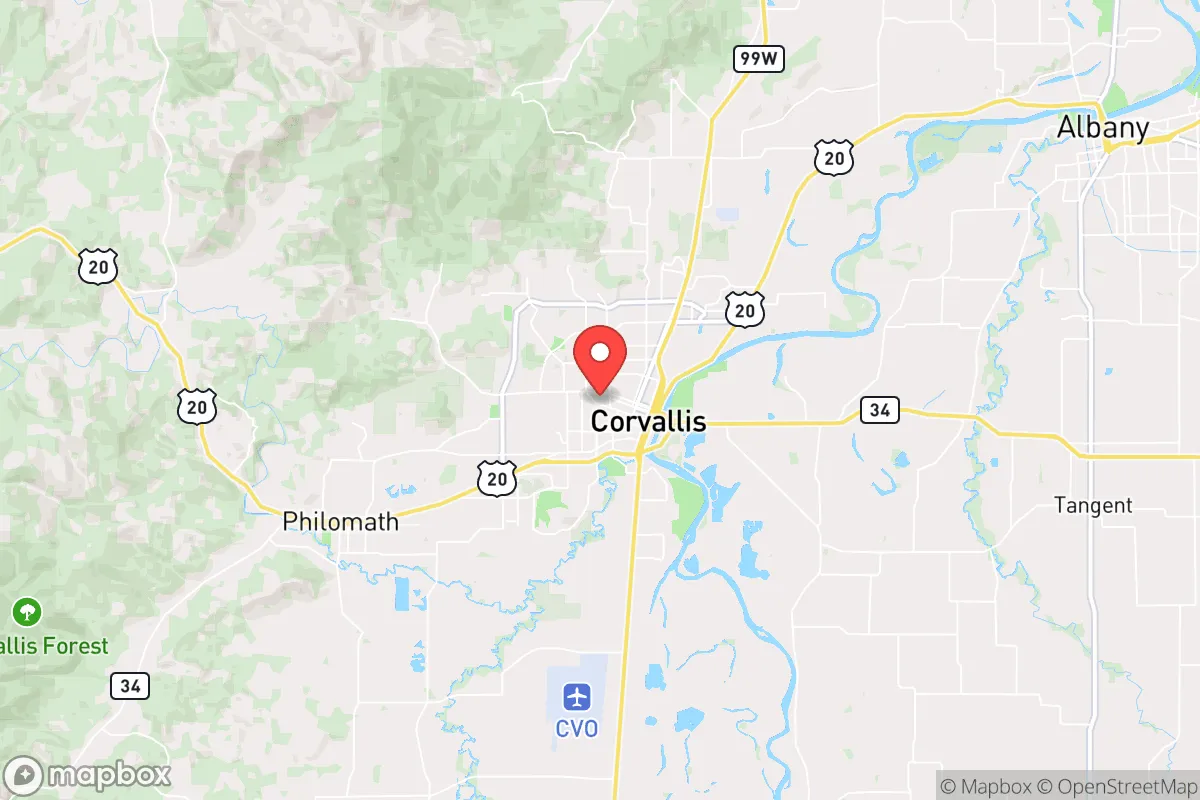
Photo: Wikipedia
Personal Sovereignty in Corvallis, OR
Viable for self-reliance. Generally workable, though some barriers may limit total independence.
What does Personal Sovereignty tell us?
Personal Sovereignty measures your capacity for self-reliance and independence with minimal government friction. Higher scores mean fewer barriers between you and the way you want to live... but it assumes you have the space you need and good neighbors.
What does this tell us?
Personal Sovereignty measures your capacity for self-reliance and independence with minimal government friction. Higher scores mean fewer barriers between you and the way you want to live... but it assumes you have the space you need and good neighbors.
State Policy
Energy independence: Importer (35% of energy produced in-state)
Personal Liberty
Homesteading

Personal Liberty Analysis
Corvallis, Oregon presents a mixed picture for personal sovereignty, where state-level policies often override local autonomy in ways that matter deeply to those prioritizing independence. While the city itself leans progressive and regulatory, Oregon's constitutional protections for self-defense and property rights provide a meaningful counterbalance that residents can leverage. For a relocation-minded individual or family weighing freedom against community structure, Corvallis offers a constrained but not hostile environment—one where state preemption on firearms and land-use laws creates a baseline of liberty that local ordinances cannot easily erode.
Tax burden and regulatory posture in Corvallis
Oregon's tax structure is a significant factor for sovereignty-minded residents. The state has no sales tax, which gives individuals more control over their spending and reduces the regressive tax burden on daily purchases. However, this is offset by a state income tax that ranges from 4.75% to 9.9%, among the highest in the nation, and property taxes in Benton County average around 1.0% of assessed value—moderate by national standards but notable given the lack of a sales tax offset. Corvallis itself does not levy a city income tax, but its regulatory posture is decidedly interventionist. The city enforces strict urban growth boundaries (UGBs) under Oregon's statewide land-use planning system, which limits where and how property can be developed. This means building a new home or adding a detached structure on your land requires navigating state-mandated zoning and city permitting processes that can take months. For those seeking to minimize government interaction, this regulatory density is a clear friction point. Business licensing and home occupation rules are also enforced, so running a small repair shop or cottage food operation from a residence requires formal approval. The overall environment is one where the state collects heavily through income tax while the city controls land use tightly—a combination that rewards those who can work within the system but frustrates those who prefer minimal oversight.
Self-defense and gun law specifics in Corvallis
Oregon is a shall-issue state for concealed handgun licenses (CHL), meaning that as long as you meet basic criteria—age 21 or older, no disqualifying criminal history, completion of a safety course—the county sheriff must issue the permit. Benton County processes CHL applications efficiently, with typical turnaround under 30 days. This is a strong point for personal sovereignty: the right to carry a concealed firearm is not subject to local discretion or political whims. Open carry is legal without a permit in most areas of Oregon, including Corvallis, though it is restricted in public buildings and schools. The state does have a red flag law (Extreme Risk Protection Order) that allows law enforcement or family members to petition a court to temporarily remove firearms from an individual deemed a risk. This law is actively used in Benton County, which has a reputation for progressive judicial application. Magazine capacity is not restricted at the state level, and there is no state-level assault weapons ban, though local ordinances in Corvallis do not add further restrictions due to state preemption. For the sovereignty-minded, the key takeaway is that Oregon's preemption statute prevents Corvallis from enacting its own gun control measures, so the city's progressive lean does not translate into local firearm restrictions. However, the red flag law and a generally pro-enforcement culture in the county mean that self-defense rights are exercised with more scrutiny than in states like Idaho or Texas.
Self-reliance and homesteading viability in Corvallis
Homesteading and off-grid living face significant structural barriers in Corvallis due to Oregon's land-use framework. The city's zoning code requires minimum lot sizes of 5,000 to 7,000 square feet in most residential zones, which allows for substantial gardens and small livestock like chickens (hens only, no roosters) but prohibits larger animals like goats or pigs without special permits. Off-grid systems such as solar panels with battery storage are permitted, but connecting to the municipal power grid is mandatory for new construction in most areas—meaning full energy independence is not legally achievable within city limits. Rainwater collection is allowed for non-potable uses, but well drilling is restricted to rural parcels. For those seeking true self-reliance, the path leads to unincorporated Benton County, where parcels of 5 to 20 acres are available within 15–20 minutes of Corvallis, and zoning is less restrictive. There, you can install septic systems, drill wells, and keep livestock without city oversight. However, even in rural areas, Oregon's Statewide Planning Goal 3 (Agricultural Lands) restricts residential development on high-value farmland, so buyers must verify that a parcel is zoned for rural residential use. Composting toilets and graywater systems are legal but require county health department permits. The overall assessment: Corvallis itself is not a homesteading-friendly city, but the surrounding rural areas offer viable options for those willing to commute and navigate state-level permitting.
Personal liberties in Corvallis: parental rights, medical autonomy, speech, and property
Parental rights in Oregon are moderately protected. The state does not have a specific parental rights statute like Florida or Texas, but parents retain authority over their children's education, medical decisions, and religious upbringing under common law. Corvallis public schools follow state-mandated curriculum, which includes comprehensive sex education and social-emotional learning standards—a point of contention for some conservative families. Homeschooling is legal with minimal regulation: parents must register with the local Education Service District and provide annual assessments, but there is no curriculum approval or home inspection requirement. Medical autonomy is more constrained. Oregon has no parental consent requirement for minors to receive reproductive health services, including contraception and abortion, which may concern families who want oversight of their children's healthcare. Vaccine mandates for school attendance are enforced, though medical and religious exemptions are available (philosophical exemptions were eliminated in 2019). Free speech is protected under the Oregon and U.S. Constitutions, and Corvallis has no local ordinances restricting public expression beyond standard time-place-manner rules. Property rights are limited by the urban growth boundary, which effectively caps land value appreciation and restricts development options. Eminent domain is used sparingly, but the state's land-use system means that what you can do with your property is heavily regulated from the outset. For the sovereignty-minded, the balance is clear: personal liberties in speech and family decisions are reasonably robust, but medical autonomy for minors and property rights are notably constrained compared to states with less regulatory frameworks.
Overall, Corvallis offers a sovereignty profile that is strong on self-defense rights and free expression but weak on tax burden, property autonomy, and off-grid feasibility. Compared to cities in Idaho or Texas, the regulatory overhead is higher and the tax bite deeper. Compared to Portland or Eugene, however, Corvallis is more manageable—smaller government footprint, faster permitting, and a more engaged community that respects individual choices within the existing framework. For a conservative-leaning individual or family, the key decision is whether the city's amenities (Oregon State University, strong job market, outdoor access) outweigh the constraints on independence. If self-reliance is the top priority, rural Benton County or neighboring Linn County offers a better fit. If a balanced life with moderate freedoms and strong community institutions is acceptable, Corvallis can work—provided you are willing to engage with the system rather than fight it.

* Values derived from national, state, county, city and local statistics and may differ in a specific area. Last updated: 2026-06-13T19:02:48.000Z
Narrative content on this page is AI-generated and may contain mistakes. Verify any details that matter before acting on them.
ReloMaps may earn a commission from affiliate links at no extra cost to you.

