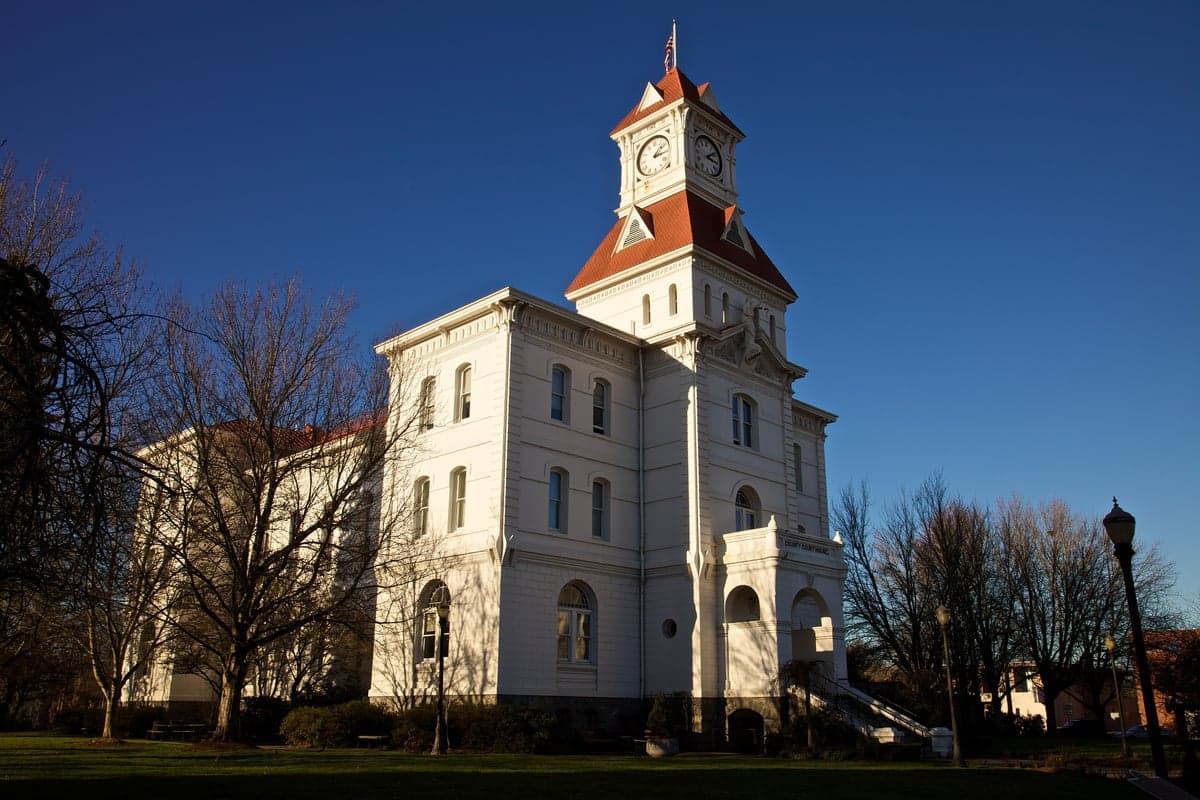
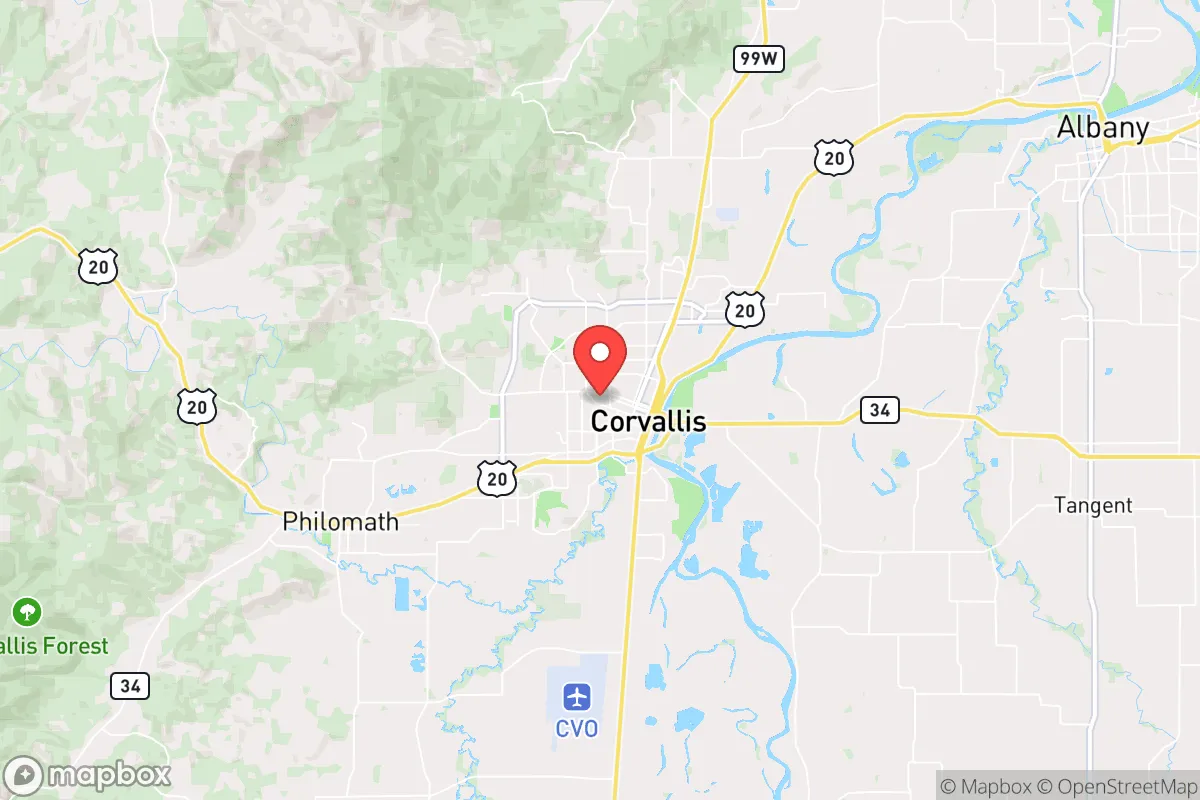
Photo: Wikipedia
Demographics of Corvallis, OR
Affluence Level in Corvallis, OR
A middle-class area roughly in line with national averages across income, home values, education, and employment.
People of Corvallis, OR
The people of Corvallis, Oregon, today number 60,424, forming a college town that is notably more educated and less diverse than the state average. With 60.9% of adults holding a bachelor's degree or higher, the population is overwhelmingly white (73.5%), with the largest minority groups being Hispanic (9.7%) and East/Southeast Asian (7.8%). The city's identity is shaped by Oregon State University's gravitational pull, creating a transient student population that overlays a stable, professional class of university staff, healthcare workers, and tech employees.
How the city was settled and grew
Corvallis was founded in 1845 by Joseph Avery, who built a cabin on the Willamette River. The Donation Land Claim Act of 1850 drew white settlers from the Midwest and Upper South, who established farms in what is now the College Hill and Central Park neighborhoods. The arrival of the Oregon & California Railroad in 1870 spurred growth, and the establishment of Oregon State University (then Corvallis College) in 1868 created a steady demand for faculty and support staff. The original population was almost entirely white, with a small number of Chinese laborers working on railroad construction and later in laundries and canneries. By 1900, the city had about 1,800 residents, with the Northwest Corvallis neighborhood emerging as a working-class area for mill and railroad workers. The 1920s and 1930s saw modest growth from Dust Bowl migrants, who settled in the South Corvallis area near the lumber mills.
Modern era (post-1965)
The Hart-Cellar Immigration Act of 1965 opened the door for new populations. The most significant post-1965 influx has been East/Southeast Asian immigrants, primarily Chinese, Korean, and Vietnamese, drawn to graduate programs and research positions at Oregon State University. These communities concentrated in the University District and College Hill neighborhoods, near campus. The Hispanic population grew more slowly, largely from agricultural labor in the surrounding Willamette Valley, with families settling in the South Corvallis and Highland neighborhoods. The Indian subcontinent population (1.4%) arrived later, mostly in the 1990s and 2000s, as tech and engineering hires at OSU and local firms like Hewlett-Packard (now part of HP Inc.). Domestic in-migration has been dominated by white professionals from California and other West Coast states, drawn by the university and the region's quality of life. This group has dispersed across the city, but particularly into the Northwest Corvallis and South Corvallis subdivisions built since the 1980s. The foreign-born share of 8.9% is below the national average of 13.7%, reflecting the city's relatively low immigration-driven diversity compared to larger Oregon cities like Portland.
The future
Corvallis's population is projected to grow slowly, around 0.5-1% annually, constrained by limited housing supply and strict urban growth boundaries. The population is becoming slightly more diverse, driven by continued international graduate student enrollment at OSU and Hispanic family formation. The East/Southeast Asian share is likely to increase modestly as OSU recruits more students from China and South Korea, while the Indian subcontinent population may grow faster due to tech sector hiring. The white share is declining gradually, from about 80% in 2000 to 73.5% today, but remains dominant. New residential development is concentrated in the South Corvallis and Highland areas, where newer subdivisions are absorbing younger families and professionals. The cultural identity is evolving from a classic college town into a more diverse, tech-adjacent community, though the university's liberal lean and the city's high cost of living (median home price ~$550,000) may limit how much the demographic profile shifts.
For someone moving to Corvallis now, the city offers a stable, highly educated environment with a strong university anchor. The population is becoming more diverse but remains predominantly white and professional, with a growing East/Southeast Asian and Hispanic presence concentrated near campus and in newer subdivisions. The next decade will likely see continued slow growth, modest diversification, and a persistent gap between the transient student population and the settled professional class.

* Values derived from national, state, county, city and local statistics and may differ in a specific area. Last updated: 2026-06-13T19:02:48.000Z
Narrative content on this page is AI-generated and may contain mistakes. Verify any details that matter before acting on them.
ReloMaps may earn a commission from affiliate links at no extra cost to you.

