Political ClimatePolitical Climate in Greater Bridgeport Planning Region County
Showing state-level results — no local-only data available.
Local Political AnalysisPolitical Analysis of Greater Bridgeport Planning Region County
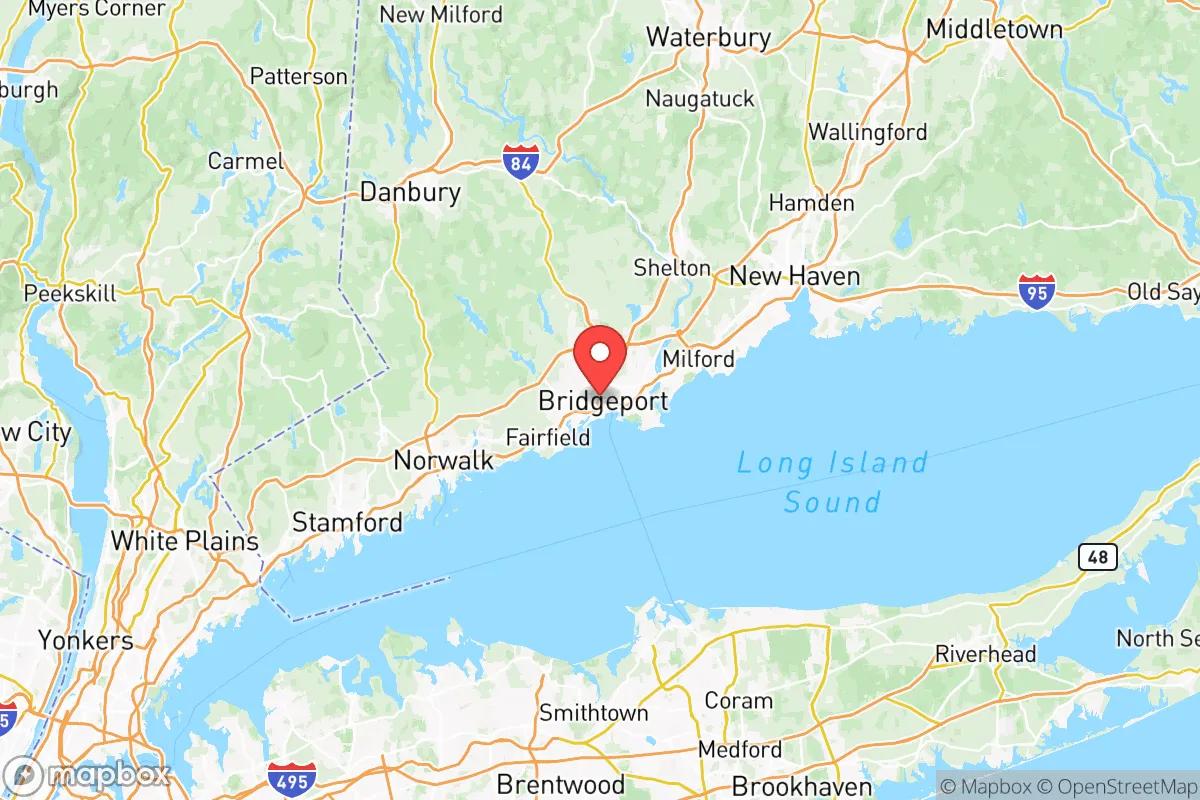
The Greater Bridgeport Planning Region leans solidly Democratic, with a Cook PVI estimated around D+12 to D+15, making it significantly more liberal than Connecticut's statewide D+8 average. This isn't a new development—the area has been a Democratic stronghold for decades, but the margin has widened noticeably since the 2016 election. The region's political identity is driven by its dense, diverse urban core and a growing suburban-liberal vote in towns like Fairfield and Trumbull, though you'll still find pockets of reliable Republican turnout in places like Monroe and parts of Shelton.
How it compares
Compared to Connecticut as a whole, Greater Bridgeport is roughly 5-7 points more Democratic on a typical ballot. The statewide D+8 PVI already puts Connecticut among the bluest states, but this region pulls even harder left. Bridgeport itself is the anchor—a majority-minority city where Democrats routinely win 75-80% of the vote. Stratford and Milford are more competitive, with Milford often serving as the region's bellwether: it voted for Biden by about 8 points in 2020, closely mirroring the statewide margin. Monroe, by contrast, is the most reliably Republican town in the county, typically voting 55-60% for GOP candidates. Fairfield has shifted left over the past decade, moving from a swing town to a solidly Democratic one, driven by educated professionals and commuters to New York City. Shelton is a mixed bag—its more rural western half leans red, while the downtown and newer developments trend blue.
What this means for residents
For liberal residents, the political climate is generally comfortable. Democratic candidates are a given for most local offices, and progressive policies on housing, transit, and environmental regulation tend to advance without major opposition. Bridgeport and Stratford have active progressive organizing scenes, and Fairfield's town government has pushed zoning reforms and sustainability initiatives. For conservative residents, the picture is more mixed. You can still find representation in Monroe and parts of Shelton, but statewide and county-level races are usually non-competitive. That said, local school board and town council races in the more moderate suburbs often see genuine two-party competition, especially in Milford and Stratford. The practical effect is that conservative voices are heard on local issues like taxes, development, and school curriculum, but have limited influence on regional policy.
Culturally, the region's political lean shows up in visible ways. Bridgeport's city government has been a testing ground for progressive policies like rent stabilization and community policing reforms. Fairfield's town meetings regularly debate affordable housing mandates and climate action plans. The contrast with Monroe is stark—there, the political culture is more libertarian-leaning, with lower taxes, fewer regulations, and a vocal property rights movement. What unites the region is a shared economic dependence on the New York metro area and a pragmatic focus on transportation infrastructure, from Metro-North service to the ongoing I-95 congestion debates. The political divide here isn't about whether government should act, but how much and at what level—a distinction that plays out in every town council meeting and ballot box across the county.

State Political ClimatePolitical Climate in Connecticut
State Political AnalysisPolitical Environment in the State
Connecticut is a reliably Democratic state with a Cook PVI of D+8, meaning it votes about eight points more Democratic than the national average in presidential elections. Over the past 20 years, the state has shifted leftward, driven by the growing dominance of its wealthy, educated suburbs and the consolidation of Democratic power in its urban centers, while its rural and exurban areas have become more Republican. For a conservative relocator, this means living in a state where state-level politics are firmly controlled by Democrats, but where local political realities vary dramatically depending on where you put down roots.
Urban vs. rural divide
The political map of Connecticut is a classic story of three distinct regions. The southwestern corner, anchored by Stamford, Greenwich, and Norwalk, is the engine of the state's Democratic lean. These are wealthy, highly educated commuter towns feeding into New York City, and they vote overwhelmingly blue — Fairfield County as a whole gave Biden over 60% of the vote in 2020. The state's other major cities — Hartford, New Haven, and Bridgeport — are deep blue, with Democratic margins exceeding 70-80% in many precincts. In contrast, the eastern half of the state, particularly Windham County and parts of New London County, is more conservative. Towns like Killingly and Plainfield vote Republican by wide margins, and the rural Litchfield Hills in the northwest also lean red. The suburbs around Hartford and New Haven are the true battlegrounds — places like Glastonbury and West Hartford have trended Democratic, while more exurban towns like Southington and Wallingford remain competitive but lean slightly right. The net effect is a state where Democrats win statewide races by comfortable margins, but Republicans hold about a third of the state legislative seats and occasionally flip a congressional district.
Policy environment
Connecticut's policy environment is shaped by its status as a high-cost, high-tax state with a strong regulatory framework. The state has a progressive income tax with rates up to 6.99%, and property taxes are among the highest in the nation — the effective rate averages around 2.1% of home value, though this varies wildly by town. There is no sales tax on most groceries and clothing under $50, but the general rate is 6.35%. The state has a strong regulatory posture on environmental and labor issues, with a $15.69 minimum wage (indexed to inflation) and paid family and medical leave. Education policy is dominated by the state's powerful teachers' unions, and Connecticut consistently ranks near the top nationally for K-12 outcomes, though with massive disparities between wealthy suburbs and poor cities. On healthcare, the state runs its own exchange (Access Health CT) and has expanded Medicaid. Election laws are relatively liberal: no-excuse absentee voting was made permanent in 2023, and early voting was implemented starting in 2024. Voter registration is same-day and online. For a conservative relocator, the tax burden and regulatory climate are the most immediate practical concerns.
Recent policy direction
Connecticut's recent legislative sessions have pushed the state further left on a range of issues that matter to relocators weighing personal liberties. On gun and self-defense law, the state already had some of the strictest laws in the nation — an assault weapons ban, universal background checks, and a permit-to-purchase system — and in 2023 it added a ban on open carry of firearms and raised the minimum purchase age to 21. On parental and education rights, the state has moved in the opposite direction from many red states: it passed a law in 2022 requiring schools to adopt policies supporting transgender students, including allowing them to use preferred names and pronouns without parental consent in some circumstances. On speech and privacy, Connecticut has strong data privacy laws (the Connecticut Data Privacy Act took effect in 2023) and protects abortion access as a statutory right, with a 2022 law expanding the types of providers who can perform abortions and protecting out-of-state patients. Property rights are constrained by the state's strict land use regulations, which contribute to high housing costs. On voting and ballot access, the trend has been toward expansion: early voting, no-excuse absentee ballots, and automatic voter registration are all now law. For a conservative relocator, the cumulative effect is a state that has moved decisively toward a progressive model of governance on nearly every front.
Civil unrest & political movements
Connecticut is not a state known for dramatic political flashpoints, but there have been notable tensions. The 2020 Black Lives Matter protests in New Haven and Hartford were large but largely peaceful. More recently, the most visible political movements have been around education and local governance. In Killingly, a conservative town in the northeast, a prolonged controversy over school library books and LGBTQ+ materials drew national attention in 2022-2023, with the school board eventually being taken over by the state. Immigration politics are relatively low-key compared to border states, but Connecticut is a sanctuary state — a 2013 law (the Trust Act) limits local police cooperation with federal immigration enforcement, and a 2024 law further restricts ICE detainers. There has been no serious secession or nullification rhetoric. Election integrity controversies have been minimal; the state's vote-by-mail expansion was implemented without major incident. The most visible political divide a new resident might notice is the stark contrast between the liberal, cosmopolitan culture of the I-95 corridor and the more traditional, small-town ethos of eastern Connecticut.
Projection
Over the next 5-10 years, Connecticut's political trajectory is likely to remain stable, with a slight further leftward drift. The state's population is aging and slowly declining, but the areas that are growing — the southwestern suburbs and the Hartford-New Haven corridor — are also the most Democratic. In-migration from New York City has accelerated since the pandemic, and these newcomers tend to be younger, wealthier, and more liberal. The rural and exurban areas that vote Republican are losing population. This demographic math suggests that the state's D+8 lean could become D+10 or D+12 by the early 2030s. However, there is a wild card: the state's high cost of living and tax burden could eventually drive out the moderate, business-friendly Democrats who have historically kept the state from going full California. If that happens, the remaining electorate could become even more polarized. For a conservative moving in now, the realistic expectation is that state-level politics will remain under unified Democratic control for the foreseeable future, with Republican influence confined to local offices in certain towns and the occasional competitive state legislative district.
For a conservative relocator, the bottom line is that Connecticut offers a high quality of life in many respects — excellent schools, low crime in most suburbs, beautiful natural scenery, and proximity to New York and Boston — but it comes with a political environment that is firmly and increasingly progressive. You will find like-minded neighbors in towns like Southington, Wallingford, Killingly, or the Litchfield Hills, but you will be living under state laws and tax policies that reflect a Democratic majority. If your priority is living in a state where your vote for president or governor has a realistic chance of affecting the outcome, Connecticut is not that place. If you can accept that trade-off for the practical benefits of the state, you can build a good life here — just know what you're signing up for.
* Values derived from national, state, county, city and local statistics and may differ in a specific area. Last updated: 2026-06-29T12:22:02.000Z
Narrative content on this page is AI-generated and may contain mistakes. Verify any details that matter before acting on them.
ReloMaps may earn a commission from affiliate links at no extra cost to you.

