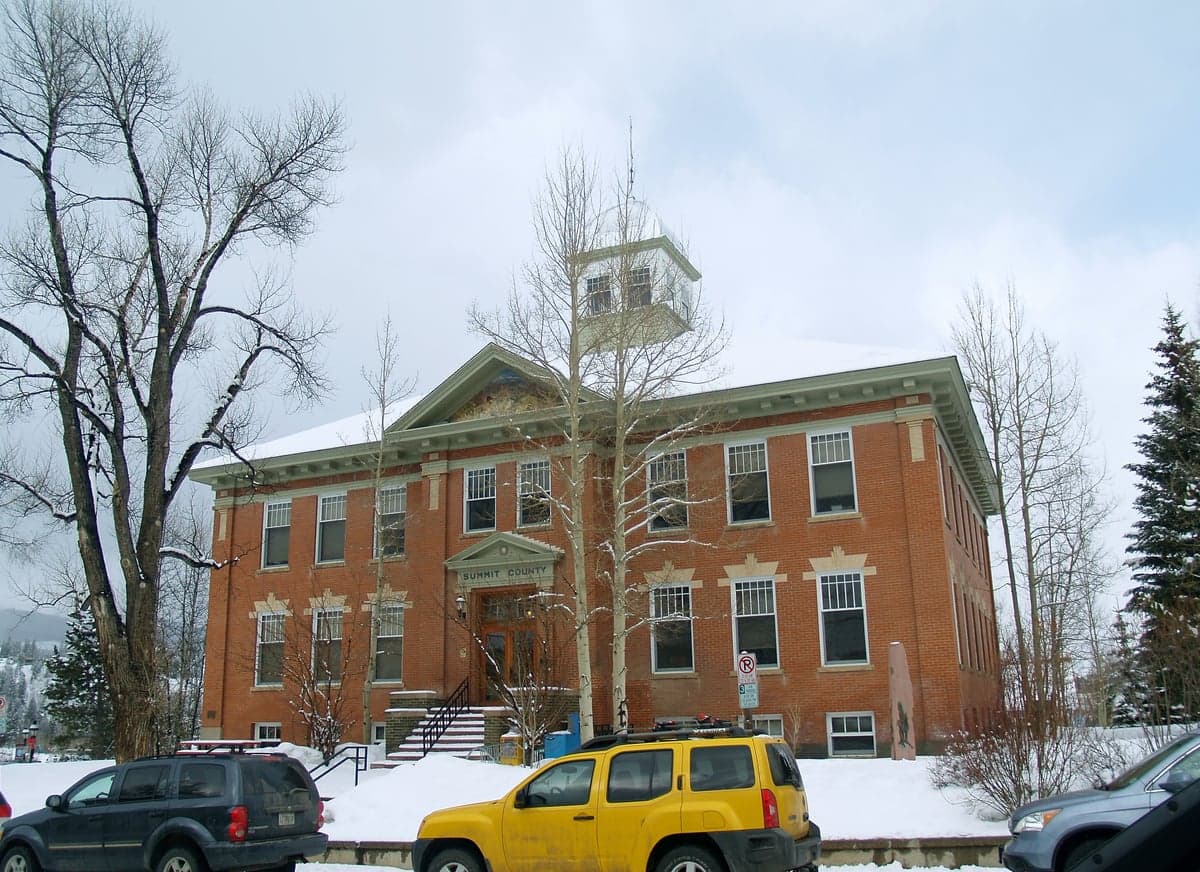
Photo: Wikipedia
Political ClimatePolitical Climate in Summit County
Showing district-level results — no local-only data available.
Local Political AnalysisPolitical Analysis of Summit County
Summit County is one of the most reliably Democratic counties in Colorado, with a Cook Partisan Voting Index (PVI) of D+20 — meaning it votes about 20 points more Democratic than the national average. That’s a full 14 points bluer than Colorado as a whole, which sits at D+6. The shift has been steady over the past two decades, driven largely by an influx of out-of-state transplants, particularly from California and the Northeast, who have reshaped the electorate in the I-70 corridor. While the county was once a swing area where a moderate Republican could win a local seat, those days are effectively over: in 2024, Kamala Harris carried Summit County by roughly 35 points, and no Republican has won a countywide office since 2016.
How it compares
The political geography within Summit County is more nuanced than the countywide numbers suggest. Breckenridge and Silverthorne are the deepest blue, with precincts routinely hitting 70-75% Democratic turnout. Frisco is close behind, though its year-round resident base is slightly more moderate than the vacation-homeowner vote. Dillon leans blue but has a handful of swing precincts near the marina and the older subdivisions. The real outlier is Blue River, a small town south of Breckenridge, where registered Republicans outnumber Democrats — it’s the only municipality in the county where a GOP candidate can expect a competitive race. Keystone and Copper Mountain are harder to pin down because their populations are so transient, but the permanent residents in those areas tend to lean left. Compared to the rest of Colorado, Summit County is significantly more liberal than the Front Range suburbs (Jefferson County is D+4) and light-years from the Eastern Plains or Western Slope counties like Mesa (R+15) or El Paso (R+12).
What this means for residents
For liberal residents, the political climate is comfortable and affirming. Local government is reliably progressive on environmental policy, housing initiatives, and social services. The county has some of the strictest short-term rental regulations in the state, a robust affordable housing trust fund, and a county commission that openly prioritizes climate resilience. For conservative residents, the reality is more isolating. There is no organized local GOP infrastructure to speak of — the Summit County Republican Party has struggled to field candidates for county commission or school board races in recent cycles. That said, conservatives are not actively marginalized; they just have to accept that their votes rarely carry a local election. Many long-time conservative locals have adapted by focusing on state-level races or simply disengaging from local politics entirely. The practical effect is that policy debates in Summit County tend to start from a progressive baseline, with the conversation being about how far left to go, not whether to go left at all.
Culturally, the political lean manifests in everyday life in ways that go beyond voting. Summit County was one of the first counties in Colorado to adopt a plastic bag ban and has a countywide goal of 100% renewable electricity by 2035. The local school district, Summit School District, has a strong DEI program and offers gender-inclusive restrooms in all schools — policies that would be controversial in many other parts of the state but barely register as a topic of debate here. The biggest cultural friction point is not between left and right, but between full-time residents and second-home owners, who often push for lower taxes and fewer regulations. That tension cuts across party lines and is probably the most consequential political dynamic in the county today. Looking ahead, expect Summit County to stay D+20 or even drift further left as housing costs continue to push out moderate-leaning working-class families and attract wealthier, more progressive newcomers.

State Political ClimatePolitical Climate in Colorado
State Political AnalysisPolitical Environment in the State
Colorado has shifted from a classic purple swing state to a solidly blue-leaning one, carrying a Cook PVI of D+6 that reflects nearly two decades of Democratic gains in the Denver metro and Front Range suburbs. The state voted for the Democratic presidential candidate in every election since 2008, and both U.S. Senate seats and the governorship have been held by Democrats since 2019. But that top-line number masks a deeply divided state: the rural eastern plains, Western Slope, and southern counties remain reliably Republican, while the population centers of Denver, Boulder, and the I-25 corridor drive the blue tilt. For a conservative relocator, the reality is that Colorado’s state-level politics are now firmly center-left, but local control varies dramatically depending on where you land.
Urban vs. rural divide
The political map of Colorado is essentially a tale of two states. The Denver metro area — including Denver County (D+29), Adams County (D+15), and Jefferson County (D+9) — delivers the lion’s share of Democratic votes. Boulder County is the state’s most liberal stronghold, with a PVI around D+30. The I-25 corridor from Fort Collins down through Colorado Springs is more mixed: Larimer County (Fort Collins) leans Democratic, while El Paso County (Colorado Springs) remains a conservative anchor, voting R+15 in 2024. The rural eastern plains — counties like Yuma, Kit Carson, and Prowers — routinely vote 70-80% Republican. The Western Slope, including Mesa County (Grand Junction) and Montrose County, is also reliably red, though resort counties like Pitkin (Aspen) and Summit (Breckenridge) are deep blue. The key takeaway: if you move to Colorado Springs or Grand Junction, you’ll experience a conservative local culture; if you settle in Denver or Boulder, you’ll be in a progressive urban environment. The state’s political trajectory is driven by population growth in the blue metros, not by rural voters flipping.
Policy environment
Colorado’s state-level policy is shaped by a progressive majority in the legislature and a Democratic governor, Jared Polis, who is more moderate on business issues than many in his party. The state has a flat income tax rate of 4.4% (set by the Taxpayer’s Bill of Rights, or TABOR, which requires voter approval for tax increases). Sales taxes vary widely by locality, from around 2.9% in some rural areas to over 8% in Denver. Property taxes are relatively low compared to the national average, but recent legislation (SB24-233) increased property tax rates for schools, which will hit homeowners. On education, Colorado has a school choice system with charter schools and open enrollment, but funding per pupil remains below the national average. Healthcare policy includes a state-based insurance exchange and Medicaid expansion under the Affordable Care Act. Election laws are among the most accessible in the country: universal mail-in ballots, same-day voter registration, and automatic voter registration at the DMV. For conservatives, the regulatory environment is mixed — business-friendly on some fronts (low corporate income tax, no inventory tax) but heavy on environmental and labor regulations, including a paid family leave program (FAMLI) that took effect in 2024.
Recent policy direction
Colorado’s recent legislative sessions have pushed the state further left on several fronts that matter to relocators weighing personal liberties. On gun policy, the state passed a ban on “ghost guns” (HB24-1349) and raised the minimum age to purchase any firearm to 21 (HB24-1174), both signed in 2024. A 2023 law (SB23-169) expanded the state’s red flag law, allowing law enforcement to petition for temporary firearm removal. On parental and education rights, the state passed a law (HB24-1036) requiring school districts to adopt policies on parental notification of student health changes, but it was weaker than similar laws in other states. A 2023 law (SB23-276) banned book bans in public libraries, a flashpoint for conservative parents. On medical and bodily autonomy, Colorado codified abortion rights into state law in 2022 (HB22-1279) and passed a law protecting providers and patients from out-of-state lawsuits (SB24-188). On property rights, the state has tightened oil and gas regulations (SB24-159) and expanded renewable energy mandates, which can affect rural landowners. On voting and ballot access, Colorado’s mail-in ballot system remains popular and secure, but conservatives have raised concerns about ballot harvesting and the lack of voter ID requirements for mail ballots (in-person voting does require ID). The overall direction is toward more regulation on guns, more protections for reproductive rights, and a continued push on climate and energy policy.
Civil unrest & political movements
Colorado has seen its share of political flashpoints. The 2020 protests in Denver over George Floyd’s death were large and occasionally violent, leading to property damage and a lasting debate over policing. The state has a strong activist presence on both sides: Indivisible and progressive groups are well-organized in Denver and Boulder, while conservative groups like the Colorado Republican Party and local 2A organizations are active in Colorado Springs and the Western Slope. Immigration politics are a live issue: Denver has been a sanctuary city since 2017, and the state passed a law (HB24-1108) limiting cooperation between local law enforcement and federal immigration authorities. In 2023-2024, Denver saw a surge of migrant arrivals from the southern border, straining city resources and fueling political tension. Election integrity controversies have been muted compared to other states, but some rural counties have passed resolutions calling for election audits. Secession rhetoric has surfaced occasionally — the “51st state” movement in Weld County and the eastern plains — but it remains fringe. A new resident in Denver will see visible homelessness and periodic protests; in Colorado Springs, the political culture is more visibly conservative, with military and evangelical influences prominent.
Projection
Over the next 5-10 years, Colorado’s political trajectory points further blue, driven by continued in-migration from blue states (California, Illinois, New York) and the natural growth of the Denver metro. The 2024 election results showed Democrats holding the governorship and both Senate seats, and the state’s PVI is unlikely to shift rightward given demographic trends. However, the rural-urban divide will deepen: expect more progressive policies from the state legislature (further gun restrictions, expanded renewable energy mandates, potential single-payer healthcare studies) and more resistance from rural counties, which may push for local control measures. For a conservative relocator, the practical reality is that Colorado will not become a red state in the foreseeable future. The best you can hope for is a moderate governor (Polis is term-limited in 2026) and a legislature that doesn’t go too far on taxes or business regulation. If you’re moving to Colorado Springs, Grand Junction, or a rural county, your local government will reflect your values, but you’ll still be subject to state-level laws on guns, taxes, and education that you may disagree with.
For a new resident, the bottom line is this: Colorado offers a high quality of life with outdoor amenities, a strong economy, and relatively low taxes compared to other blue states, but the state government is firmly Democratic and trending left. If you’re a conservative who can tolerate a blue state government in exchange for local control in a red county, Colorado can work well. If you want a state where your vote consistently wins at the state level, you’ll want to look at Wyoming or Texas instead. The key is choosing your county carefully — and understanding that state-level politics will continue to shift left regardless of where you live.
* Values derived from national, state, county, city and local statistics and may differ in a specific area. Last updated: 2026-06-24T23:01:55.000Z
Narrative content on this page is AI-generated and may contain mistakes. Verify any details that matter before acting on them.
ReloMaps may earn a commission from affiliate links at no extra cost to you.

