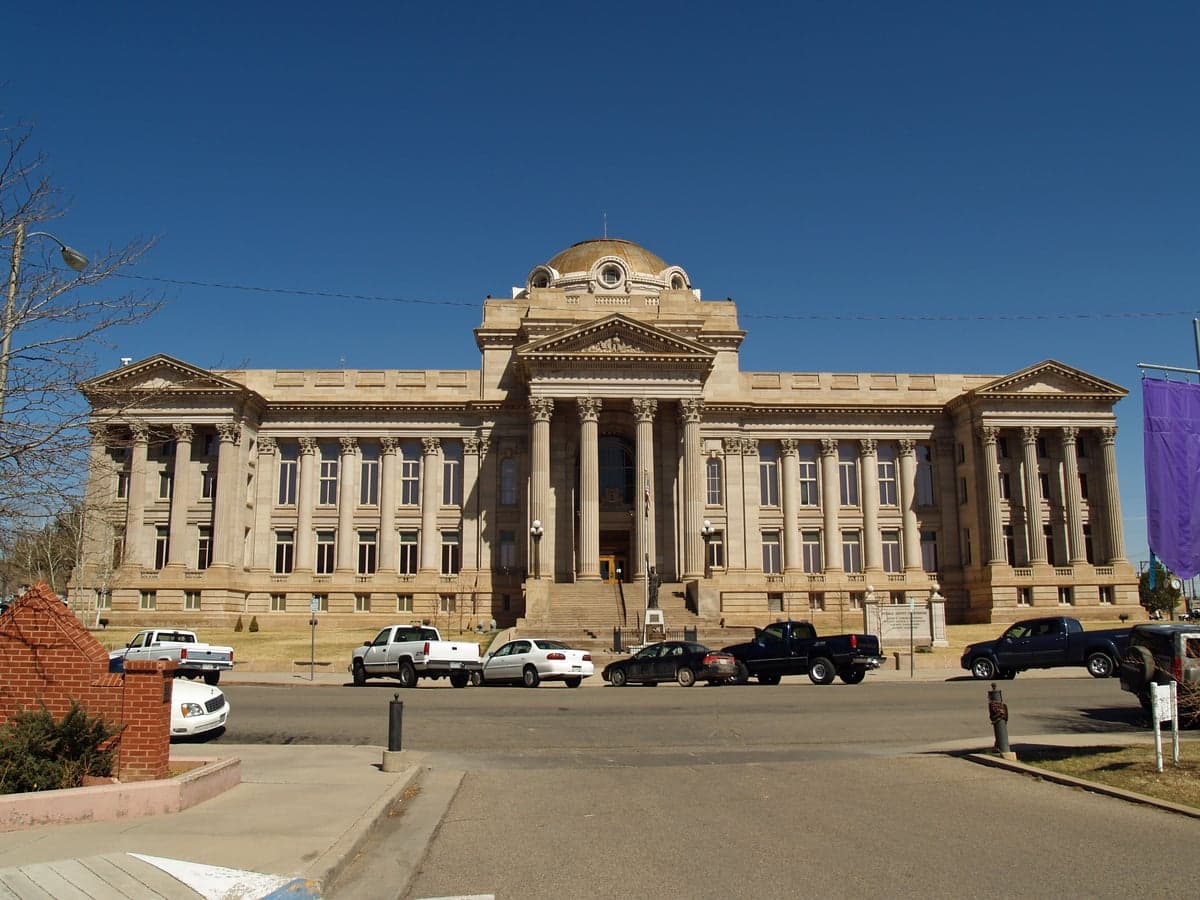
Photo: Wikipedia
Political ClimatePolitical Climate in Pueblo County
Showing district-level results — no local-only data available.
Local Political AnalysisPolitical Analysis of Pueblo County
Pueblo County is a genuine political battleground in Colorado, a blue dot in a sea of red on the state's southern front. While the county carries a Cook PVI of R+5, meaning it leans about five points more Republican than the nation as a whole, it's far from a lock for either party. This is a place where a Democrat can win a countywide race one year and a Republican can flip it the next, making it one of the most watched swing counties in the state. The real story, though, is how that countywide number masks a deep internal divide between the city of Pueblo and its surrounding towns.
How it compares
The contrast with the rest of Colorado is stark. The state as a whole has a Cook PVI of D+6, a solidly blue lean driven by the Denver-Boulder corridor and mountain resort towns. Pueblo County's R+5 rating puts it a full 11 points to the right of the state's average. That gap isn't just a statistic; it's the reason Pueblo is often the deciding factor in close statewide races. A Democrat running for governor or Senate can't win Colorado without running up the score in Denver, but they also can't afford to lose Pueblo by too much. Conversely, a Republican hoping to flip a statewide seat knows that a strong performance in Pueblo County is the only way to offset the massive Democratic margins in the Front Range. Within the county itself, the city of Pueblo leans reliably Democratic, with precincts near the historic Union Avenue District and the Colorado State University Pueblo campus often going +15 to +20 for Democrats. Drive 15 minutes east to Pueblo West, and you'll find a reliably Republican stronghold where margins can hit +25 for the GOP. The swing precincts are in the unincorporated areas and smaller towns like Avondale and Boone, where economic anxiety and cultural conservatism often pull voters in both directions.
What this means for residents
For conservative residents, Pueblo County offers a rare chance to feel politically relevant in a state that's otherwise trending blue. You can attend a county commission meeting and see your values reflected in policy, especially on land use, water rights, and Second Amendment issues. The county's Republican-leaning sheriff's office is a source of pride for many, and local GOP candidates often run competitive races. For liberal residents, the dynamic is more challenging but not hopeless. You can win city council seats and mayoral races in Pueblo proper, and you'll find a strong community of activists focused on labor rights, environmental justice, and affordable housing. The key for both sides is that Pueblo County rewards coalition-building. A candidate who can bridge the urban-rural divide—talking about jobs at the steel mill in town and water rights in Pueblo West—can win here. The county's political identity is still very much tied to the working-class legacy of the CF&I Steel Mill, which means economic populism often trumps pure partisanship.
Culturally, Pueblo County stands apart from the rest of Colorado. You won't find the same level of transplant-driven growth or tech-industry influence that defines the Front Range. Instead, the political conversation is grounded in local issues: the health of the Arkansas River, the future of the historic steel mill site, and the balance between agricultural water rights and municipal growth. The county's large Hispanic population, which makes up nearly half of the city of Pueblo, adds a unique layer to the politics, often creating a more moderate, family-values-oriented Democratic base than what you'd see in Denver. For anyone moving here, the takeaway is simple: your vote will matter more in Pueblo County than almost anywhere else in Colorado. Whether you're a conservative looking for a foothold or a liberal hoping to hold the line, this is a place where local elections feel genuinely consequential.

State Political ClimatePolitical Climate in Colorado
State Political AnalysisPolitical Environment in the State
Colorado has shifted from a quintessential purple swing state to a solidly blue one over the past two decades, now carrying a Cook PVI of D+6. The Democratic coalition is anchored by the Denver-Aurora-Lakewood metroplex, Boulder, and the resort towns of the central Rockies, while the Eastern Plains, Western Slope, and southern Colorado remain reliably Republican. This isn't a state that flips back and forth anymore — it's a state where Democrats control every lever of state government, and the conservative minority has been forced to adapt to a policy environment that moves leftward with each legislative session.
Urban vs. rural divide
The political map of Colorado is a story of two starkly different Colorados. The Front Range urban corridor — Denver, Boulder, Aurora, Lakewood, and Fort Collins — generates the vast majority of the state's population and votes overwhelmingly Democratic. Denver County routinely delivers 80%+ of its vote to Democratic presidential candidates. Boulder County is even more lopsided, often exceeding 75% Democratic. These metros are the engine of the state's D+6 lean. Meanwhile, the Eastern Plains counties like Yuma, Kit Carson, and Cheyenne vote 80%+ Republican, as do Western Slope counties like Mesa (Grand Junction) and Montrose. The suburban ring around Denver — Jefferson County, Arapahoe County, and Douglas County — tells the real story of Colorado's shift. Jefferson County, once a classic bellwether, has trended blue over the last decade. Douglas County, historically the conservative stronghold of the south metro, has moved from deep red to light red, and its southern precincts near Colorado Springs are now the only reliably Republican parts of the Front Range. Colorado Springs (El Paso County) remains the last major red city in the state, home to the Air Force Academy and a heavy military and evangelical presence, but even there, the city proper has been inching toward purple as younger residents move in.
Policy environment
Colorado's policy environment is defined by a moderate-to-liberal tax structure paired with aggressive regulatory and social policy. The state has a flat income tax rate of 4.4% (down from 4.55% after a 2024 ballot measure) and a state sales tax of 2.9%, though local jurisdictions pile on significantly — Denver's combined rate is around 8.8%. Property taxes are relatively low by national standards, thanks to the Gallagher Amendment (repealed in 2020) that historically capped residential property tax growth. The TABOR (Taxpayer Bill of Rights) amendment still constrains state spending growth and requires voter approval for tax increases, which has kept Colorado from becoming as high-tax as neighboring blue states. On the regulatory side, Colorado has some of the nation's strictest environmental and energy regulations, including a mandate for 100% renewable electricity by 2040. The state has fully legalized recreational marijuana, has a robust renewable energy economy, and has expanded Medicaid under the Affordable Care Act. Election law is among the most accessible in the country — universal mail-in voting has been in place since 2013, same-day registration is available, and ballots are automatically sent to all active registered voters.
Recent policy direction
The last five years have seen Colorado's legislature move aggressively on a broad front. On gun policy, the state passed a 2023 law raising the minimum age to purchase any firearm to 21, enacted a three-day waiting period for all gun purchases, and in 2024 passed a law banning so-called "assault weapons" (though enforcement is currently tied up in litigation). Self-defense law remains relatively strong — Colorado is a "make my day" state with a Castle Doctrine statute, but there is no permitless carry, and the state has a red flag law (Extreme Risk Protection Orders) that allows family members or law enforcement to petition for temporary firearm removal. On education and parental rights, the state has moved left: a 2023 law requires schools to allow transgender students to use facilities matching their gender identity, and a 2024 law prohibits school boards from banning books based on "controversial" content. Medical and bodily autonomy is fully protected — Colorado codified abortion rights into state law in 2022 and passed a 2024 constitutional amendment enshrining abortion access, with no gestational limits. Property rights have been a flashpoint: the state's 2021 "land use" reform bill preempted local zoning to allow higher-density housing near transit, which conservatives and some suburban homeowners opposed as a loss of local control. Voting and ballot access continues to expand — automatic voter registration at the DMV, same-day registration, and mail-in ballots for all. On privacy and surveillance, Colorado passed one of the nation's strongest data privacy laws (the Colorado Privacy Act) in 2021, giving residents the right to opt out of data collection and request deletion of personal data. The state also legalized psilocybin therapy in 2022 via ballot measure, though regulated access is still being rolled out.
Civil unrest & political movements
Colorado has seen its share of political turbulence. The 2020 protests in Denver over George Floyd's murder were among the largest in the country relative to population, with several nights of property damage and a prolonged encampment at the state capitol. The Denver Police Department faced heavy criticism and subsequent reform legislation, including a 2020 law banning chokeholds and requiring body cameras. On the right, the Colorado Republican Party has become increasingly factionalized between establishment and populist wings, with the state party itself endorsing primary challengers against incumbent Republicans it deems insufficiently conservative. El Paso County (Colorado Springs) has been a center of conservative activism, including a 2023 push to explore secession from the state — the "State of Jefferson" movement has some traction in rural counties, though it remains a fringe effort. Immigration politics are a growing flashpoint: Denver has declared itself a sanctuary city, and the state passed a 2023 law limiting cooperation between local law enforcement and federal immigration authorities. The influx of migrants bused from Texas in 2023-2024 strained Denver's shelter system and became a major political issue, with the city spending over $60 million on migrant services. Election integrity remains a live issue: Colorado's mail-in voting system is widely considered secure and has bipartisan support at the administrative level, but a 2022 controversy over a county clerk in Mesa County who was indicted for allegedly allowing unauthorized access to voting machines has kept the issue in the news. The Colorado Secretary of State's office has aggressively pursued election security measures, including mandatory risk-limiting audits after every election.
Projection
Over the next 5-10 years, Colorado is likely to continue its leftward drift, but at a slower pace than the 2010-2020 period. The state's population growth has slowed from its 2010s boom, and the in-migration that drove the blue shift — young professionals, remote workers, and retirees from California and Texas — is tapering. The Denver metro will continue to dominate state politics, and the suburbs will keep trending blue as older conservative homeowners are replaced by younger, more diverse buyers. The Western Slope and Eastern Plains will remain deeply red, but their political influence will continue to shrink as the Front Range grows. The Colorado Republican Party faces a structural challenge: it has not won a statewide election since 2014, and its base is increasingly concentrated in shrinking rural areas. The most likely scenario is a continued Democratic trifecta, with policy moving left on housing, energy, and social issues, but constrained by TABOR's spending limits and the state's moderate tax structure. A major wild card is the 2026 gubernatorial election — if Democrats nominate a far-left candidate, a moderate Republican could potentially win, but that would be an exception to the trend, not a reversal of it.
For a new resident, the bottom line is this: Colorado is a blue state where a conservative can live comfortably but will have limited political influence. The tax burden is moderate, the outdoor lifestyle is world-class, and the economy is diversified and resilient. But if you're moving here expecting a purple state where your vote will regularly decide elections, that Colorado no longer exists. The practical reality is that state policy will continue to move left on guns, education, and social issues, while the state's fiscal conservatism (thanks to TABOR) provides a brake on tax increases. If you're a conservative who values low taxes, outdoor recreation, and a relatively business-friendly environment, Colorado can still work — just don't expect to win many political battles. If you're a liberal, you'll find a state that largely aligns with your values, with the caveat that the cost of living — especially housing in the Front Range — is high and getting higher.
* Values derived from national, state, county, city and local statistics and may differ in a specific area. Last updated: 2026-07-28T18:02:54.000Z
Narrative content on this page is AI-generated and may contain mistakes. Verify any details that matter before acting on them.
ReloMaps may earn a commission from affiliate links at no extra cost to you.

