
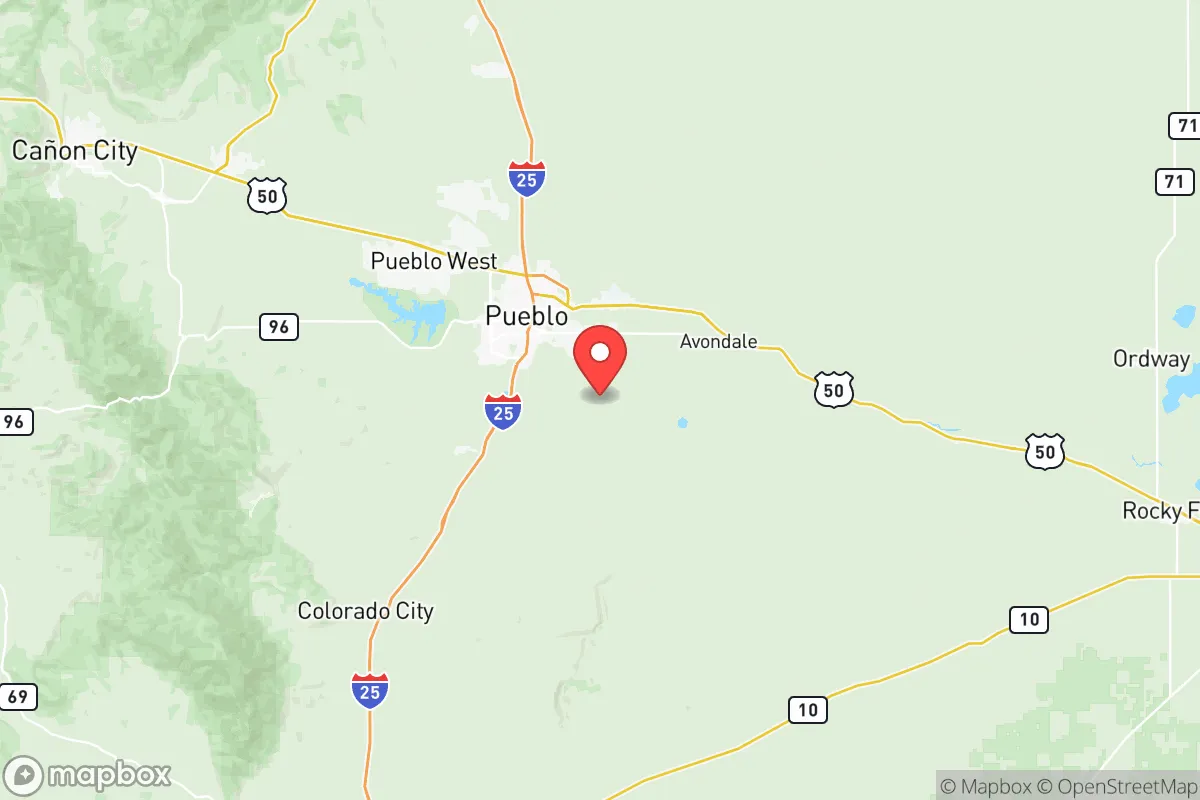
Photo: Wikipedia
Quality of Life in Pueblo County
A livable area that tracks near national norms for affordability, walkability, and neighborhood health.
What does Quality of Life tell us?
Quality of Life measures an area by evaluating factors like cost of living, nearby amenities, country club access, airport proximity, socioeconomic signals and neighborhood character. For large states, this is a general average — quality of life can vary dramatically between metro areas, suburbs, and rural communities within the same state.
What does this tell us?
Quality of Life measures an area by evaluating factors like cost of living, nearby amenities, country club access, airport proximity, socioeconomic signals and neighborhood character. For large states, this is a general average — quality of life can vary dramatically between metro areas, suburbs, and rural communities within the same state.
Cost of Living
7% below national average
80%
The Real Cost of Living in Pueblo County for 2026
| Tier | Individual | Family (4) |
|---|---|---|
| Survival | $17k | $32k |
| Comfortable | $53k | $78k |
| Luxury | $111k+ | $171k+ |
| Elite (Top 5%) | $130k+ | $202k+ |
Quality-of-Life Analysis
Pueblo County offers a broad spectrum of living environments, from the urban core of its largest city to quiet agricultural hamlets and high-mountain subdivisions, attracting everyone from industrial workers and college students to retirees seeking affordable land and outdoor enthusiasts. The county’s character shifts dramatically over its 2,398 square miles, with the Arkansas River valley hosting the densest development while the southern and western reaches open into ranchland and the foothills of the Wet Mountains. This range means a household’s daily experience — commute length, school size, access to groceries, and even political leanings — can vary significantly depending on which part of the county they choose.
Largest town(s) & population centers
Pueblo is the county seat and by far the dominant population center, home to roughly 113,000 of the county’s 170,000 residents. Daily life here revolves around a modest downtown anchored by the Historic Arkansas Riverwalk (HARP), Colorado State University Pueblo, and a mix of manufacturing and logistics employers including Vestas (wind turbine blades) and the Evraz steel mill. The city offers the widest array of amenities in the county — two hospitals, a regional airport, multiple grocery chains, and a walkable core with local restaurants and breweries. Pueblo West, an unincorporated master-planned community of about 30,000 residents just west of the city, functions as a suburban extension with larger lots, newer homes, and a more car-dependent layout centered on McCulloch Boulevard. Together, Pueblo and Pueblo West concentrate the county’s rental stock, retail, and entertainment options, making them the default choice for renters and families who want proximity to jobs and services.
Smaller towns & rural pockets
Beyond the main population corridor, several distinct communities offer a quieter pace. Beulah, a small unincorporated village in the Wet Mountains at roughly 6,400 feet elevation, is a popular weekend destination with forested homes, a general store, and easy access to San Isabel National Forest hiking trails — a stark contrast to the semi-arid plains around Pueblo. Rye, a few miles east of Beulah, is a tiny census-designated place (pop. ~200) that serves as a gateway to the mountains, with a mix of year-round residents and vacation cabins. On the eastern plains, Avondale and Boone are agricultural communities centered on the Arkansas River’s fertile bottomland, where residents tend to work in farming, feedlots, or commute into Pueblo for employment. Colorado City, straddling the Pueblo-Huerfano county line, is a low-cost unincorporated area with a mix of manufactured homes and older single-family houses, attracting retirees and workers willing to drive 25–30 minutes into Pueblo. These smaller towns lack the retail density of the main population centers — residents typically drive to Pueblo for groceries, medical care, and schooling — but offer lower land prices and a stronger sense of isolation.
Cost & lifestyle range
The county’s cost of living index of 93 (100 = U.S. average) masks significant internal variation. At the lower end, Colorado City and parts of east Pueblo have median home values well below the countywide figure of $271,800, with some older homes and manufactured units available under $200,000. Median rent countywide is $1,059, but rents in Pueblo’s older neighborhoods and in Avondale can dip below $900 for a two-bedroom unit. At the higher end, Pueblo West and the Beulah/Rye mountain corridor command premiums: newer Pueblo West homes on acre lots often exceed $400,000, while Beulah’s forested properties with mountain views can reach $500,000–$700,000. The average commute of 22 minutes reflects the county’s compact geography — most residents work within Pueblo or Pueblo West, while those in Beulah or Colorado City face longer drives of 30–40 minutes each way. Amenity access follows the same gradient: Pueblo offers full-service hospitals, a university, and entertainment venues, while rural residents trade those conveniences for space, privacy, and direct access to outdoor recreation.
The county works best for households that value affordability and are flexible about trade-offs. Budget-conscious families and first-time homebuyers find the most attainable prices in Pueblo’s east side or Colorado City. Remote workers and retirees who prioritize land and quiet often choose Beulah or Rye despite the longer drive to services. Industrial and trades workers employed at the steel mill or in logistics gravitate toward Pueblo West for newer housing and short commutes. The county’s diversity of settings — from urban core to mountain hamlet to plains farm town — means most lifestyles can find a fit, provided the household accepts the specific compromises each area demands.

Crime in Pueblo County
Higher crime rates than 57% of comparable U.S. locations.
Violent CrimeViolent Crime Analysis
Property CrimeProperty Crime Analysis
Crime Analysis
Pueblo County, Colorado, experiences a crime rate significantly above both state and national averages, presenting a serious safety concern for current residents and those considering a move to the area. The county's violent crime rate stands at 428.1 incidents per 100,000 residents, while property crime is reported at 2,177.4 per 100,000. These figures place Pueblo County among the more dangerous jurisdictions in Colorado, with the city of Pueblo itself driving the majority of these statistics, while smaller communities like Pueblo West and Beulah Valley offer notably safer alternatives.
Crime in context
When compared to the national average of roughly 380 violent crimes per 100,000, Pueblo County's rate of 428.1 is approximately 13% higher. The gap widens dramatically for property crime, where the county's 2,177.4 rate far exceeds the national average of approximately 1,954 per 100,000. Against Colorado's statewide averages — which are themselves elevated by crime in Denver, Aurora, and Pueblo — the county still underperforms. The city of Pueblo, which contains the vast majority of the county's population, reports even higher localized rates, particularly in its central and east-side neighborhoods. The Pueblo County District Attorney's Office, which operates under a progressive prosecutorial philosophy, has faced criticism for declining to file charges in a significant percentage of property crime cases and for pursuing diversion programs for repeat offenders. This approach, while intended to reduce incarceration rates, has resulted in a perception among residents that property crimes carry minimal consequences, contributing to the area's persistently high theft and burglary numbers.
What residents experience
For those living in Pueblo County, the experience of crime varies sharply by location. Residents of Pueblo West, an unincorporated community west of the city, report far fewer incidents of violent crime and property theft, with many neighborhoods seeing rates comparable to safer Colorado suburbs. Conversely, the East Side and Bessemer neighborhoods of Pueblo city proper experience concentrated poverty and gang activity, driving up the county's overall violent crime statistics. Auto theft is a particular problem countywide, with Pueblo ranking among the top five Colorado counties for vehicle thefts per capita. The Pueblo Police Department has struggled with staffing shortages, leading to slower response times for non-emergency property crimes. Many residents have turned to private security measures — including surveillance cameras, neighborhood watch programs, and personal firearms — as a direct response to the perceived inadequacy of the local justice system. The 10th Judicial District, which covers Pueblo County, has implemented several progressive bail reform policies that critics argue have allowed repeat offenders to return to the streets quickly, further eroding public confidence in the system's ability to protect law-abiding citizens.
Neighborhood-level variation is stark. The safest areas within the county include Beulah Valley, a small mountain community southwest of Pueblo, and the newer developments in South Pueblo West, where crime rates are a fraction of the city's. The most dangerous areas are concentrated in the Downtown Pueblo corridor and the East Side, where violent crime rates can exceed 800 per 100,000. For prospective residents, choosing a home in Pueblo West, Beulah, or the St. Charles Mesa area dramatically reduces the likelihood of becoming a victim of crime, while properties within Pueblo city limits — particularly near the historic district or industrial zones — carry significantly higher risk. The county's overall safety trajectory depends heavily on whether the current progressive judicial policies are maintained or reversed in future elections.
* Values derived from national, state, county, city and local statistics and may differ in a specific area. Last updated: 2026-07-28T18:02:54.000Z
Narrative content on this page is AI-generated and may contain mistakes. Verify any details that matter before acting on them.
ReloMaps may earn a commission from affiliate links at no extra cost to you.

