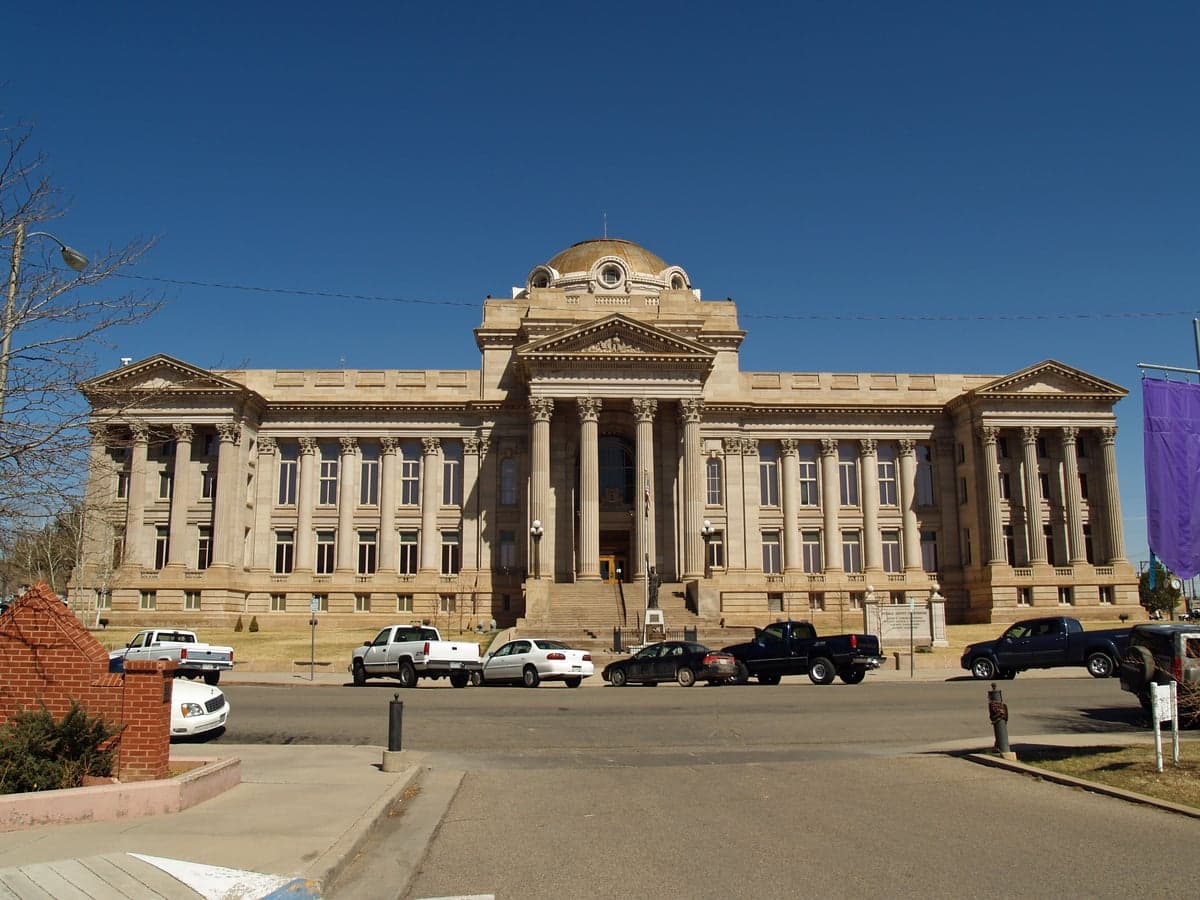
Photo: Wikipedia
Demographics of Pueblo County
Affluence Level in Pueblo County
A middle-class area roughly in line with national averages across income, home values, education, and employment.
People of Pueblo County
Today, Pueblo County is home to 168,726 residents, a population defined by its deep Hispanic heritage and working-class roots. The county is 51.6% White and 42.0% Hispanic, with small Black (1.8%), East/Southeast Asian (0.6%), and Indian subcontinent (0.1%) communities. Only 2.3% of residents are foreign-born, and 25.0% hold a college degree, reflecting a population that is largely native-born, family-oriented, and tied to the region's industrial and agricultural history. Pueblo's identity is distinctly different from Colorado's booming Front Range cities—it is slower-paced, more affordable, and proud of its multi-generational, blue-collar character.
Settlement & growth (pre-1960)
The area now known as Pueblo County was originally inhabited by the Ute, Apache, and Comanche nations, who used the Arkansas River valley for hunting and seasonal camps. Spanish explorers and traders passed through as early as the 16th century, but permanent European settlement began in earnest after the 1848 Treaty of Guadalupe Hidalgo, which transferred the region to U.S. control. The first Anglo-American settlers were largely traders and farmers who established small communities along the Arkansas River, including the original settlement of Pueblo (founded in 1842 as a trading post) and the nearby agricultural hamlets of Avondale and Boone.
The real population boom came with the arrival of the railroad in the 1870s. The Denver and Rio Grande Railway made Pueblo a major rail hub, and the discovery of coal and iron ore in the surrounding foothills spurred heavy industry. The Colorado Fuel and Iron Company (CF&I) built the state's largest steel mill in Pueblo, drawing thousands of immigrant workers. Between 1880 and 1920, waves of immigrants arrived from Italy, Germany, Ireland, and Eastern Europe, settling in neighborhoods like the Bessemer district and the Salt Creek area near the mill. These groups formed tight-knit ethnic enclaves, with Italian and Slavic families dominating the steelworker ranks. At the same time, Hispanic families—many of whom had lived in the region for generations under Spanish and Mexican rule—continued to work in agriculture and railroad maintenance, concentrating in the East Side and South Side of Pueblo and in the farming community of Vineland.
The Dust Bowl and Great Depression of the 1930s brought another wave: Anglo farmers from Oklahoma, Texas, and Kansas—often called "Okies"—migrated west seeking work in Pueblo's mills and farms. They settled in Pueblo West (then open ranchland) and the rural areas around Rye and Colorado City. By 1950, Pueblo County's population had grown to roughly 90,000, with a workforce anchored almost entirely by CF&I steel and the nearby Pueblo Army Depot. The county was heavily White and Hispanic, with a small but established Black community that had grown during World War II as defense jobs opened at the depot.
Modern era (post-1965)
The 1965 Hart-Cellar Act had a limited direct impact on Pueblo County, as the region never became a primary destination for post-1965 immigration. Unlike Denver or Aurora, Pueblo did not see large influxes from Asia, Africa, or Latin America. The foreign-born population remains just 2.3% today, far below the national average. Instead, the major demographic shift since the 1960s has been internal: the steady growth of the Hispanic population through natural increase and continued migration from New Mexico and Texas. Hispanic residents, many of whom trace their roots in the region back centuries, now make up 42.0% of the county, up from roughly 30% in 1980. This growth is concentrated in Pueblo's East Side and South Side neighborhoods, as well as in the unincorporated communities of Salt Creek and Bessemer.
The decline of the steel industry in the 1980s hit Pueblo County hard. CF&I (later Oregon Steel) shed thousands of jobs, and the population stagnated through the 1990s. Many working-age families left for Denver, Colorado Springs, or out of state. Those who stayed were often older, more rooted, or employed in healthcare, education, and government—the sectors that now dominate Pueblo's economy. Suburbanization reshaped the county as well. Pueblo West, a master-planned community founded in the 1960s, grew from a few hundred residents to over 30,000 by 2020, attracting mostly White families seeking larger lots and lower taxes. Meanwhile, the city of Pueblo itself became more Hispanic and more economically diverse, with a growing number of mixed-race and multi-generational households. The Black and East/Southeast Asian communities remain small but stable, concentrated in central Pueblo and near Colorado State University Pueblo.
The future
Pueblo County is projected to grow slowly but steadily over the next two decades, reaching roughly 190,000 by 2040. The Hispanic share of the population will continue to rise, likely approaching 50% by 2035, driven by higher birth rates and continued in-migration from the Southwest. The White population will decline slightly in share but remain the largest single group. The county will remain predominantly native-born, with little change in the foreign-born percentage. New residential development is concentrated in Pueblo West and the St. Charles Mesa area, where new subdivisions are attracting families priced out of Colorado Springs and Denver. The city of Pueblo is seeing modest infill development, particularly near the historic Union Avenue District and the riverfront, but the overall pattern is one of slow, low-density expansion rather than rapid urbanization.
Culturally, Pueblo County is becoming more Hispanic in its public identity—Spanish-language media, Hispanic-owned businesses, and cultural festivals like the Chile & Frijoles Festival are increasingly central to the county's character. At the same time, the county remains politically moderate to conservative, with a strong union legacy and a pragmatic, working-class outlook. The population is aging slightly, but younger families are moving in from more expensive Front Range cities, drawn by Pueblo's lower cost of living and slower pace.
For someone moving in now, Pueblo County offers a stable, family-oriented community with a clear sense of its own history. It is not a place of rapid change or high diversity by national standards, but it is a place where Hispanic and Anglo cultures have coexisted for generations, and where the economy is slowly diversifying beyond its industrial roots. The county's future is one of gradual, organic growth—more Hispanic, more suburban, but still unmistakably Pueblo.

* Values derived from national, state, county, city and local statistics and may differ in a specific area. Last updated: 2026-07-28T18:02:54.000Z
Narrative content on this page is AI-generated and may contain mistakes. Verify any details that matter before acting on them.
ReloMaps may earn a commission from affiliate links at no extra cost to you.

