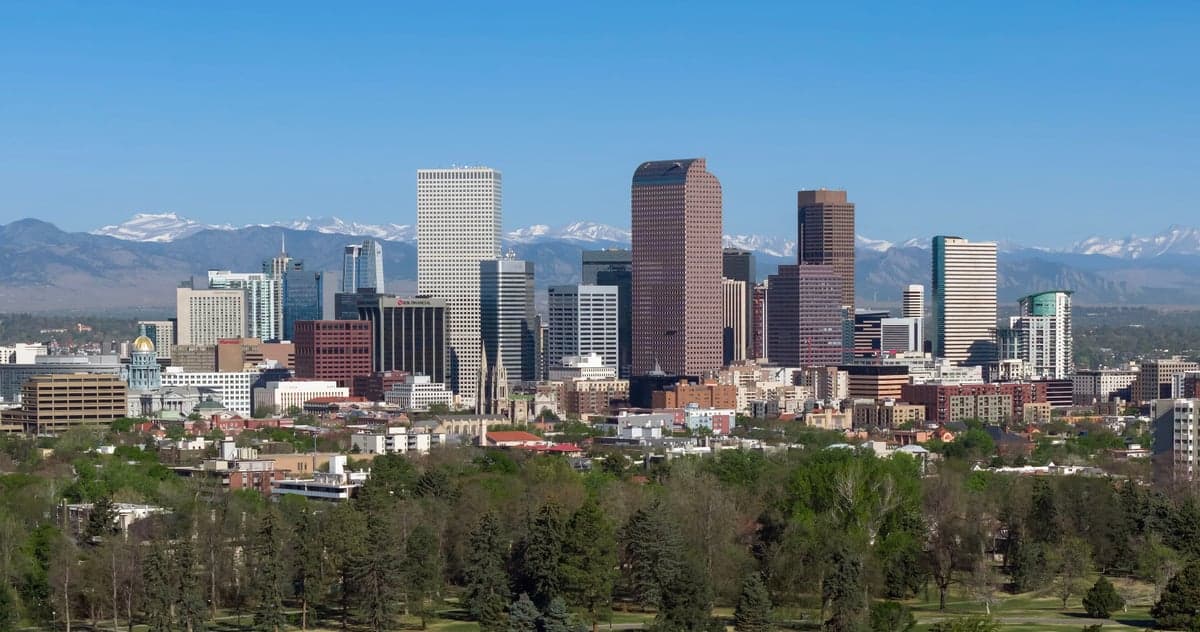
Photo: Wikipedia
Political ClimatePolitical Climate in Denver County
Showing district-level results — no local-only data available.
Local Political AnalysisPolitical Analysis of Denver County
Denver County is one of the most reliably Democratic urban strongholds in the entire country, carrying a Cook Partisan Voting Index (PVI) of D+29. That means the county votes nearly thirty points more Democratic than the national average, a margin that has only widened over the last two decades. While the surrounding state of Colorado as a whole leans Democratic at D+6, Denver County is the engine driving that statewide tilt — without its massive turnout, Colorado would be a true swing state. The shift has been dramatic: as recently as the early 2000s, the county was competitive in some local races, but today, Democratic candidates routinely win by 40-50 point margins in presidential and Senate elections.
How it compares
Denver County’s D+29 PVI places it in the same league as Manhattan (D+30) and San Francisco (D+32), making it far more liberal than the rest of Colorado. For context, neighboring suburban counties like Jefferson (D+5) and Arapahoe (D+6) are much more moderate, while Douglas County to the south leans Republican (R+15). Within Denver County itself, there is meaningful variation. The central neighborhoods — Capitol Hill, Cheesman Park, and the Highlands — are deep blue, often hitting 80-85% Democratic. However, pockets of the far southeast, like the Hampden South neighborhood near the Denver Tech Center, and parts of the Montbello area in the northeast, show more conservative leanings, occasionally voting 40-45% Republican in local races. The swing precincts are almost nonexistent countywide, but the Hampden Heights and Southmoor Park areas near the Arapahoe County line are the closest thing to competitive ground, where a well-funded moderate Republican can sometimes crack 45% in a city council race.
What this means for residents
For liberal residents, Denver County offers a policy environment that aligns closely with their values. The city has enacted strong rent control measures, a universal preschool program, and some of the most progressive zoning reforms in the nation, including the elimination of single-family-only zoning in 2022. Conservative residents, while a clear minority, are not entirely without representation. The Denver City Council has one reliably conservative member — Amanda Sandoval, representing the northwest district — and there is a small but active Republican precinct network in the Hampden and Montbello areas. However, conservatives often find themselves outvoted on issues like police funding, homeless encampment policies, and tax increases. The practical reality is that a conservative family living in Denver will face a city government that is uniformly Democratic, but they can still find community in specific neighborhoods and through local GOP clubs that meet in places like the Hampden Heights Community Center.
Culturally, Denver County stands apart from the rest of Colorado in its embrace of urban density and public transit. While the state is known for its libertarian, outdoor-oriented ethos, Denver proper has become a laboratory for progressive urban policy — from its dedicated sales tax for homeless services to its nation-leading electric scooter and bike lane network. The county’s political trajectory shows no sign of moderating; if anything, the D+29 PVI could drift toward D+32 or higher as younger, more liberal transplants from California and the East Coast continue to move in. For anyone moving here, the key takeaway is simple: Denver County is not just blue, it is deep indigo, and its politics shape everything from the cost of housing to the way your trash is collected.

State Political ClimatePolitical Climate in Colorado
State Political AnalysisPolitical Environment in the State
Colorado has transformed from a quintessential swing state into a reliably Democratic-leaning state, rated D+6 on the Cook Partisan Voting Index as of 2026. This shift has been driven primarily by explosive population growth in the Denver metro area and the Front Range corridor over the last two decades. While the state last voted for a Republican presidential candidate in 2004 (George W. Bush), the margin has widened steadily: Hillary Clinton won by 5 points in 2016, Joe Biden by 13 in 2020, and the trend continues. However, this statewide blue lean masks a deeply divided political geography that makes Colorado feel like two different states depending on where you live.
Urban vs. rural divide
The political battle lines in Colorado are drawn along the I-25 corridor. The Denver-Aurora-Lakewood metropolitan area, home to nearly 60% of the state's population, is the Democratic engine, regularly producing margins of 30-40 points for Democratic candidates. Adjacent Boulder County is the state's bluest stronghold, routinely delivering 70-75% Democratic shares. To the south, Colorado Springs remains the largest conservative bastion in the state, though its influence is waning as the city itself trends purple — El Paso County still votes Republican, but by shrinking margins (down to single digits in recent statewide races). The Western Slope, including Grand Junction and Montrose, is reliably red, while Durango and resort towns like Aspen and Breckenridge have become increasingly liberal as wealthy out-of-state transplants have reshaped their politics. The Eastern Plains — towns like Lamar and Burlington — are deeply conservative, but their small populations have diminishing electoral weight. The 3rd Congressional District, which covers much of the Western Slope and southern Colorado, flipped to Democrat in 2022 after redistricting and remains a competitive toss-up.
Policy environment
Colorado operates under a relatively unique tax structure: the Taxpayer's Bill of Rights (TABOR), passed in 1992, caps state revenue growth and requires voter approval for any tax increases. This has kept Colorado's income tax a flat 4.4%, one of the lowest among states with a broad-based income tax. Property taxes are also relatively low, averaging about 0.5% of assessed value. The regulatory environment leans progressive: the state has strict oil and gas regulations (SB 19-181), a growing electric vehicle mandate, and a renewable energy portfolio standard targeting 100% carbon-free electricity by 2040. On education, Colorado funds its schools largely through local property taxes, leading to significant disparities between wealthy Front Range districts and rural areas. School choice is robust, with charter schools and open enrollment widely available. Election laws are among the most accessible in the nation: universal mail-in ballots, same-day voter registration, and automatic voter registration at the DMV.
Recent policy direction
The last five years have seen a dramatic leftward shift in state policy. On gun and self-defense law, Colorado passed a red flag law (Extreme Risk Protection Order) in 2019, raised the purchasing age for firearms to 21 in 2023, and enacted a 3-day waiting period and universal background checks. Concealed carry permits remain available but local discretion on open carry has tightened in Denver and Boulder. Parental and education rights have been flashpoints: the state passed a law requiring school districts to notify parents of health services offered, but controversy continues over curriculum transparency laws defeated in 2023. Privacy and surveillance protections are relatively strong, with a first-in-the-nation data privacy law (CPA) taking effect in 2023. Medical and bodily autonomy is firmly protected: abortion rights are codified in state law via the Reproductive Health Equity Act (2022), and gender-affirming care for adults is protected. Property rights are circumscribed by stringent land-use regulations, particularly in the Front Range, and a 2024 law limiting oil and gas development near homes. Voting and ballot access continues to expand, with same-day registration and universal mail ballots already in place. A 2023 law restores voting rights to individuals on parole.
Civil unrest & political movements
Colorado has a vigorous protest culture, particularly around environmental and immigration issues. Denver has been a sanctuary city since 2018, and in 2024-2025, the arrival of migrant buses from Texas triggered sustained protests both supporting and opposing sanctuary policies. The 2020 George Floyd protests in Denver were among the largest per capita in the country, leading to a $14 million police reform settlement and ongoing debates over public safety. Right-wing activism is concentrated in Colorado Springs, home to Focus on the Family and a hub for Christian conservative organizing. The 2022 "Take Our Border Back" convoy passed through the state en route to the southern border. Secessionist movements exist but are fringe: the proposed "State of Jefferson" for rural counties in Colorado and New Mexico has garnered attention but no ballot success. Election integrity controversies flared in 2020 and 2022, with rural clerks in Mesa County facing criminal charges for allegedly breaching voting equipment, a case that became a national Rorschach test.
Projection
Over the next 5-10 years, Colorado's blue trend is likely to continue but with potential for a slight moderation. The state's population growth remains among the fastest in the nation, currently around 5.9 million and projected to reach 7 million by 2035. Most new arrivals settle along the Front Range and lean Democratic, but the rising cost of housing — median home prices in Denver exceed $600,000 — is driving some conservative families to more affordable rural areas like the San Luis Valley and the Eastern Plains, which could slightly shift the rural maps. The state's independent voters, now the largest bloc (over 40% of registered voters), increasingly determine outcomes and are trending center-left on cultural issues but fiscally moderate. Expect continued fights over energy policy (oil and gas versus renewables), housing affordability, and immigration. A Republican comeback at the statewide level is possible only if the party can moderate its positions on social issues while presenting a credible economic message in a high-cost state.
For a new resident, the bottom line is straightforward: if you lean conservative, you'll find plenty of ideological kin in Colorado Springs, Grand Junction, and rural areas, but you'll be swimming against the state-level current on most policy issues. If you lean liberal, you'll feel broadly aligned with the state direction, though you'll pay a premium for housing and face increasing congestion. Either way, Colorado's political reality is defined by its geography — the Front Range dominates, and that's not changing anytime soon.
* Values derived from national, state, county, city and local statistics and may differ in a specific area. Last updated: 2026-06-27T15:39:16.000Z
Narrative content on this page is AI-generated and may contain mistakes. Verify any details that matter before acting on them.
ReloMaps may earn a commission from affiliate links at no extra cost to you.

