Photo: Wikipedia
Demographics of Denver County
Affluence Level in Denver County
An upper-middle-class area. Household wealth, education levels, and homeownership run ahead of national benchmarks.
People of Denver County
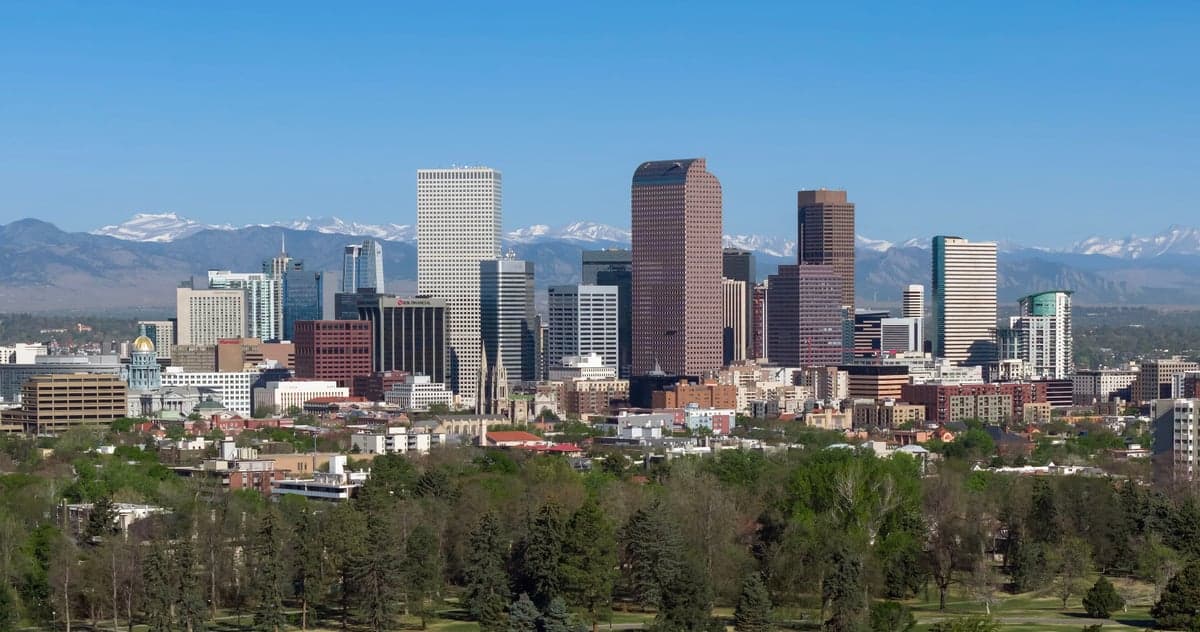
Denver County is the urban heart of the Front Range, a dense, highly educated, and politically moderate-to-liberal core of 713,734 people where the state's power, culture, and economy converge. The county's population is predominantly White (54.6%) with a substantial Hispanic presence (27.9%), a smaller but significant Black community (8.5%), and a growing East/Southeast Asian population (2.9%) alongside a distinct Indian-subcontinent community (0.7%). With 55.6% of adults holding a college degree—one of the highest rates in the Mountain West—Denver County's identity is that of a fast-growing, amenity-rich urban hub that has drawn successive waves of fortune-seekers, from gold rush miners to tech workers.
Settlement & growth (pre-1960)
Denver County lies within the traditional territory of the Arapaho and Cheyenne peoples, who used the confluence of the South Platte River and Cherry Creek as a seasonal camp and trading ground. The county's Euro-American settlement began abruptly during the 1858 Pike's Peak Gold Rush, when placer gold was discovered at the confluence itself. The original settlement of Denver City was founded in November 1858 as a supply hub for mining camps, and it quickly absorbed the rival town of Auraria (on the west bank of Cherry Creek) within a year. By 1860, the population had swelled to roughly 4,700, nearly all Anglo-American fortune-seekers from the Midwest and Upper South, with a sprinkling of German, Irish, and Cornish miners who followed the silver and gold booms deeper into the Rockies.
The railroad's arrival in 1870 transformed Denver from a mining camp into a permanent regional capital. The county became a distribution and processing center for agricultural goods from the surrounding plains and for minerals from the mountains. A significant number of German and Scandinavian immigrants settled in the working-class neighborhoods of North Denver and Globeville, finding work in the smelters, stockyards, and railroads. The 1880s and 1890s saw a second wave: Italian immigrants, largely from southern Italy, clustered in the North Side (around what is now the Highlands neighborhood) and in West Denver along the South Platte, working in the brick yards and on the railroads. The Latino presence in Denver County—originally Spanish-speaking settlers from New Mexico—dates to the 1900-1920 period, when Hispano sheepherders and railroad laborers established a barrio in Five Points and the Sun Valley neighborhood.
The Great Migration brought Black Americans to Denver County from the 1910s through the 1940s, drawn by the promise of industrial work at firms like the Gates Rubber Company and the Denver & Rio Grande Railroad. They concentrated in Five Points, which by the 1920s was known as the "Harlem of the West," a vibrant cultural district with jazz clubs and Black-owned businesses. The Dust Bowl of the 1930s sent a wave of "Okies" and "Arkies"—white tenant farmers from Oklahoma, Arkansas, and Texas—into Denver County's Overland Park and Ruby Hill neighborhoods, where they found work in the meatpacking plants and the construction trades. Federal spending during World War II, including the establishment of Lowry Air Force Base and the Denver Ordnance Plant, supercharged the county's population to 415,796 by 1950, making it the dominant city between St. Louis and the West Coast.
Modern era (post-1965)
The 1965 Hart-Cellar Act reshaped Denver County's demographics by enabling a substantial influx from Latin America and Asia, while domestic migration patterns simultaneously brought new groups from the Rust Belt and the coasts. The Hispanic population, already present for decades, surged after 1970 with arrivals from rural Mexico and Central America; they settled heavily in West Denver, Montbello, and the Alta Vista neighborhood in the county's southwest corner, working in construction, services, and the food industry. The county's Hispanic share climbed from roughly 11% in 1970 to 27.9% by the 2020s, making Latinos the largest minority group.
Post-1965 immigration also brought East/Southeast Asian communities, primarily Vietnamese and Chinese refugees and professionals. Vietnamese refugees arrived after 1975 and later found employment in the hospitality and service sectors, concentrating in the Mile High neighborhoods near Federal Boulevard and in Far Northeast Denver around the old Fitzsimons Army Medical Center site. The East/Southeast Asian population now stands at 2.9% of the county. A smaller but growing Indian-subcontinent community (0.7%) has settled more recently, drawn by the technology and healthcare sectors, with clusters in the Cherry Creek corridor and near the University of Colorado Anschutz Medical Campus in Aurora (just east of the county line).
Domestically, the 1980s and 1990s brought a massive wave of people from California and the Rust Belt—engineers, entrepreneurs, and telecommuters—disproportionately white and college-educated, who reshaped the county's housing market and political character. This cohort fueled the gentrification of Lower Downtown (LoDo), the Highlands, and Washington Park, pushing the county's college-attainment rate above 55%. The Black population, once heavily concentrated in Five Points, has dispersed to the suburbs of Adams and Arapahoe counties; Denver County's Black share declined from a peak of about 12% in 1990 to 8.5% today, reflecting both out-migration of longtime residents and in-migration of whites and Hispanics.
The future
Denver County is projected to continue growing, with the state demographer forecasting a population of roughly 770,000 by 2035, but the growth rate has slowed from the boom years of 2010-2020. The county is becoming more diverse, though the white share (54.6%) remains high relative to other major urban counties in Texas or California. The Hispanic population is expected to increase as a share, driven by natural increase and continued migration from the Southwest, while the East/Southeast Asian and Indian-subcontinent populations will likely grow modestly as the city's tech and bioscience sectors expand.
The most significant demographic trend is the county's increasing educational and economic polarization. The 55.6% college-educated share is one of the highest in the nation, attracting a new wave of professional migrants from coastal cities, but this is placing upward pressure on housing costs and accelerating the displacement of lower-income households—particularly Black and Hispanic families—to the outer suburbs of Adams, Arapahoe, and Douglas counties. The cultural identity of Denver County is shifting from a blue-collar Western city with a laid-back vibe to a sophisticated, high-cost urban center dominated by millennial professionals and empty-nesters; the political orientation has become increasingly Democratic, reflecting the values of the college-educated populace.
For someone moving in now, Denver County offers a dense, walkable urban experience with a vibrant food scene, strong job market, and high spending on parks and transit, but it comes with a price of very high housing costs relative to incomes and a growing sense of economic exclusivity. The county is becoming a place for those who can afford the entry fee—increasingly a mix of well-educated professionals from across the country, alongside a long-established Latino working class—while the city's historic Black and working-class white communities continue to thin out. It is an energetic, forward-looking urban center, but one where the demographic story is increasingly one of winners and losers in a high-cost housing market.

* Values derived from national, state, county, city and local statistics and may differ in a specific area. Last updated: 2026-06-27T15:39:16.000Z
Narrative content on this page is AI-generated and may contain mistakes. Verify any details that matter before acting on them.
ReloMaps may earn a commission from affiliate links at no extra cost to you.

