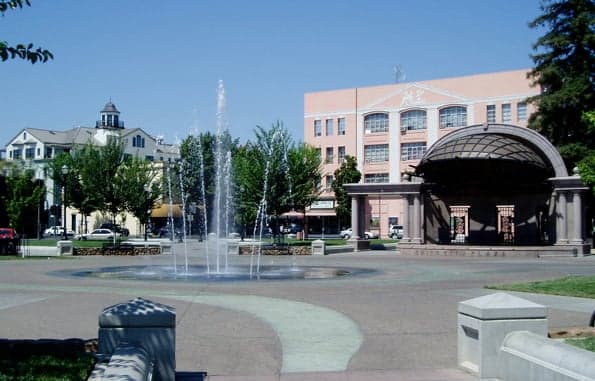
Photo: Wikipedia
Political ClimatePolitical Climate in Chico, CA
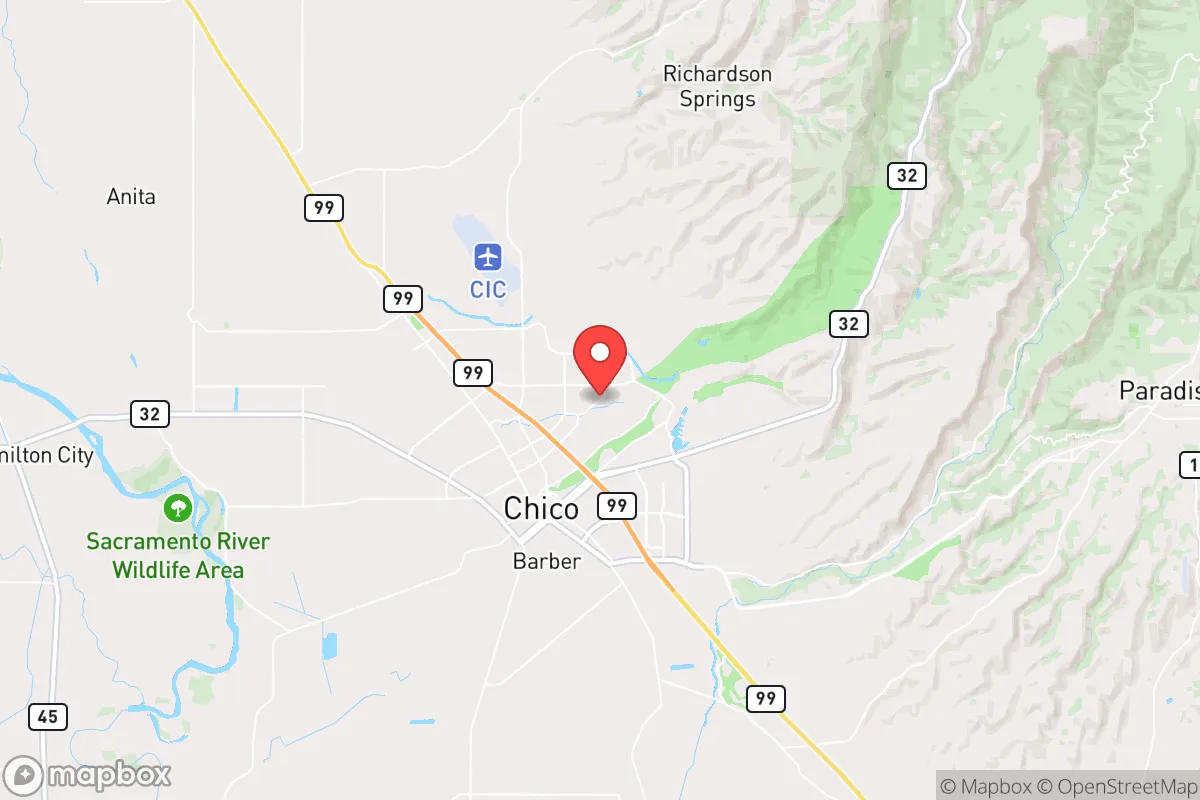
District shown is the primary district for this city’s centroid. Cities may span multiple districts.
Local Political AnalysisPolitical Analysis of Chico, CA
Chico is a genuine political outlier in California, a reliably Republican stronghold in a deep-blue state. The city and its surrounding Butte County carry a Cook Partisan Voting Index (PVI) of R+12, meaning the area votes about 12 percentage points more Republican than the national average. That’s a stark contrast to the state as a whole, which leans Democratic by roughly D+13. This isn’t a new development—Chico has been a conservative anchor in the North State for decades—but the gap has widened in recent cycles as the rest of California has moved left. You can feel it in local elections, where Republicans routinely sweep countywide offices, and in the way national politics plays out in everyday conversation.
How it compares
To understand Chico’s politics, you have to look at the map around it. Drive 20 minutes south to Oroville, and you’ll find an even redder community—working-class, heavily Trump-leaning, with a PVI closer to R+18. Head 30 minutes west to Willows or Orland, and the rural, agricultural character pushes the lean even further right. The real contrast comes when you go south toward Sacramento (about 90 minutes away), where the state capital’s Democratic machine dominates. Within Chico itself, the political divide is visible: the neighborhoods around California State University, Chico and the downtown core lean more liberal, while the sprawling suburbs east of Highway 99 and the rural fringes are deeply conservative. The city council often reflects this split, with a mix of moderate Republicans and progressive Democrats, but the county board of supervisors and the sheriff’s office have been reliably Republican for as long as anyone can remember.
What this means for residents
For conservative residents, Chico feels like a refuge—a place where you can fly a Trump flag without getting side-eye, where the local gun culture is strong, and where property taxes and business regulations are generally less burdensome than in the Bay Area. The Butte County Republican Party is active and well-funded, and local GOP candidates often win by double digits. For liberal residents, it’s a different story. You’ll find plenty of like-minded people near the university and in the downtown arts scene, but you’ll also encounter a vocal conservative majority in county politics. That means progressive policies on housing, environmental regulation, and social services often stall at the county level. The practical effect is that Chico feels more like a small Texas town than a California city—lower density, more pickup trucks, and a general skepticism of Sacramento’s authority.
One cultural distinction that stands out is the area’s strong Second Amendment culture. Gun ownership is common, and open carry is a regular sight at local events. Another is the influence of evangelical Christianity, which shapes local politics more than in most of California. The Chico Christian School and several megachurches are politically active, particularly on issues like abortion and religious freedom. At the same time, the university brings a steady stream of young, progressive voters, which has slowly nudged the city itself toward the center—Chico’s city council has flipped to a Democratic majority in recent years, even as the county remains deep red. Looking ahead, I expect the city to keep trending slightly left as the university grows, but the county will stay Republican for the foreseeable future. The tension between those two forces—campus liberalism and rural conservatism—is what makes Chico’s politics so interesting and, frankly, a bit unpredictable.

State Political ClimatePolitical Climate in California
State Political AnalysisPolitical Environment in the State
California is one of the most reliably Democratic states in the nation, with a partisan lean of roughly D+20 in statewide elections, but that headline number hides a deeply fractured political geography. Over the last 20 years, the state has shifted from a competitive battleground (where Arnold Schwarzenegger won the recall in 2003) to a solidly one-party state, driven by explosive growth in the coastal metros and a simultaneous collapse of Republican registration in the suburbs. For a conservative relocator, the reality is that you are moving into a state where Democrats control every statewide office and hold supermajorities in both legislative chambers, but where your vote still matters intensely at the local level—especially in the Central Valley and inland counties.
Urban vs. rural divide
The political map of California is essentially a story of three distinct regions. The Bay Area and Los Angeles County are the Democratic engine rooms—San Francisco, Oakland, and San Jose routinely vote 80-85% Democratic, and Los Angeles County alone casts more votes than 38 other states. These metros drive the statewide margin, and their policy preferences (dense housing mandates, public transit expansion, and strict environmental regulation) dominate Sacramento. The second region is the Central Valley, anchored by cities like Fresno, Bakersfield, and Modesto, which are the state's conservative heartland. These are agricultural and oil-producing communities where Democrats still hold some local offices but where the presidential margin has swung hard Republican—Kern County (Bakersfield) went +22 for Trump in 2024. The third region is the Inland Empire (Riverside and San Bernardino counties), which is the state's true political battleground. These fast-growing suburbs east of Los Angeles have flipped from reliably Democratic to competitive, with San Bernardino County voting narrowly for Trump in 2024. The coastal counties (Orange, San Diego, Ventura) have moved in the opposite direction—Orange County, once the national symbol of suburban conservatism, has voted Democratic in every presidential election since 2016, with the city of Irvine now electing progressive city councils.
Policy environment
California's policy environment is defined by a few structural realities that affect every resident regardless of party. The state has a progressive income tax with a top marginal rate of 13.3% (the highest in the nation), no property tax reassessment on transfer (thanks to Proposition 13), and a statewide sales tax that averages 8.85% with local add-ons pushing it past 10% in many cities. The regulatory posture is the most interventionist in the country: the California Environmental Quality Act (CEQA) gives citizens broad standing to sue virtually any development, which has made housing construction extremely slow and expensive. Education policy is centralized in Sacramento, with the state imposing curriculum standards and funding formulas that favor urban districts; the state also mandates that all public schools offer free meals and requires ethnic studies courses for high school graduation. Healthcare is heavily regulated, with the state operating its own insurance exchange (Covered California) and imposing individual mandates that predate the federal penalty. Election law is among the most liberal in the nation: all registered voters receive mail-in ballots automatically, same-day voter registration is available, and felons on parole can vote. The state also has a top-two primary system, meaning the two highest vote-getters advance regardless of party, which often results in two Democrats facing off in November in deep-blue districts.
Recent policy direction
The last five years have seen California double down on its progressive trajectory, but with some notable internal tensions. On gun policy, the state has enacted some of the strictest laws in the nation: a 2024 law bans carrying firearms in most public places (currently tied up in federal court), and the state has a 10-day waiting period, an assault weapons ban, and a requirement that all ammunition purchases go through licensed dealers. On education and parental rights, the state has moved the opposite direction from Texas and Florida: a 2024 law prohibits schools from notifying parents if a student changes their gender identity, and the state has banned book bans in school libraries. On property rights, the state has aggressively pursued housing density mandates, requiring cities to plan for millions of new units and stripping local zoning control in favor of state-level approval for accessory dwelling units and multi-family housing near transit. On taxation, the state has not raised income tax rates since 2012, but a 2024 ballot measure to increase the corporate tax rate narrowly failed, suggesting voters are reaching a ceiling. On voting access, the state has expanded mail-in voting and automatic voter registration through the DMV, and it has resisted any voter ID requirements. The most controversial recent law is the California Values Act (SB 54), which prohibits state and local law enforcement from cooperating with federal immigration authorities, making the state a formal sanctuary jurisdiction.
Civil unrest & political movements
California has a long history of political activism that a new resident will notice immediately. The homelessness crisis has become the state's most visible political flashpoint, with encampments in Los Angeles' Skid Row and San Francisco's Tenderloin prompting both progressive "housing first" advocates and conservative "clean up the streets" campaigns. The state has seen organized recall efforts against progressive prosecutors—the successful recall of San Francisco District Attorney Chesa Boudin in 2022 and the failed recall of Los Angeles DA George Gascón in 2024—showing that even in deep-blue cities, voters are pushing back on criminal justice reform. The secession movement (Calexit) remains a fringe effort with no serious political traction, but the state has embraced "nullification" in reverse: it refuses to cooperate with federal immigration enforcement and has sued the federal government over 100 times during the Trump administration. The state has also been a flashpoint for election integrity debates, with Republicans alleging that the universal mail-in ballot system (made permanent in 2021) creates fraud risks, though no significant fraud has been documented. The Central Valley has seen growing conservative activism, with groups like the California Republican Assembly organizing in places like Clovis and Visalia, while the coastal cities have seen progressive grassroots movements pushing for rent control and defunding police.
Projection
Over the next 5-10 years, California's political trajectory is likely to remain solidly Democratic at the statewide level, but the internal dynamics are shifting in ways that matter for new residents. The Inland Empire and Central Valley are growing faster than the coastal metros, and these areas are voting more Republican with each cycle—if current trends hold, the state's Republican vote share could grow from 38% to 42% by 2030, though that still leaves Democrats with a comfortable margin. The more significant shift is demographic: the state's population is aging, the Latino electorate is becoming more conservative on social issues (particularly abortion and LGBTQ curriculum), and the high cost of housing is driving young professionals to Sacramento, Fresno, and Bakersfield, which are more politically moderate than the coast. The state's fiscal situation is the wildcard—a projected $70 billion deficit in 2025 has forced cuts to social programs, and if the state enters a prolonged recession, the progressive coalition could fracture over how to allocate scarce resources. A new resident moving to California in 2026 should expect that in a decade, the state will still be Democratic, but the margin will be narrower, the internal fights between coastal progressives and inland moderates will be sharper, and the state's reputation as a national policy laboratory will continue—for better or worse.
For a conservative family or individual moving to California, the bottom line is this: you will be in a political minority at the state level, and you should expect state policy to continue moving left on guns, education, and immigration. But the state is not monolithic—choosing to live in Bakersfield, Clovis, or Temecula will give you a community where your values are shared, your local government is responsive, and your state representatives are likely Republican. For a liberal relocator, California offers the most aligned policy environment in the nation, but you will pay for it in taxes and cost of living, and you will find that even in the bluest cities, voters are increasingly skeptical of the progressive status quo on crime and homelessness. The practical takeaway: California rewards those who understand its regional differences and punishes those who assume the entire state is like San Francisco.
* Values derived from national, state, county, city and local statistics and may differ in a specific area. Last updated: 2026-10-30T23:50:37.000Z
Narrative content on this page is AI-generated and may contain mistakes. Verify any details that matter before acting on them.
ReloMaps may earn a commission from affiliate links at no extra cost to you.

