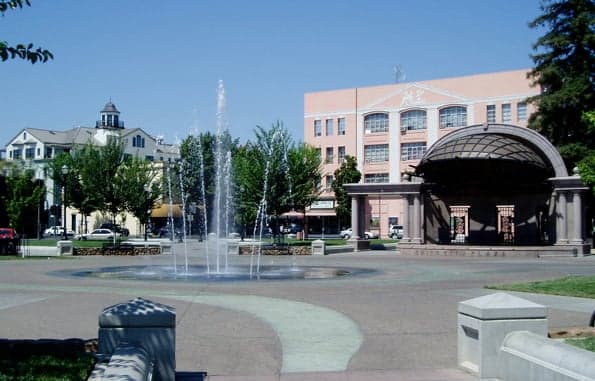
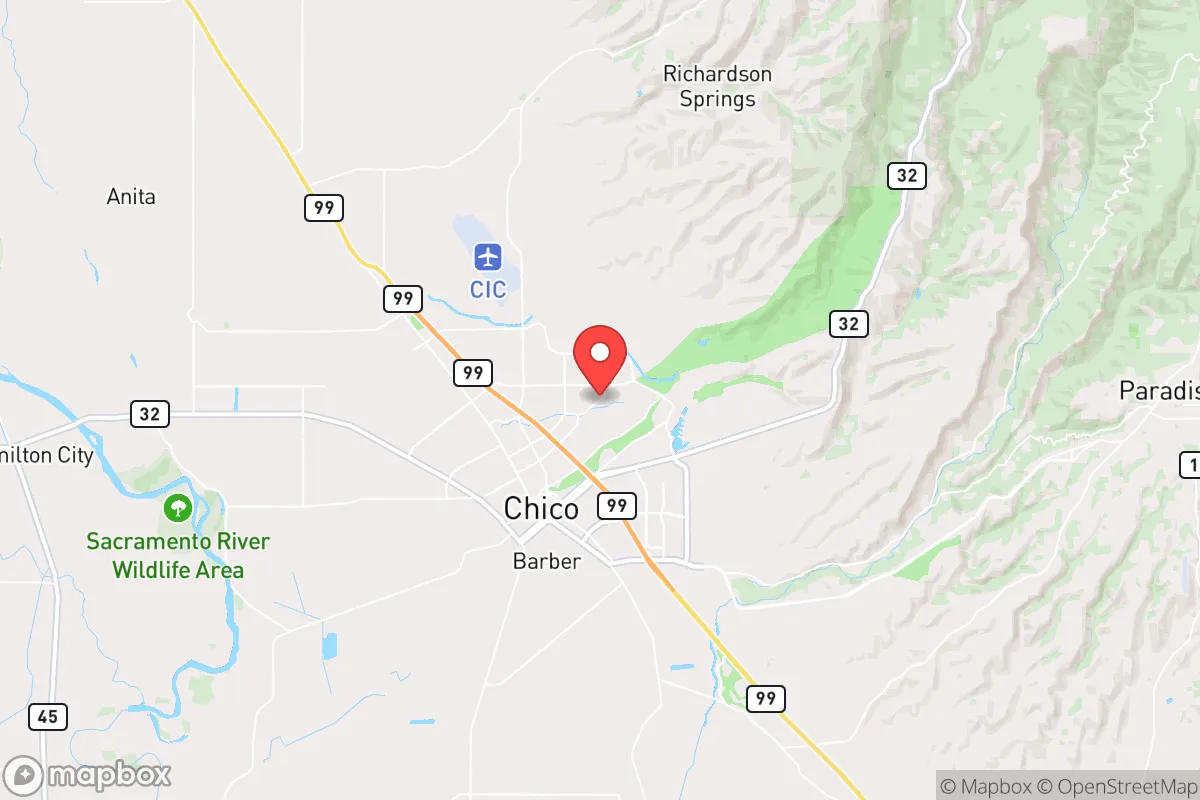
Photo: Wikipedia
Demographics of Chico, CA
Affluence Level in Chico, CA
A middle-class area roughly in line with national averages across income, home values, education, and employment.
People of Chico, CA
Chico, California, is a city of roughly 102,000 residents where a dominant white majority (65.7%) coexists with a growing Hispanic community (20.7%) and a notable East/Southeast Asian population (4.5%). The city’s identity is shaped by its role as a regional agricultural, educational, and healthcare hub, anchored by California State University, Chico, and a historic downtown that retains a distinctly Northern California character. With a foreign-born share of just 3.6% — roughly half the national average — Chico remains a predominantly native-born community, though its demographic future is being reshaped by domestic migration and natural growth rather than new international arrivals.
How the city was settled and grew
Chico’s population history begins with the Mechoopda Maidu people, who inhabited the area along Big Chico Creek for millennia before European contact. The modern city traces its founding to 1860, when John Bidwell — a land speculator and later a U.S. Congressman — laid out a town on his 26,000-acre Rancho del Arroyo Chico land grant. Bidwell actively recruited settlers, and the city’s early population was a mix of Anglo-American farmers, European immigrants (particularly Germans, Italians, and Portuguese), and Chinese laborers who worked on the ranch and in early agriculture. The completion of the Central Pacific Railroad through Chico in 1870 accelerated growth, turning the town into a shipping point for wheat, almonds, and later, olives and prunes.
The neighborhoods that took shape in this era still define the city’s core. The Mansion Park and Barber District, just south of downtown, was built by the city’s merchant and professional class in the late 19th century, with grand Victorian homes that remain intact today. Working-class families, including many of the European immigrant arrivals, settled in the Chapmantown area east of downtown — a neighborhood that has remained a working-class enclave for over a century. The Avenue District, along the Esplanade, developed in the early 20th century as a streetcar suburb, attracting middle-class families and university faculty as Chico State Normal School (founded 1887) grew into a full university.
Modern era (post-1965)
The post-1965 period brought significant demographic change, though Chico’s trajectory differed from many California cities. The 1965 Immigration and Nationality Act opened the door to new Asian and Latin American immigration, but Chico’s distance from coastal gateway cities meant its foreign-born population remained modest. Instead, the city’s growth in this era was driven by domestic in-migration: the expansion of Chico State University, the growth of Enloe Medical Center as a regional employer, and the city’s appeal as a lower-cost alternative to the Bay Area and Sacramento.
The Hispanic population grew steadily through the 1970s and 1980s, driven by agricultural labor demand in the surrounding orchards and by families moving from the Central Valley. Today, the Hispanic community is concentrated in Chapmantown and the South Chico neighborhoods along Park Avenue, where a visible cluster of Mexican-American businesses, taquerias, and churches anchors the community. The East/Southeast Asian population — primarily Hmong, Filipino, and Vietnamese families — arrived in smaller waves, many connected to Chico State’s international programs and refugee resettlement efforts in the 1980s. This community is more dispersed, with notable concentrations near the university in the College Park district and in the Barber District, where several Asian-American-owned businesses operate alongside the historic homes.
The future
Chico’s population is becoming more diverse, but slowly and primarily through domestic migration rather than international immigration. The Hispanic share has risen from roughly 15% in 2010 to 20.7% today, a trend expected to continue as younger Hispanic families have higher birth rates and as agricultural and service-sector jobs continue to attract workers from the Central Valley. The white population, while still the majority, is aging and slowly declining as a share of the total. The East/Southeast Asian population has remained stable at around 4-5%, with growth driven by university enrollment and healthcare-sector employment rather than new immigration.
New residential development is concentrated in North Chico, particularly around the Meriam Park and Eaton Road corridors, where master-planned communities are attracting younger families and Bay Area transplants seeking more affordable housing. These new developments are more ethnically mixed than the older neighborhoods, reflecting the broader diversification of the city. The university continues to be a demographic wildcard — Chico State enrolls roughly 16,000 students, many of whom leave after graduation, but those who stay tend to settle in the College Park and North Chico areas, contributing to the city’s above-average college-educated share of 41.3%.
Chico is becoming a more diverse, more educated, and more suburban city, but it remains fundamentally a Northern California community with deep agricultural roots and a strong university presence. For someone moving in now, the city offers a mix of historic neighborhoods with established character and newer developments with more demographic variety — a place where the population is changing gradually, not dramatically, and where the dominant culture remains distinctly local rather than cosmopolitan.

* Values derived from national, state, county, city and local statistics and may differ in a specific area. Last updated: 2026-10-30T23:50:37.000Z
Narrative content on this page is AI-generated and may contain mistakes. Verify any details that matter before acting on them.
ReloMaps may earn a commission from affiliate links at no extra cost to you.

