Photo: Wikipedia
Political ClimatePolitical Climate in Carmel-by-the-Sea, CA
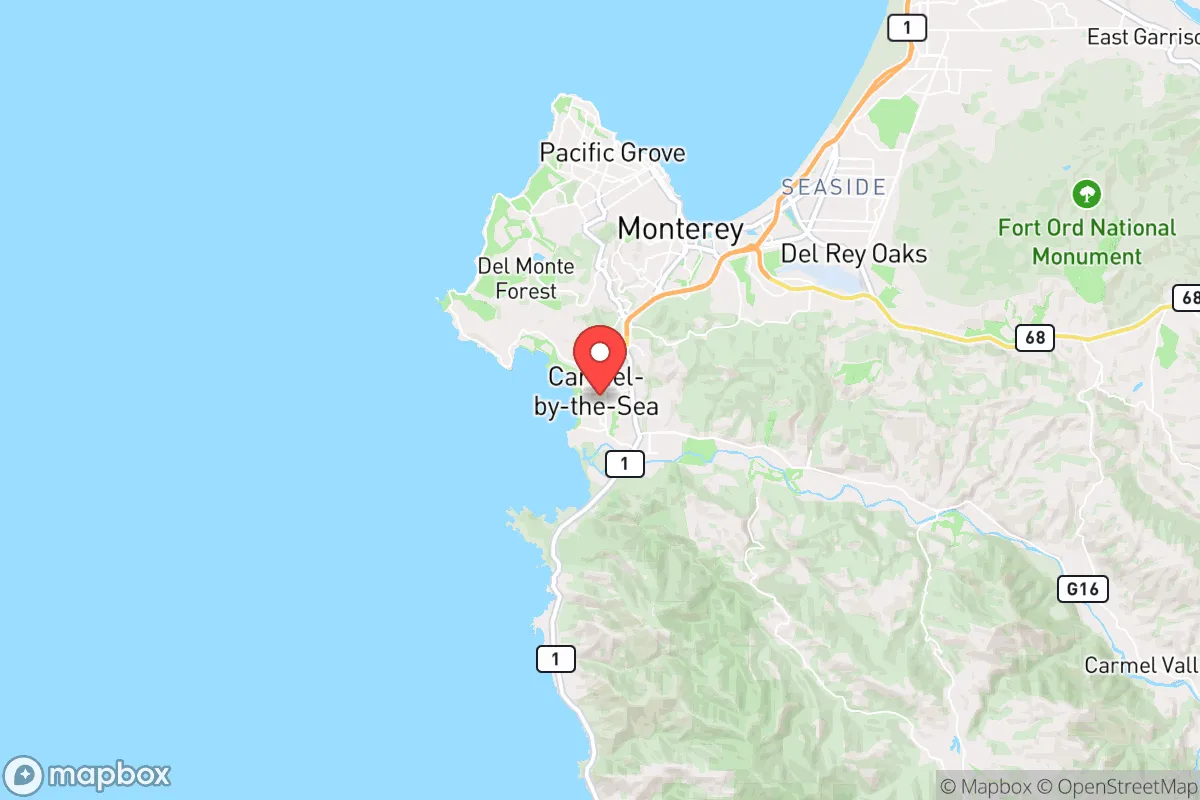
District shown is the primary district for this city’s centroid. Cities may span multiple districts.
Local Political AnalysisPolitical Analysis of Carmel-by-the-Sea, CA
Carmel-by-the-Sea is a deep blue enclave on California’s central coast, carrying a Cook Partisan Voting Index of D+18 — meaning it votes about 18 points more Democratic than the national average. This isn’t a recent shift; the town has been reliably liberal for decades, driven by a highly educated, affluent, and environmentally conscious population. If you look at the 2020 presidential election, Joe Biden likely carried Carmel by a margin closer to 70-75%, far outpacing even the statewide California average of about 63%. The trajectory here is steady: Carmel isn’t trending red or purple. It’s a place where progressive values are baked into the local identity, from land-use restrictions to a near-total ban on chain stores.
How it compares
Compared to California as a whole, Carmel-by-the-Sea is noticeably more liberal. The state’s Cook PVI is also D+13, so Carmel is about 5 points bluer — a meaningful gap in a state that already leans heavily Democratic. The real contrast, though, is with the surrounding region. Drive 15 minutes inland to Monterey or Seaside, and you’ll find a more mixed political landscape. Monterey leans Democratic but with a larger working-class and military presence (the Naval Postgraduate School is there), so it’s less uniformly progressive. Head 30 minutes south to Big Sur, and you’re in a libertarian-leaning, off-grid community that votes more unpredictably. To the north, Santa Cruz is even further left than Carmel, but with a younger, more activist energy. Carmel’s politics feel more genteel — think environmentalism through land trusts and historic preservation, not street protests. The surrounding rural areas of Carmel Valley and the Salinas Valley tilt conservative, especially in agricultural communities like Gonzales and Soledad, creating a stark urban-rural divide within a 20-mile radius.
What this means for residents
For liberal residents, Carmel is a comfortable fit. Local policies align with their values: strict building height limits (most structures can’t exceed two stories), a ban on formula retail to protect small businesses, and strong environmental protections for the coastline and the nearby Carmel River. You’ll find robust support for public transit, affordable housing initiatives (though they often stall due to NIMBYism), and climate action plans. For conservative residents, life is more about accommodation than confrontation. You won’t see many Trump signs, but you also won’t face hostility — the culture is polite and private. The biggest practical impact is on housing and development: conservative-leaning residents who favor property rights or less regulation often find themselves frustrated by the city’s slow-growth ethos. The local city council is uniformly Democratic, and Republican candidates rarely run. In practice, this means taxes and fees tend to be higher, and business permits take longer, but the trade-off is a preserved small-town character that even many conservatives appreciate.
Culturally, Carmel stands apart from much of California by being aggressively anti-commercial. There’s no Starbucks on Ocean Avenue, no McDonald’s in town — the city council has actively fought to keep out chains since the 1980s. This creates a unique policy distinction: Carmel is one of the few places in the state where local government explicitly prioritizes aesthetic and cultural preservation over economic growth. The result is a village that feels frozen in time, for better or worse. For newcomers, the political reality is simple: if you want a quiet, liberal, nature-focused community with a strong sense of place, Carmel delivers. If you’re looking for political diversity or a laissez-faire approach to business and development, you’ll find more of that in nearby Monterey or the unincorporated areas of Carmel Valley. The town’s trajectory is unlikely to change — it’s a wealthy, older, deeply Democratic community that values stability over change, and that’s exactly how most residents want it.

State Political ClimatePolitical Climate in California
State Political AnalysisPolitical Environment in the State
California is a deeply blue state, with Democrats holding every statewide office and supermajorities in both legislative chambers, but that label hides a far more complicated reality. The state hasn't voted Republican in a presidential race since 1988, and in 2024, Kamala Harris carried it by roughly 20 points. Yet the 10-20 year arc shows a slow but real erosion of that dominance: the Democratic share of registered voters has slipped from a peak of about 47% in 2016 to around 45% in 2025, while "no party preference" has grown to nearly 23%. The state's political center of gravity is shifting, not toward the GOP, but toward a more fractured, less predictable electorate.
Urban vs. rural divide
The political map of California is a study in extremes. The coastal metros—Los Angeles, San Francisco, Oakland, and San Jose—are among the most liberal jurisdictions in the country, routinely delivering 75-85% of the vote to Democrats. These cities, along with Sacramento and San Diego, account for roughly two-thirds of the state's population and drive its overall blue lean. In contrast, the Central Valley and inland regions are solidly red: Bakersfield, Fresno, and Redding vote Republican by wide margins, with some rural counties like Modoc and Lassen going +40 or more for Trump in 2024. The Inland Empire—Riverside and San Bernardino—is the real battleground; these counties have been trending rightward as working-class Latino and white voters drift from the Democratic coalition. Orange County, once a GOP stronghold, flipped blue in 2018 and has stayed competitive, but its suburbs like Huntington Beach and Yorba Linda remain conservative redoubts. The divide isn't just urban vs. rural—it's coastal vs. interior, and that interior is growing faster than the coast.
Policy environment
California's policy environment is defined by high taxes, heavy regulation, and a robust social safety net. The state has a progressive income tax with a top marginal rate of 13.3% (the highest in the nation), a state sales tax base rate of 7.25% (with local add-ons pushing it over 10% in many cities), and some of the highest gas taxes in the country. Property taxes are capped at 1% of assessed value plus inflation under Proposition 13, but reassessment on sale means new buyers face much higher bills. The regulatory posture is aggressive: California has its own environmental standards (CARB), its own labor laws (including a $16/hour minimum wage as of 2024, rising to $16.50 in 2025), and its own healthcare mandates (the individual mandate penalty was reinstated in 2020). Education policy leans left, with a strong teachers' union, a ban on charter school expansion (2020's AB 1505), and a "sanctuary state" law (SB 54) that limits local law enforcement cooperation with federal immigration authorities. Election laws are among the most accessible in the country: universal mail-in ballots, same-day registration, and no-excuse absentee voting. For a conservative relocator, the tax and regulatory burden is the biggest shock; for a liberal one, the safety net and environmental protections are the draw.
Recent policy direction
The last five years have seen California double down on its progressive identity, but with some notable crosscurrents. On gun and self-defense law, the state passed SB 2 in 2023, effectively banning concealed carry in most public places (currently tied up in court), and in 2024 voters upheld a ban on assault weapons and high-capacity magazines via Proposition 6. Parental and education rights saw a major flashpoint: AB 1955 (2024) prohibits school districts from requiring parental notification when a child changes their gender identity, a direct response to conservative school boards in places like Chino Valley and Temecula that had passed parental notification policies. On speech and privacy, the state passed the California Age-Appropriate Design Code Act (2022), which imposes strict data privacy rules on platforms used by minors, though it's been partially blocked by courts. Medical and bodily autonomy is fully protected: abortion is codified as a constitutional right (Proposition 1, 2022), and the state has a "shield law" protecting providers who serve out-of-state patients. Property rights remain contentious: rent control was expanded via the Tenant Protection Act of 2019 (AB 1482), capping annual rent increases at 5% plus inflation, and in 2024 voters rejected a measure to repeal it. Taxation saw a modest shift: Proposition 19 (2020) tightened inheritance property tax breaks, making it harder to pass homes to children without reassessment. Voting and ballot access expanded further with the Voter's Choice Act, which replaced traditional polling places with vote centers and mail-in ballots in most counties. The overall direction is toward more regulation, more state control, and more individual rights on social issues—but with a growing backlash in the interior.
Civil unrest & political movements
California has been a stage for some of the most visible political movements in the country. The 2020 George Floyd protests in Los Angeles and Oakland were among the largest and most destructive in the nation, with looting and arson causing billions in damage. The homelessness crisis has spawned its own activism: "camp cleanups" in San Francisco and Los Angeles have been met with fierce opposition from groups like the Coalition on Homelessness, while suburban cities like Anaheim and San Jose have passed anti-camping ordinances that are constantly litigated. Immigration politics are a constant flashpoint: the state's sanctuary law (SB 54) has been challenged by the Trump administration, and border-related protests flare up regularly in San Diego and Imperial County. Secession rhetoric is alive but fringe: the "Calexit" movement has never gained real traction, but the State of Jefferson movement in far northern counties like Siskiyou and Modoc continues to push for separation from California, with some county supervisors passing symbolic resolutions. Election integrity controversies are muted compared to swing states, but in 2024, conservative activists in Shasta County (Redding) successfully pushed to hand-count ballots, a move that was later blocked by the state. A new resident would notice the constant presence of political signage—"Recall Newsom" signs in rural areas, "Defund the Police" graffiti in Oakland—and the palpable tension between the coastal elite and the interior working class.
Projection
Over the next 5-10 years, California's political trajectory is toward a more fragmented, less reliably blue state, but not a red one. Demographic shifts are the key driver: the state's population has been flat or declining since 2020, with net out-migration of about 700,000 people, mostly to Texas, Arizona, and Nevada. Those leaving tend to be middle-income, moderate-to-conservative families and retirees, while the newcomers are largely international immigrants (especially from Asia and Latin America) and young professionals drawn to coastal tech hubs. This means the interior counties will continue to redden, while the coastal metros will stay blue but may see a slight moderation as tech workers age and become more property-tax-conscious. The Central Valley, particularly Fresno and Bakersfield, could flip some state legislative seats if the GOP can capitalize on working-class discontent. The biggest wildcard is housing: if the state's high cost of living continues to push out moderate families, the electorate will become even more polarized between the very wealthy and the very poor. A conservative moving in now should expect a state that remains solidly Democratic at the statewide level, but with growing pockets of conservative influence in the interior and suburbs. A liberal moving in should expect a state that continues to lead on progressive policy, but with increasing pushback from a shrinking but vocal minority.
For a new resident, the bottom line is this: California's politics are not monolithic, and your experience will depend heavily on where you land. If you're a conservative moving to Bakersfield or Redding, you'll find a community that shares your values, but you'll be fighting uphill against state-level policies on taxes, guns, and education. If you're a liberal moving to San Francisco or Los Angeles, you'll find a government that aligns with your priorities, but you'll also face high costs, homelessness, and a bureaucracy that can be frustrating. The state's political climate is best understood as a series of overlapping contradictions: a blue state with red counties, a high-tax state with a booming economy, a progressive policy leader with a growing conservative backlash. Know your neighborhood, know your county, and know that the state government in Sacramento will often feel like it's in a different country than your local city council.
* Values derived from national, state, county, city and local statistics and may differ in a specific area. Last updated: 2026-09-02T22:09:17.000Z
Narrative content on this page is AI-generated and may contain mistakes. Verify any details that matter before acting on them.
ReloMaps may earn a commission from affiliate links at no extra cost to you.

