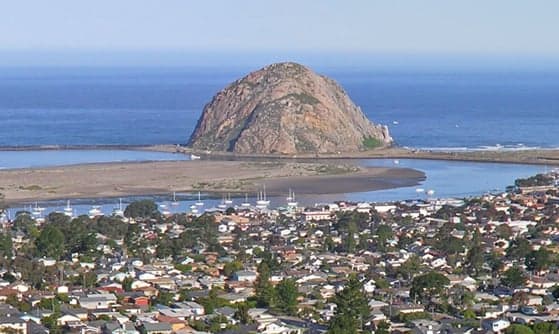
Photo: Wikipedia
Political ClimatePolitical Climate in San Luis Obispo County
Showing district-level results — no local-only data available.
Local Political AnalysisPolitical Analysis of San Luis Obispo County
San Luis Obispo County has a solid Democratic lean, reflected in its Cook Partisan Voting Index of D+13, but that number masks a more nuanced local reality than you'd find in deep-blue coastal metros like San Francisco or Los Angeles. The county has been shifting leftward over the past decade, driven largely by an influx of remote workers and retirees from the Bay Area and Southern California, plus the growing political engagement of Cal Poly students. However, the shift hasn't been uniform—pockets of the county remain reliably red, and the overall political culture is more moderate and pragmatic than the statewide average might suggest.
How it compares
Compared to California as a whole, San Luis Obispo County is noticeably more conservative, especially outside the city limits of San Luis Obispo itself. The city of San Luis Obispo is the county's Democratic stronghold, with precincts around Cal Poly and downtown consistently voting 65-70% Democratic in recent elections. In contrast, the northern part of the county—towns like Atascadero, Paso Robles, and Templeton—tend to lean Republican, often by 10-15 points. The swing precincts are concentrated in the unincorporated areas between these towns, particularly along the Highway 101 corridor in Santa Margarita and San Miguel, where independent voters can tip a race. The county's D+13 PVI is a compromise between these extremes: it's bluer than the state's inland agricultural counties (like Kings or Tulare) but redder than the Bay Area or coastal Los Angeles. The statewide PVI is unknown, but SLO County's D+13 places it roughly in the middle of California's 58 counties—more Democratic than the Central Valley, less so than the urban coast.
What this means for residents
For liberal residents, the county's trajectory is generally favorable. Local elections in San Luis Obispo city and the county Board of Supervisors have seen progressive candidates win seats, and ballot measures on housing density, environmental protections, and rent control tend to pass in the city. However, conservative residents still hold significant influence, particularly in the North County. Property taxes remain relatively low compared to coastal California (thanks to Prop 13), and the county's land-use policies are more development-friendly than in Santa Barbara or Monterey counties. For both sides, the practical effect is a politics of compromise: you'll see Democratic-backed climate initiatives alongside Republican-supported agricultural water rights, and the county's general plan balances urban growth boundaries with rural property rights. The biggest flashpoint is housing—liberals push for more density near transit, while conservatives resist changes to single-family zoning in places like Arroyo Grande and Nipomo.
Culturally, the county's political divide shows up in everyday life. In San Luis Obispo, you'll find farmers markets, bike lanes, and a vocal environmentalist presence; in Paso Robles, the conversation centers on winery regulations, water availability, and school board politics. The county's independent streak is its defining feature—voters here are less tribal than in many parts of California, and it's common to see a "No on both propositions" yard sign. Looking ahead, the trend is likely to continue leftward as the population grows and diversifies, but the North County's agricultural base and the presence of Cal Poly (which draws students from conservative Central Valley communities) will keep the county from becoming a Democratic lock anytime soon. For a resident, that means you'll encounter genuine debate at the coffee shop, not just echo chambers—a rarity in modern California politics.

State Political ClimatePolitical Climate in California
State Political AnalysisPolitical Environment in the State
California is a solidly Democratic state in statewide elections, with Democrats holding every statewide office and supermajorities in both legislative chambers, but its reputation as a monolithic liberal bastion oversimplifies a deeply fractured political landscape. The state hasn't voted Republican in a presidential race since 1988, and the Democratic margin has widened from about 10 points in 2008 to nearly 30 points in 2024. However, that blue wave is almost entirely driven by the coastal metros of Los Angeles, the San Francisco Bay Area, and San Diego, while vast interior regions—the Central Valley, the Sierra foothills, and most of the far north—have moved sharply right over the past two decades, creating one of the most pronounced urban-rural political divides in the country.
Urban vs. rural divide
The political map of California is essentially a tale of two states. The coastal corridor from Santa Barbara through Los Angeles, San Francisco, and up to the Oregon border votes overwhelmingly Democratic—Los Angeles County alone delivers about a quarter of the state's total Democratic votes. In contrast, the Central Valley cities of Bakersfield, Fresno, and Redding are reliably Republican strongholds, with Bakersfield's Kern County voting +22 points Republican in 2024. The Inland Empire, including Riverside and San Bernardino counties, has become a key battleground: these exurban areas voted for Obama in 2008 and 2012 but have swung hard right since, with San Bernardino County flipping to Trump in 2020 and 2024. Even within blue metros, there are notable conservative pockets: Orange County's northern suburbs like Yorba Linda and Fullerton remain Republican-leaning, while the Central Coast's San Luis Obispo County has trended purple, voting for Biden by just 3 points in 2020. The state's most conservative county is Modoc in the far northeast, which voted +68 points Republican in 2024, while the most liberal is San Francisco, at +78 points Democratic.
Policy environment
California's policy environment is defined by high taxes, heavy regulation, and a robust social safety net, which creates a specific set of incentives and disincentives for relocators. The state has a progressive income tax with a top marginal rate of 13.3% (the highest in the nation), a state sales tax of 7.25% that can exceed 10% with local add-ons, and some of the highest gas taxes in the country at roughly 68 cents per gallon. Property taxes are capped at 1% of assessed value under Proposition 13, but reassessment upon sale can create a shock for new buyers. The regulatory environment is among the most stringent in the nation, particularly in housing (CEQA lawsuits routinely delay construction), energy (California mandates 100% zero-emission vehicle sales by 2035), and labor (a $16 minimum wage that rises with inflation). Education policy leans progressive, with a $125 billion K-12 budget and universal pre-K, but test scores rank near the bottom nationally. Healthcare is heavily regulated, with the state running its own insurance exchange (Covered California) and expanding Medi-Cal to all income-eligible residents regardless of immigration status. Election laws are among the most accessible in the country: all active registered voters receive a mail-in ballot automatically, same-day registration is available, and the state has a top-two primary system that often locks third-party and minor-party candidates out of general elections.
Recent policy direction
Over the past five years, California has accelerated its progressive agenda in ways that directly affect the liberties a relocator might weigh. On gun and self-defense law, the state passed SB 2 in 2023, which bans carrying firearms in most public places (including parks, hospitals, and public transit) and raises the minimum age for concealed carry to 21, following the Bruen decision; the law is currently tied up in federal court. On parental and education rights, AB 1955 (2024) prohibits school districts from requiring teachers to notify parents if a child changes their gender identity, while the state has also banned book bans in schools and mandated ethnic studies for high school graduation. On speech and privacy, the California Age-Appropriate Design Code Act (2022) requires tech companies to default to high privacy settings for minors, though it's partially blocked by a First Amendment challenge. On medical and bodily autonomy, the state has codified abortion rights into law (SB 245, 2022) and passed a shield law protecting providers who serve patients from states with abortion bans. On property rights, the state has tightened rent control (AB 1482 caps annual increases at 5% plus inflation) and expanded tenant protections against eviction. On taxation, the state has not cut income tax rates but did pass a temporary gas tax suspension in 2022 and expanded the earned income tax credit. On voting and ballot access, the state expanded mail-in voting permanently after the pandemic and passed the Voter's Choice Act, which replaced traditional precincts with vote centers in many counties.
Civil unrest & political movements
California has been a flashpoint for political movements on both sides. The 2020 George Floyd protests were among the largest and most destructive in the state, particularly in Los Angeles, Oakland, and San Francisco, where property damage exceeded $1 billion combined. The state's sanctuary policies remain a major point of contention: SB 54 (2017) prohibits state and local law enforcement from cooperating with federal immigration enforcement, and the state has sued the Trump administration multiple times over immigration policy. Secession and nullification rhetoric is active on both extremes: the "Calexit" movement (pushing for California's independence) has failed to gain ballot access, while the "State of Jefferson" movement in the far north (advocating for a new state from rural northern California and southern Oregon) has seen county-level resolutions but no legislative traction. Election integrity controversies have been less pronounced than in swing states, but the 2020 and 2024 elections saw scattered protests at county election offices in conservative areas like Shasta and Butte counties. Homelessness and drug policy have become visible flashpoints: Proposition 36 (2024), which re-criminalized some drug possession and theft offenses after the 2014 Proposition 47 decriminalization, passed with 68% support, signaling a shift even in blue areas. Antifa and far-right activity have both been present: the 2017 Berkeley protests over Milo Yiannopoulos drew violent clashes, and the 2021 Capitol riot included several California participants from the far-right "Boogaloo" movement.
Projection
Over the next 5-10 years, California's political trajectory points toward a continued deepening of the urban-rural divide, with the coastal metros becoming more progressive while the interior becomes more conservative. Demographic shifts are the key driver: the state's population has declined for four consecutive years (2020-2024), with net out-migration concentrated among middle-income families and working-class voters—precisely the groups that have historically moderated the state's politics. The people leaving are disproportionately moving to Texas, Arizona, and Nevada, while the state's growth is driven by international immigration (largely from Asia and Latin America) and births, both of which tend to lean Democratic. In-migration patterns from other states are minimal, and those who do move in are often drawn by tech or entertainment jobs, reinforcing the coastal blue tilt. The legislative supermajority is likely to persist, meaning the policy direction—higher taxes, stricter regulation, expanded social programs—will continue. However, the 2024 passage of Proposition 36 suggests a pragmatic limit: voters are willing to support progressive policies on social issues but are increasingly concerned about public safety and homelessness. A new resident moving in now should expect to find a state where the political environment is stable at the top (Democratic control of all branches) but increasingly polarized locally, with conservative strongholds like Bakersfield and Redding feeling culturally and politically distant from Los Angeles and San Francisco.
For a conservative-leaning relocator, the bottom line is that California offers a high-cost, high-regulation environment where your political voice will be a minority at the state level, but you can find like-minded communities in the Central Valley, Inland Empire, and far north. For a liberal relocator, the state delivers on policy priorities like climate action, abortion access, and immigrant protections, but you'll pay for it in taxes and cost of living. The practical takeaway: if you're moving to California, pick your county carefully—your experience of the state's politics will depend far more on whether you land in Orange County or Modoc County than on the governor's party affiliation.
* Values derived from national, state, county, city and local statistics and may differ in a specific area. Last updated: 2026-09-08T01:46:51.000Z
Narrative content on this page is AI-generated and may contain mistakes. Verify any details that matter before acting on them.
ReloMaps may earn a commission from affiliate links at no extra cost to you.

