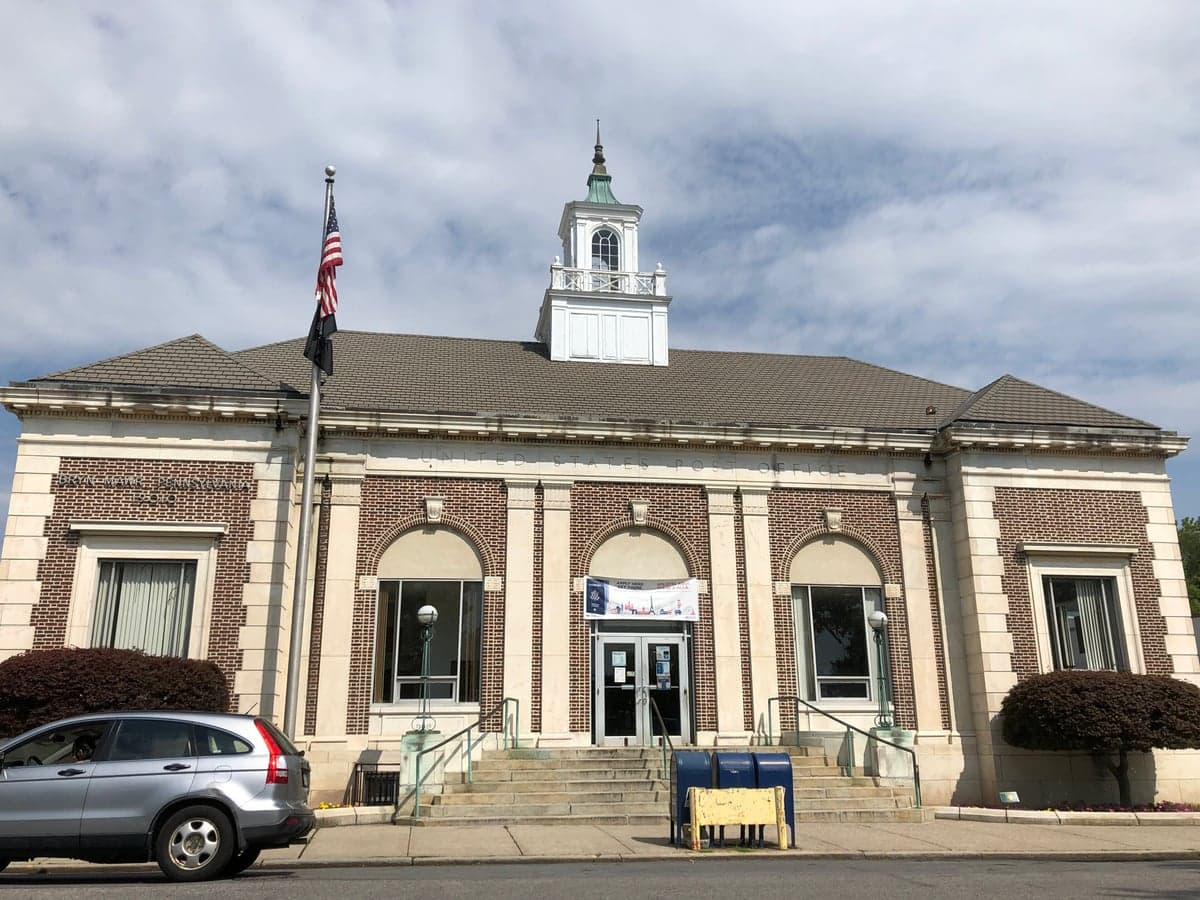
Photo: Wikipedia
Political ClimatePolitical Climate in Bryn Mawr, PA
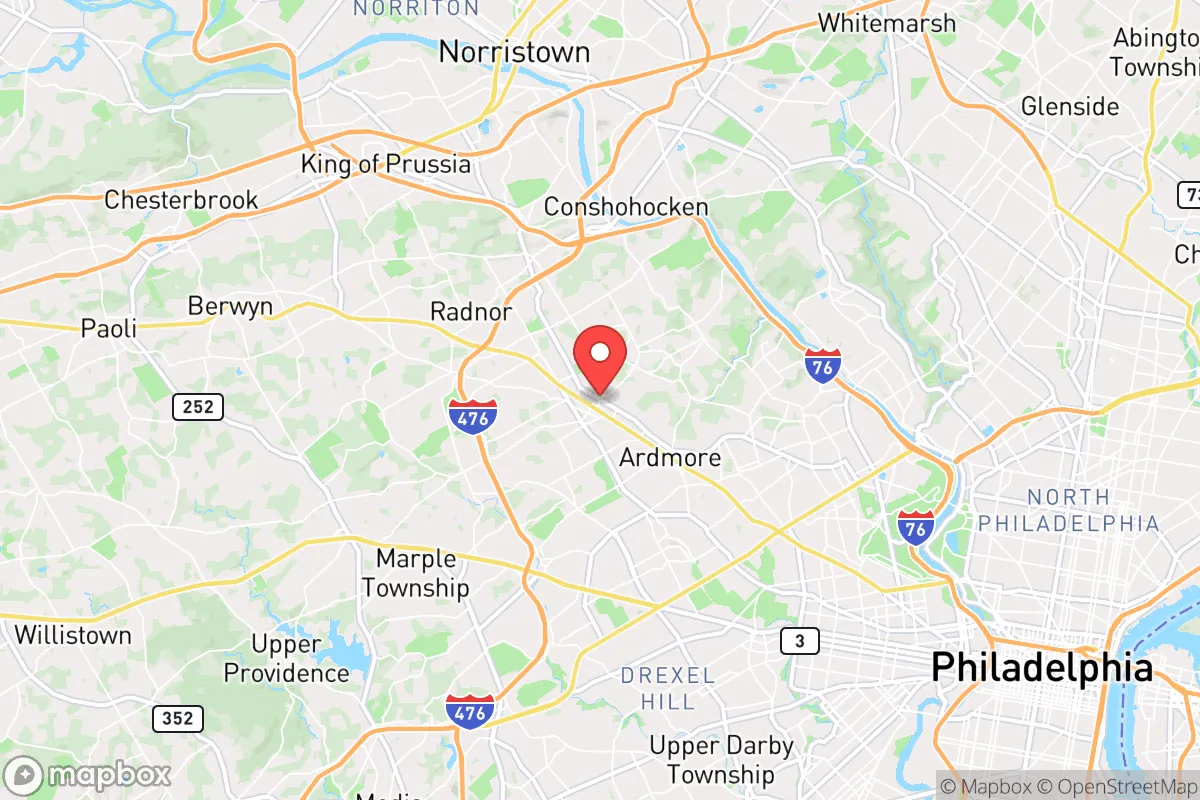
District shown is the primary district for this city’s centroid. Cities may span multiple districts.
Local Political AnalysisPolitical Analysis of Bryn Mawr, PA
Bryn Mawr leans heavily Democratic, with a Cook PVI of D+15, making it one of the most reliably blue enclaves in the Philadelphia suburbs. This isn't a recent shift—the area has been trending left for decades, driven by its educated, professional population and proximity to the city. In the 2024 presidential election, the precincts around Bryn Mawr College and the Main Line's historic districts delivered margins closer to D+25 or higher, while the surrounding state of Pennsylvania as a whole sits at a Cook PVI of EVEN—a perfect toss-up. The trajectory here is steady: Bryn Mawr gets bluer with each cycle, even as the rest of the state remains fiercely competitive.
How it compares
Bryn Mawr's politics stand in sharp contrast to its immediate neighbors. Drive 10 minutes west to Malvern or Exton, and you'll find precincts that lean Republican by 5-10 points, reflecting Chester County's more balanced suburban mix. Head 15 minutes north to King of Prussia, and the political vibe shifts again—more moderate, with a mix of union households and tech workers. But Bryn Mawr itself is a Democratic stronghold, similar to Ardmore or Narberth just to the east. The real contrast comes when you compare it to rural Pennsylvania: places like Lancaster County or York County, which vote R+15 or more. In practice, this means Bryn Mawr residents live in a bubble where Democratic candidates win by default, while the state's electoral votes are decided by swing counties like Bucks and Northampton.
What this means for residents
For liberal residents, Bryn Mawr is comfortable. You'll find yard signs for progressive candidates, active Democratic clubs, and a local government that prioritizes environmental initiatives and public transit funding. The school board and township council are reliably Democratic, so policy debates tend to be about how far left to go, not whether to go left. For conservative residents, life here is more challenging. You're a clear minority—your views on taxes, zoning, or school curriculum will often be out of step with your neighbors. That said, the Main Line is polite; you won't face hostility, but you'll need to seek out like-minded company, perhaps at the Radnor Hunt or through local Republican committees that still meet in nearby Wayne. The practical effect is that Bryn Mawr's politics shape daily life: higher property taxes fund excellent schools and parks, but zoning fights over density are common, and the local paper's letters page leans heavily blue.
Culturally, Bryn Mawr stands apart from much of Pennsylvania. The area's identity is tied to Bryn Mawr College, a women's liberal arts school with a famously progressive student body, and to the Main Line's old-money Quaker and WASP heritage. This creates a unique blend: highbrow intellectualism meets quiet affluence. Policy-wise, you'll see strong support for gun safety measures, abortion rights, and renewable energy—positions that put Bryn Mawr at odds with the state's rural and exurban majority. The local government has also pushed for complete streets and affordable housing mandates, which are controversial among some longtime homeowners. In the near future, expect Bryn Mawr to keep drifting left, even as Pennsylvania's statewide races remain nail-biters. The real tension here isn't between red and blue—it's between the old Main Line's preservationist instincts and the new wave of younger, more diverse residents pushing for change.

State Political ClimatePolitical Climate in Pennsylvania
State Political AnalysisPolitical Environment in the State
Pennsylvania is the ultimate swing state, with a Cook PVI of EVEN that perfectly captures its knife-edge balance. Over the past 20 years, it has shifted from a reliably blue firewall in presidential races to a true battleground, flipping from Obama (2008, 2012) to Trump (2016) by a razor-thin 44,000 votes, then back to Biden (2020) by just 80,000, and again to Trump (2024) by about 120,000. The dominant coalitions are a shrinking, union-heavy Democratic base in the southeast and southwest versus a growing, exurban and rural Republican majority everywhere else, making it a state where every election feels like a coin flip.
Urban vs. rural divide
The political map of Pennsylvania is a tale of two commonwealths. The Democratic stronghold is the southeast, anchored by Philadelphia and its collar counties like Montgomery and Delaware, which together deliver a 600,000-vote margin that Democrats need to offset losses elsewhere. Pittsburgh and its Allegheny County base provide another 200,000-vote cushion, though the surrounding southwestern counties—Washington, Westmoreland, Butler—have flipped hard red. The rural "T" that runs from the northern tier down through the center and into the south-central region is deeply Republican; Lycoming, Bradford, and Franklin counties routinely vote 70%+ Republican. The key battlegrounds are the suburban "collar counties" around Philadelphia—Bucks, Chester, and Lancaster—which have trended leftward in presidential years but still elect moderate Republicans locally. Erie and Northampton counties in the northwest and east are classic bellwethers, flipping with every close statewide race.
Policy environment
Pennsylvania’s policy landscape is a patchwork reflecting its divided government. The state has a flat personal income tax of 3.07% and a corporate net income tax that was cut from 9.99% to 8.49% in 2023, with a scheduled phase-down to 4.99% by 2031. There is no state sales tax on groceries or clothing, but the statewide rate is 6% (higher in Philadelphia and Allegheny County). Property taxes are high—among the top 10 in the nation—but the state offers a Homestead Exemption and a Property Tax/Rent Rebate program for seniors. Education policy is a flashpoint: the state funds schools primarily through local property taxes, leading to massive disparities between wealthy suburbs and poor rural districts. A 2023 Commonwealth Court ruling declared the funding system unconstitutional, but legislative action remains stalled. Election laws are moderate: no-excuse mail-in voting was enacted in 2019 under Act 77, but it remains controversial, with Republican legislators pushing for voter ID requirements and restrictions on drop boxes. Gun laws are relatively permissive—no permit needed for open carry, and a "shall issue" concealed carry system—but Philadelphia and Pittsburgh have their own local restrictions that are often preempted by state law.
Recent policy direction
The last five years have seen Pennsylvania lurch in both directions, depending on which party holds the governor’s mansion. Under Democratic Governor Josh Shapiro (elected 2022), the state has moved left on several fronts: executive orders expanded LGBTQ+ nondiscrimination protections for state contractors, and the state joined a multi-state lawsuit to protect access to the abortion pill mifepristone. On gun policy, Shapiro signed a universal background check bill for long guns in 2023 (though it was later struck down by a court), and he has pushed for a "red flag" law that remains stalled. Meanwhile, the Republican-controlled legislature has passed constitutional amendments on voter ID (requiring a photo ID to vote) and restricting abortion access (declaring no constitutional right to abortion), both of which must pass again in 2025 before going to a public referendum. On education, the legislature approved Act 1 of 2022, creating a $100 million voucher program for students in low-performing districts, which Shapiro initially supported then vetoed. On energy, the state remains a top natural gas producer, but Shapiro’s proposal to join the Regional Greenhouse Gas Initiative (RGGI) was blocked by the courts. For relocators weighing liberties: medical marijuana is legal (since 2016), but recreational use remains illegal; self-defense law includes a Castle Doctrine and Stand Your Ground (since 2011); property rights are strong with no statewide rent control; and ballot access is moderate—same-day registration is not allowed, but mail-in voting is available to all.
Civil unrest & political movements
Pennsylvania has seen its share of political flashpoints. The 2020 election aftermath was particularly intense: Trump’s campaign filed dozens of lawsuits challenging mail-in ballot procedures, and the state became a national focus for "Stop the Steal" rallies, including a large protest at the Pennsylvania Capitol in Harrisburg on January 6, 2021. The 2022 midterms saw a surge in election integrity activism, with Republican county commissioners in Luzerne and York counties refusing to certify primary results over concerns about voting machines. On the left, Black Lives Matter protests in Philadelphia and Pittsburgh in 2020 were large and occasionally violent, leading to property damage and a lasting debate over policing. Immigration politics are less visible than in border states, but Philadelphia is a self-declared "sanctuary city" (since 2017), which has drawn criticism from Republican lawmakers who have proposed a ban on such policies. The anti-fracking movement remains active in the southwest, with protests at state capitol hearings, but has not halted drilling. A new resident would notice the prevalence of political yard signs and bumper stickers—especially in swing counties like Erie and Northampton—and the intensity of local Facebook groups where election integrity and school board politics are constant topics.
Projection
Over the next 5-10 years, Pennsylvania is likely to remain a toss-up, but with a slight rightward tilt driven by demographic shifts. The in-migration from New York and New Jersey is mostly to the southeastern suburbs (Bucks, Chester, Montgomery), which are trending blue, but these new arrivals are often fiscally conservative and socially moderate, not hard-left. Meanwhile, the out-migration from rural counties is accelerating, as young people leave for jobs in cities, leaving behind an older, whiter, more conservative electorate. The 2024 election results showed Trump winning the state by a wider margin than 2016, suggesting that the Democratic coalition may be fraying among working-class voters in the southwest and northeast. The Republican-controlled legislature will likely continue to push constitutional amendments on voter ID and abortion, which could pass by 2026-2027 if the GOP holds its majorities. The flat tax phase-down will make the state more attractive to businesses and high earners, potentially shifting the tax burden onto property owners. A relocator moving in now should expect a state that remains politically divided but where the balance of power is slowly shifting toward the center-right, especially on economic and education issues, while social issues remain a perpetual battleground.
For a new resident, the bottom line is that Pennsylvania offers a genuine swing-state experience: your vote matters, your local school board elections are contested, and the policy environment can change dramatically with each election cycle. Conservatives will find a state with low income taxes, strong gun rights, and a growing school choice movement, but they will also face a Democratic governor who can veto their priorities until at least 2026. Liberals will find strong union protections, a sanctuary city in Philadelphia, and a path to legalized recreational marijuana, but they will have to contend with a legislature that is structurally gerrymandered toward rural Republicans. The practical takeaway: choose your county carefully. A conservative will feel at home in Lancaster or York, a liberal in Montgomery or Allegheny, and a moderate in Bucks or Erie. The state’s political future is uncertain, but its present is a fascinating, high-stakes experiment in democratic competition.
* Values derived from national, state, county, city and local statistics and may differ in a specific area. Last updated: 2026-11-05T02:23:43.000Z
Narrative content on this page is AI-generated and may contain mistakes. Verify any details that matter before acting on them.
ReloMaps may earn a commission from affiliate links at no extra cost to you.

