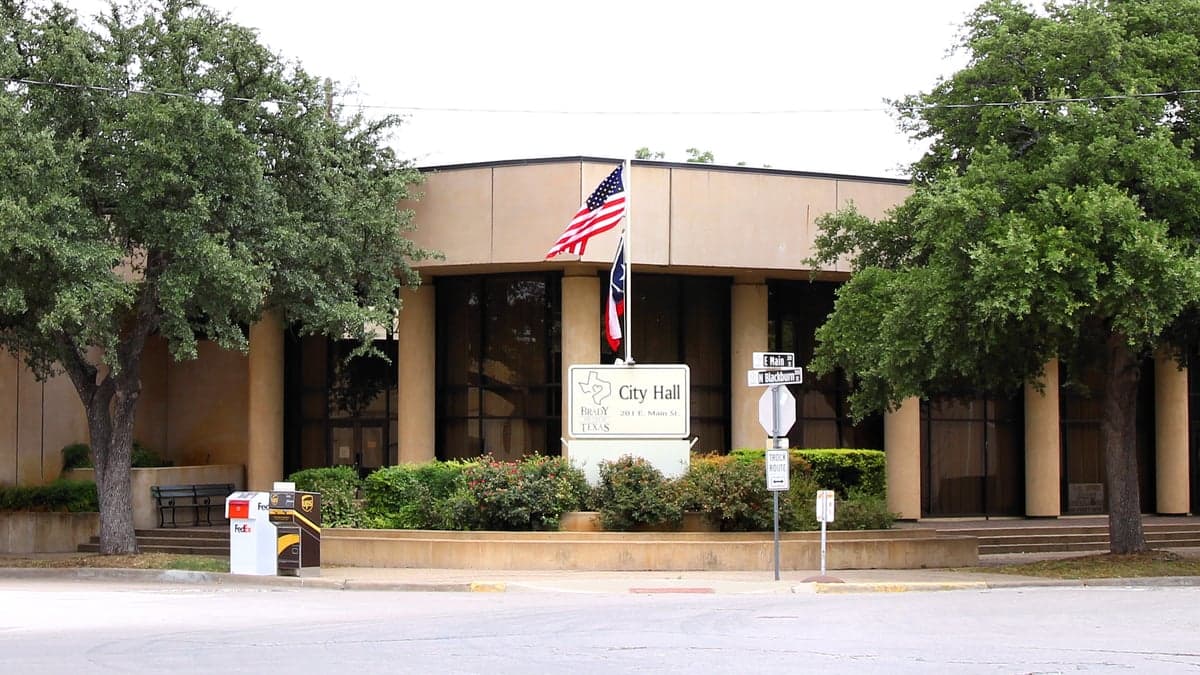
Photo: Wikipedia
Political ClimatePolitical Climate in Brady, TX
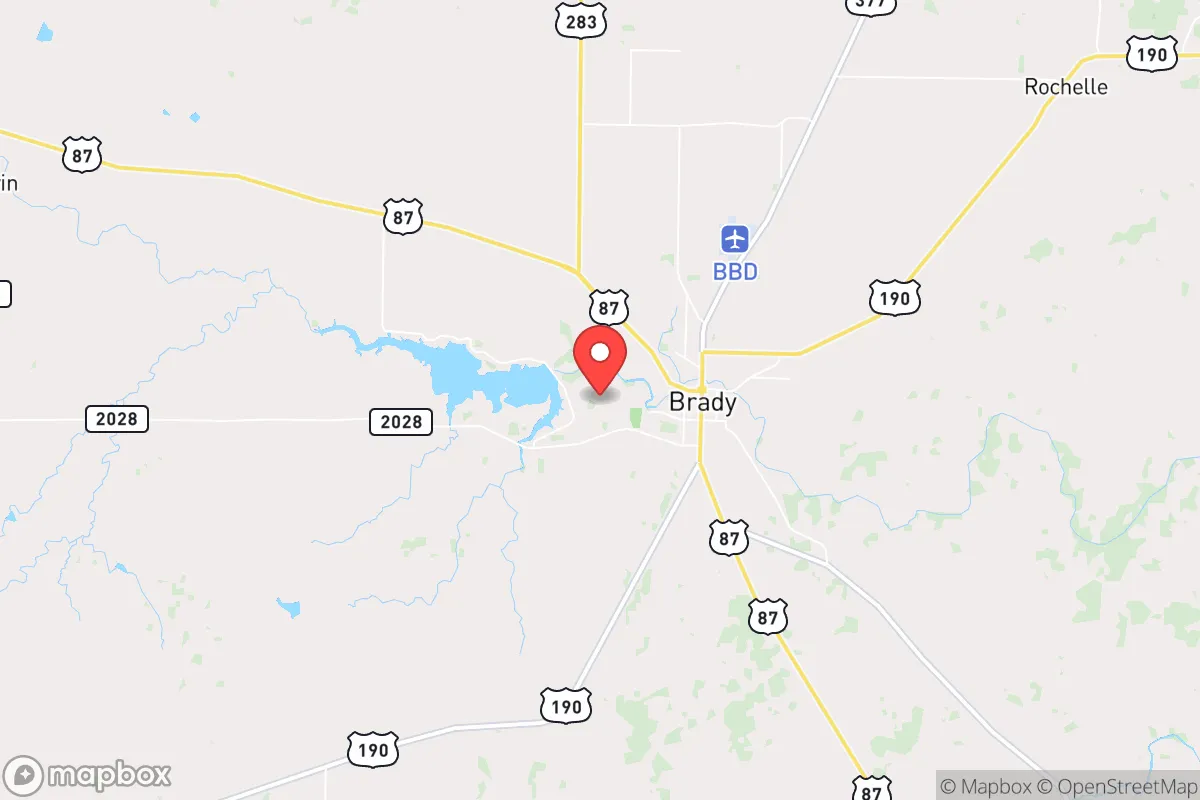
District shown is the primary district for this city’s centroid. Cities may span multiple districts.
Local Political AnalysisPolitical Analysis of Brady, TX
Brady, Texas, sits deep in the heart of the state's conservative stronghold, and the numbers back up what you'd feel driving through town. The area carries a Cook Partisan Voting Index (PVI) of R+22, meaning the district is 22 points more Republican than the national average. That’s a far cry from the state of Texas as a whole, which sits at R+4, and it tells you Brady isn’t just red—it’s deep crimson. This isn’t a recent shift, either. My family’s been here since the 80s, and while the rest of Texas has seen some purple creeping in around the edges, especially in the suburbs of Dallas or Houston, Brady has stayed the course. The local elections are decided in the Republican primary, and the general election is usually a formality. You don’t see a lot of yard signs for Democrats here, and when you do, they stand out like a sore thumb.
How it compares
To understand Brady’s political climate, you have to look at the surrounding landscape. While Texas as a whole has become a battleground state in recent cycles—with places like Tarrant County (Fort Worth) flipping blue in 2020 before flipping back in 2024—Brady is insulated from that volatility. The nearest cities of any size, like San Angelo (Tom Green County) or Brownwood (Brown County), lean similarly conservative, but Brady is in a class of its own. McCulloch County, where Brady is the county seat, has voted Republican by margins of 70-80% in recent presidential elections. That’s a stark contrast to the state’s overall R+4 PVI, which reflects the influence of blue-leaning urban centers like Austin, Houston, and Dallas. If you drive an hour and a half east to Llano or Marble Falls, you’ll find a similar conservative vibe, but head two hours south to San Antonio, and you’re in a completely different political universe. Brady is a place where the old-school, rural Texas values still hold sway, and the national political winds don’t seem to ruffle many feathers.
What this means for residents
For conservative residents, Brady is a comfortable place to live. Local policies reflect their values, from low taxes to a strong law-and-order approach. The city council and county commissioners are almost universally Republican, so there’s little friction on issues like gun rights, property rights, or school curriculum. For liberal residents, it’s a different story. You’re likely to feel like a minority voice, and you won’t find many like-minded neighbors in local government or social circles. That said, Brady isn’t hostile—people are generally polite and neighborly, regardless of politics. The practical reality is that if you’re progressive, you’ll probably keep your opinions to yourself at the coffee shop or the feed store. The area’s political lean also means that state-level policies, like the recent push for school vouchers or restrictions on abortion, are broadly supported here, even if they’re controversial elsewhere in Texas.
One cultural distinction worth noting is the role of local institutions. The Brady/McCulloch County Chamber of Commerce and the local churches are deeply intertwined with the community’s political identity. You’ll see more "God Bless America" signs than campaign signs, and the annual Brady Rodeo and the Heart of Texas Fair are as much about community solidarity as they are about entertainment. The area’s political trajectory seems stable for the foreseeable future. As long as Brady remains a ranching and agricultural hub, with a population that’s older and more homogenous than the state average, the R+22 lean isn’t going anywhere. If anything, as Texas continues to urbanize and diversify, Brady might become even more of a political outlier—a place where the old ways persist, for better or worse.

State Political ClimatePolitical Climate in Texas
State Political AnalysisPolitical Environment in the State
Texas is a solidly Republican state with a Cook PVI of R+4, but that label masks a far more complex and rapidly shifting political reality. For the past two decades, the state has been defined by a tug-of-war between its deeply conservative rural and suburban base and the explosive growth of diverse, left-leaning metro areas. While Republicans have held every statewide office for over 30 years, the margin of victory has been shrinking, and the 2024 election saw Donald Trump win the state by roughly 9 points—down from 19 points in 2012. The long arc is clear: Texas is trending purple, but it remains a state where conservative policy dominates the levers of power.
Urban vs. rural divide
The political map of Texas is a study in stark contrasts. The state's five largest metros—Houston, Dallas-Fort Worth, San Antonio, Austin, and El Paso—are the engines of Democratic growth. Austin and El Paso are deep blue strongholds, with Travis County delivering 71% of its vote to Biden in 2020 and El Paso County at 65%. Harris County (Houston) and Dallas County have flipped decisively Democratic over the last decade, driven by a surge in Hispanic and Asian-American voters and an influx of college-educated professionals. Meanwhile, the vast rural expanse—from the Panhandle down through West Texas and into East Texas—votes overwhelmingly Republican. The real battleground is the suburbs: Collin County (north of Dallas) and Fort Bend County (southwest of Houston) were once reliably red but are now competitive, with Fort Bend flipping to Biden in 2020. Tarrant County (Fort Worth), the largest swing county in the state, voted for Trump in 2024 after backing Biden in 2020, signaling that the suburban shift is not a one-way street. The divide isn't just geographic—it's demographic, generational, and cultural, and it's reshaping every election cycle.
Policy environment
Texas's policy environment is a reflection of its Republican leadership: low taxes, light regulation, and a strong emphasis on individual liberty in certain domains. There is no state income tax, which is a major draw for relocators. Property taxes are high to compensate, but the state legislature has periodically passed compression measures to slow their growth. The regulatory posture is business-friendly, with minimal zoning in many cities and a "right-to-work" law that limits union power. On education, the state has expanded school choice through voucher-like programs and charter schools, though traditional public school funding remains a perennial debate. Healthcare policy is notably hands-off: Texas did not expand Medicaid under the Affordable Care Act, leaving roughly 1.5 million residents in the coverage gap. Election laws have tightened in recent years, with stricter voter ID requirements and limits on mail-in voting, passed under the banner of election integrity. The overall policy mix is designed to attract conservative-leaning families and businesses, but it creates friction for those who prefer a more robust public safety net.
Recent policy direction
The last few legislative sessions have pushed Texas decisively to the right on a broad set of issues. On gun and self-defense law, the state enacted permitless carry in 2021, allowing most adults to carry a handgun without a license or training. Parental and education rights have been a flashpoint: the 2023 session passed a school choice voucher program and expanded restrictions on how race and gender are taught in public schools, including the controversial ban on diversity, equity, and inclusion (DEI) programs at public universities. On speech and privacy, Texas passed a law in 2023 prohibiting social media platforms from moderating content based on political viewpoint, though it faces ongoing legal challenges. Medical and bodily autonomy saw the most dramatic shift: after the 2022 Dobbs decision, Texas triggered a near-total abortion ban with no exceptions for rape or incest, and the state has since passed laws restricting gender-affirming care for minors. Property rights remain strong, with no state-level rent control and limited eminent domain abuse. Taxation has seen modest relief: the 2023 session allocated $18 billion for property tax cuts, though rates remain high by national standards. Voting and ballot access have been tightened: Senate Bill 1 (2021) restricted mail-in voting, banned drive-through and 24-hour voting, and gave partisan poll watchers more authority. The direction is clear: Texas is doubling down on conservative governance, but the pace and scope of change are creating friction with its growing urban and suburban populations.
Civil unrest & political movements
Texas has been a stage for high-profile political movements on both sides. The 2020 protests in Austin and Houston over police brutality were among the largest in the country, with Austin seeing sustained demonstrations for months. In response, the state legislature passed a law in 2021 that increased penalties for rioting and protected drivers who strike protesters. On the right, the Texas Nationalist Movement continues to push for secession, though it remains a fringe effort with little mainstream support. Immigration politics are a constant flashpoint: Governor Greg Abbott's Operation Lone Star has deployed state troopers and National Guard to the border, bused migrants to northern cities, and installed razor wire and buoys in the Rio Grande, leading to ongoing legal battles with the Biden administration. Sanctuary city policies are banned by state law, and sheriffs who refuse to cooperate with federal immigration enforcement face penalties. Election integrity remains a live issue: the 2020 and 2022 cycles saw intense scrutiny of voting procedures, particularly in Harris County, where the state took over election administration after a series of logistical failures. For a new resident, the most visible signs of political tension are likely to be the border security checkpoints in South Texas, the partisan signage in suburban yards, and the occasional protest in downtown Austin.
Projection
Over the next 5-10 years, Texas is likely to continue its slow drift toward competitiveness, but it will not become a swing state overnight. The key drivers are demographic: the state's Hispanic population, which leans Democratic but is not monolithic, is growing rapidly, while white non-Hispanic voters—who lean heavily Republican—are a shrinking share of the electorate. In-migration from California and other blue states has been a net plus for Democrats in the suburbs, but many of those newcomers are actually conservatives fleeing high taxes and regulation. The Republican Party is also adapting, investing heavily in Hispanic outreach and tightening election laws to maintain its edge. The most likely scenario is a state that remains Republican-leaning but with narrower margins, where control of the legislature and statewide offices is contested but not yet flipped. For a relocator, this means a policy environment that will remain conservative for the foreseeable future, but with increasing debate and occasional liberal wins at the local level, particularly in Austin, Houston, and Dallas.
For someone moving to Texas, the bottom line is this: you are choosing a state where conservative values shape the laws, taxes are low, and government intervention in your daily life is minimal in many areas—but where the political climate is increasingly polarized and the direction of policy is contested. If you align with the dominant Republican coalition, you will find a state that reflects your priorities on guns, taxes, education, and abortion. If you lean left, you will find strong communities in the major cities and a growing political movement that is slowly gaining ground, but you will also face a state government that is actively working against many of your preferences. The key is to choose your location carefully: the political reality of Lubbock is very different from that of Austin, and the gap is only widening.
* Values derived from national, state, county, city and local statistics and may differ in a specific area. Last updated: 2026-07-10T00:53:03.000Z
Narrative content on this page is AI-generated and may contain mistakes. Verify any details that matter before acting on them.
ReloMaps may earn a commission from affiliate links at no extra cost to you.

