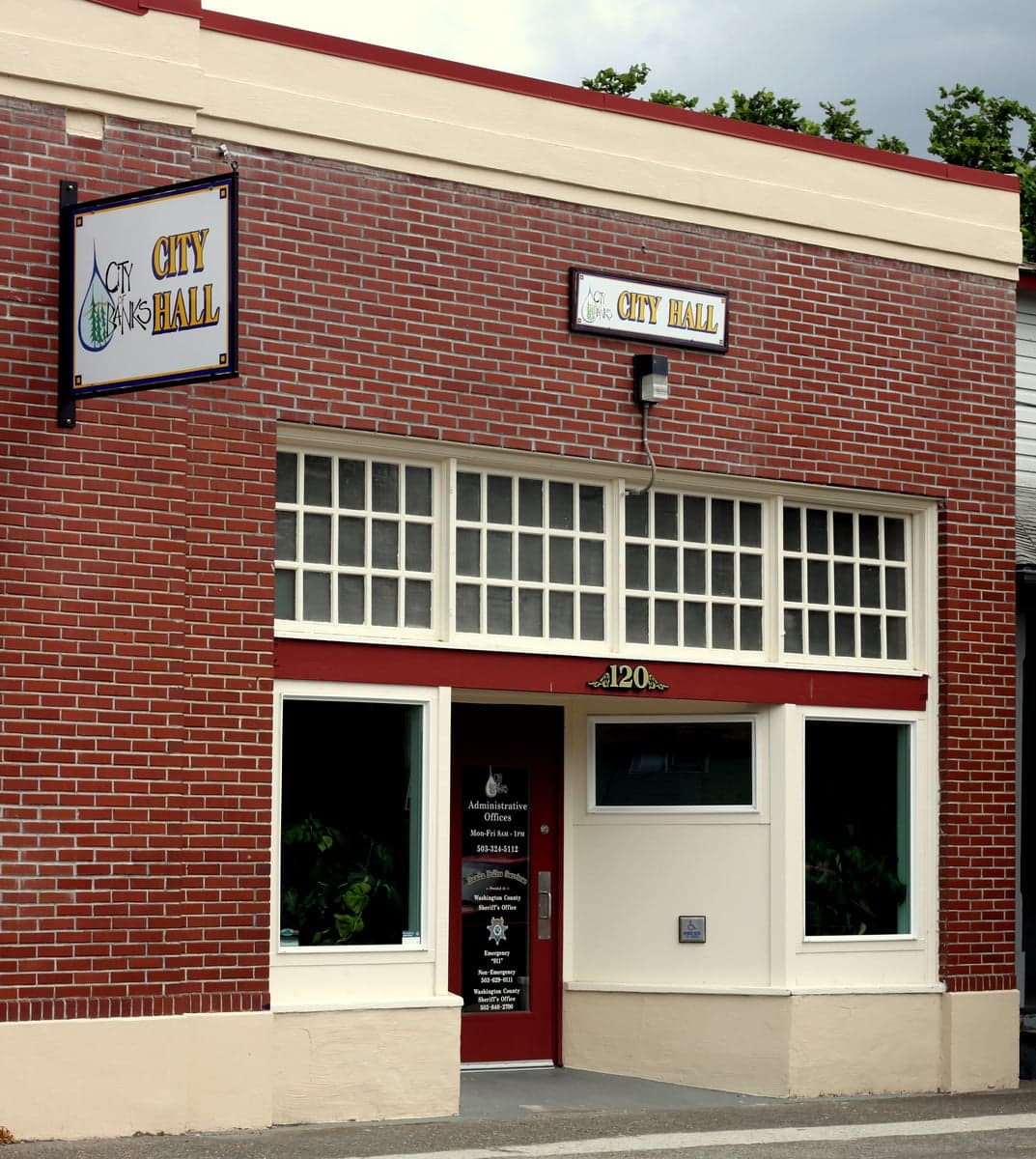
Photo: Wikipedia
Political ClimatePolitical Climate in Banks, OR
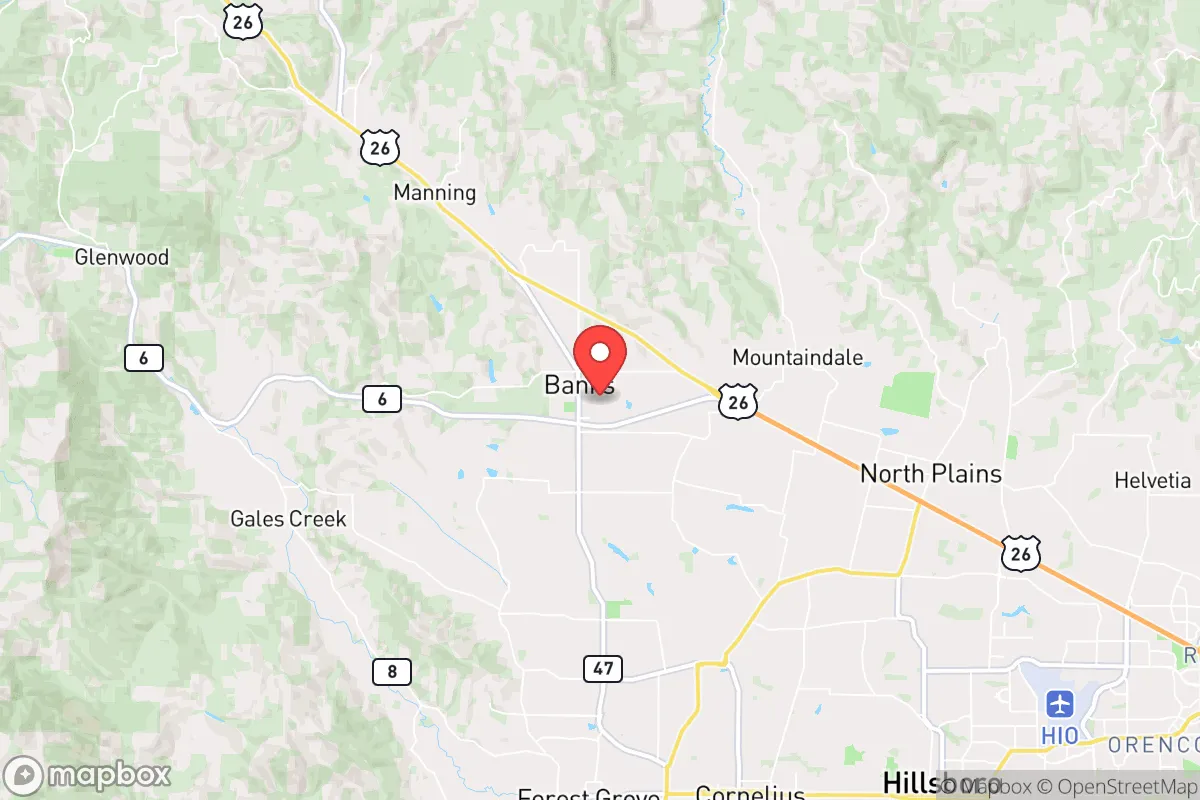
District shown is the primary district for this city’s centroid. Cities may span multiple districts.
Local Political AnalysisPolitical Analysis of Banks, OR
Banks, Oregon, sits in a political bubble that’s significantly bluer than the state around it. With a Cook Partisan Voting Index (PVI) of D+20, this small Washington County town is a solidly Democratic stronghold, voting about 20 points more Democratic than the national average. That’s a stark contrast to Oregon as a whole, which has a PVI of D+8—already a reliably blue state. In practice, this means Banks is one of the most liberal-leaning communities in a state that’s known for its progressive politics, and the gap has only widened in recent years as the Portland metro area’s influence has crept westward.
How it compares
To understand Banks’ political climate, you have to look at its neighbors. Drive 15 miles east and you hit Hillsboro, a Democratic stronghold that’s part of the Portland exurbs. But head 10 miles west or north, into rural Washington County or neighboring Columbia County, and the landscape shifts dramatically. Towns like Vernonia or St. Helens lean more conservative, often voting red in local and national elections. Banks itself is an outlier: it’s a small town (population around 2,000) that feels rural but votes like a college town. The D+20 PVI means that in a typical presidential election, Banks might go for the Democrat by a 60-40 margin, while Oregon as a whole might be closer to 54-46. This isn’t a recent fluke—it’s been trending this way for at least a decade, driven by an influx of commuters who work in the Portland tech and healthcare sectors but want a quieter, more affordable home base.
What this means for residents
For liberal residents, Banks is a comfortable place to live. Local policies tend to align with progressive values—think support for environmental regulations, public transit expansion (the WES commuter rail runs nearby), and school funding. You’ll find yard signs for Democratic candidates and local initiatives like renewable energy projects. For conservative residents, it can feel like swimming upstream. While you won’t face outright hostility, your views on gun rights, taxes, or land use might be in the minority at town hall meetings. That said, Oregon’s statewide laws—like the 2021 ban on new gas stations in certain zones or the tight land-use regulations under Senate Bill 100—apply uniformly, so Banks doesn’t have the same kind of local culture war you’d see in, say, rural Idaho. The practical effect is that both sides coexist, but the political energy leans left.
Culturally, Banks reflects its blue lean in subtle ways. The local schools emphasize sustainability and diversity programs, and the town’s small businesses often cater to a health-conscious, eco-aware crowd. But it’s not a monoculture—there’s still a strong sense of rural independence, with farmers and loggers who’ve been here for generations. The key distinction from Oregon as a whole is intensity: Banks is more uniformly Democratic than the state average, which includes deep-red areas like eastern Oregon’s Harney County (R+30) or the more moderate Willamette Valley swing zones. If you’re moving here, expect a community where political conversations are common but rarely heated—most folks are too busy enjoying the proximity to the Coast Range or the quiet streets to argue about national politics. The trajectory suggests this blue tilt will hold steady, as Portland’s suburban sprawl continues to push outward, bringing more like-minded newcomers with it.

State Political ClimatePolitical Climate in Oregon
State Political AnalysisPolitical Environment in the State
Oregon is a reliably Democratic state with a Cook PVI of D+8, but that number masks one of the most dramatic urban-rural political chasms in the country. The state has shifted leftward over the past 20 years, driven by explosive growth in the Portland metro area and the Willamette Valley, while vast stretches of eastern and southern Oregon have become deeply Republican and increasingly frustrated with Salem’s one-party rule. For a conservative relocator, Oregon offers a mixed bag: low income taxes relative to other blue states, but a regulatory and cultural environment in its population centers that can feel hostile to traditional values.
Urban vs. rural divide
The political map of Oregon is a study in extremes. Multnomah County (Portland) alone delivers roughly 20% of the state’s vote and votes about 75% Democratic, making it the engine of the state’s blue lean. Washington County (suburban Portland, home to Intel and Nike) and Lane County (Eugene) are also solidly Democratic, though with more moderate pockets. In contrast, the vast rural counties east of the Cascades — like Malheur, Harney, and Lake — routinely vote 70-80% Republican. The real story is in the exurbs and smaller cities that have flipped or tightened. Clackamas County, once a swing county, has trended Democratic in recent cycles, while Deschutes County (Bend) has moved from red to purple, with Democrats now competitive in local races. Jackson County (Medford) and Josephine County (Grants Pass) remain reliably red, but are seeing an influx of Californians that is slowly shifting the needle. The 2022 gubernatorial race saw Democrat Tina Kotek win by just 3.5 points, a sign that the state is not a lock for the left in statewide contests.
Policy environment
Oregon’s policy environment is a patchwork. The state has no sales tax, which is a major draw for conservatives, but it has high property taxes (averaging about 1% of assessed value) and a progressive income tax that tops out at 9.9% for high earners. The regulatory climate is generally business-friendly in name but burdensome in practice, especially in land use and environmental permitting. Oregon’s land-use planning system, established in the 1970s, strictly controls urban growth boundaries, driving up housing costs in desirable areas. Education policy is mixed: the state spends above the national average per pupil, but graduation rates and test scores lag, and school choice options are limited compared to states like Florida or Arizona. Healthcare is dominated by the Oregon Health Plan (Medicaid expansion), and the state has a robust public health infrastructure. Election laws are among the most accessible in the nation: Oregon was the first state to vote entirely by mail (1998), and automatic voter registration is the norm. This system is popular across the political spectrum for its convenience, though some conservatives worry about ballot security.
Recent policy direction
Recent legislation in Oregon has pushed the state further left on several fronts, with notable implications for personal liberties. On gun rights, Measure 114 (passed in 2022, but currently blocked by court challenges) would require a permit to purchase a firearm and ban magazines over 10 rounds. This has galvanized rural counties, with Harney and Malheur counties declaring themselves “Second Amendment sanctuaries.” On parental rights and education, the state has moved to expand LGBTQ+ inclusive curriculum and protect transgender students, which has sparked backlash from conservative parents. Speech and privacy are generally protected under the Oregon Constitution, which has a strong free-expression clause, but the state has enacted laws limiting “conversion therapy” and requiring social media platforms to moderate certain content. Medical and bodily autonomy is broadly protected: Oregon was the first state to legalize physician-assisted suicide (Death with Dignity Act, 1994) and has codified abortion rights. Property rights are constrained by the land-use system, which can make building or developing difficult. On taxation, the state has not raised income tax rates recently, but a 2023 corporate activity tax increase is funding education. Voting and ballot access remain easy, with same-day registration and mail-in ballots, though a 2024 measure to require voter ID failed. The overall direction is toward expanded government regulation and social liberalism, with rural areas pushing back through sanctuary ordinances and legal challenges.
Civil unrest & political movements
Oregon has a long history of political activism, from the 2020 Portland protests (which saw nightly demonstrations and federal intervention) to the 2016 Malheur National Wildlife Refuge occupation. The Portland protests of 2020 were a national flashpoint, with both left-wing antifa-style groups and right-wing counter-protesters (including the Proud Boys) clashing in the streets. The city’s response — including a 2021 law limiting police use of tear gas — remains controversial. In rural areas, the Wolverine Watchmen and other militia groups have been active, though their influence has waned after the 2020 arrests related to a plot to kidnap Governor Kate Brown. Immigration politics are less heated than in border states, but Oregon is a sanctuary state (since 1987), and local law enforcement does not cooperate with federal immigration detainers. Election integrity controversies have been relatively muted compared to other states, though the 2020 election saw Trump supporters protest outside the Marion County elections office in Salem. The Greater Idaho movement, which proposes moving rural Oregon counties into Idaho, has gained traction in 13 counties that have voted to explore the idea, though it remains a symbolic protest rather than a realistic policy change. A new resident in Portland will see visible homelessness and occasional street protests; in rural areas, you’ll see “Trump 2024” flags and signs declaring “No More Portland Politics.”
Projection
Over the next 5-10 years, Oregon will likely remain a Democratic-leaning state, but the margin could narrow. In-migration from California has slowed, and the state’s high housing costs and regulatory environment are pushing some families to Idaho and Texas. The Willamette Valley will continue to drive the state’s politics left, but the exurbs (like Canby, Newberg, and Sandy) are becoming more conservative as families flee Portland’s high costs and crime. The Greater Idaho movement will remain a talking point but is unlikely to succeed, as it requires approval from both Oregon and Idaho legislatures. The biggest wild card is the state’s housing crisis: if Oregon fails to build enough homes, the political center of gravity could shift as younger, more liberal residents are priced out. Expect continued battles over gun laws, land use, and education, with rural counties increasingly using “sanctuary” ordinances to resist state mandates. A conservative moving to Oregon today should expect to find a state where their vote matters most in local races and where they’ll need to be politically active to protect their interests, especially in the legislature.
For a conservative relocator, Oregon offers a beautiful landscape and a relatively low tax burden, but it comes with a political environment that is often at odds with traditional values. If you’re moving to a rural county like Lake or Harney, you’ll find a like-minded community and a slower pace of life, but you’ll be far from amenities and subject to state-level policies you may oppose. If you’re moving to a suburb like Happy Valley or West Linn, you’ll find good schools and a more moderate political climate, but you’ll still be in a blue county. The bottom line: Oregon is not a red state, but it’s not a deep-blue monolith either. Your experience will depend heavily on where you land, and your voice can make a difference in local elections. Come for the mountains and the lack of sales tax; stay if you’re ready to engage in the fight for the state’s future.
* Values derived from national, state, county, city and local statistics and may differ in a specific area. Last updated: 2026-10-02T13:43:37.000Z
Narrative content on this page is AI-generated and may contain mistakes. Verify any details that matter before acting on them.
ReloMaps may earn a commission from affiliate links at no extra cost to you.

