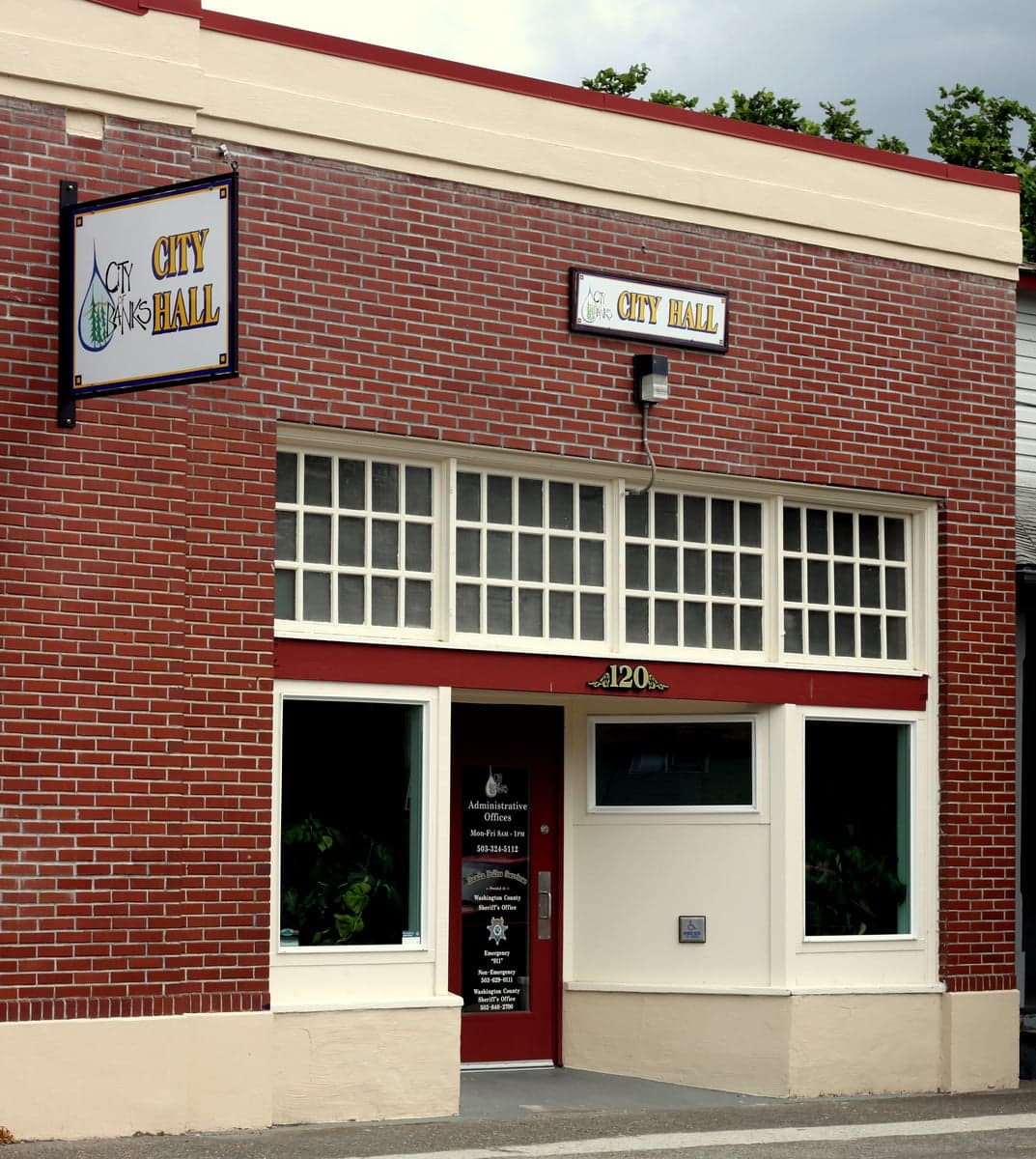
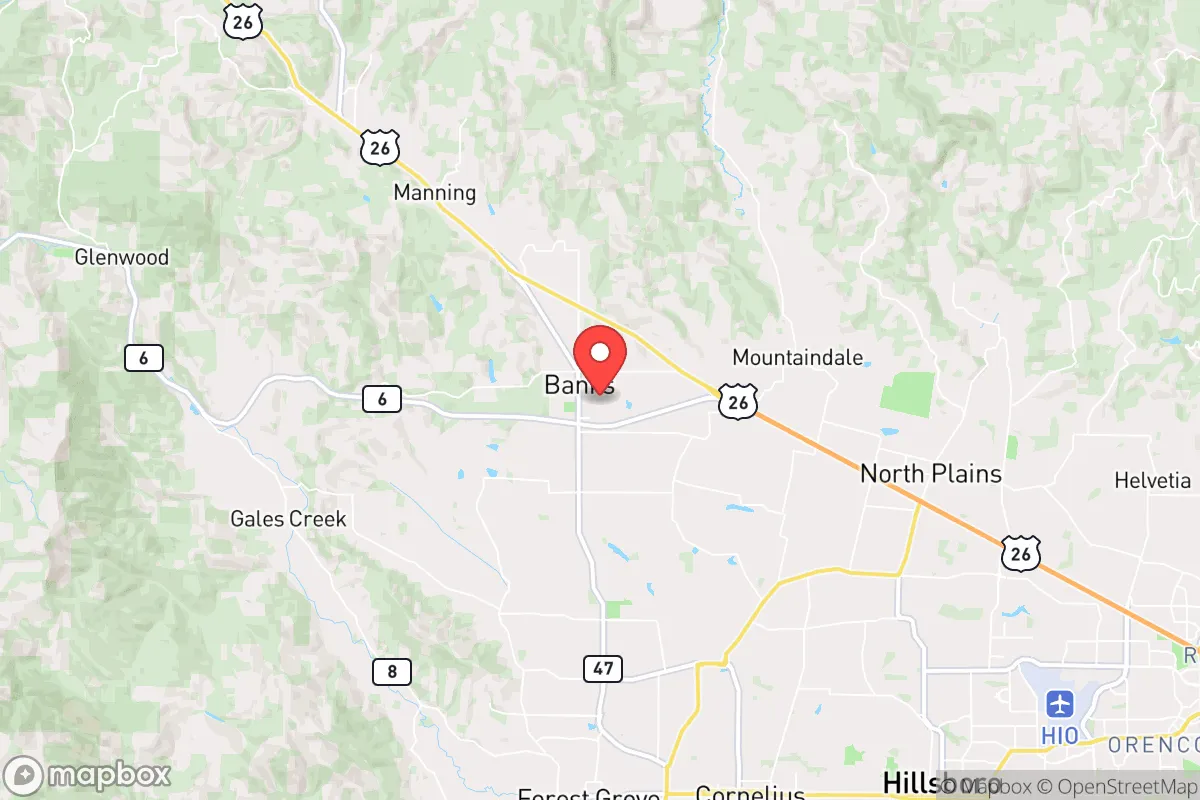
Photo: Wikipedia
Personal Sovereignty in Banks, OR
Viable for self-reliance. Generally workable, though some barriers may limit total independence.
What does Personal Sovereignty tell us?
Personal Sovereignty measures your capacity for self-reliance and independence with minimal government friction. Higher scores mean fewer barriers between you and the way you want to live... but it assumes you have the space you need and good neighbors.
What does this tell us?
Personal Sovereignty measures your capacity for self-reliance and independence with minimal government friction. Higher scores mean fewer barriers between you and the way you want to live... but it assumes you have the space you need and good neighbors.
State Policy
Energy independence: Importer (35% of energy produced in-state)
Personal Liberty
Homesteading

Personal Liberty Analysis
Banks, Oregon, offers a notably higher degree of personal sovereignty than much of the Portland metro area, largely due to its location in rural Washington County where local governance tends to be more permissive and enforcement less aggressive. While Oregon’s state-level regulatory framework imposes certain constraints—particularly around land use and environmental policy—the day-to-day autonomy experienced by residents in Banks is closer to that of a small agricultural town than a suburban bedroom community. For individuals and families who prioritize self-reliance, limited government interference, and the freedom to make personal choices without excessive oversight, Banks represents a pragmatic middle ground: state-level guardrails exist, but local culture and enforcement patterns leave significant room for independent living.
Tax burden and regulatory posture: How Oregon’s framework affects Banks residents
Oregon has no state sales tax, which is a direct financial benefit for residents of Banks who make large purchases or buy goods online. The trade-off is a state income tax that is among the highest in the nation, with marginal rates reaching 9.9% for top earners. Property taxes in Banks are moderate by Oregon standards—typically around 1.0% to 1.2% of assessed value—but are constrained by Measure 5 and Measure 50, which cap annual increases at 3% and limit overall rates. This creates predictability for homeowners but can be a shock for new buyers whose assessed value resets to market price. The regulatory posture in Banks is light-touch relative to urban Washington County. The city’s zoning code is straightforward, with no overlay districts or design review boards that complicate home improvements. Business licensing is minimal, and home-based enterprises are permitted by right in most residential zones, provided they don’t generate excessive traffic or noise. The Oregon Department of Environmental Quality (DEQ) does impose stricter stormwater and septic regulations than many states, but enforcement in rural Banks is complaint-driven rather than proactive. For a freedom-oriented resident, the key takeaway is that state-level taxes are unavoidable, but local regulatory friction is low.
Self-defense and gun law specifics: What Banks residents can and cannot do
Oregon is a “shall issue” state for concealed handgun licenses, meaning that as long as you meet basic criteria—age 21 or older, no disqualifying criminal record, completion of a safety course—the sheriff’s office must issue the permit. Washington County processes these efficiently, with typical turnaround under 30 days. Open carry is legal without a permit in Banks, though it’s uncommon in practice. The state does have a red flag law (Extreme Risk Protection Order) that allows law enforcement or family members to petition a court to temporarily remove firearms from an individual deemed a risk, which is a point of concern for some Second Amendment advocates. However, enforcement in rural areas like Banks is rare and typically reserved for documented threats. Magazine capacity is not restricted in Oregon, and there is no state-level assault weapons ban. Private firearm sales between individuals do not require a background check, though this may change under future legislation. For residents who prioritize self-defense autonomy, Banks offers a permissive environment relative to the West Coast: no waiting periods, no ammunition restrictions, and a sheriff’s office that is generally supportive of gun rights. The nearest gun ranges are in Forest Grove (about 10 miles east) and the Tillamook State Forest (20 miles west), providing ample space for practice.
Self-reliance and homesteading viability: Lot sizes, zoning, and off-grid feasibility
Banks is one of the few communities in Washington County where genuine homesteading is still practical. The city’s zoning allows for residential lots as small as 7,000 square feet in standard subdivisions, but the surrounding rural area—particularly along Highway 6 and into the Coast Range foothills—offers parcels of 5 to 40 acres zoned for exclusive farm use (EFU) or rural residential. On EFU land, you can keep livestock, grow crops, and build a primary dwelling without special permits, though the state’s farm-use regulations require that the property generate at least $1,000 in annual agricultural income to maintain the tax deferral. Off-grid living is legally feasible but requires navigating Oregon’s building code. The state allows alternative energy systems (solar, wind, micro-hydro) without net metering agreements, but you must still connect to a permitted septic system and comply with well water testing. Rainwater collection is legal for outdoor use, but indoor potable use requires a permit and treatment system. Composting toilets are allowed under the state’s alternative sanitation rules, but the county health department must approve the system. The biggest regulatory hurdle for off-grid enthusiasts is Oregon’s land use law (Senate Bill 100), which restricts building on rural land unless it’s for a farm dwelling or a lot that was legally created before 1973. This means you cannot simply buy a cheap parcel and plop down a tiny house—you need to verify the lot’s legal status and zoning. For those willing to do the due diligence, Banks offers some of the best homesteading opportunities within an hour of Portland.
Personal liberties: Parental rights, medical autonomy, speech, and property
Oregon’s state laws on medical autonomy and parental rights are mixed from a sovereignty perspective. The state has no parental consent requirement for minors to receive reproductive health services, which some families view as an infringement on parental authority. Conversely, Oregon has strong vaccine exemption laws—both medical and non-medical (philosophical) exemptions are allowed for school attendance, though the process requires a signed form from a healthcare provider. During the COVID-19 pandemic, Banks residents largely opposed mask and vaccine mandates, and local businesses were generally accommodating to those who chose not to comply. On free speech, Oregon has no state-level hate speech laws that restrict expression beyond the First Amendment, and Banks is a community where political signs and open debate are common. Property rights are robust in Banks: there is no rent control, no inclusionary zoning, and no short-term rental bans (though the city requires a $50 annual permit for Airbnb-style rentals). The Oregon Constitution provides stronger protections against warrantless searches than the U.S. Constitution, and the state’s “castle doctrine” allows the use of deadly force in self-defense within one’s home without a duty to retreat. For families, the Banks School District has a reputation for respecting parental input—school board meetings are well-attended, and curriculum decisions are made locally rather than dictated by the state. The overall environment is one where personal liberties are respected as long as they don’t create a public nuisance.
Compared to other areas in the Pacific Northwest, Banks offers a notably high degree of personal sovereignty for a community within commuting distance of a major city. The tax burden is real—Oregon’s income tax is a significant cost—but the absence of sales tax and the predictability of property taxes offset some of that. The regulatory environment is permissive enough for homesteading, self-defense, and independent living, while still providing basic public services like roads, schools, and emergency response. For a freedom-oriented individual or family who wants proximity to Portland’s job market without the urban regulatory overreach, Banks is one of the strongest options in the region. The trade-offs are clear: you accept state-level constraints on land use and taxes in exchange for local autonomy, low crime, and a community that values self-reliance. If your priority is maximum sovereignty with minimal government involvement, you’d need to look further east to central Oregon or into Idaho, but for those who need to stay within the Portland metro orbit, Banks strikes a pragmatic balance.

* Values derived from national, state, county, city and local statistics and may differ in a specific area. Last updated: 2026-10-02T13:43:37.000Z
Narrative content on this page is AI-generated and may contain mistakes. Verify any details that matter before acting on them.
ReloMaps may earn a commission from affiliate links at no extra cost to you.

