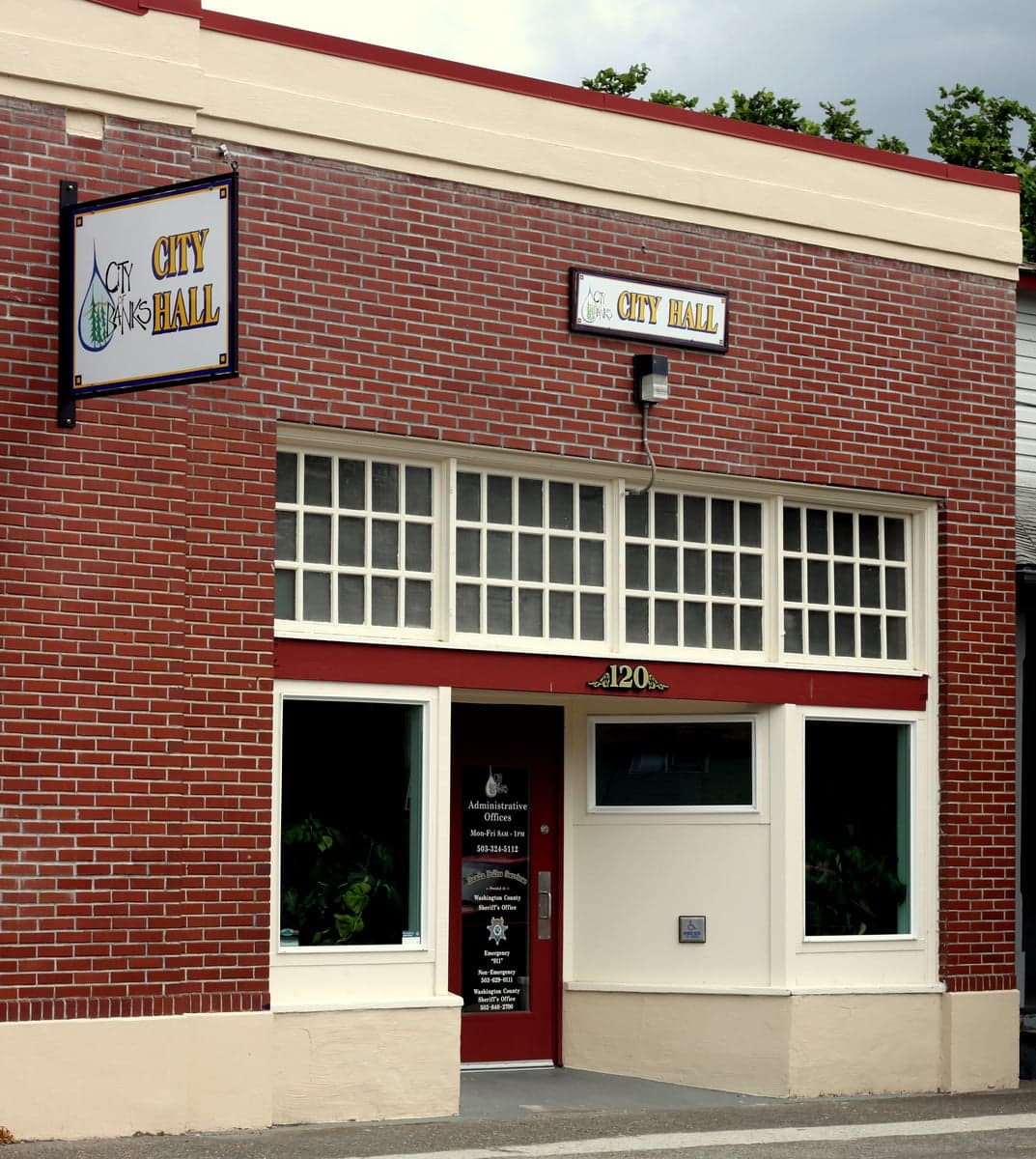
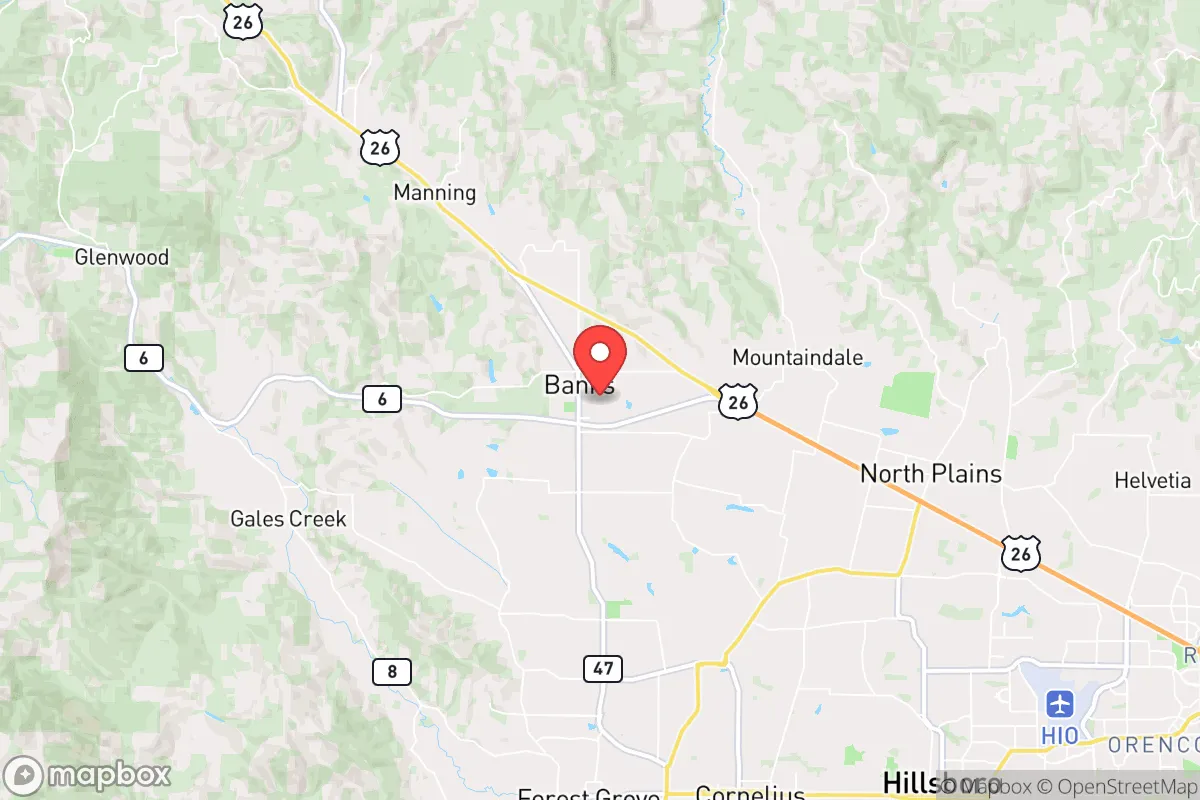
Photo: Wikipedia
Demographics of Banks, OR
Affluence Level in Banks, OR
A middle-class area roughly in line with national averages across income, home values, education, and employment.
People of Banks, OR
The people of Banks, Oregon, today number 2,092 and form a tight-knit, predominantly white community with a growing Hispanic minority. The city’s character is defined by its rural small-town feel, strong agricultural and timber roots, and a family-oriented, conservative-leaning culture. With a foreign-born population of just 1.7% and a college attainment rate of 33.5%, Banks is less diverse and less educated than the Portland metro area it borders, yet it offers a distinct identity as a quiet, affordable alternative to suburban sprawl.
How the city was settled and grew
Banks was originally settled in the 1850s by Euro-American homesteaders drawn to the fertile Tualatin Valley for farming and timber. The arrival of the Oregon Electric Railway in the early 1900s spurred the town’s first real growth, transforming it into a shipping point for local lumber and agricultural goods. The original population was almost entirely of Northern European descent—English, German, and Scandinavian families—who built the first homes along what is now Main Street and the surrounding Historic Downtown Banks district. These early settlers established the town’s enduring character: independent, resourceful, and rooted in the land. The city was officially incorporated in 1921, and for the next several decades, growth remained slow and steady, driven by the timber industry and local farming. The Banks-Vernonia State Trail, a rail-to-trail path, now traces the route of the old railway that once connected these early communities.
Modern era (post-1965)
After the 1965 Hart-Cellar Act, Banks saw very little direct immigration from abroad. Instead, the city’s modern growth has come almost entirely from domestic in-migration—primarily white families from the Portland metro area seeking larger lots, lower housing costs, and a slower pace of life. This wave began in the 1990s and accelerated after 2000, as suburban development pushed westward from Hillsboro and Beaverton. Newer subdivisions like Timber Creek Estates and Banks Crossing absorbed most of these arrivals, creating a contrast with the older, more established homes along Market Street and Treharne Avenue. The Hispanic population, now 12.1%, grew during this period as well, largely through families working in agriculture, construction, and service industries. They have concentrated in the South Banks area, near the railroad tracks and Highway 6, where more affordable rental housing is available. The Black population remains negligible at 0.7%, and East/Southeast Asian residents make up 1.4%, with no significant Indian subcontinent population (0.0%). The city’s racial and ethnic makeup has shifted only modestly, remaining overwhelmingly white (73.9%) compared to the state average of about 71%.
The future
Banks’ population is projected to grow slowly but steadily, driven by continued domestic migration from the Portland metro area. The city’s 2018 Comprehensive Plan anticipates adding roughly 500-700 new residents by 2038, with most growth occurring in planned subdivisions on the city’s eastern and southern edges. The Hispanic share of the population is likely to increase gradually, as younger Hispanic families have higher birth rates and continue to move into the area for work. However, the city’s overall diversity will remain low compared to Oregon’s urban centers. Newer developments like Banks Crossing and Sunset Meadows are attracting younger, more educated families—some with remote tech jobs—who value the rural lifestyle but bring slightly more progressive social views. This is creating a subtle cultural tension between longtime residents and newcomers, though the city’s conservative political leanings remain strong. The Historic Downtown area is seeing modest reinvestment, with new small businesses catering to both locals and trail users, but the core identity of Banks as a quiet, family-oriented, predominantly white community is unlikely to change dramatically in the next decade.
For someone moving in now, Banks offers a stable, low-crime, and affordable small-town environment where community ties run deep and change comes slowly. The population is becoming slightly more diverse and slightly more suburban, but the city remains a place where conservative values, outdoor recreation, and a strong sense of local identity define daily life. It is not a melting pot, but a community where newcomers are expected to fit into an existing culture rather than reshape it.

* Values derived from national, state, county, city and local statistics and may differ in a specific area. Last updated: 2026-10-02T13:43:37.000Z
Narrative content on this page is AI-generated and may contain mistakes. Verify any details that matter before acting on them.
ReloMaps may earn a commission from affiliate links at no extra cost to you.

