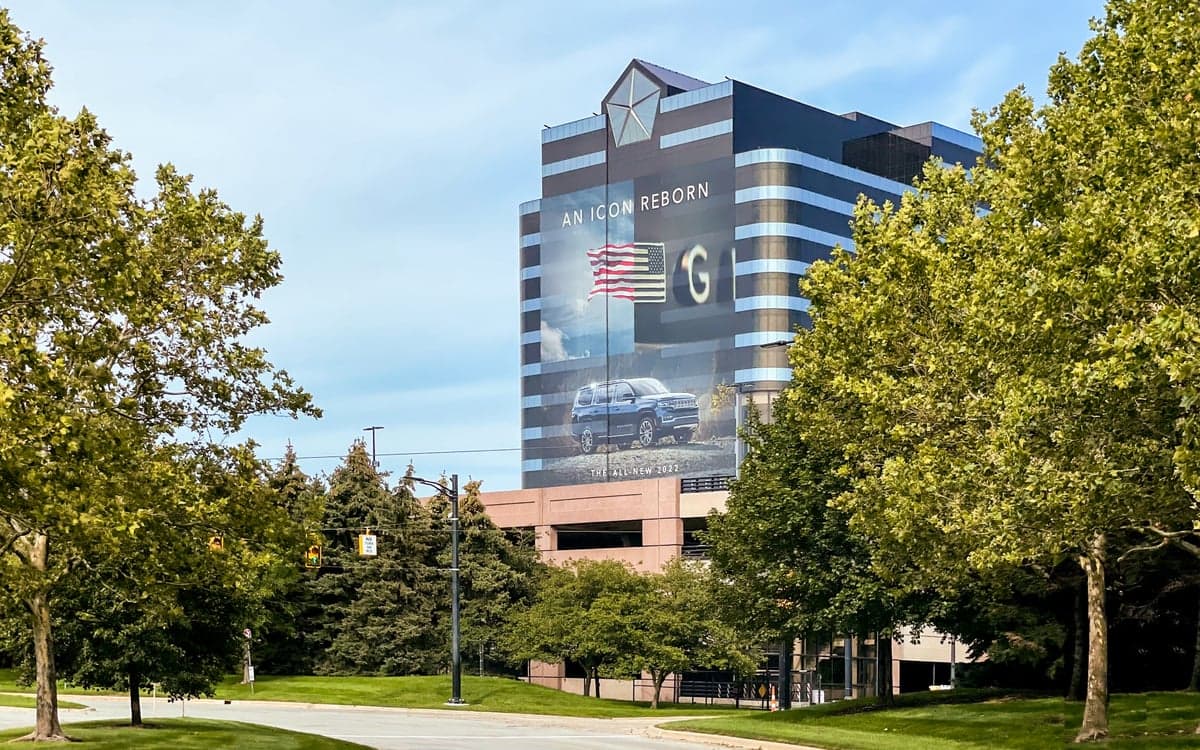
Photo: Wikipedia
Political ClimatePolitical Climate in Auburn Hills, MI
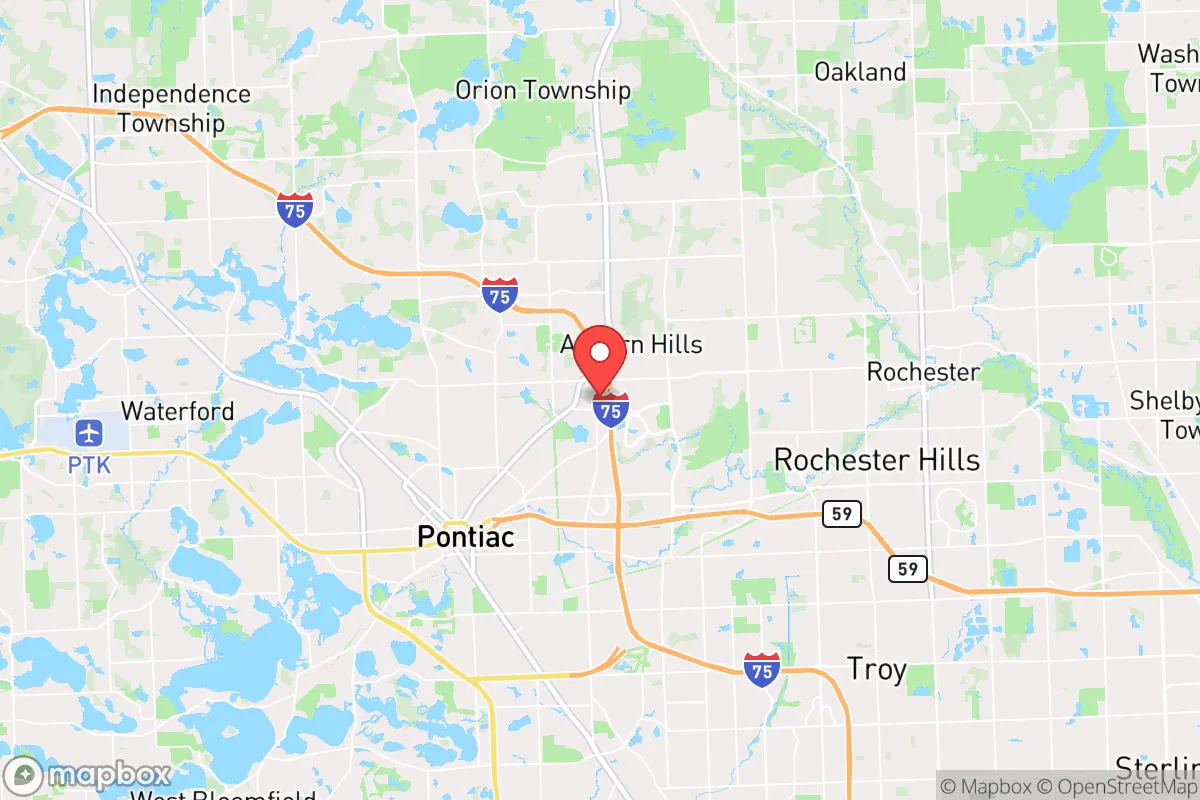
District shown is the primary district for this city’s centroid. Cities may span multiple districts.
Local Political AnalysisPolitical Analysis of Auburn Hills, MI
Auburn Hills leans reliably Democratic, carrying a Cook Partisan Voting Index of D+9 that places it well to the left of Michigan as a whole, which sits at EVEN. This isn't a new development; the city has trended blue for years, driven by its diverse, college-educated workforce and the anchor presence of Oakland University and the corporate headquarters of companies like Stellantis (formerly Fiat Chrysler). While you won't see the same kind of deep-red energy you'd find in, say, Oxford or Romeo just a few miles north, the political reality here is more nuanced than a simple D+9 label suggests — it's a pragmatic, suburban liberalism shaped more by economic stability and quality-of-life concerns than by ideological fervor.
How it compares
The contrast between Auburn Hills and its surrounding communities is stark and instructive. Drive ten minutes west to Rochester Hills or fifteen minutes north to Lake Orion, and you'll find precincts that lean Republican or are evenly split. The D+9 rating for Auburn Hills is largely a product of its dense, walkable downtown core near the university and the Great Lakes Crossing shopping district, where younger renters and students dominate. Meanwhile, the more rural townships of Oakland County — places like Brandon Township or Groveland Township — vote red by margins that would make a statewide race competitive. This makes Auburn Hills a blue island in a purple county, and a key reason why Michigan's 11th Congressional District (which includes the city) has flipped between parties in recent cycles. The city's trajectory is clear: as the university expands and more tech-adjacent employers move in, the Democratic lean is likely to solidify, not weaken.
What this means for residents
For liberal residents, Auburn Hills offers a comfortable environment where local policies tend to favor public transit investment, sustainability initiatives, and inclusive housing ordinances. You'll find city council meetings where climate action plans and affordable housing mandates are debated seriously, not dismissed outright. For conservative residents, the reality is more about coexistence than conflict. The city's tax base is strong — thanks to Stellantis and the auto R&D corridor — so there's little appetite for the kind of fiscal fights that divide other suburbs. You won't feel out of place flying a Trump flag from your pickup, but you also won't see many of them on the main drag. The practical effect is that both sides can find their niche: conservatives often live in the single-family home neighborhoods on the city's edges, while liberals cluster near the university and downtown lofts. The local school board and city council races are generally low-drama, focused on potholes and school capacity rather than culture-war flashpoints.
Culturally, Auburn Hills distinguishes itself from both the deep-blue enclaves of Ann Arbor and the redder exurbs to the north by being a place where politics rarely dominates daily life. The biggest local controversies in recent years have been about development density and traffic patterns, not abortion or guns. That's the real insider scoop: Auburn Hills is a D+9 city that votes like a D+9 city, but it lives like a place where most people just want good schools, safe streets, and a short commute. The political lean is real, but it's a quiet blue — pragmatic, suburban, and unlikely to change much in the next decade.

State Political ClimatePolitical Climate in Michigan
State Political AnalysisPolitical Environment in the State
Michigan is the ultimate swing state in 2026, carrying a Cook Partisan Voting Index of EVEN, meaning it votes almost exactly with the national average. Over the past 20 years, the state has lurched from reliably blue (voting for Kerry in 2004 and Obama twice) to a Trump pickup in 2016 by 0.2 points, then back to Biden in 2020 by 2.8 points, and then swung hard right again in 2024 with Trump winning it by 1.5 points. The dominant coalitions are a shrinking union-heavy, blue-collar Democratic base in the southeast (Wayne County, Macomb County) and a rapidly growing, exurban and rural Republican base in western and northern Michigan, with the critical swing voters living in the suburban "blue wall" counties of Kent (Grand Rapids), Oakland (north of Detroit), and Ottawa (Holland).
Urban vs. rural divide
The political map of Michigan is a story of three distinct regions. Detroit and its inner suburbs (Wayne County) are the Democratic anchor, delivering massive margins for the party, but the city's population decline has sapped that advantage over the decades. The real battleground is the "collar counties" around Detroit: Oakland County, once a Republican stronghold, has trended blue as educated professionals in places like Royal Oak and Ferndale have moved in, while Macomb County (Warren, Sterling Heights) remains the ultimate working-class bellwether—it went for Obama twice, then Trump twice, then Biden narrowly, then Trump again in 2024. Out west, Grand Rapids (Kent County) has flipped from red to purple to light blue as the city's downtown has boomed with young professionals and transplants, while the surrounding Ottawa County (Holland) remains deeply conservative, home to the Christian Reformed Church and a stronghold for the "DeVos family" political network. Up north, the Traverse City region and the entire Upper Peninsula are culturally conservative but economically populist, often splitting tickets between Republican presidential candidates and Democratic state legislators who protect the tourism and natural resources industries.
Policy environment
Michigan's policy environment is a mixed bag that reflects its swing-state status. The state has a flat income tax rate of 4.25%, which was cut from 4.35% in 2023 via a 2015 automatic trigger law. Property taxes are moderate, with the Headlee Amendment capping annual increases to the rate of inflation. Sales tax is 6%, with no local add-ons. On regulation, Michigan is a right-to-work state—but only barely: the GOP passed it in 2012, Democrats repealed it in 2023, and the repeal is currently tied up in court challenges. Education policy is a flashpoint: the state has a robust charter school sector (one of the most permissive in the Midwest) but also some of the nation's most powerful teachers' unions. Election laws are relatively accessible: no-excuse absentee voting was passed by voters via a 2018 ballot initiative, and same-day voter registration is available. There is no voter ID law requiring a photo—a non-photo ID or signed affidavit suffices.
Recent policy direction
The 2023-2024 legislative session under Democratic control (Governor Gretchen Whitmer, a narrow House and Senate majority) produced a flurry of progressive legislation that has defined the state's recent direction. On gun and self-defense law, Michigan passed universal background checks and a "red flag" extreme risk protection order law in 2023, making it one of the few states to do so post-COVID. On parental and education rights, the state repealed its 1931 abortion ban (a pre-Roe law) and codified abortion access into state law, while also expanding the Elliott-Larsen Civil Rights Act to include sexual orientation and gender identity—a move that has energized conservative parents' rights groups. On privacy and surveillance, Michigan has no comprehensive state privacy law like California or Virginia, though a bill is pending. On medical and bodily autonomy, recreational marijuana is legal (since 2018 via ballot initiative), and the state has a robust medical marijuana program. On property rights, Michigan is not a "taking" state that compensates landowners for regulatory value loss, but it does have strong agricultural property tax exemptions. On taxation, the 2023 budget included a significant expansion of the Earned Income Tax Credit, but also a retroactive tax on pension income that was later partially rolled back. On voting and ballot access, the 2022 ballot initiative "Promote the Vote 2022" expanded early voting, required drop boxes, and mandated that absentee ballots be counted if postmarked by Election Day—a system that has been heavily litigated by the GOP.
Civil unrest & political movements
Michigan has been a national flashpoint for political movements on both sides. The 2020 Whitmer kidnapping plot (involving militia members targeting the governor) and the Operation Gridlock protests at the state capitol (where armed protesters entered the building in April 2020 over COVID restrictions) put Michigan at the center of the national debate over public health mandates and Second Amendment rights. On the left, the Wolverine Watchmen militia case and the subsequent trials have kept the state in the news. Immigration politics are relatively quiet compared to border states, but Detroit and Ann Arbor have "sanctuary city" policies limiting cooperation with ICE, while rural counties like Lenawee and Hillsdale have passed resolutions declaring themselves "Second Amendment sanctuaries." Election integrity remains a live issue: the 2020 election in Michigan was the subject of multiple lawsuits and the "Audit the Vote" movement, and the 2024 election saw intense scrutiny of Wayne County's ballot counting process. A new resident will notice the "Don't Tread on Me" flags flying from pickup trucks in northern Michigan and the "We Believe" signs in progressive Ann Arbor yards—the cultural divide is visible and real.
Projection
Over the next 5-10 years, Michigan is likely to remain a true battleground, but the demographic trends favor a slight rightward shift. The in-migration from the Chicago area to western Michigan (Grand Rapids, Holland, Saugatuck) is bringing more moderate-to-conservative families, while the out-migration from Detroit to the suburbs and exurbs is diluting the Democratic base. The state's aging population (Michigan has one of the oldest median ages in the Midwest) tends to vote more Republican, while the youth vote in college towns like Ann Arbor, East Lansing, and Kalamazoo remains reliably blue but is a smaller share of the electorate. The wild card is the auto industry transition to electric vehicles: if the transition creates jobs in the conservative-leaning rural areas (battery plants in Big Rapids and Marshall), it could moderate those areas; if it kills traditional auto jobs in the blue-leaning southeast, it could push those voters further right. Expect the state to continue oscillating between parties every 2-4 years, with no permanent majority in sight.
For a new resident, the bottom line is this: Michigan offers a genuinely competitive political environment where your vote actually matters. If you're conservative, you'll find strong communities in the western suburbs of Grand Rapids, the Lake Michigan shoreline, and most of the Lower Peninsula north of Muskegon. If you're liberal, you'll be comfortable in Ann Arbor, Detroit proper, and the inner-ring suburbs of Oakland County. The state's policy environment is volatile—what's law today could be repealed in two years—so don't move here expecting a stable regulatory climate. What you get instead is a state where politics is a contact sport, the weather is real, and the people are direct. If you can handle the winters and the constant election ads, you'll find a place that rewards engagement and punishes apathy.
* Values derived from national, state, county, city and local statistics and may differ in a specific area. Last updated: 2026-10-13T16:28:29.000Z
Narrative content on this page is AI-generated and may contain mistakes. Verify any details that matter before acting on them.
ReloMaps may earn a commission from affiliate links at no extra cost to you.

