
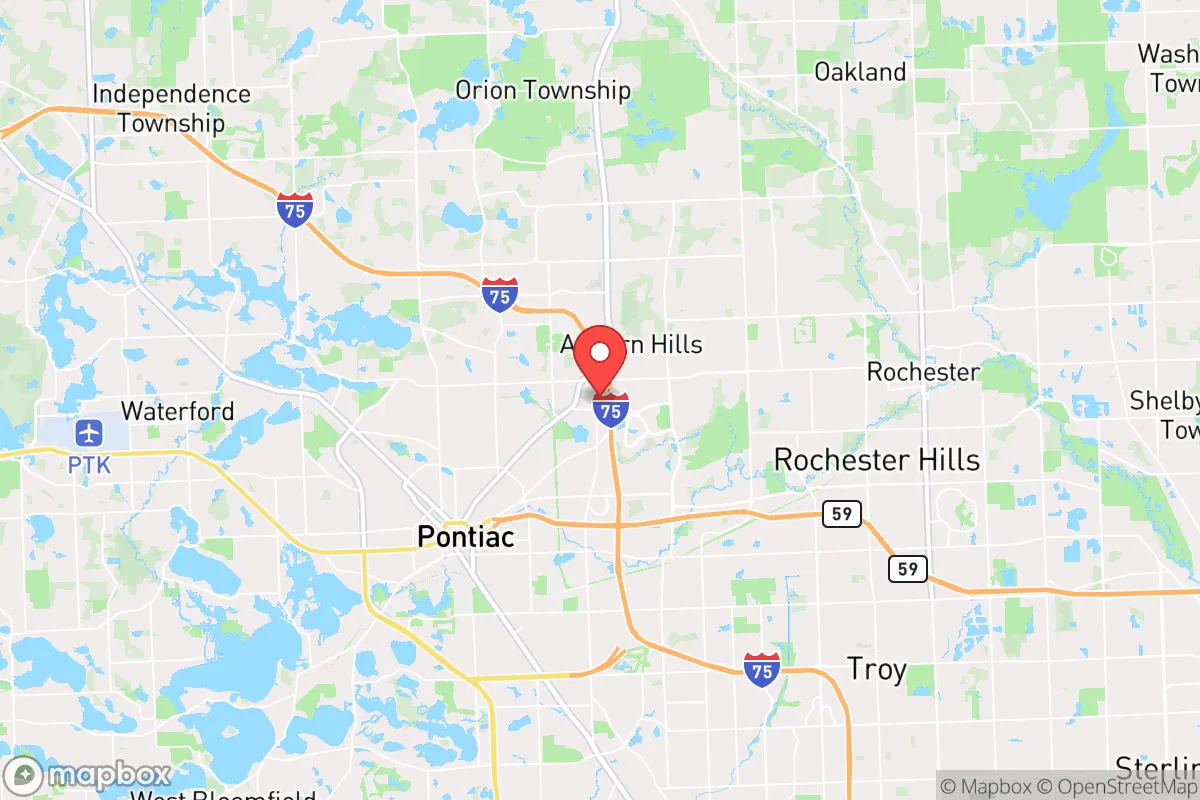
Photo: Wikipedia
Personal Sovereignty in Auburn Hills, MI
Strong independent fundamentals that actively favor personal liberty and low regulation.
What does Personal Sovereignty tell us?
Personal Sovereignty measures your capacity for self-reliance and independence with minimal government friction. Higher scores mean fewer barriers between you and the way you want to live... but it assumes you have the space you need and good neighbors.
What does this tell us?
Personal Sovereignty measures your capacity for self-reliance and independence with minimal government friction. Higher scores mean fewer barriers between you and the way you want to live... but it assumes you have the space you need and good neighbors.
State Policy
Energy independence: Importer (20% of energy produced in-state)
Personal Liberty
Homesteading

Personal Liberty Analysis
Auburn Hills, Michigan, offers a notably strong environment for personal sovereignty, blending Michigan's constitutional protections with a local culture that leans toward individual autonomy. As a suburban city in Oakland County, it provides residents with a legal and regulatory framework that generally respects personal choice, particularly in areas of self-defense, property rights, and parental authority. For those prioritizing independence and self-reliance, Auburn Hills presents a balanced option where state-level protections are robust, and local governance tends to be pragmatic rather than intrusive.
Tax burden and regulatory posture in Auburn Hills
Michigan's tax structure is moderate compared to many states, and Auburn Hills benefits from this balance. The state levies a flat 4.25% personal income tax, which is predictable and relatively low. Property taxes in Auburn Hills are governed by Michigan's Proposal A, which caps annual increases on taxable value at the rate of inflation or 5%, whichever is lower. This provides homeowners with long-term predictability and shields them from sudden spikes. The city's total millage rate is approximately 48 mills, which includes school operating and debt levies, placing it in the middle range for Oakland County. Sales tax is a flat 6%, with no local add-ons. On the regulatory side, Auburn Hills maintains a business-friendly posture, with streamlined permitting processes and a zoning code that accommodates both commercial and residential development without excessive red tape. The city does not impose rent control, and occupational licensing requirements are limited to state-mandated professions. For a resident seeking to minimize government entanglement in daily financial decisions, Auburn Hills offers a light-touch environment relative to many other Midwestern suburbs.
Self-defense and gun law specifics in Michigan
Michigan is a shall-issue state for concealed pistol licenses (CPL), meaning that if a resident meets statutory requirements — including a background check, fingerprinting, and an 8-hour training course — the county gun board must issue the license. Auburn Hills residents apply through the Oakland County Clerk's office, which processes applications efficiently. The state also permits open carry of handguns without a license for individuals legally allowed to possess firearms, though local ordinances in Auburn Hills do not restrict this. Michigan law provides strong stand-your-ground protections, eliminating any duty to retreat before using deadly force in self-defense when lawfully present. The state also recognizes the Castle Doctrine, which creates a presumption that a homeowner who uses force against an intruder acted reasonably. Magazine capacity is not restricted, and there is no state-level assault weapons ban. Background checks are required only for dealer sales, not private transfers. For a resident prioritizing the right to keep and bear arms, Auburn Hills sits within a legal framework that is among the most protective in the Great Lakes region.
Self-reliance and homesteading viability in Auburn Hills
Auburn Hills is primarily a suburban community, but it retains pockets of land that support self-reliance activities. Typical residential lot sizes range from 0.25 to 1 acre, with some larger parcels in the northern and western parts of the city. Zoning regulations permit backyard chickens on lots of at least half an acre, subject to a permit and distance requirements from neighboring structures. Beekeeping is allowed with registration, and vegetable gardens are unrestricted. However, the city's zoning code does not permit livestock such as goats or pigs on standard residential lots. Off-grid living is feasible in theory, but practical constraints exist: Auburn Hills requires connection to municipal water and sewer in most developed areas, and building codes mandate compliance with state energy standards. Solar panels are permitted with a building permit, and rainwater collection for non-potable uses is allowed. For a resident seeking a moderate level of homesteading — chickens, a large garden, and solar supplementation — Auburn Hills is viable. For full off-grid independence, more rural areas of Oakland County or neighboring Lapeer County would be more accommodating.
Personal liberties in Auburn Hills: parental rights, medical autonomy, speech, and property
Michigan law provides strong protections for parental rights. Parents have the legal authority to direct their children's education, including the option to homeschool without state interference. Auburn Hills is served by several public school districts, including Avondale and Pontiac, but parents may also enroll children in charter schools or private institutions. The state does not mandate vaccine requirements for homeschooled children, and medical exemption processes for public school vaccine mandates are straightforward. On medical autonomy, Michigan does not have a state-level right-to-try law for experimental treatments, but it does allow terminally ill patients access to investigational drugs under federal law. The state has not enacted broad vaccine passport mandates, and local businesses in Auburn Hills generally do not require proof of vaccination for entry. Free speech protections are robust, with no local ordinances restricting political signage or public assembly beyond standard time, place, and manner regulations. Property rights are well-protected: Michigan is a right-to-farm state, and while Auburn Hills is not an agricultural zone, the state's laws limit nuisance lawsuits against farms. Eminent domain is constrained by state law, and homeowners have strong protections against arbitrary seizure. For a resident who values the ability to make personal medical decisions, direct their children's upbringing, and speak freely without government overreach, Auburn Hills offers a legal environment that respects these liberties.
Overall, Auburn Hills provides a solid foundation for personal sovereignty, particularly for those who prioritize self-defense rights, predictable taxation, and parental authority. While it is not a libertarian enclave — municipal water and sewer requirements, moderate property taxes, and zoning restrictions on livestock are present — it compares favorably to many suburban communities in the Northeast and West Coast. For a single individual or family seeking a balance between suburban amenities and personal autonomy, Auburn Hills represents a pragmatic choice within a state that generally respects individual liberty.

* Values derived from national, state, county, city and local statistics and may differ in a specific area. Last updated: 2026-10-13T16:28:29.000Z
Narrative content on this page is AI-generated and may contain mistakes. Verify any details that matter before acting on them.
ReloMaps may earn a commission from affiliate links at no extra cost to you.

