
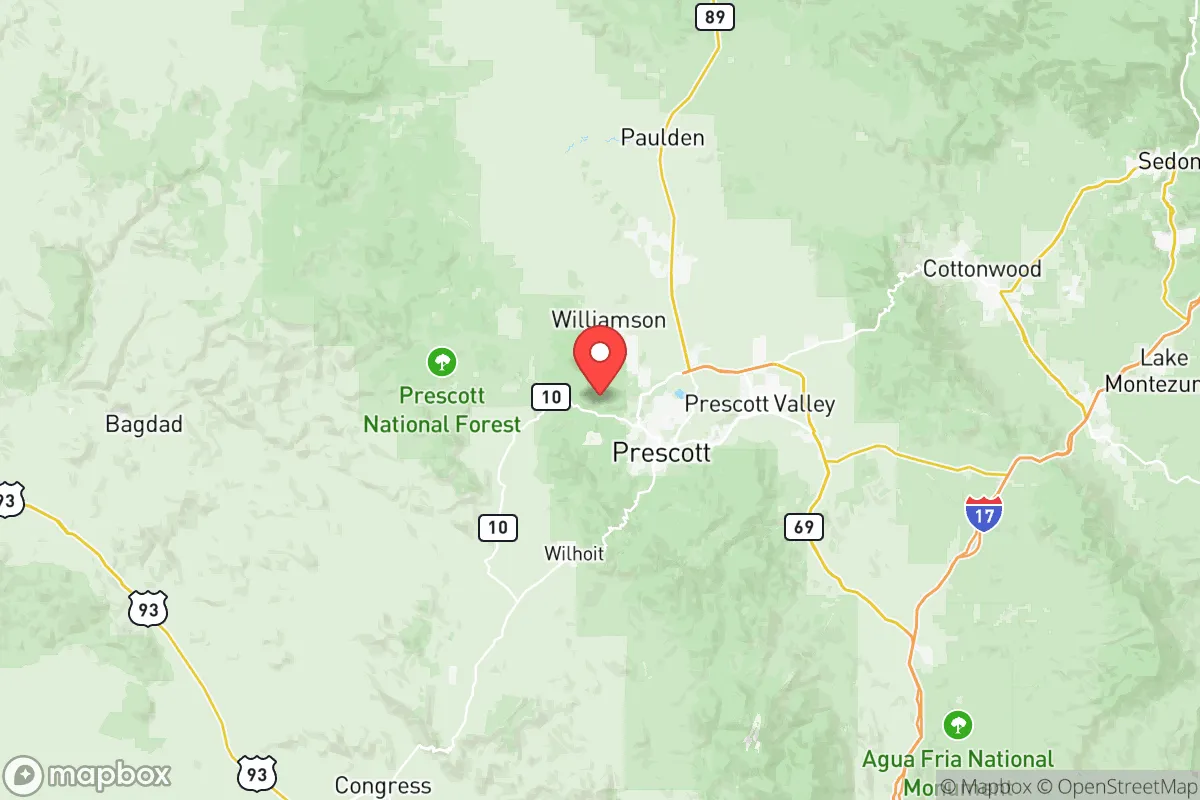
Photo: Wikipedia
Personal Sovereignty in Yavapai County
Viable for self-reliance. Generally workable, though some barriers may limit total independence.
What does Personal Sovereignty tell us?
Personal Sovereignty measures your capacity for self-reliance and independence with minimal government friction. Higher scores mean fewer barriers between you and the way you want to live... but it assumes you have the space you need and good neighbors.
What does this tell us?
Personal Sovereignty measures your capacity for self-reliance and independence with minimal government friction. Higher scores mean fewer barriers between you and the way you want to live... but it assumes you have the space you need and good neighbors.
State Policy
Energy independence: Importer (20% of energy produced in-state)
Personal Liberty
Homesteading

Personal Liberty Analysis
Yavapai County offers one of the strongest personal sovereignty environments in Arizona, combining low state-level interference with a deeply ingrained culture of self-reliance that spans from Prescott to the rural stretches of Bagdad and Seligman. The county’s regulatory posture is notably light-touch compared to urbanized Maricopa County or Pima County, and its residents benefit from Arizona’s broad preemption laws that limit local government overreach on everything from firearms to land use. For individuals and families who prioritize autonomy over convenience, Yavapai County presents a compelling balance of legal freedom and practical independence, though the degree of sovereignty varies significantly between incorporated cities like Prescott Valley and unincorporated areas like Williamson Valley or Skull Valley.
Tax burden and regulatory posture: How Yavapai County compares to Arizona’s urban centers
Arizona’s state-level tax environment is already favorable for personal sovereignty, with a flat income tax rate of 2.5% as of 2025 and no estate or inheritance tax. Yavapai County adds a relatively low sales tax rate of 8.35% in unincorporated areas, though this climbs to 9.35% inside Prescott city limits and 9.6% in Cottonwood. Property taxes remain among the lowest in the nation, with effective rates averaging around 0.62% of assessed value countywide. The regulatory posture is defined by Arizona’s strong preemption statutes: state law prohibits counties and cities from enacting stricter regulations than the state on firearms, occupational licensing, and short-term rentals. This means a homeowner in Chino Valley faces far fewer bureaucratic hurdles than a counterpart in Flagstaff or Tucson. The county’s planning and zoning department is generally described as pragmatic rather than adversarial, particularly in unincorporated areas where building permits for owner-built structures are processed with minimal friction. However, incorporated towns like Sedona and Jerome have adopted more restrictive land-use codes, so the regulatory experience depends heavily on whether you choose a city lot or a rural parcel.
Self-defense and gun law specifics: What the Second Amendment landscape looks like in Yavapai County
Arizona is a constitutional carry state, meaning no permit is required to carry a concealed firearm for anyone legally allowed to possess one, and Yavapai County fully reflects that posture. The county sheriff’s office, led by Sheriff David Rhodes as of 2025, has a public record of opposing any additional firearm restrictions and issues concealed carry permits on a shall-issue basis for those who want reciprocity with other states. Stand-your-ground laws are in full effect, with no duty to retreat in any place where a person has a legal right to be. The county’s gun culture is visible and normalized: open carry is common in Prescott, Chino Valley, and Dewey-Humboldt, and firearm retailers are plentiful along Highway 69 and in downtown Prescott. The Prescott Valley Police Department and Yavapai County Sheriff’s Office both maintain a cooperative relationship with the firearm community, and there are no local ordinances that restrict magazine capacity, ammunition sales, or firearm storage beyond state law. For a reader who prioritizes self-defense autonomy, Yavapai County is among the most permissive jurisdictions in the western United States, with the only meaningful limitation being federal restrictions on firearm purchases by prohibited persons.
Self-reliance and homesteading viability: Lot sizes, zoning, and off-grid feasibility across the county
Yavapai County’s unincorporated areas offer some of the most favorable conditions for homesteading and off-grid living in Arizona, but the feasibility varies sharply by location. In the western reaches around Bagdad and Wikieup, minimum lot sizes in rural zoning districts are typically 5 acres, and the county does not require connection to municipal water or sewer systems. Off-grid solar installations are permitted without special permitting beyond standard electrical inspection, and rainwater catchment is actively encouraged through state tax credits. The county’s building code follows the 2021 International Residential Code but allows owner-builder permits where the homeowner acts as their own general contractor, a significant advantage for self-reliant builders. In contrast, incorporated cities like Prescott and Cottonwood enforce stricter subdivision regulations and require engineered septic systems, which can raise costs for homesteaders. The town of Camp Verde has carved out a middle ground, with a rural character overlay that permits accessory dwelling units and small-scale agriculture on parcels as small as one acre. Water rights are a critical consideration: in the Prescott Active Management Area, new groundwater permits are restricted, while areas outside that boundary, such as parts of Yarnell and Peeples Valley, have fewer limitations. For a family seeking genuine self-sufficiency, the unincorporated areas of western and southern Yavapai County offer the most regulatory breathing room, while the Prescott Basin requires more careful navigation of water and zoning rules.
Personal liberties: Parental rights, medical autonomy, speech, and property protections
Arizona law provides strong protections for parental rights, including a statutory right to direct the upbringing and education of one’s children, and Yavapai County’s school districts generally accommodate homeschooling and private school enrollment without excessive reporting requirements. The county has a robust homeschooling community, with support networks in Prescott, Chino Valley, and Cottonwood that offer co-ops and extracurricular activities. Medical autonomy is protected by state law that prohibits mandatory vaccination requirements for school attendance beyond the standard exemptions, and Yavapai County has a higher-than-average rate of medical freedom advocacy, reflected in the presence of alternative health practitioners in Sedona and Prescott. Free speech protections are reinforced by Arizona’s lack of a state-level hate speech law and the county’s general deference to First Amendment activity, though local ordinances in Sedona regulate signage and public assembly more strictly than in unincorporated areas. Property rights are secured by Arizona’s private property protections, including a requirement that government demonstrate a clear public necessity for any taking, and Yavapai County has a reputation for resisting eminent domain abuse. The county’s planning department generally respects the principle that landowners should be able to use their property as they see fit, provided they meet basic health and safety standards, which is a meaningful distinction from more interventionist counties in California or the Pacific Northwest.
Overall, Yavapai County ranks among the top-tier jurisdictions in the United States for personal sovereignty, particularly for those who choose unincorporated areas over the more regulated city limits of Prescott or Sedona. The combination of constitutional carry, low property taxes, minimal zoning interference in rural zones, and strong state-level preemption creates an environment where individuals and families can exercise a high degree of autonomy in their daily lives. Compared to the regulatory density of Maricopa County or the political volatility of Pima County, Yavapai offers a more stable and predictable legal landscape for the self-reliant. For a conservative-leaning reader weighing relocation options, the county’s main trade-off is between the convenience of Prescott Valley’s services and the near-total freedom of a 10-acre parcel in Skull Valley or Williamson Valley — both are available, and the choice depends on how much autonomy you actually want to exercise.

* Values derived from national, state, county, city and local statistics and may differ in a specific area. Last updated: 2026-06-21T00:18:44.000Z
Narrative content on this page is AI-generated and may contain mistakes. Verify any details that matter before acting on them.
ReloMaps may earn a commission from affiliate links at no extra cost to you.

