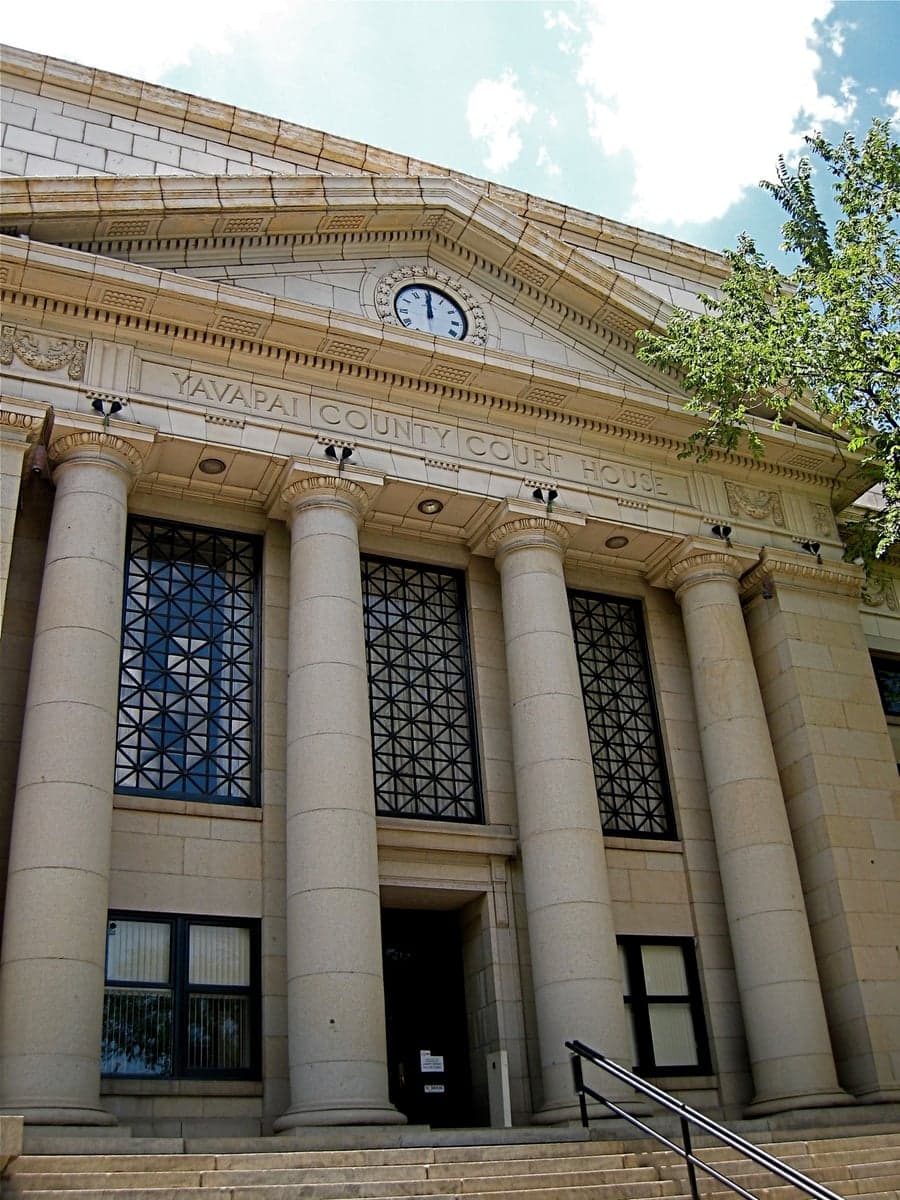
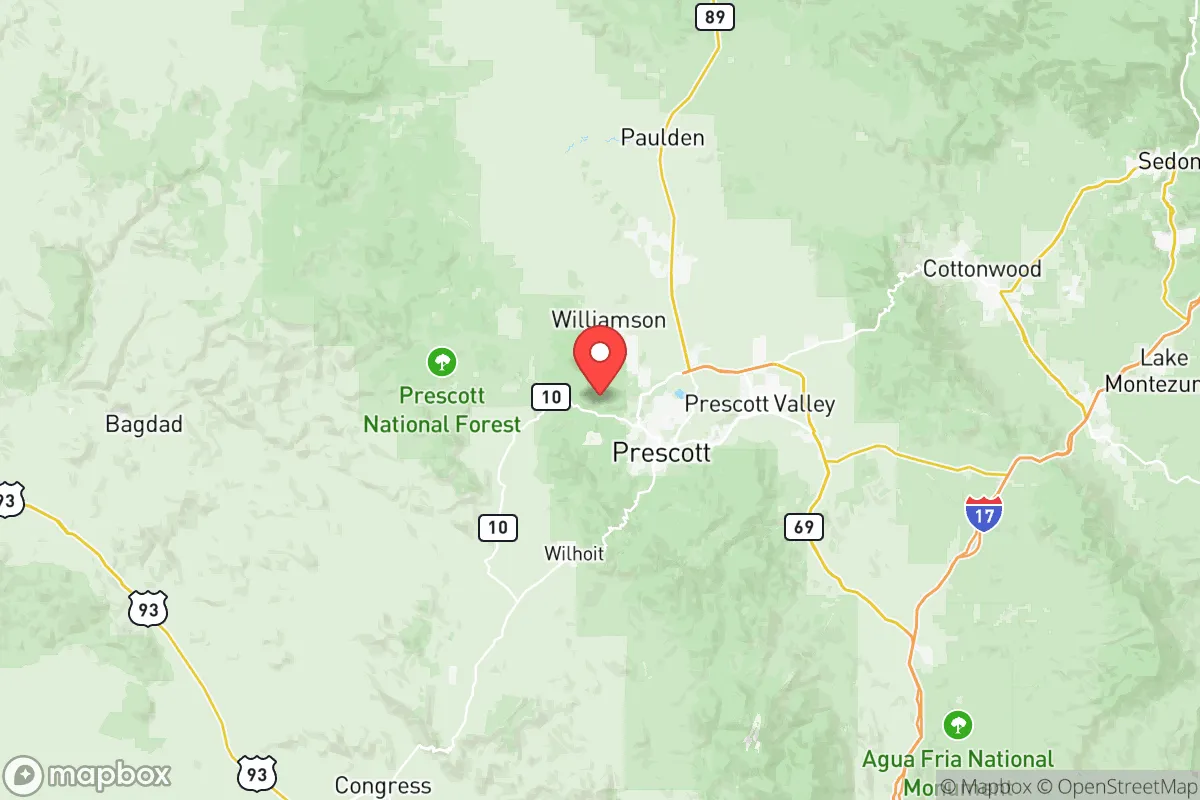
Photo: Wikipedia
Demographics of Yavapai County
Affluence Level in Yavapai County
A middle-class area roughly in line with national averages across income, home values, education, and employment.
People of Yavapai County
Yavapai County’s 241,656 residents today form a predominantly white, politically conservative population that is older than the state average, with a strong libertarian streak and a deep attachment to the region’s mining and ranching heritage. The county is characterized by a mix of small cities like Prescott, the historic territorial capital, and sprawling unincorporated communities such as Prescott Valley and Chino Valley, where retirees, remote workers, and second-home owners have reshaped the landscape. With a foreign-born share of just 3.2% and a Hispanic population of 15.0%, Yavapai remains one of Arizona’s least ethnically diverse counties, though its cultural identity is increasingly split between longtime ranching families and newer arrivals from California and the Midwest seeking a slower pace of life.
Settlement & growth (pre-1960)
Long before European contact, the area now called Yavapai County was home to the Yavapai people, a Yuman-speaking tribe whose bands—the Tolkepaya, Yavepe, and Wipukpa—lived in extended family groups across the Verde Valley, the Bradshaw Mountains, and the high plateaus near present-day Prescott. The Yavapai were semi-nomadic hunter-gatherers who moved seasonally between the low desert and the pine forests, and they fiercely resisted encroachment. Spanish explorers passed through as early as the 1580s under Antonio de Espejo, but no permanent Spanish settlement took root; the region’s rugged terrain and the Yavapai’s resistance kept it outside the mission system that defined southern Arizona.
American settlement began in earnest after the 1863 discovery of gold in the Bradshaw Mountains, which triggered a rush of white prospectors and miners. The same year, President Abraham Lincoln signed the Arizona Organic Act, and Prescott was founded as the territorial capital—a position it held until 1889. The early Anglo population was overwhelmingly male, drawn from the mining camps of California, Nevada, and Colorado, with a smaller number of Cornish and Irish miners who brought hard-rock mining expertise. The U.S. Army’s campaign against the Yavapai and Apache culminated in the 1875 removal of roughly 1,500 Yavapai to the San Carlos Apache Reservation, a forced march known as the “Yavapai Trail of Tears” that depopulated the county of its original inhabitants. Today, the Yavapai-Prescott Indian Tribe operates a small reservation just outside Prescott, and the Yavapai-Apache Nation is based in Camp Verde, representing a combined enrolled population of roughly 2,500.
After the mining boom subsided in the 1890s, the county’s economy shifted to ranching, dryland farming, and timber. Homesteaders—many of them Anglo families from Texas, the Midwest, and the South—settled in the broad valleys around Chino Valley, Paulden, and Ash Fork, where they raised cattle and grew hay. A distinct Mormon presence emerged in the 1870s and 1880s, with Latter-day Saint families establishing farming communities in the Verde Valley near Camp Verde and Cottonwood, though the Mormon share of the county never reached the levels seen in eastern Arizona. By 1900, Yavapai County was overwhelmingly native-born white, with a small Hispanic population concentrated in the mining towns of Jerome and Clarkdale, where Mexican and Mexican-American laborers worked the copper mines. The 1910 census recorded just 1.2% of the county’s population as foreign-born, a figure that would remain low for decades.
The Great Depression and the Dust Bowl sent a modest wave of displaced farmers from Oklahoma, Texas, and Arkansas into Yavapai, but the county’s population grew slowly—from about 24,000 in 1930 to 28,000 in 1950. The real transformation began after World War II, when returning veterans and retirees from the Midwest and California discovered Prescott’s mild four-season climate and affordable land. The construction of Interstate 17 in the 1960s, linking the Verde Valley to Phoenix, accelerated this trend, turning Cottonwood and Camp Verde into bedroom communities for the state capital.
Modern era (post-1965)
The 1965 Hart-Cellar Act had little direct effect on Yavapai County, which never developed the large immigrant enclaves seen in Phoenix or Tucson. The foreign-born share peaked at just 4.1% in 2010 and has since declined to 3.2%, reflecting the county’s limited job base in agriculture and hospitality and its lack of a major urban center. The Hispanic population, however, has grown steadily—from 8.5% in 1990 to 15.0% today—driven primarily by domestic migration from southern Arizona and California, not by new immigration. Most Hispanic residents live in the Verde Valley towns of Cottonwood, Clarkdale, and Camp Verde, where they work in construction, retail, and the wine industry, as well as in Prescott Valley’s service sector.
The dominant demographic story of the post-1965 era is domestic in-migration, particularly from California. Between 2000 and 2020, Yavapai County added roughly 80,000 residents, with the vast majority coming from California, Colorado, and the Pacific Northwest. These new arrivals—disproportionately white, college-educated, and over 50—have concentrated in master-planned subdivisions in Prescott Valley, Dewey-Humboldt, and the newer developments on the outskirts of Prescott. The county’s median age rose from 42 in 2000 to 51 in 2020, making it one of the oldest counties in Arizona. This wave has reshaped the county’s politics: while Yavapai remains deeply Republican—Donald Trump won 62% of the vote in 2024—the newer Californian transplants have pushed the county slightly more moderate on environmental issues and land conservation, creating friction with the older ranching and mining families.
The East/Southeast Asian population remains tiny at 0.9%, with small clusters of Chinese-American and Filipino-American families in Prescott and Prescott Valley, many of them connected to the county’s two hospitals and Embry-Riddle Aeronautical University. The Indian-subcontinent population is negligible at 0.1%, and the Black population, at 0.6%, is one of the smallest of any Arizona county. These figures reflect Yavapai’s continued lack of the industrial, tech, or academic job base that draws diverse populations to Maricopa County. The county’s racial homogeneity is self-reinforcing: newcomers are overwhelmingly white retirees or remote workers who choose Yavapai precisely for its small-town, low-crime character.
The future
Yavapai County’s population is projected to reach roughly 280,000 by 2040, with growth concentrated in Prescott Valley, Dewey-Humboldt, and the expanding subdivisions along the State Route 69 corridor. The county is likely to become slightly more Hispanic—perhaps reaching 20% by 2040—as younger Hispanic families from Phoenix and southern Arizona move north for lower housing costs and a slower pace. The white share will decline gradually but remain above 70%, and the county will almost certainly stay one of Arizona’s least diverse. The biggest wild card is water: Yavapai relies entirely on groundwater and the Verde River system, and state projections show that at current growth rates, the Prescott Active Management Area could face a supply deficit by the 2030s. This could slow development and push future growth toward higher-density infill in Prescott and Cottonwood rather than sprawling subdivisions.
Culturally, the county is becoming a hybrid of two Americas: the old ranching and mining Yavapai, embodied by the annual Prescott Frontier Days rodeo and the Whiskey Row saloons, and the new Yavapai of golf-course communities, farmers’ markets, and remote-work coffee shops. The tension between these two groups—over growth, water, and land use—will define the county’s politics for the next decade. For a newcomer, Yavapai offers a reliably conservative, low-crime environment with strong community institutions, but it requires accepting a population that is older, whiter, and more insular than almost any other part of the Sun Belt.

* Values derived from national, state, county, city and local statistics and may differ in a specific area. Last updated: 2026-06-21T00:18:44.000Z
Narrative content on this page is AI-generated and may contain mistakes. Verify any details that matter before acting on them.
ReloMaps may earn a commission from affiliate links at no extra cost to you.

