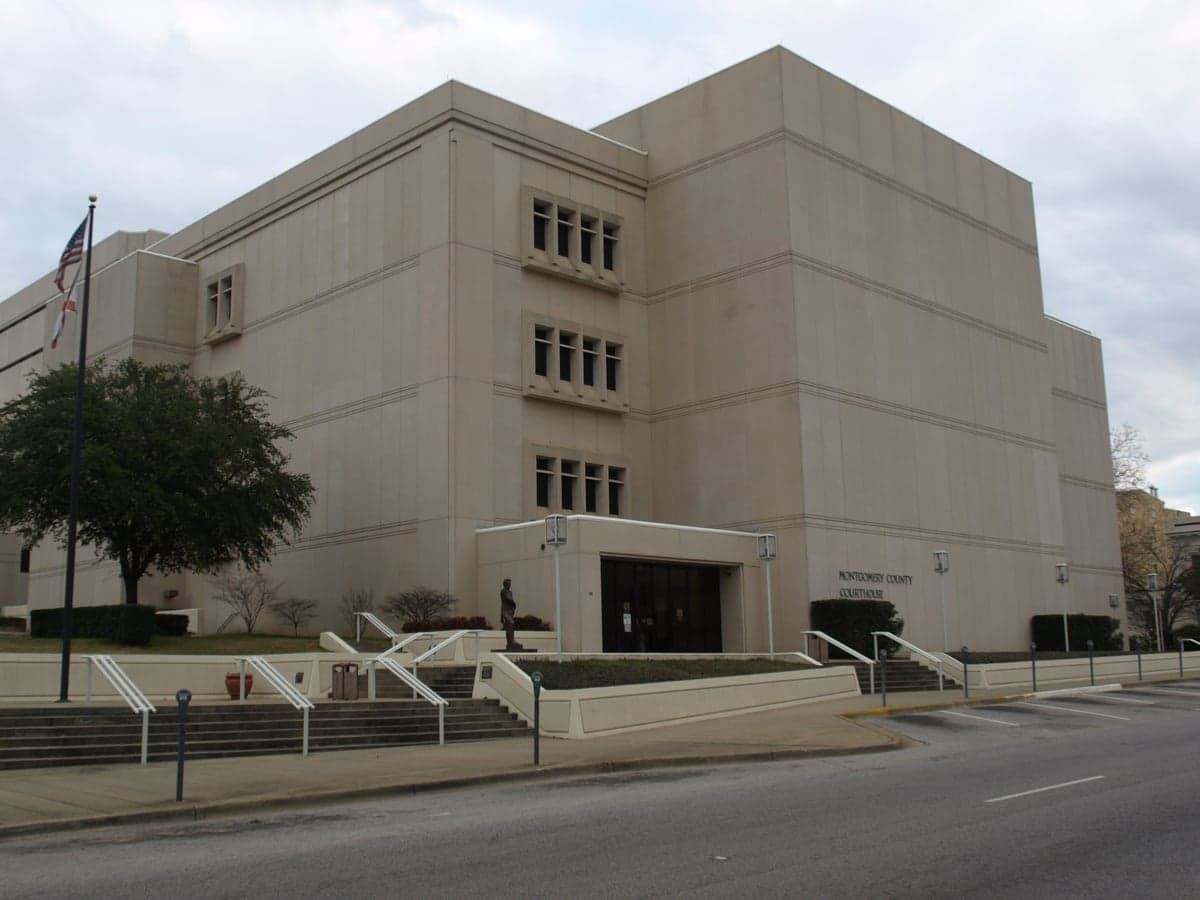
Photo: Wikipedia
Demographics of Montgomery County
Affluence Level in Montgomery County
A below-average socioeconomic profile. Incomes, home values, and educational attainment trail the U.S., with higher poverty and unemployment.
People of Montgomery County
The people of Montgomery County, Alabama, today form a majority-Black population (58.6%) with a significant White minority (30.6%) and small but growing Hispanic (4.8%) and Asian (2.5%) communities, creating a demographic profile that is both deeply rooted in Southern history and gradually diversifying. With a total population of 227,197, the county is anchored by the state capital of Montgomery, a city whose character has been shaped by the civil rights movement, government employment, and a legacy of Black political and cultural leadership. The foreign-born share remains low at 3.5%, and the college-educated rate of 34.3% reflects the presence of state government, Maxwell Air Force Base, and several universities, giving the area a mix of working-class, professional, and military families.
Settlement & growth (pre-1960)
Long before European settlement, the area that is now Montgomery County was home to the Alabama and Coushatta Native American peoples, part of the Creek Confederacy. The first Europeans to arrive were Spanish explorers in the 16th century, but no permanent settlement took hold until the French established Fort Toulouse in 1717 near present-day Wetumpka, just north of the county line. The region passed from French to British to Spanish control before becoming part of the United States after the War of 1812, when the Creek War (1813-1814) broke Creek resistance and opened the land to American settlers.
The first major wave of American settlers were Scots-Irish and English planters from Virginia, Georgia, and the Carolinas, who arrived in the 1810s and 1820s to establish cotton plantations. They founded the city of Montgomery in 1819 by merging two earlier settlements, East Alabama and New Philadelphia, and the county was created the same year. These early settlers brought enslaved Black laborers, who quickly became the majority of the population. By 1860, enslaved people made up roughly 55% of the county's residents, and the economy was entirely dependent on cotton cultivation and the slave trade. Montgomery itself became a major domestic slave-trading hub, with slave markets operating downtown.
After the Civil War and emancipation, the freed Black population remained in the county, working as sharecroppers, tenant farmers, and later as urban laborers. The Reconstruction era saw Black political participation, including the election of Black legislators, but this was violently suppressed by the end of the 19th century. The Great Migration (roughly 1910-1970) saw tens of thousands of Black residents leave Montgomery County for industrial jobs in the North and Midwest, reducing the Black share of the population. Meanwhile, the county's White population grew with the expansion of state government and the establishment of Maxwell Air Force Base in the 1920s, which brought military families from across the country. The city of Prattville, just north of the county line in Autauga County, and the town of Pike Road within Montgomery County, began to see suburban growth in the post-World War II period, as White families moved to new developments away from the urban core.
Modern era (post-1965)
The 1965 Hart-Cellar Act had a limited immediate effect on Montgomery County, as the area did not attract the large-scale immigration seen in coastal or border states. However, the post-1965 period brought two transformative domestic shifts: the return of Black residents in the reverse Great Migration and the suburbanization of the White population. Since 2000, the county has seen a net increase in Black residents moving from Northern and Midwestern cities back to the South, drawn by lower costs of living, family ties, and the cultural and political significance of Montgomery as a civil rights landmark. This reverse migration has reinforced the county's Black majority, which now stands at 58.6%.
The Hispanic population, while still small at 4.8%, has grown steadily since the 1990s, driven by immigration from Mexico and Central America for work in construction, agriculture, and the service industry. The largest concentrations are in Montgomery itself, particularly in the eastern and southern parts of the city, and in the town of Pike Road, where new housing developments have attracted a mix of families. The Asian population (East and Southeast Asian, excluding Indian subcontinent) stands at 2.5%, with a notable Vietnamese community that formed after the Vietnam War, concentrated in central Montgomery near the Vaughn Road corridor. The Indian subcontinent population (0.8%) is smaller but growing, primarily professionals in medicine and technology, living in the East Montgomery area near Baptist Medical Center South and the Hyundai Motor Manufacturing plant. The White population, now 30.6%, has become increasingly concentrated in the suburban and exurban areas: Pike Road, the East Montgomery suburbs, and the town of Coosada in the county's northern reaches. The city of Montgomery itself is now roughly 60% Black, with White residents concentrated in a few eastern neighborhoods and the historic Old Cloverdale district.
Suburbanization has reshaped the county since the 1970s, with the development of East Montgomery along the Eastern Boulevard (U.S. 80) corridor and the incorporation of Pike Road as a town in 1997, which has since grown into the county's fastest-growing municipality. The Hyundai plant, opened in 2005 in the western part of the county near Hope Hull, brought a wave of Korean and other Asian professionals, though many commute from the Auburn-Opelika area or live in East Montgomery. The military presence at Maxwell Air Force Base and Gunter Annex continues to bring a transient population of active-duty personnel and civilian contractors from across the country, adding to the county's diversity.
The future
Montgomery County is projected to become more diverse over the next 10-20 years, though the pace of change will be slower than in the fast-growing Sun Belt metros of Texas or Georgia. The Black majority is expected to remain stable or grow slightly, as reverse migration from the North continues and the White population ages and suburbanizes further. The Hispanic share is likely to rise from 4.8% toward 7-8% by 2040, driven by both immigration and higher birth rates, with new communities forming in Pike Road and the East Montgomery suburbs. The Asian and Indian populations will grow modestly, tied to the expansion of the Hyundai plant and the medical sector, but will remain small overall. The foreign-born share, currently 3.5%, will likely rise to 5-6% but stay well below the national average.
The most significant demographic trend is the continued suburbanization of the White population and the gentrification of select urban neighborhoods. Pike Road is expected to double in population by 2040, attracting families of all races but remaining predominantly White and affluent. Meanwhile, the city of Montgomery is seeing reinvestment in historic Black neighborhoods like Centennial Hill and the Garden District, drawing a mix of Black professionals, young White families, and retirees. The cultural identity of the county is evolving from a stark Black-White binary toward a more multiethnic, though still predominantly Black and White, character. For someone moving in now, Montgomery County offers a deeply historic, majority-Black Southern capital with a growing suburban fringe, a stable military presence, and a cost of living that remains low by national standards.
What Montgomery County is becoming is a more suburban, slightly more diverse, and economically bifurcated place: a Black-led urban core with a growing professional class, surrounded by predominantly White suburbs that are themselves slowly diversifying. For a relocating family or individual, the choice is between the historic density and cultural richness of Montgomery itself and the newer, more homogeneous subdivisions of Pike Road or East Montgomery, with the county's future likely to see that suburban ring expand while the urban core continues its slow revitalization.

* Values derived from national, state, county, city and local statistics and may differ in a specific area. Last updated: 2026-06-21T15:43:05.000Z
Narrative content on this page is AI-generated and may contain mistakes. Verify any details that matter before acting on them.
ReloMaps may earn a commission from affiliate links at no extra cost to you.

