
Photo: Wikipedia
Personal Sovereignty in Montgomery County
Viable for self-reliance. Generally workable, though some barriers may limit total independence.
What does Personal Sovereignty tell us?
Personal Sovereignty measures your capacity for self-reliance and independence with minimal government friction. Higher scores mean fewer barriers between you and the way you want to live... but it assumes you have the space you need and good neighbors.
What does this tell us?
Personal Sovereignty measures your capacity for self-reliance and independence with minimal government friction. Higher scores mean fewer barriers between you and the way you want to live... but it assumes you have the space you need and good neighbors.
State Policy
Energy independence: Importer (45% of energy produced in-state)
Personal Liberty
Homesteading

Personal Liberty Analysis
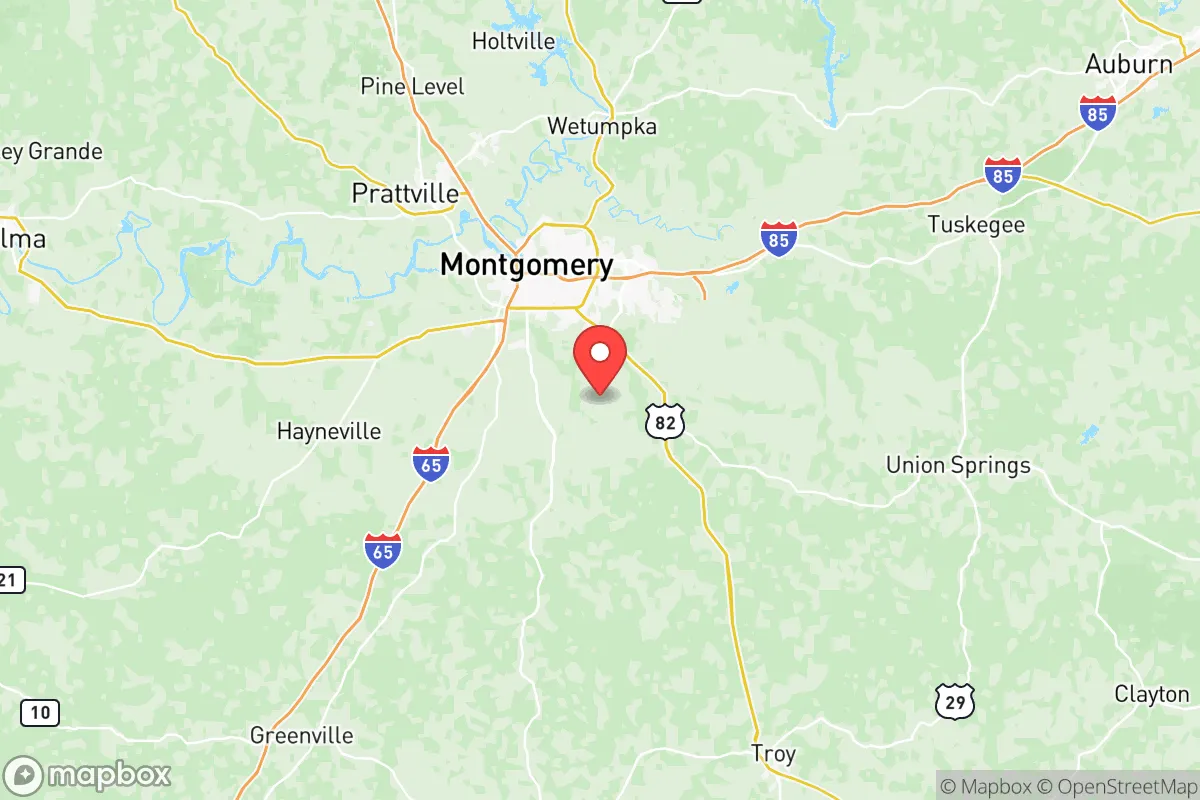
Montgomery County, Alabama, offers a notably high degree of personal sovereignty compared to many urban and suburban areas in the Southeast, driven by a light-touch regulatory environment, strong state-level preemption laws, and a culture that values self-reliance. The county seat, Montgomery, is the state capital and largest city, but its regulatory posture is tempered by state laws that limit local control over firearms, land use, and taxation. Surrounding communities like Pike Road, Wetumpka (just across the county line in Elmore County), and the unincorporated areas of Mount Meigs and Hope Hull provide distinctly different autonomy profiles, ranging from suburban order to near-rural independence. For a relocation reader prioritizing personal freedom, the county presents a mixed but generally favorable landscape, with the strongest sovereignty found outside the city limits of Montgomery.
Tax burden and regulatory posture: How heavy is the hand of government?
Alabama is one of the most tax-friendly states in the U.S., and Montgomery County reflects that. There is no state or local income tax on wages, and the combined state and local sales tax in Montgomery city is 10%, while unincorporated areas of the county see rates as low as 8% (4% state, 2% county, 2% local). Property taxes are among the lowest in the nation, with an effective rate around 0.4% of assessed value. The regulatory posture is generally light: there are no county-wide zoning ordinances in unincorporated areas, meaning property owners in places like Mount Meigs or Hope Hull can use their land for a variety of purposes without seeking variances. Montgomery city does have zoning and building codes, but they are not considered onerous compared to peer cities. Business licensing is straightforward, and there are no county-level occupational taxes. The state's right-to-work laws and limited union presence further reduce regulatory friction for entrepreneurs and tradespeople.
Self-defense and gun law specifics: What are the rules of the road?
Alabama is a constitutional carry state, meaning no permit is required to carry a concealed firearm for anyone 19 or older (18 for military members) who is legally allowed to possess a firearm. Montgomery County does not impose any additional restrictions beyond state law. The sheriff's office issues concealed carry permits for reciprocity purposes, but they are not required for in-state carry. Stand-your-ground laws are in effect, with no duty to retreat in any place where the individual is lawfully present. Castle doctrine protections extend to vehicles and occupied structures. There are no county-level firearm registration or storage laws. The city of Montgomery has no local gun ordinances that exceed state preemption, which is strong and broadly interpreted. Gun ranges and firearms retailers are common, with several in the county including the Montgomery Shooting Complex and private clubs in the Pike Road area. The culture is generally pro-Second Amendment, and open carry is legal without a permit.
Self-reliance and homesteading viability: Can you live off the land?
Homesteading and self-reliance are highly viable in Montgomery County, particularly outside the urban core. Unincorporated areas like Mount Meigs, Hope Hull, and the rural stretches near the Autauga County line offer lots of 1 to 10 acres at affordable prices (often under $5,000 per acre). There are no county-level restrictions on keeping livestock, including chickens, goats, or cattle, in unincorporated areas. Gardening, beekeeping, and rainwater collection are unregulated. Off-grid living is feasible: there are no county mandates for grid connection, and solar panel installation is not subject to HOA restrictions in unincorporated areas (though subdivisions may have covenants). The city of Montgomery does have animal ordinances and requires permits for certain livestock within city limits, but the county as a whole is very permissive. Water access is generally via well, and septic systems are standard for rural properties. The growing community of Pike Road, while more suburban, still allows for larger lots (often 0.5 to 2 acres) and has a more permissive approach to backyard agriculture than Montgomery proper.
Personal liberties: Parental rights, medical autonomy, speech, and property
Alabama has strong protections for parental rights, including a law that requires parental consent for medical procedures on minors and a robust opt-out framework for school curricula. Medical autonomy is limited by state law: there is no state-level vaccine mandate, and the state has passed legislation restricting certain public health orders. Speech is protected under the First Amendment, and there are no county-level restrictions on political expression or assembly. Property rights are strongly protected: eminent domain is limited to public use, and there is no county-level rent control or landlord licensing. The state's homestead exemption protects up to $15,500 of assessed property value from creditors. Montgomery County does not have a county-wide noise ordinance, and there are no restrictions on the display of flags or political signage on private property. The city of Montgomery does have some sign ordinances, but they are not aggressively enforced in residential areas.
Overall, Montgomery County offers a high degree of personal sovereignty relative to most metropolitan areas in the U.S., with the strongest autonomy found in unincorporated areas like Mount Meigs, Hope Hull, and the rural fringes near the Autauga County line. The combination of no income tax, constitutional carry, permissive land use, and strong property rights creates an environment where self-reliant individuals and families can operate with minimal government interference. The city of Montgomery itself is more regulated but still far less restrictive than comparably sized cities in states like California, New York, or even Georgia. For a relocation reader who values personal freedom, Montgomery County represents a solid choice, particularly if they are willing to live outside the city limits and embrace a rural or semi-rural lifestyle.

* Values derived from national, state, county, city and local statistics and may differ in a specific area. Last updated: 2026-06-21T15:43:05.000Z
Narrative content on this page is AI-generated and may contain mistakes. Verify any details that matter before acting on them.
ReloMaps may earn a commission from affiliate links at no extra cost to you.

