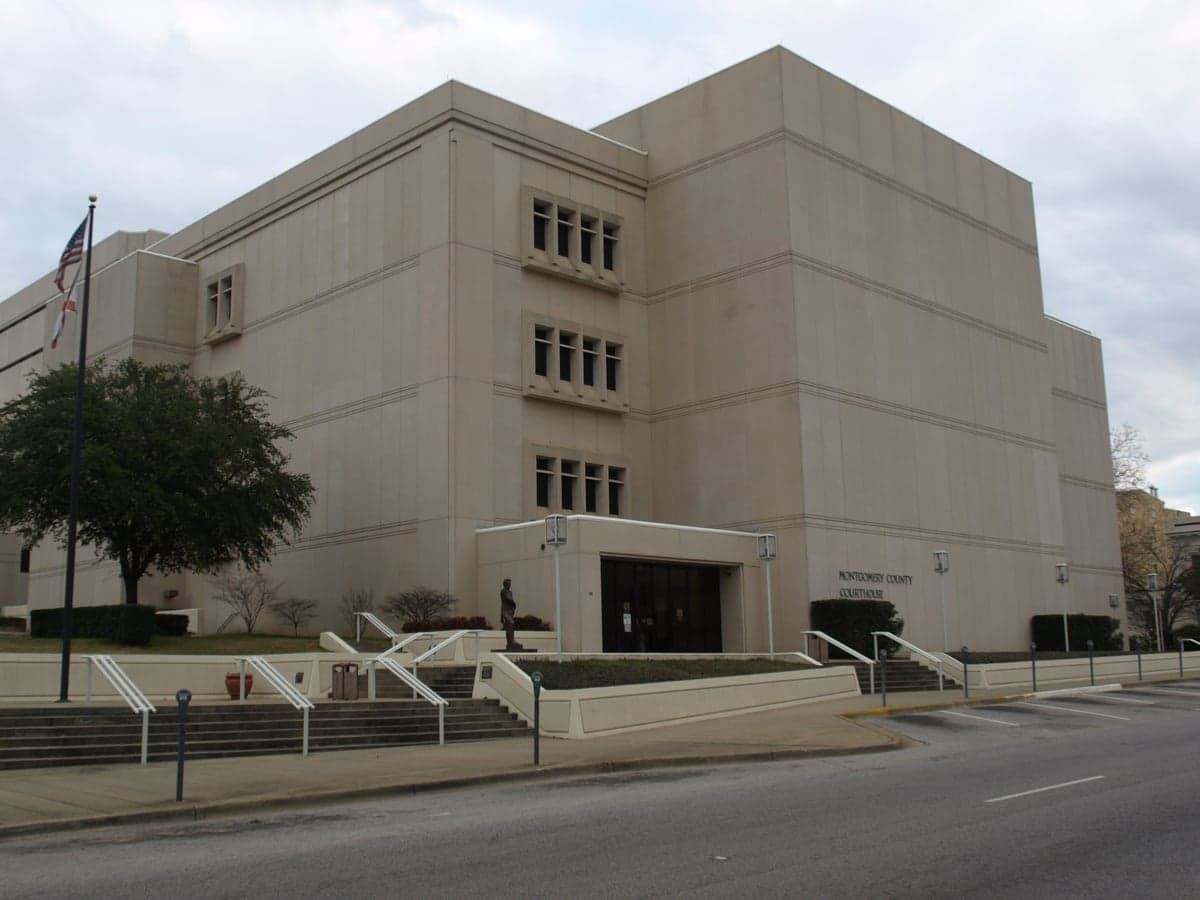
Photo: Wikipedia
Political ClimatePolitical Climate in Montgomery County
Showing district-level results — no local-only data available.
Local Political AnalysisPolitical Analysis of Montgomery County
Montgomery County, Alabama, is a Democratic stronghold in an otherwise deeply Republican state, carrying a Cook Partisan Voting Index (PVI) of D+5. This stands in stark contrast to Alabama's statewide PVI of R+14, making the county a true political island. The city of Montgomery itself drives this blue lean, powered by a large African American population and a strong base of progressive and moderate white voters, particularly in the historic Old Cloverdale and Garden District neighborhoods. However, the political reality is far from monolithic; as you head south toward Pike Road or east toward the rural stretches near the Tallapoosa River, the landscape shifts dramatically red, with precincts often voting 70% or more for Republican candidates.
How it compares
The gap between Montgomery County and the rest of Alabama isn't just wide—it's one of the starkest urban-rural divides in the South. While the state as a whole has moved decisively to the right over the past two decades, Montgomery has held steady as a D+5 county, a testament to the political organization and turnout of its Black electorate, which makes up roughly 60% of the county's population. Compare that to neighboring Autauga or Elmore counties, which are R+20 or more, and you see a complete inversion of the state's political norms. The swing precincts aren't in the suburbs; they're in the city's northern and eastern fringes, places like the area around the Hyundai plant or the newer developments off Vaughn Road, where a mix of moderate white families and upwardly mobile Black professionals can tip a local race either way. In statewide elections, Montgomery County reliably delivers a 15-20 point margin for Democrats, but that's rarely enough to overcome the massive Republican margins from the rest of the state.
What this means for residents
For liberal residents, Montgomery County offers a rare pocket of political refuge in Alabama. You can live your life, attend city council meetings, and see your values reflected in local policy—like the city's push for criminal justice reform and its support for LGBTQ+ nondiscrimination ordinances—without feeling like a complete outlier. Conservative residents, particularly in the Pike Road and eastern county areas, often feel more aligned with the state government in Montgomery (the city) than with the city government itself. They tend to focus on local school board races and county commission seats, where their votes carry more weight. The practical upshot is a constant, low-grade tension: the city government pushes progressive initiatives on minimum wage or policing, while the state legislature, dominated by rural Republicans, frequently preempts or overrides them. It creates a political dynamic where residents learn to navigate two very different levels of government simultaneously.
Culturally, this divide manifests in everything from school choice debates to economic development priorities. The city of Montgomery leans into its civil rights history and arts scene, while the county's unincorporated areas emphasize agriculture, manufacturing, and a more traditional Southern lifestyle. The Hyundai and Kia plants in the eastern part of the county have brought in a more diverse, globally-minded workforce that doesn't fit neatly into either political camp. Long-term, the county's blue lean is likely to persist as long as its urban core remains demographically stable, but the surrounding suburbs and exurbs will continue to deepen in their Republican identity, making Montgomery County an ever more distinct political outlier within Alabama.

State Political ClimatePolitical Climate in Alabama
State Political AnalysisPolitical Environment in the State
Alabama is a deeply conservative state with a Cook PVI of R+14, meaning it votes about 14 points more Republican than the national average in presidential elections. The state hasn't voted for a Democratic presidential candidate since 1976, and that partisan lean has only hardened over the past two decades as the old "Yellow Dog Democrat" tradition in rural areas has faded and been replaced by a solidly Republican electorate. The dominant coalition is a mix of evangelical Christians, rural voters, and suburbanites, while the Democratic base is largely confined to the Black Belt counties and the city of Birmingham.
Urban vs. rural divide
The political map of Alabama is starkly divided. The major metro areas—Birmingham, Huntsville, and Montgomery—are the state's Democratic strongholds, with Jefferson County (Birmingham) and Montgomery County consistently voting blue. Huntsville, despite its high concentration of defense and aerospace workers, has trended more purple in recent cycles, though it still leans Republican overall. The rural counties, particularly in the northern part of the state and the Wiregrass region in the southeast, are overwhelmingly Republican. The Black Belt, a swath of counties stretching across the central part of the state with majority-Black populations, remains reliably Democratic, though turnout there is often lower than in the rest of the state. Mobile and Baldwin counties on the Gulf Coast are a mixed bag: Baldwin is deeply red, while Mobile is more competitive but still leans Republican. The political reality is that a Democrat running statewide must rack up huge margins in Jefferson and Montgomery counties while hoping to keep losses manageable everywhere else—a math problem that has proven nearly impossible in recent cycles.
Policy environment
Alabama's policy environment is shaped by a low-tax, limited-government philosophy. The state has no state-level property tax to speak of—the average effective property tax rate is around 0.4%, one of the lowest in the nation. Income tax is a flat 5%, and the state sales tax is 4%, though local add-ons can push it much higher in some cities. The regulatory posture is business-friendly, with right-to-work laws and minimal zoning restrictions in most areas. Education policy has been a flashpoint: the state has a robust school choice movement, with the Alabama Accountability Act providing tax credits for private school tuition, and the recent creation of the Alabama School Choice and Education Savings Account (ESA) program in 2024. Healthcare is a perennial issue—Alabama did not expand Medicaid under the Affordable Care Act, leaving a coverage gap for roughly 200,000 low-income adults. Election laws are among the stricter in the country: voter ID is required, early voting is limited, and absentee voting requires an excuse. The state also passed a law in 2024 banning the use of private money to fund election administration, a response to the "Zuckerbucks" controversy from 2020.
Recent policy direction
The last few years have seen Alabama move decisively in a conservative direction on a broad range of issues. On gun rights, the state passed constitutional carry in 2022, allowing permitless carry of concealed firearms. On education and parental rights, the legislature passed the Alabama Parental Rights Protection Act in 2023, which requires schools to notify parents of any changes to a student's mental or physical health and prohibits classroom instruction on sexual orientation or gender identity in grades K-5. The state also passed a law in 2024 banning the use of puberty blockers and hormone therapy for minors. On abortion, Alabama has one of the most restrictive laws in the country—the Human Life Protection Act of 2019 bans nearly all abortions, with no exceptions for rape or incest, and only a narrow exception for the life of the mother. On property rights, the state has strong eminent domain protections and no statewide zoning mandates. On voting and ballot access, the legislature has tightened absentee ballot rules and shortened the window for requesting mail-in ballots. The overall direction is toward maximizing individual liberty on guns and property while restricting it on social and medical issues.
Civil unrest & political movements
Alabama has not seen the kind of large-scale civil unrest that has hit other states in recent years, but there have been notable flashpoints. The 2020 Black Lives Matter protests in Birmingham and Montgomery were significant but largely peaceful, with some property damage in downtown Birmingham. The state's immigration politics are relatively quiet compared to border states, though there have been periodic controversies over the enforcement of the 2011 Beason-Hammon Alabama Taxpayer and Citizen Protection Act, which was one of the strictest immigration laws in the country at the time. Election integrity has been a recurring theme: the state's Republican Secretary of State has been vocal about voter roll maintenance and the removal of non-citizens from the rolls, and there was a brief controversy in 2022 over the use of ballot drop boxes in Jefferson County. There is no serious secessionist movement in Alabama today, though "state sovereignty" rhetoric occasionally surfaces in political speeches. The most visible political movements are the pro-life and school choice advocacy groups, which have significant influence in the state capitol.
Projection
Over the next 5-10 years, Alabama's political trajectory is likely to remain deeply conservative, but there are demographic shifts worth watching. Huntsville is growing rapidly, driven by the expansion of the Redstone Arsenal and the broader defense and aerospace sector, and that growth is bringing in a more educated, more moderate electorate. The city's politics could shift toward the center over time, much like what has happened in other tech-heavy Southern cities. Meanwhile, the Black Belt continues to lose population, which weakens the Democratic base. In-migration from other states is modest compared to places like Texas or Florida, but the newcomers who do arrive tend to be retirees and remote workers drawn by low taxes and low cost of living—a demographic that leans Republican. The wild card is the state's education system: if the school choice movement succeeds in improving outcomes, it could reinforce the state's conservative coalition; if not, the state could see a slow bleed of families to other states. A new resident moving in now should expect Alabama to be as conservative in 2034 as it is today, with perhaps a slightly more moderate flavor in the growing metro areas.
For a new resident, the bottom line is this: Alabama is a state where conservative values are baked into the policy landscape, from taxes to guns to education. If you lean right, you'll find a government that largely shares your priorities. If you lean left, you'll be in a clear minority, but you'll find your political community in Birmingham, Montgomery, or the Black Belt. The practical takeaway is that the state's politics are stable and predictable—what you see is what you're going to get for the foreseeable future.
* Values derived from national, state, county, city and local statistics and may differ in a specific area. Last updated: 2026-06-21T15:43:05.000Z
Narrative content on this page is AI-generated and may contain mistakes. Verify any details that matter before acting on them.
ReloMaps may earn a commission from affiliate links at no extra cost to you.

