
Photo: Wikipedia
Demographics of Lee County
Affluence Level in Lee County
A middle-class area roughly in line with national averages across income, home values, education, and employment.
People of Lee County
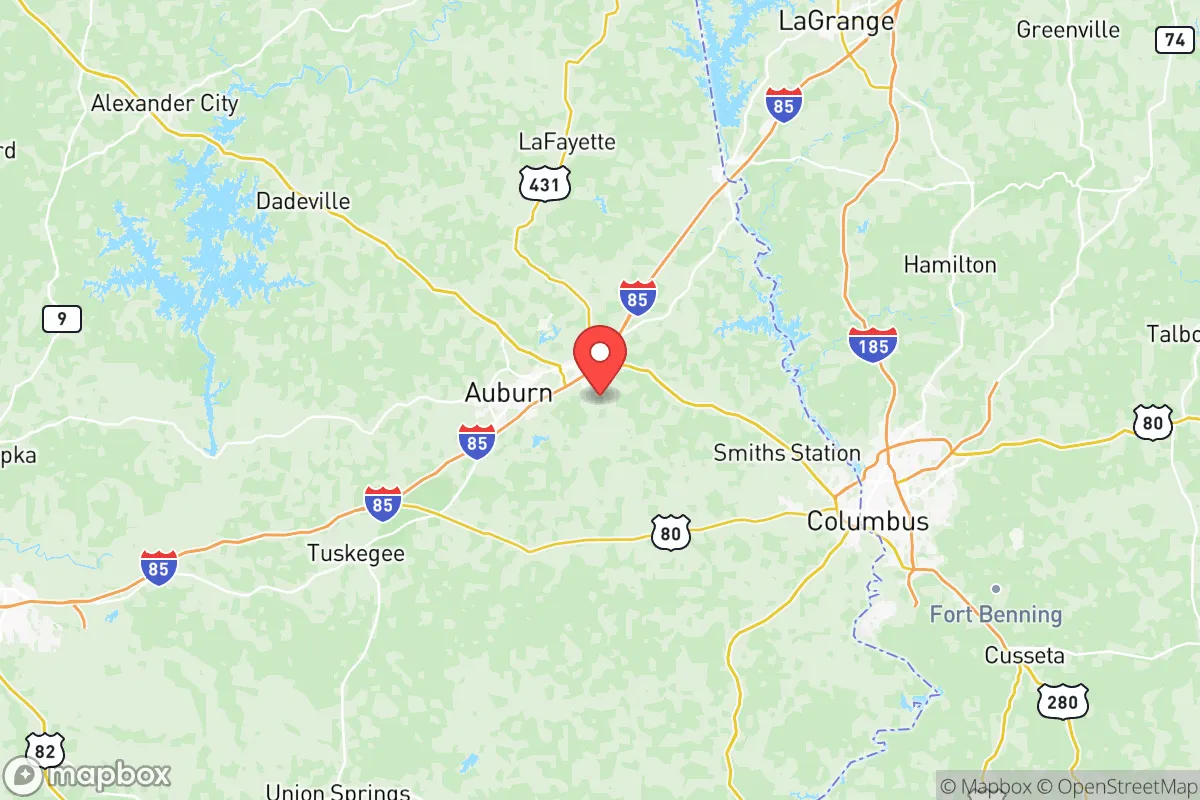
Lee County, Alabama, is home to 177,663 residents who blend Deep South tradition with a rapidly modernizing, university-driven economy. The population is 65.9% white, 21.9% Black, 5.3% Hispanic, 3.4% East/Southeast Asian, and 0.8% Indian (subcontinent), with 41.3% holding a college degree and only 4.1% foreign-born. This is a county shaped by Auburn University, the legacy of plantation agriculture, and a steady influx of professionals and families drawn to the Auburn-Opelika metro area. The character is distinctly Southern but increasingly suburban and educated, with a conservative-leaning civic culture that is being gently reshaped by growth from outside the region.
Settlement & growth (pre-1960)
Before European settlement, the area that is now Lee County was part of the ancestral homeland of the Muscogee (Creek) Nation, with major towns along the Chattahoochee River. The Creeks were forcibly removed in the 1830s under the Indian Removal Act, opening the land to white settlers. The county was created in 1866 from parts of Macon, Russell, and Chambers counties, named for Confederate General Robert E. Lee. The first major wave of settlers were Scots-Irish and English farmers from Georgia and the Carolinas, who arrived in the 1830s-1850s to grow cotton on small to medium-sized plantations. They founded the towns of Auburn (1836) and Opelika (1854), which became the county's twin anchors. Auburn was established as a planned town around the East Alabama Male College (now Auburn University), while Opelika grew as a railroad and industrial center.
After the Civil War, the Black population surged as freed slaves settled in the county, many working as sharecroppers and tenant farmers. By 1870, Black residents made up roughly 45% of the population, concentrated in rural areas and in the town of Loachapoka, which became a majority-Black community with its own schools and churches. The post-Reconstruction era saw the rise of Jim Crow laws, which enforced segregation and limited Black economic mobility. The 1890s brought a small wave of German and Irish immigrants who worked as merchants and craftsmen in Opelika, but foreign-born populations remained tiny. The early 20th century saw the founding of Smiths Station (1900s) as a farming hamlet, and Waverly (1830s, incorporated later) as a cotton-ginning center. The Great Migration (1910-1970) drew many Black residents out of Lee County to Northern industrial cities, reducing the Black share of the population from 45% in 1900 to about 30% by 1960. Meanwhile, Auburn University's growth as a land-grant institution began attracting faculty and students from across the South, laying the groundwork for the county's modern identity.
Modern era (post-1965)
The 1965 Hart-Cellar Act had a modest direct impact on Lee County, as the foreign-born share remains low at 4.1%. However, the county's demographic transformation since 1965 has been driven primarily by domestic migration and suburbanization. The most significant shift has been the expansion of Auburn University, which grew from 8,000 students in 1960 to over 30,000 today. This brought a wave of faculty, researchers, and graduate students from across the U.S. and abroad, particularly in engineering, agriculture, and veterinary sciences. The East/Southeast Asian population (3.4%) is largely composed of Chinese, Korean, and Vietnamese academics and their families, concentrated in the Auburn neighborhoods near campus, such as the Woodfield and Cary Creek areas. The Indian (subcontinent) population (0.8%) is similarly university-linked, with many working in tech and engineering roles at Auburn's research parks.
The Hispanic population (5.3%) grew rapidly after 1990, driven by Mexican and Central American immigrants who arrived for construction, poultry processing, and agricultural work. They are concentrated in Opelika, particularly in the Pepperell and South Railroad Avenue neighborhoods, and in Smiths Station, where many work in the region's poultry plants. The Black population (21.9%) has stabilized after decades of out-migration, with many families now rooted in the county for generations. Black communities are concentrated in Loachapoka, Notasulga (partially in Macon County), and the northern sections of Opelika. The white population (65.9%) has grown through suburban sprawl from Auburn and Opelika, with new subdivisions spreading into Beauregard and Salem. The county's college-educated share (41.3%) is double the national average, reflecting the university's gravitational pull on professionals. Suburbanization has been intense: the Auburn-Opelika metro area grew by 18% between 2010 and 2020, with most new housing built in the corridor between the two cities and along the I-85 corridor toward Valley and Lanett in neighboring Chambers County.
The future
Lee County's population is projected to continue growing at a steady pace, likely reaching 200,000 by 2035. The primary driver will remain Auburn University's expansion, which shows no signs of slowing. The foreign-born share is expected to rise slowly, possibly reaching 6-7% by 2040, as the university recruits more international faculty and as Hispanic families settle permanently. The East/Southeast Asian and Indian populations will likely grow modestly, remaining concentrated in Auburn's academic and tech sectors. The Hispanic population is the fastest-growing demographic segment, with a projected share of 8-10% by 2040, spreading from Opelika into the surrounding unincorporated areas. The Black population share is expected to remain stable or decline slightly, as white and Hispanic in-migration outpaces Black natural increase. The county's cultural identity is becoming less distinctly Southern and more of a hybrid: a conservative-leaning university town with a growing suburban middle class that values schools, safety, and economic opportunity. The tension between Auburn's liberal academic culture and the county's broader conservative electorate will likely persist, but the overall trajectory is toward a more diverse, more educated, and more suburban population.
For someone moving in now, Lee County offers a stable, growing community with strong schools, a low crime rate relative to the national average, and a cost of living that remains below the U.S. average. The population is becoming more diverse but remains predominantly white and Black, with a small but growing Hispanic and Asian presence. The county's identity is anchored by Auburn University, which provides both economic stability and a cultural counterweight to the region's traditional conservatism. New arrivals will find a place that is changing steadily but not radically, where the pace of growth is manageable and the quality of life is high for those who value education, community, and a slower pace of life.

* Values derived from national, state, county, city and local statistics and may differ in a specific area. Last updated: 2026-07-08T01:52:37.000Z
Narrative content on this page is AI-generated and may contain mistakes. Verify any details that matter before acting on them.
ReloMaps may earn a commission from affiliate links at no extra cost to you.

