
Photo: Wikipedia
Personal Sovereignty in Lee County
Viable for self-reliance. Generally workable, though some barriers may limit total independence.
What does Personal Sovereignty tell us?
Personal Sovereignty measures your capacity for self-reliance and independence with minimal government friction. Higher scores mean fewer barriers between you and the way you want to live... but it assumes you have the space you need and good neighbors.
What does this tell us?
Personal Sovereignty measures your capacity for self-reliance and independence with minimal government friction. Higher scores mean fewer barriers between you and the way you want to live... but it assumes you have the space you need and good neighbors.
State Policy
Energy independence: Importer (45% of energy produced in-state)
Personal Liberty
Homesteading

Personal Liberty Analysis
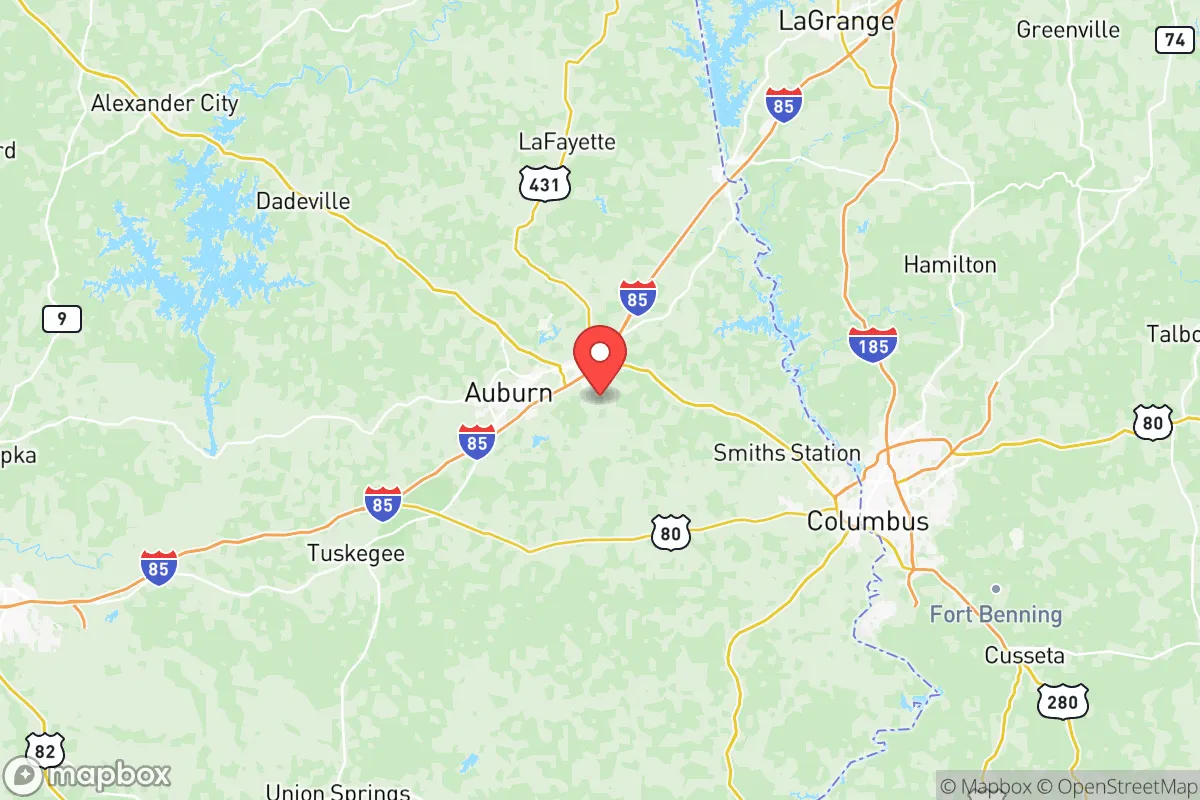
Lee County, Alabama, offers a personal sovereignty environment that is broadly favorable to individual autonomy, particularly when compared to more heavily regulated states in the Northeast or West Coast, though it is not a libertarian free-for-all. The county’s character is shaped by a mix of the Auburn-Opelika metro area’s university influence and the more rural, traditionalist attitudes in towns like Loachapoka, Salem, and Smiths Station. Residents generally enjoy low taxes, permissive gun laws, and a regulatory culture that leans toward personal responsibility, but local zoning and development rules can vary significantly between the urban core and the outlying communities.
Tax burden and regulatory posture: How Alabama’s light-touch approach affects Lee County
Alabama’s state-level tax and regulatory posture is among the most business- and individual-friendly in the nation, and Lee County largely reflects this. The state has a flat income tax rate of 5% on taxable income over $3,000, and the combined state and local sales tax in Lee County averages around 9-10%, depending on the municipality. Property taxes are exceptionally low: the effective rate in Lee County is roughly 0.33% of assessed home value, meaning a $300,000 home carries an annual tax bill of about $990. This is a fraction of what homeowners pay in states like Texas or Illinois. Regulatory burden is light: there is no state-level occupational licensing for many trades, no state income tax on Social Security benefits, and no estate or inheritance tax. However, the city of Auburn enforces stricter zoning and building codes than unincorporated areas or smaller towns like Opelika and Notasulga. For a reader prioritizing minimal government interference, the rural parts of Lee County—especially around Salem and Loachapoka—offer the most hands-off environment, while Auburn’s university-driven planning means more permitting and design review.
Self-defense and gun law specifics: Constitutional carry and stand-your-ground in practice
Alabama is a strong Second Amendment state, and Lee County residents enjoy some of the most permissive self-defense laws in the country. Since 2022, Alabama has been a constitutional carry state: any law-abiding adult 18 or older can carry a concealed firearm without a permit. No background check is required for private firearm sales, and there is no state-level registry or waiting period. The state also has a stand-your-ground law with no duty to retreat in any place where a person has a legal right to be. In practice, this means that in Lee County, from the suburban streets of Opelika to the rural lanes of Smiths Station, carrying a firearm for self-defense is a normal, legally protected activity. Gun ranges and firearm retailers are common, and local law enforcement generally does not take an adversarial posture toward gun owners. The only notable restriction is that firearms are prohibited on K-12 school grounds and in certain government buildings, but these are standard limitations. For a reader who views self-defense as a core personal responsibility, Lee County’s legal framework is about as accommodating as it gets in the southeastern U.S.
Self-reliance and homesteading viability: Lot sizes, zoning, and off-grid feasibility across Lee County
Homesteading and off-grid living are feasible in Lee County, but viability depends heavily on location. In unincorporated areas and small towns like Loachapoka and Notasulga, minimum lot sizes are typically 1-2 acres, and there are no county-wide zoning ordinances that restrict livestock, gardening, or alternative housing. Many properties in these areas already have wells and septic systems, making it possible to live without municipal water or sewer. Off-grid solar is legal and common, though Alabama’s net metering policy is less generous than some states—excess power is credited at the avoided cost rate, not retail. Rainwater collection is unrestricted for outdoor use, and composting toilets are permitted under the state’s on-site sewage rules. However, within the Auburn city limits, zoning is more restrictive: lot sizes are smaller, backyard chickens are limited to six hens (no roosters), and accessory dwelling units require permits. Opelika falls somewhere in between, with more lenient rules than Auburn but stricter than the rural areas. For a reader serious about self-reliance, the best strategy is to buy land in the county’s eastern or southern rural pockets, such as near Salem or along the Georgia line, where neighbors are sparse and county enforcement is minimal.
Personal liberties: Parental rights, medical autonomy, speech, and property rights in practice
Lee County’s personal liberties environment is shaped by Alabama’s conservative legal framework and local cultural norms. Parental rights are strongly protected: Alabama law gives parents broad authority over their children’s education, medical decisions, and upbringing, and the state has a robust school choice system that includes charter schools, private school tax credits, and homeschooling without intrusive state oversight. Medical autonomy is more limited: Alabama has strict laws on abortion (effectively banned with narrow exceptions), and vaccine mandates are prohibited for public employees and students. However, there are no state-level restrictions on alternative or complementary medicine, and direct primary care practices are available in Auburn and Opelika. Free speech is protected under the First Amendment, and there are no local ordinances that restrict political signage, leafleting, or public assembly beyond standard time-place-manner rules. Property rights are strong: Alabama is a “right to farm” state, meaning agricultural operations are protected from nuisance lawsuits, and there is no state-level rent control. Eminent domain is limited to public use projects, not private development. In practice, a resident in Smiths Station can put up a political sign, keep livestock, and refuse a vaccine without fear of local government overreach—a level of personal sovereignty that is increasingly rare in more urbanized parts of the country.
Overall, Lee County ranks as a high-sovereignty area within the southeastern United States, offering a combination of low taxes, permissive gun laws, and light regulation that appeals to individuals and families who prioritize personal freedom. The main trade-off is the urban-rural split: Auburn’s university influence brings more planning and oversight, while the outlying communities of Loachapoka, Salem, Notasulga, and Smiths Station provide a near-libertarian environment for those willing to trade some convenience for autonomy. For a reader comparing Lee County to other parts of Alabama or the South, it sits comfortably in the top tier for personal sovereignty, alongside counties like Baldwin and Shelby, but with a more accessible land market and a less crowded feel than the Birmingham suburbs.

* Values derived from national, state, county, city and local statistics and may differ in a specific area. Last updated: 2026-07-08T01:52:37.000Z
Narrative content on this page is AI-generated and may contain mistakes. Verify any details that matter before acting on them.
ReloMaps may earn a commission from affiliate links at no extra cost to you.

