Photo: Wikipedia
Political ClimatePolitical Climate in Lee County
Showing district-level results — no local-only data available.
Local Political AnalysisPolitical Analysis of Lee County
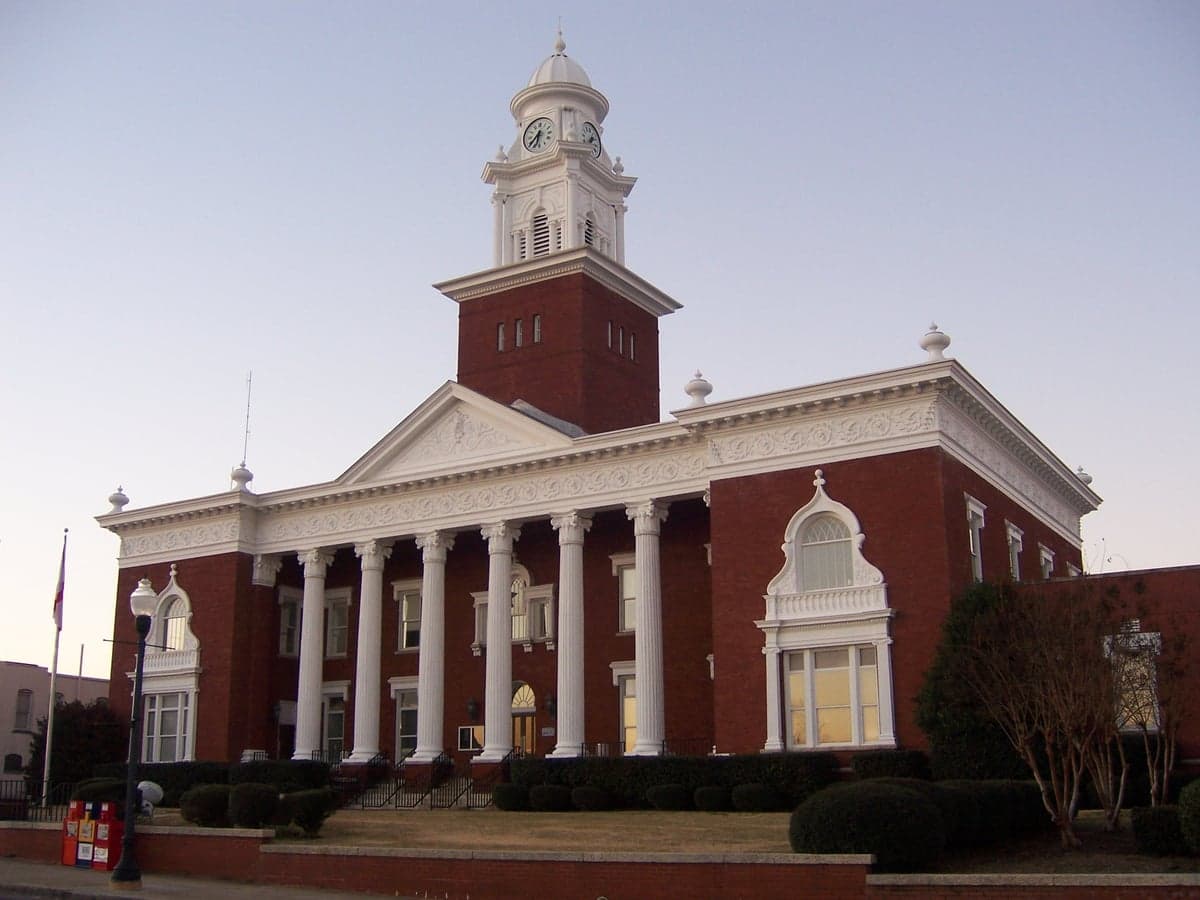
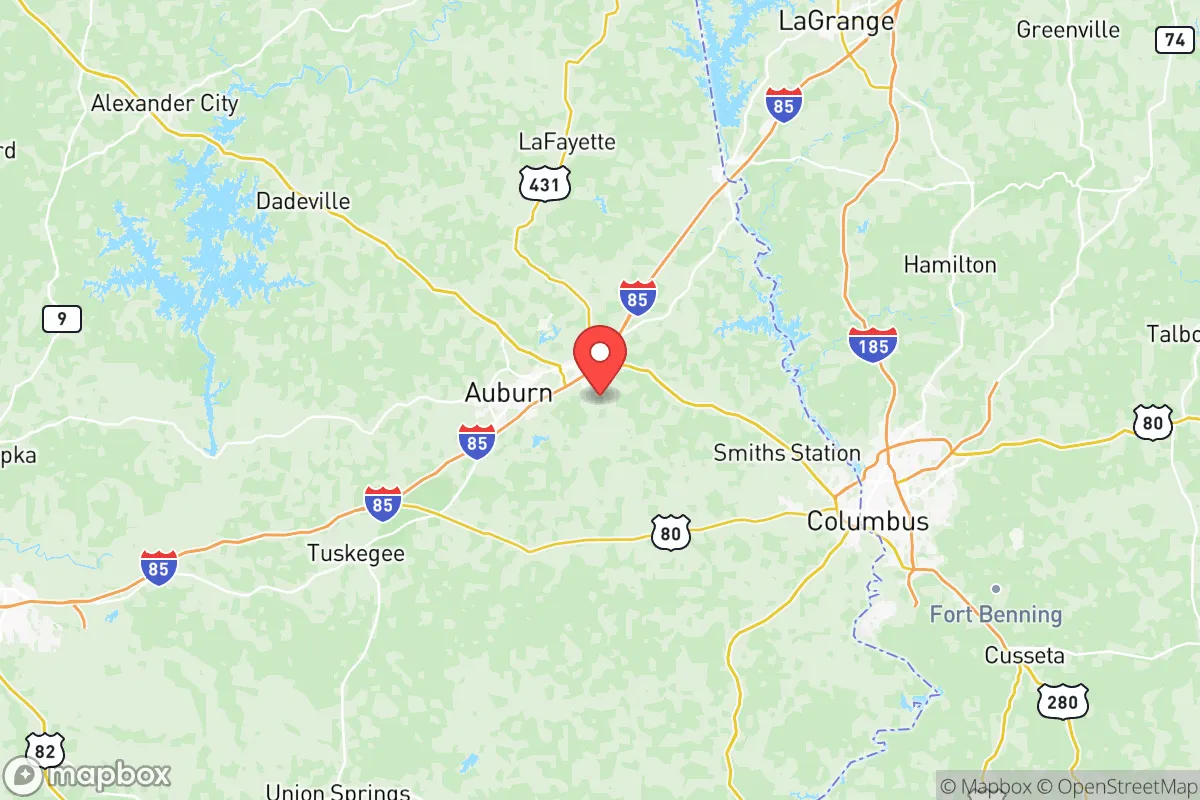
Lee County, Alabama, is a classic example of a deeply red area that’s slowly shifting under the weight of growth, with a Cook PVI of R+23 that tells only part of the story. The county has voted Republican by wide margins in every presidential election since 2000, but the margin has tightened noticeably in the last two cycles—from a 38-point GOP win in 2016 down to about 26 points in 2020 and 2024. That shift is almost entirely driven by Auburn and the surrounding suburban corridor, where younger, more educated voters and a growing Black professional class are nudging the county toward purple, even as the rural precincts in the eastern and southern parts of the county remain rock-ribbed Republican.
How it compares
Compared to Alabama as a whole, Lee County is actually slightly more Republican than the state average, which sits around R+15 to R+18 depending on the metric. The difference is that Lee County’s red is concentrated in its rural towns like Opelika (the county seat, which votes about 62% Republican) and Loachapoka (nearly 75% Republican), while the city of Auburn itself is a genuine swing area—precincts around the university campus and downtown often vote 55-60% Democratic, especially in midterm and local elections. The county’s overall R+23 is a bit of a mirage: it masks a growing urban-rural split that’s more pronounced than in, say, Madison County (Huntsville) or Jefferson County (Birmingham), where the blue areas are larger and more consolidated. In Lee County, the blue is still a minority, but it’s a growing, organized minority that has flipped a few county commission and school board seats in the last decade.
What this means for residents
For conservative residents, especially in Opelika and the rural areas, life is largely unchanged: the county government is reliably Republican, property taxes are low, and the Second Amendment is broadly supported. The local GOP is still dominant, but you’ll notice a more pragmatic, business-friendly tone in Auburn city politics, where even Republican candidates have to talk about infrastructure, affordable housing, and public transit. For liberal residents, the reality is that you’re in a minority, but not an isolated one—Auburn’s city council has a Democratic majority as of 2024, and the city has passed a non-discrimination ordinance and a modest affordable housing fund. The trade-off is that state-level politics (the legislature, the governor’s office) are overwhelmingly conservative, so local wins don’t always translate to broader policy changes. Both sides will find that the county’s rapid growth—Auburn’s population has grown 25% since 2010—is the real driver of political tension, with debates over zoning, school funding, and development often splitting along geographic rather than purely partisan lines.
The cultural distinction that sets Lee County apart from much of Alabama is the university effect. Auburn University brings in a steady stream of out-of-state students and faculty, many of whom are more moderate or liberal than the native population. This creates a visible, if not dominant, progressive presence in the county’s cultural life—think farmer’s markets, bike lanes, and a thriving arts scene in downtown Auburn—that coexists with the traditional Southern conservatism of Opelika’s historic district and the rural churches. The result is a county that feels like two different places depending on where you stand: a deeply conservative rural Alabama in the east and south, and a more cosmopolitan, college-town Alabama in the west. That split is likely to widen as Auburn continues to grow, but for now, the county’s political center of gravity remains firmly right of center, with a slow, steady drift toward the middle.

State Political ClimatePolitical Climate in Alabama
State Political AnalysisPolitical Environment in the State
Alabama is one of the most reliably Republican states in the country, with a partisan lean of roughly +25 to +30 points in federal elections, driven by a coalition of white evangelical voters, rural conservatives, and a growing exurban population around Birmingham and the Gulf Coast. Over the past 20 years, the state has shifted from a competitive Democratic stronghold in local races to a deep-red lock at every level, with Democrats now holding no statewide offices and only a handful of legislative seats in the Black Belt and urban cores. The 2024 presidential election saw Donald Trump carry the state by 30 points, continuing a trend where the only real political action is in the Republican primary.
Urban vs. rural divide
The political map of Alabama is a stark study in contrast. The state’s three major metro areas—Birmingham, Huntsville, and Mobile—each have distinct political characters. Birmingham’s Jefferson County is the state’s most reliably Democratic stronghold, delivering about 60% of its vote to Joe Biden in 2020, driven by a large Black population and a growing professional class. Huntsville, home to the Redstone Arsenal and a booming tech sector, is more of a purple-to-light-red area, with Madison County voting about 55% Republican in 2024, though the city itself leans left. Mobile County is a classic swing county, voting about 58% Republican in 2024, but with a Democratic base in the city of Mobile itself. The rest of the state—the Black Belt counties like Dallas and Lowndes, which are heavily Black and Democratic, and the vast rural white counties like DeKalb and Marshall—are overwhelmingly Republican. The real divide isn’t just urban vs. rural; it’s the Black Belt vs. the rest, with the state’s 26% Black population providing the Democratic base, while white voters, especially in the north and south, vote Republican at rates exceeding 80% in many precincts.
Policy environment
Alabama’s policy environment is among the most conservative in the nation, reflecting its dominant Republican supermajority. The state has no income tax on Social Security benefits and a flat 5% income tax on most other income, with a state sales tax of 4% that can reach 10% or more with local add-ons. Property taxes are among the lowest in the country, averaging about 0.4% of assessed value, which is a major draw for relocators from high-tax states. Education policy is a flashpoint: the state passed the Alabama Literacy Act in 2019, requiring third graders to read at grade level before advancing, and in 2022 created a school choice program through the Alabama Accountability Act, which provides tax credits for private school tuition. Healthcare is a mixed bag—Alabama did not expand Medicaid under the Affordable Care Act, leaving about 300,000 residents in the coverage gap, but the state has a robust network of rural hospitals, many of which are struggling financially. Election laws are strict: voter ID is required, early voting is limited to absentee ballots only, and the state passed a 2021 law banning curbside voting and limiting absentee ballot drop boxes. The state also has a near-total abortion ban, the Human Life Protection Act of 2019, with no exceptions for rape or incest, which took effect after the Dobbs decision.
Recent policy direction
Over the past five years, Alabama has moved aggressively to expand what it frames as "freedom" for conservative residents while tightening restrictions on issues like abortion, guns, and education. In 2022, the state passed a permitless carry law, allowing anyone 21 or older to carry a concealed handgun without a permit, and in 2023 it passed a law prohibiting local governments from enforcing federal gun laws, a direct challenge to federal authority. On education, the 2022 "Don't Say Gay" law (the Alabama Vulnerable Child Protection Act) bans classroom instruction on sexual orientation or gender identity in K-5, and the 2024 CHOOSE Act created a universal school choice program with Education Savings Accounts worth up to $7,000 per child. On property rights, the state has strong eminent domain protections, and in 2023 it passed a law prohibiting foreign ownership of agricultural land near military bases. On privacy and surveillance, Alabama has no comprehensive data privacy law, but it passed a 2023 law banning TikTok on state devices. On voting, the 2021 law tightened absentee ballot rules, and the state has resisted efforts to expand early voting. On medical autonomy, the abortion ban is the most restrictive in the region, and the state has not legalized medical marijuana, though a 2021 law allows limited use of CBD oil for certain conditions. The overall direction is toward less regulation on guns and school choice, and more regulation on social issues and voting access.
Civil unrest & political movements
Alabama has a history of civil rights activism that remains a living memory, particularly in cities like Montgomery, Selma, and Birmingham. The state saw significant protests in 2020 following the murder of George Floyd, with large demonstrations in Birmingham and Montgomery that were largely peaceful but led to some property damage and arrests. The Black Lives Matter movement has a visible presence in the state’s urban centers, but it’s countered by a strong conservative activist base, particularly around gun rights and anti-abortion causes. The Alabama Citizens for Life and the Alabama Rifle and Pistol Association are influential lobbying groups. Immigration politics are less heated than in border states, but the 2011 HB 56 law, which was one of the strictest anti-immigration laws in the country, was largely gutted by federal courts, and the state has not passed major new immigration legislation since. There is no sanctuary city movement in Alabama; in fact, the state passed a law in 2024 requiring local law enforcement to cooperate with federal immigration authorities. Election integrity controversies have been minimal compared to other states, though the 2020 election saw some Republican activists question the results, and the state’s Republican secretary of state has been a vocal proponent of voter ID laws. The most visible flashpoint for a new resident would be the presence of Confederate monuments, which remain in place in many towns, and the ongoing debate over their removal, particularly in Birmingham and Montgomery.
Projection
Over the next 5-10 years, Alabama is likely to remain deeply Republican, but demographic shifts could create subtle changes. The Huntsville metro area is growing rapidly, adding about 15,000 people per year, many of them young professionals and military retirees who are more moderate than the state’s rural base. This could make Madison County a genuine swing county by 2030, and the state’s overall partisan lean could shrink from +30 to +25 as the Huntsville and Birmingham suburbs diversify. The Black Belt is losing population, which will reduce the Democratic base, but the growing Hispanic population in north Alabama, particularly in DeKalb and Marshall counties, could create a new Democratic-leaning constituency. The state’s in-migration is primarily from other Southern states, so it’s not importing liberal voters from California or New York at the same rate as Texas or Florida. The biggest wildcard is the state’s education system: if the school choice program accelerates the decline of rural public schools, it could drive further political polarization. A new resident moving in now should expect the state to remain a conservative stronghold, but with a growing moderate-liberal corridor along the I-65 corridor from Huntsville to Birmingham to Montgomery.
For a new resident, the bottom line is that Alabama offers a low-tax, low-regulation environment that strongly favors conservative values, but it comes with trade-offs: limited healthcare access in rural areas, a restrictive abortion law, and a political culture where Democrats have little influence outside of a few urban pockets. If you’re a conservative looking for a place where your vote counts and your values are reflected in state law, you’ll feel at home. If you’re a liberal, you’ll find like-minded communities in Birmingham, Huntsville, and parts of Mobile, but you’ll be living in a state where your political views are a distinct minority. The practical takeaway is to choose your location carefully—the political climate in Mountain Brook is very different from the one in Selma, even though they’re only 90 minutes apart.
* Values derived from national, state, county, city and local statistics and may differ in a specific area. Last updated: 2026-07-08T01:52:37.000Z
Narrative content on this page is AI-generated and may contain mistakes. Verify any details that matter before acting on them.
ReloMaps may earn a commission from affiliate links at no extra cost to you.

