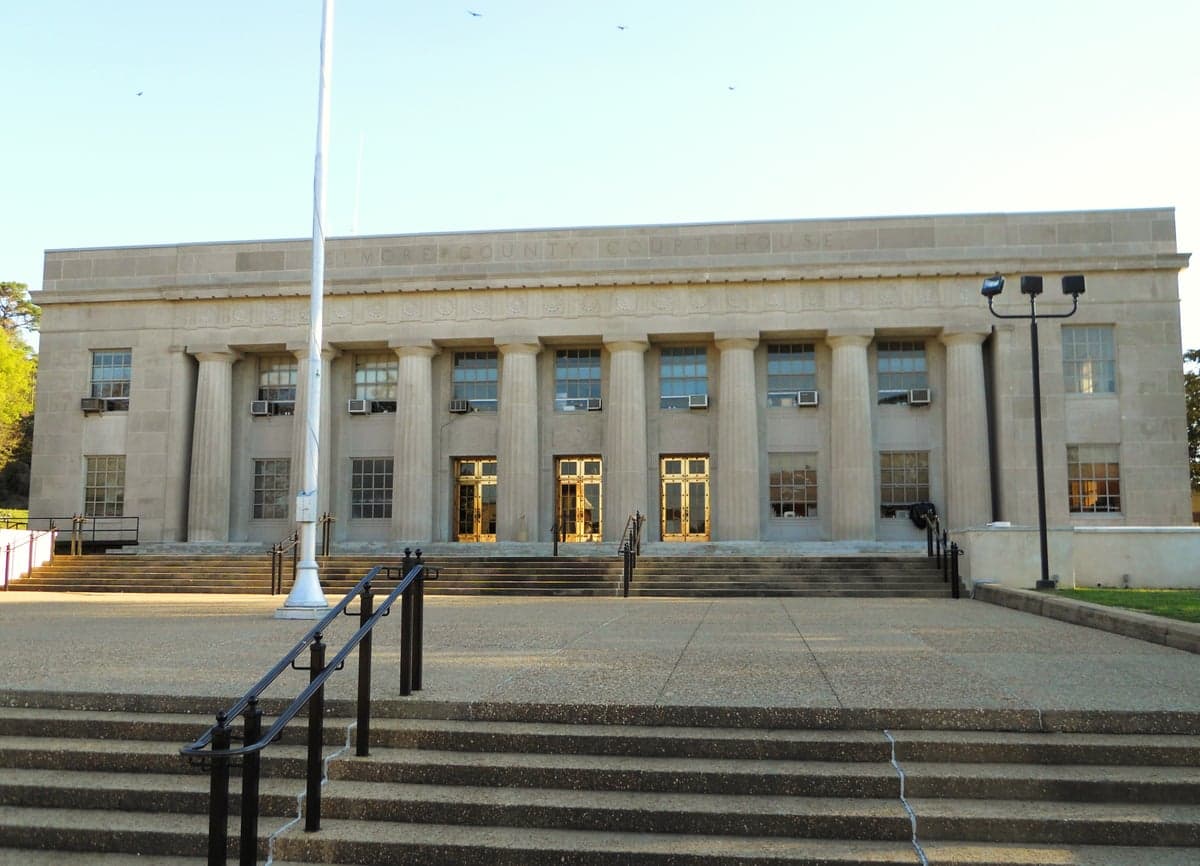
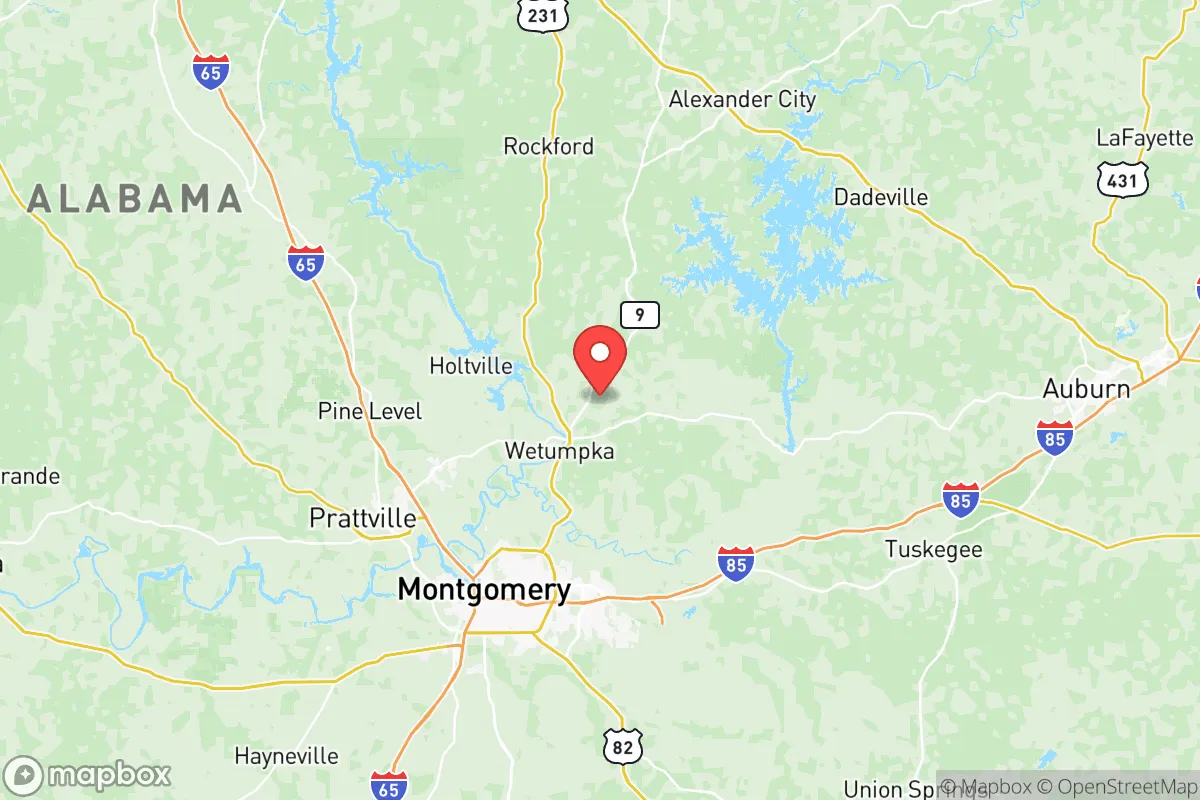
Photo: Wikipedia
Political ClimatePolitical Climate in Elmore County
Showing district-level results — no local-only data available.
Local Political AnalysisPolitical Analysis of Elmore County
Elmore County, Alabama, is a reliably Republican stronghold with a Cook Partisan Voting Index (PVI) of R+20, making it significantly more conservative than the state of Alabama as a whole (R+14). This isn't a recent shift; the county has voted for the GOP presidential candidate by wide margins for decades, with the 2024 election seeing Donald Trump carry the county by roughly 40 points. The political center of gravity is firmly in the rural and suburban areas, but there are subtle variations across its towns and unincorporated communities that shape the local political landscape.
How it compares
While Alabama as a state is solidly red, Elmore County is a deeper shade of that red. The R+6 difference between the county and the state is meaningful. In statewide races, a Republican candidate can expect to run up the score in Elmore County, often outperforming their statewide average by 5-8 points. This is most visible in the county's northern and eastern precincts, particularly around Eclectic and Elmore itself, where the rural, agricultural character drives very strong conservative turnout. In contrast, the more suburban areas near the county's western edge, like Millbrook and the southern fringes of Wetumpka, show a slightly more moderate Republican lean. These areas, which have seen an influx of residents from Montgomery and the River Region, occasionally produce precincts that vote more in line with the state's R+14 baseline, though they still reliably vote GOP. There are no true "blue" towns in Elmore County, but the precincts around the Coosa River in Wetumpka and the newer subdivisions in Millbrook are where you'd find the highest concentration of Democratic votes, typically in the 30-35% range.
What this means for residents
For conservative residents, the political climate is highly favorable. Local offices—from the county commission to the school board—are dominated by Republicans, and policy debates tend to center on tax cuts, limited government, and Second Amendment rights. The county's strong GOP lean means that conservative candidates rarely face serious primary challenges from the left, so the real political action often happens in the Republican primary. For liberal residents, the reality is that they are a clear minority. While they are not ostracized, they have little direct influence on local elections. Their political energy is often channeled into state-level or national races, or into non-partisan community issues like school funding and infrastructure. The county's political culture is generally polite but firm; open political disagreement is common, but it rarely becomes hostile in public settings.
Culturally, Elmore County's politics are intertwined with a strong sense of local identity and a wariness of outside influence, particularly from Montgomery. This manifests in a preference for local control over schools and land use, and a general skepticism of regional planning initiatives. The county's rapid growth—especially in the Wetumpka and Millbrook areas—has introduced some tension between long-time residents who value the rural character and newcomers who may bring more suburban, and occasionally slightly more moderate, political views. This dynamic is likely to continue, with the county's political trajectory remaining deeply red, but with the possibility of a very gradual shift toward the state's R+14 baseline as the suburban population grows. For now, though, Elmore County remains one of the most reliably conservative corners of an already conservative state.

State Political ClimatePolitical Climate in Alabama
State Political AnalysisPolitical Environment in the State
Alabama is a solidly Republican state with a Cook Partisan Voting Index of R+14, meaning it votes about 14 points more Republican than the national average in presidential elections. The dominant coalition is a mix of culturally conservative white voters in rural and suburban areas, a growing evangelical and exurban base in the Birmingham and Huntsville exurbs, and a small but influential business-friendly faction that pushes for low taxes and light regulation. Over the last 20 years, Alabama has shifted sharply right: George W. Bush won it by 14 points in 2000, but Donald Trump carried it by 25 points in 2020 and by 27 points in 2024. The shift is driven by the realignment of white working-class voters away from Democrats, the decline of unionized industrial areas like the Black Belt, and the near-total collapse of Democratic competitiveness outside of majority-Black counties and a few college-town enclaves.
Urban vs. rural divide
The political map of Alabama is a study in contrast. The state’s three largest metro areas—Birmingham, Huntsville, and Mobile—each have distinct political characteristics. The Birmingham metro, anchored by largely Democratic Jefferson County and the heavily Black city of Birmingham proper, votes blue overall, but its fast-growing northern exurbs like Gardendale and Trussville are solidly red. Huntsville, home to the military and aerospace economy, is more moderate but still leans Republican; its western suburbs like Madison are trending redder as the area grows. Mobile County is competitive, often flipping between parties, while its eastern suburbs like Fairhope and Daphne in Baldwin County are deeply conservative and growing fast. Meanwhile, the state’s rural areas are almost uniformly Republican—places like Cullman, Clanton, and Opelika vote 70-80% Republican. The only reliably Democratic counties are the poor, majority-Black rural counties of the Black Belt (like Lowndes and Greene), and college towns like Tuscaloosa and Auburn, where student populations and university faculty lean left but are outnumbered by surrounding rural precincts. The urban-rural split is more extreme here than in most Southern states: Mobile County is about R+8, but Baldwin County, just across the bay, is R+30.
Policy environment
Alabama’s policy environment is deeply conservative and low-tax. The state has no personal income tax on most wage earners—the state constitution sets a flat 5% rate on taxable income, but that's only on income above $3,000 for individuals, meaning most middle-class workers pay very little. Property taxes are among the lowest in the nation, averaging about 0.4% of home value, but local school funding is minimal, leading to wide disparities between wealthy suburbs and poor rural districts. The regulatory posture is business-friendly: the state is a right-to-work state, with no union bargaining rights in the private sector, and permits are generally easy to obtain. Education policy is centered on school choice: the state has a robust charter school law, a tax-credit scholarship program for private schools, and a new universal Education Savings Account (ESA) program passed in 2024 that lets parents use state education dollars for private school tuition, homeschooling, or tutoring. Election laws are restrictive: strict voter ID requirements, limited early voting (no early in-person voting except absentee by excuse), and a ban on curbside voting. Healthcare policy is limited; Alabama did not expand Medicaid under the Affordable Care Act, leaving about 200,000 low-income adults in the coverage gap. Abortion is almost entirely banned, with a near-total prohibition on abortion after fertilization, and no exceptions for rape or incest—Alabama’s Human Life Protection Act of 2019 is one of the most restrictive in the nation.
Recent policy direction
Alabama’s recent legislative sessions have been overwhelmingly focused on culture-war priorities and limiting government reach in social areas. Gun rights are expansive: Constitutional carry (permitless carry for handguns both open and concealed) became law in 2022, and the state preempts all local gun ordinances. Parental rights have been strengthened: a 2022 law requires parental consent for any medical or counseling service offered to minors, effectively banning gender-affirming care for transgender youth under 19. In 2023, the state passed the CHOOSE Act, creating the universal ESA program mentioned above. In education, the state has banned teaching "divisive concepts" about race and sex in public schools, and a 2024 law requires the Ten Commandments to be prominently displayed in every public school classroom—though it’s currently tied up in court. On the liberty front, property rights are strong: the state has a constitutional protection against eminent domain for private economic development. Privacy and surveillance remain a mixed bag: Alabama’s biometric privacy law is weak compared to states like Illinois, but the state has no broad data privacy law. On medical and bodily autonomy, the abortion ban is absolute, with no exceptions for rape or incest, and there’s no legal route for medical marijuana (though a limited program has been signed into law but stalled in implementation). Voting access is restricted: the state requires a government-issued photo ID to vote, and straight-ticket voting was banned in 2020, which was widely seen as an attempt to reduce Democratic turnout.
Civil unrest & political movements
Alabama has a mixed history of civil unrest, but recent political movements remain largely organized and quiet. The state saw significant Black Lives Matter protests in Birmingham, Montgomery, and Mobile in 2020, with large marches but relatively little property damage compared to peer states. The Confederate monument controversies in Birmingham and Mobile led to local removals, which in turn sparked state legislation preempting local governments from removing historical monuments—a 2021 law that gave final say to the state. Immigrant politics remain a flashpoint: Alabama’s 2011 anti-immigrant law (HB 56) was one of the strictest in the nation, though most provisions were gutted by courts. Today, there are no sanctuary city policies in the state; Birmingham is seen as more tolerant but still has no official safe-haven policy. Election integrity was a major issue in 2020: Alabama conducted a forensic audit of the 2020 election results in Montgomery County and Lee County after widespread national debate, but found no evidence of fraud. The state’s voter ID and absentee ballot restrictions remain a topic of debate, though no major protests have occurred since 2020. Secession rhetoric is present among far-right groups but has no serious political support; the state largely rejects nullification talk. Organized activism on the right is strong through the Alabama Citizens Action Program and the Alabama Policy Institute, while left-wing organizing is more diffuse, centered in the college towns and Birmingham’s Magic City Organizing group.
Projection
Looking ahead, Alabama’s political trajectory is likely to remain deeply red but with a few significant shifts. The state’s demographic changes are modest—Alabama's population is aging and growing slowly, with the fastest growth in the Huntsville metro (about 12% over the last decade) and the Baldwin County coast. The Huntsville area is attracting a mix of young tech and aerospace professionals, many of whom come from other states and lean slightly more moderate than the native population, but still strongly Republican. The Black Belt counties continue to lose population, meaning Democratic voter share will keep shrinking in statewide races. In-migration from the North and West is concentrated in the coastal areas, and these newcomers tend to be conservative-leaning but less culturally rigid than Alabama natives. By 2030, expect the state to remain a reliable R+14 to R+16 in presidential races, but you may see closer margins in the 2032 gubernatorial and Senate races if more moderate Republicans or conservative Democrats emerge. The key wildcard will be the ongoing effect of the ESA program and the Ten Commandments litigation: if those policies are struck down or watered down, we could see a slight moderation in cultural policy. The abortion ban is unlikely to be softened absent federal law change, as the state legislature is unapologetically anti-abortion. Overall, what a new resident should expect is a state that will continue to be a low-tax, religiously conservative, and culturally Southern environment for the foreseeable future, with few surprises except maybe a shift in how the Huntsville suburbs vote.
Bottom line for a new resident: If you’re a conservative-looking family, Alabama offers a secure, affordable, and ideologically comfortable environment with strong gun rights, school choice, and low property taxes. If you’re a liberal or moderate, you’ll find that your values are in the minority, but you’ll have safe havens in Birmingham and Huntsville’s core, and you won’t face everyday harassment. The practical takeaway: check local politics town-by-town—the difference between Birmingham and Trussville is the difference between a blue city and a deep-red suburb 20 minutes away. Know that culture-war legislation will continue, but daily life for most people is about backyard barbecues, football, and friendly neighbors, not political argument.
* Values derived from national, state, county, city and local statistics and may differ in a specific area. Last updated: 2026-07-03T04:07:25.000Z
Narrative content on this page is AI-generated and may contain mistakes. Verify any details that matter before acting on them.
ReloMaps may earn a commission from affiliate links at no extra cost to you.

