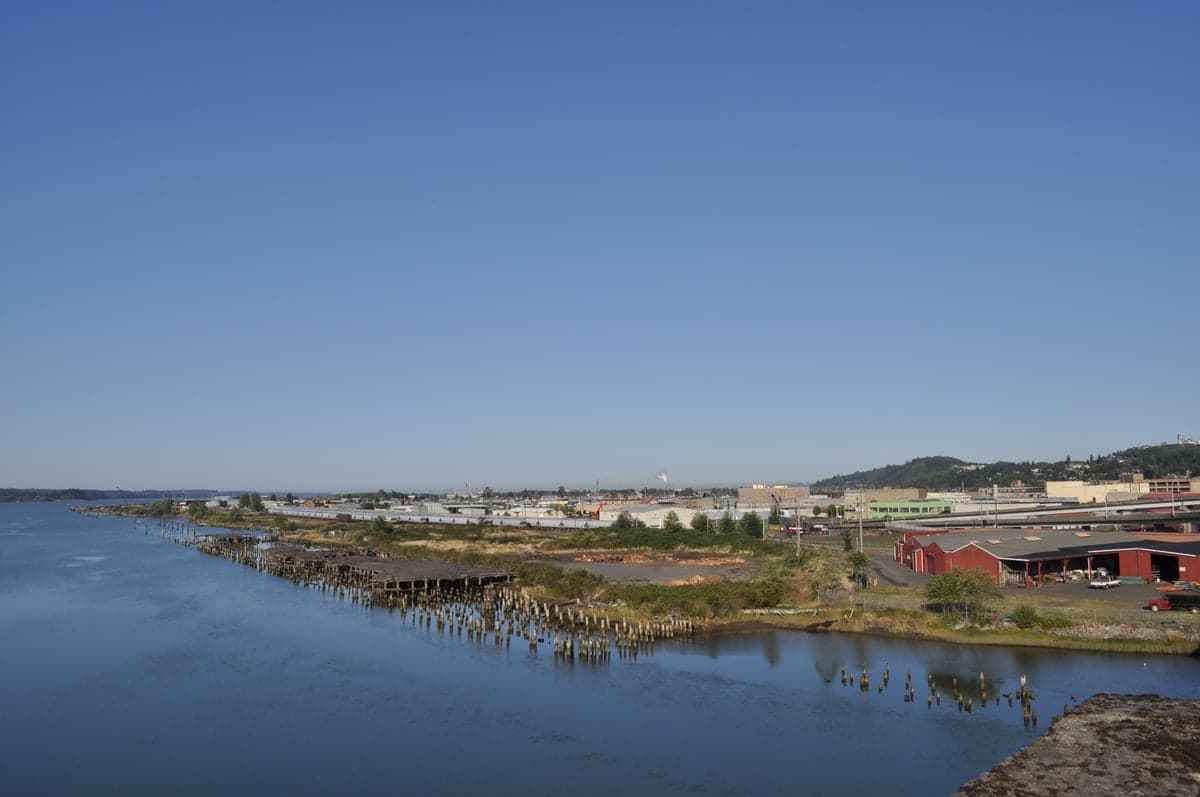
Photo: Wikipedia
Political ClimatePolitical Climate in Aberdeen, WA
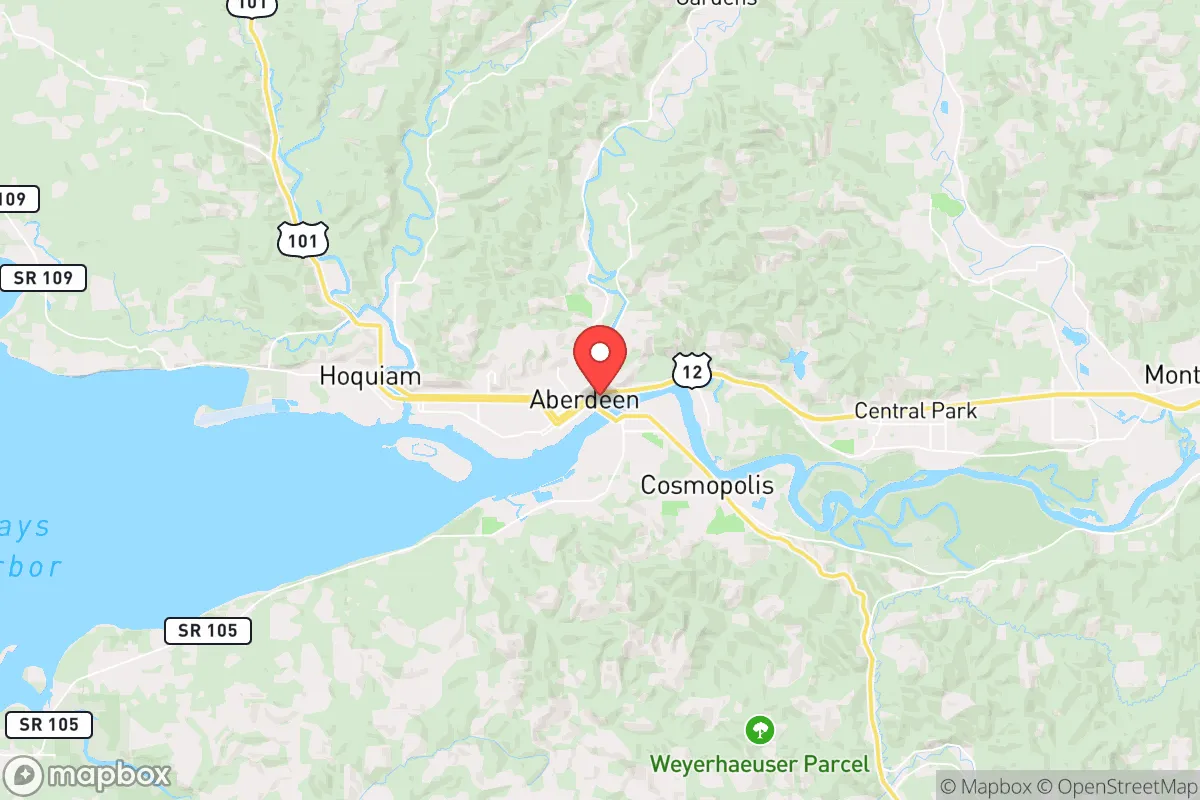
District shown is the primary district for this city’s centroid. Cities may span multiple districts.
Local Political AnalysisPolitical Analysis of Aberdeen, WA
Aberdeen, Washington, sits in a political landscape that’s more Democratic than its rural Grays Harbor County surroundings, with a Cook Partisan Voting Index (PVI) of D+10. That means the city leans about 10 points more Democratic than the national average, a shift that’s become more pronounced over the past decade as the area’s old timber and fishing economy gave way to service and healthcare jobs. Locals will tell you it wasn’t always this way—Aberdeen used to be a blue-collar, union-heavy town where Democrats and Republicans both felt at home, but the national polarization has sharpened things. Today, you’ll see more Biden-Harris yard signs than Trump flags in the city limits, though drive ten minutes out to Hoquiam or Cosmopolis, and the balance flips noticeably redder.
How it compares
Compared to Washington state as a whole, Aberdeen is slightly more conservative than the Seattle metro area but still solidly blue. The state’s overall PVI isn’t officially calculated, but King County (Seattle) votes D+30 or more, while rural eastern Washington counties like Yakima or Spokane lean R+10 to R+15. Aberdeen’s D+10 puts it closer to the state’s average than you might think—think of it as a moderate Democratic stronghold in a sea of rural red. Neighboring towns like Montesano and Elma trend more Republican, often by 5 to 10 points, so a quick drive east on Highway 12 shows a real shift. In state elections, Aberdeen reliably backs Democratic candidates for governor and Senate, but local races for county commissioner or port authority can swing either way, depending on turnout.
What this means for residents
For liberal residents, Aberdeen feels like a safe space to voice opinions on environmental issues, public transit, or social services—the city council and school board are generally progressive. You’ll find support for things like the new Aberdeen Transit Center and local food bank expansions. For conservative residents, it’s not hostile, but you’ll be in the minority at city hall. The real tension isn’t between neighbors—most people are friendly—but in policy debates over logging restrictions, fishing regulations, and how much to spend on downtown revitalization versus rural road maintenance. The political reality is that Aberdeen’s lean means state funding flows more easily for social programs, but property taxes and business regulations can feel higher than in nearby Republican-led towns like Raymond or South Bend.
Culturally, Aberdeen has a distinct working-class identity that cuts across party lines. The legacy of Kurt Cobain and the grunge scene still gives the town a countercultural edge, but you’re just as likely to hear talk about hunting, fishing, and the high cost of diesel. The city’s policy distinctions show up in its support for public arts funding and a relatively strong police oversight board—both more common in blue-leaning towns. Looking ahead, if the area’s population continues to slowly grow with remote workers from Seattle, the D+10 lean could hold or even deepen. But if the timber industry sees a revival or cost-of-living pressures push out younger liberals, Aberdeen might drift back toward the purple middle. For now, it’s a place where you can debate politics over a beer at the local tavern without anyone getting too hot under the collar—as long as you’re respectful.

State Political ClimatePolitical Climate in Washington
State Political AnalysisPolitical Environment in the State
Washington state has been a reliably blue stronghold for over a decade, with Democrats controlling the governorship, both U.S. Senate seats, and both chambers of the state legislature since 2012. The state’s overall partisan lean is roughly D+8 to D+10 in presidential elections, but this masks a deep and growing urban-rural chasm. The trajectory over the last 20 years has been a steady march leftward, driven by explosive growth in the Seattle metro area and the Puget Sound corridor, while much of Eastern Washington has become more solidly Republican.
Urban vs. rural divide
The political map of Washington is essentially two states. King County (Seattle) alone casts about 30% of the state’s vote and delivers a Democratic margin of roughly 500,000 votes—enough to decide most statewide races before the rest of the state even weighs in. Pierce County (Tacoma) and Snohomish County (Everett) have also trended blue, though less overwhelmingly. The I-5 corridor from Olympia north to the Canadian border is the Democratic engine. In contrast, Eastern Washington is dominated by conservative counties like Spokane, Yakima, and the Tri-Cities (Kennewick, Pasco, Richland). Spokane County, once a swing area, has shifted right in recent cycles, though the city of Spokane itself remains a blue island. The rural counties of Ferry, Stevens, and Pend Oreille vote 70-80% Republican. The political reality is that a conservative moving to Seattle will feel like a minority, while a liberal moving to Colville will feel similarly isolated.
Policy environment
Washington has no state income tax—a major draw for conservatives—but makes up for it with some of the highest sales tax rates in the nation (state rate 6.5%, but local add-ons push it to 9-10.5% in many cities). Property taxes are moderate. The regulatory posture is heavily pro-environment, with the state’s Growth Management Act tightly controlling land use, especially in Western Washington. Education policy is dominated by the teachers’ union; the state has a strong charter school law but it’s been under constant legal attack. Healthcare is heavily regulated, with a state-based exchange and a public option law passed in 2021. Election laws are among the most liberal in the country: all elections are conducted by mail, same-day voter registration is allowed, and ballots are automatically sent to every registered voter. This system has high turnout but has drawn criticism from conservatives over ballot security, though no major fraud has been proven.
Recent policy direction
The last five years have seen a rapid acceleration of progressive legislation. On gun and self-defense law, Washington passed a ban on “assault weapons” (HB 1240) in 2023, a ban on high-capacity magazines, and a 10-day waiting period for all firearm purchases. A 2024 law requires a permit to purchase a semi-automatic rifle. On parental and education rights, the state has strong LGBTQ+ anti-discrimination laws in schools, and a 2023 law (SB 5599) allows minors to receive shelter and certain medical care without parental consent if they are homeless. On speech, Washington has no specific law against “hate speech” (protected by the First Amendment), but a 2023 law (HB 1440) expanded the definition of “malicious harassment” to include certain online conduct. On privacy and surveillance, the state passed a strong biometric privacy law (HB 1493) in 2023, limiting how companies can collect facial recognition data. On medical and bodily autonomy, Washington has codified abortion rights into law (HB 2078, 2023) and protects providers from out-of-state lawsuits. On property rights, the Growth Management Act continues to limit development in rural areas, and a 2023 law (HB 1110) preempted local zoning to allow duplexes and fourplexes in single-family neighborhoods statewide. On taxation, a 2023 law created a 7% capital gains tax on profits over $250,000 (currently being challenged in court). Voting and ballot access remains the most liberal in the nation, with no voter ID requirement beyond a signature check.
Civil unrest & political movements
Seattle was the epicenter of the 2020 Black Lives Matter protests, including the six-week Capitol Hill Autonomous Zone (CHAZ) occupation, which became a national flashpoint. Since then, organized activism has shifted to more conventional channels. The left is dominated by groups like the Washington State Labor Council and Moms Demand Action. On the right, the Washington State Republican Party has become more populist, with the 2022 convention endorsing election integrity audits and opposing vaccine mandates. The “sanctuary state” law (SB 5497, 2019) limits local law enforcement cooperation with federal immigration authorities, and has been a major point of contention in rural counties like Grant and Adams, where agricultural labor relies heavily on immigrant workers. There have been periodic calls for a “51st state” movement in Eastern Washington (the “State of Liberty” proposal), but it remains fringe. Election integrity controversies have been minimal compared to other states, though the 2020 and 2022 elections saw a few small-scale ballot drop box fires in Vancouver and Portland, Oregon.
Projection
Over the next 5-10 years, Washington will likely continue its leftward drift, but at a slower pace. The Seattle metro area is still growing, but the rate of in-migration has slowed since 2022, and some tech workers are moving to lower-cost states. The biggest demographic shift is the aging of the baby boomer generation in rural areas, which could slightly reduce the Republican vote share in Eastern Washington. However, the growth of Spokane and the Tri-Cities is attracting some conservative-leaning Californians and Oregonians, which could keep the rural-urban divide stable. The state’s tax structure—no income tax but high sales tax—is unlikely to change, as any attempt to introduce a state income tax would require a constitutional amendment and is politically dead. The biggest wild card is housing: if the state’s zoning reforms (HB 1110) actually produce more supply, it could slow the exodus of moderate voters to Idaho and Texas. For a conservative moving in now, expect to be in a permanent minority in statewide elections, but with significant local control in most counties east of the Cascades.
Bottom line for a new resident: If you’re conservative, you’ll find your political home in Spokane, the Tri-Cities, or Yakima—places where your vote matters locally, even if statewide elections are a lost cause. If you’re liberal, you’ll feel at home in Seattle, Bellevue, or Olympia, but be prepared for high taxes and a housing market that’s among the tightest in the nation. Either way, the state’s natural beauty and strong economy make it a compelling choice, but the political climate is something you’ll need to factor into your daily life, especially around school board meetings and local zoning battles.
* Values derived from national, state, county, city and local statistics and may differ in a specific area. Last updated: 2026-08-27T20:03:48.000Z
Narrative content on this page is AI-generated and may contain mistakes. Verify any details that matter before acting on them.
ReloMaps may earn a commission from affiliate links at no extra cost to you.

