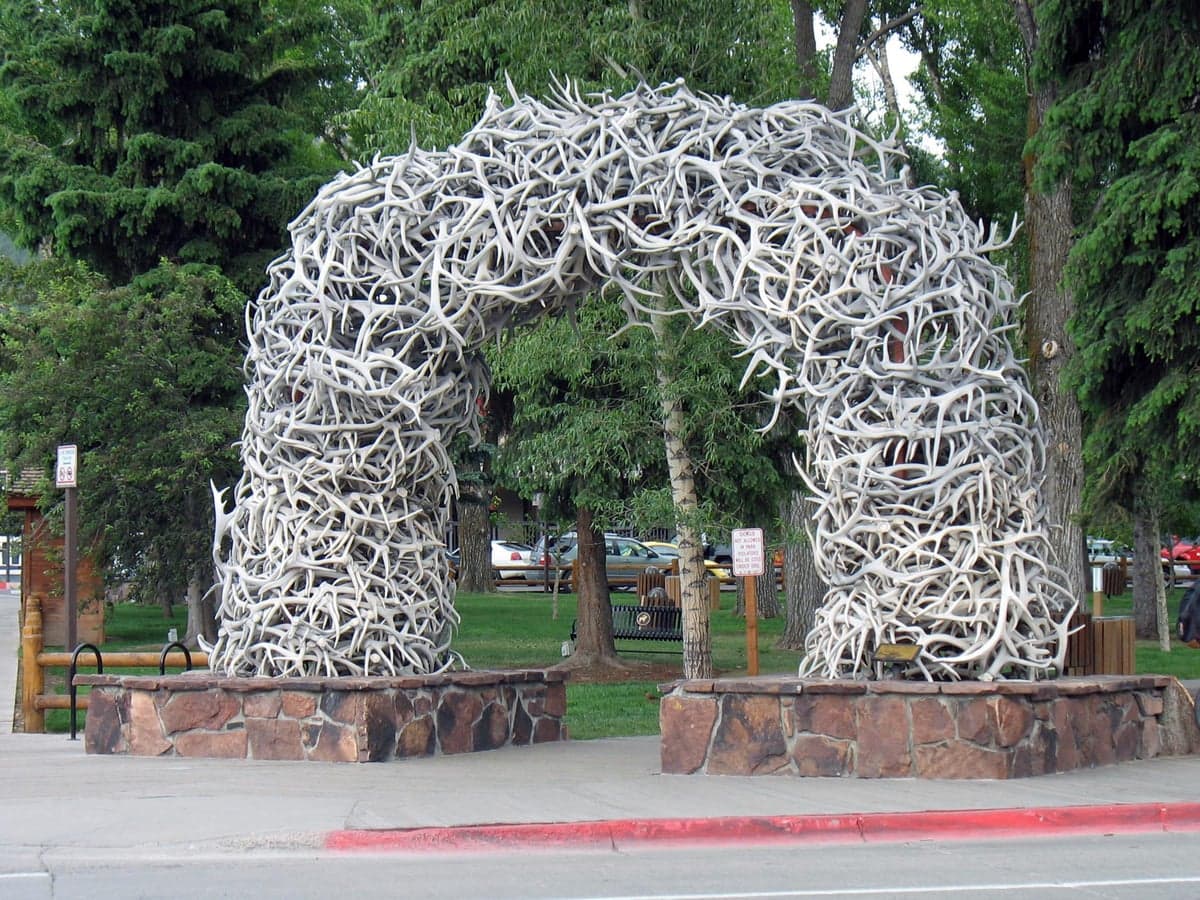
Photo: Wikipedia
Political ClimatePolitical Climate in Teton County
Showing state-level results — no local-only data available.
Local Political AnalysisPolitical Analysis of Teton County
Teton County, Wyoming, is a striking political outlier in a deeply red state. While the state of Wyoming as a whole carries a Cook PVI of R+23, Teton County has been a consistent Democratic stronghold for decades, voting for the Democratic presidential candidate in every election since 2000. In 2020, Joe Biden won the county by a 25-point margin, a stark contrast to the rest of the state. However, this blue island is not monolithic; the political landscape shifts dramatically as you move from the tourist-heavy valley floor to the more rural, ranching communities in the northern and eastern parts of the county.
How it compares
The comparison between Teton County and the rest of Wyoming is less about a difference in degree and more about a difference in kind. The state's R+23 PVI reflects a deeply conservative, libertarian-leaning electorate that prioritizes energy extraction, agriculture, and limited government. Teton County, on the other hand, is driven by a tourism-based economy, a high concentration of second-home owners, and a workforce heavily involved in hospitality, conservation, and outdoor recreation. This economic base attracts a more liberal, environmentally-conscious population, particularly in the town of Jackson and the surrounding valley. In contrast, communities like Dubois and the rural precincts of Alta and the northern reaches of the county lean more conservative, often voting in line with the state's broader preferences. The swing precincts are often found in the more suburban areas of Wilson and the South Park loop, where a mix of long-time locals and newer transplants create a more competitive dynamic.
What this means for residents
For a liberal resident, living in Teton County means being in a local political bubble that aligns with their values on environmental protection, land use, and social issues, but it also means being a minority voice in state-level politics. State legislation often feels at odds with local priorities, particularly around public lands management and housing policy. For a conservative resident, the county can feel like a frustrating blue enclave where local regulations on short-term rentals, development, and environmental impact are stricter than they'd prefer. However, they find strong representation in the state legislature, where Teton County's state representatives are often among the most moderate Republicans in the chamber. The practical reality is a constant negotiation between local progressive governance and state-level conservative mandates, creating a unique political tension that shapes everything from school board elections to zoning laws.
Culturally, this divide is visible in daily life. Jackson Hole is a hub for environmental nonprofits, arts organizations, and high-end tourism, with a palpable focus on conservation and outdoor access. Drive an hour east to Dubois, and the culture shifts to a more traditional Western ranching and hunting lifestyle, with a greater emphasis on property rights and resource extraction. Policy-wise, the most contentious local issues are housing affordability—driven by the influx of wealthy second-home owners—and the management of public lands, including the Bridger-Teton National Forest and Grand Teton National Park. The county's unique position as a blue dot in a red state means that residents, regardless of their political leanings, are acutely aware of the delicate balance between local autonomy and state-level authority, a dynamic that is unlikely to change in the near future.

State Political ClimatePolitical Climate in Wyoming
State Political AnalysisPolitical Environment in the State
Wyoming is one of the most reliably Republican states in the country, with a Cook Partisan Voting Index of R+23, meaning it votes about 23 points more Republican than the national average. The state hasn't voted for a Democratic presidential candidate since 1964, and that streak isn't going anywhere soon. Over the last 20 years, the GOP's grip has actually tightened as the state's small population has become more ideologically conservative, with the Democratic Party shrinking to near-irrelevance outside of Teton County and a few pockets in Laramie.
Urban vs. rural divide
The political map of Wyoming is less about urban-rural tension and more about degrees of conservatism. Cheyenne, the state's largest city, leans Republican but is the most competitive area in the state — Laramie County occasionally elects a Democratic state senator or two, though the county itself hasn't gone blue in a presidential race in decades. Casper (Natrona County) is solidly conservative, driven by the energy industry and ranching culture. Jackson (Teton County) is the outlier: it's the only county that regularly votes Democratic, fueled by wealthy second-home owners, ski resort workers, and a tourism-driven economy. Teton County gave Joe Biden over 60% of the vote in 2020. Laramie (Albany County), home to the University of Wyoming, is a purple-ish island — it went for Biden in 2020 but by a much narrower margin than Teton. Everywhere else — Gillette (Campbell County), Rock Springs (Sweetwater County), Sheridan, Cody, Powell — votes Republican by massive margins, often 70-80% or higher. The divide isn't really "urban vs. rural" in the way you see in other states; it's "Teton County and the university town vs. everything else."
Policy environment
Wyoming's policy environment is shaped by a deep distrust of the federal government, a reliance on mineral extraction revenue, and a culture of self-reliance. There is no state income tax, and sales tax is capped at 6% (4% state, up to 2% local). Property taxes are among the lowest in the nation, though they've been a flashpoint recently as rising home values have pushed up bills. The state legislature is dominated by the Wyoming Freedom Caucus, a hardline conservative faction that has pushed the state further right in recent sessions. Education policy is locally controlled, with school choice limited to charter schools and homeschooling — there's no private school voucher program yet, though it's been debated. Healthcare policy is minimal: Wyoming did not expand Medicaid under the Affordable Care Act, leaving a coverage gap for low-income adults. Election laws are moderately restrictive: voter ID is required, same-day registration is not available, and absentee voting requires an excuse. The state has no automatic voter registration and no online registration. That said, Wyoming was the first state to allow straight-ticket voting by party, and election integrity is a top concern for the legislature, which has banned private funding of elections and limited drop boxes.
Recent policy direction
The last few legislative sessions have been dominated by cultural and liberty issues. On guns, Wyoming is a constitutional carry state — no permit needed to carry concealed — and in 2023, the legislature passed a law prohibiting state and local enforcement of federal gun laws that conflict with state law (the "Second Amendment Preservation Act"). On parental and education rights, the state passed a law requiring schools to notify parents of any "sexually explicit" instructional materials and allowing parents to opt their kids out. A 2024 law banned transgender girls from participating in girls' school sports, and another restricted gender-affirming care for minors. On speech, there's been no major crackdown, but the legislature has considered bills to limit "critical race theory" in schools and universities. Privacy and surveillance are live issues: Wyoming passed a law restricting the use of facial recognition technology by law enforcement without a warrant, and it has a strong "right to farm" law protecting agricultural operations from nuisance lawsuits. On medical and bodily autonomy, abortion is banned except in cases of rape, incest, or to save the mother's life, following a trigger law that took effect after Dobbs. Property rights are strongly protected — Wyoming has a "private property rights" act that requires compensation for any regulation that reduces property value by more than 50%. On voting, the state recently passed a law requiring proof of citizenship to register, though it's been challenged in court. The overall direction is clear: the state is moving to enshrine conservative cultural values and limit federal authority wherever possible.
Civil unrest & political movements
Wyoming doesn't see much civil unrest in the traditional sense. There are no major protest movements that draw regular crowds. The most visible political activism comes from the far-right: the Wyoming Freedom Caucus is the dominant force in the legislature, and there's a strong strain of anti-federal sentiment that surfaces in county-level "Second Amendment sanctuary" resolutions and talk of nullification. In 2022, a group of activists pushed for a "constitutional convention" to rewrite the U.S. Constitution, but it didn't gain traction. Immigration politics are less heated than in border states — Wyoming has a very small foreign-born population (about 3%), so the issue is more symbolic than practical. There are no sanctuary cities or counties. The most notable flashpoint in recent years was the 2020 election: despite Trump winning Wyoming by 43 points, some local GOP officials pushed for an audit of the state's election results, which found no significant irregularities. The state's small population means that political movements are often personal — you might run into your state representative at the grocery store — and activism tends to be low-key and community-based rather than confrontational.
Projection
Over the next 5-10 years, Wyoming is likely to become even more conservative, not less. In-migration is driven by people fleeing high-tax, high-regulation states — many from California, Colorado, and the Pacific Northwest — and they tend to be conservative-leaning themselves. Teton County will remain a blue dot, but its influence is limited by its small population (about 23,000). The real shift is happening in places like Sheridan and Sublette County, where newcomers are buying up land and pushing for even lower taxes and less regulation. The Democratic Party shows no signs of revival outside of Laramie and Jackson. The biggest wildcard is the energy transition: if coal and oil decline faster than expected, the state's budget could take a hit, potentially forcing tax increases or spending cuts that could shift the political conversation. But for now, the trajectory is clear: Wyoming is getting redder, more culturally conservative, and more assertive in challenging federal authority. Someone moving in now should expect to live in a state where conservative values are not just dominant but increasingly codified into law.
For a new resident, the bottom line is this: if you're conservative, you'll find a state that aligns closely with your values on taxes, guns, education, and personal liberty. If you're liberal, you'll find a small but active community in Jackson or Laramie, but you'll be living in a state where your vote is unlikely to matter in statewide elections and where the policy environment will feel increasingly hostile. Either way, Wyoming offers a high degree of personal freedom in the traditional sense — low taxes, minimal regulation, and a culture of leaving people alone — but that freedom comes with trade-offs in public services, healthcare access, and educational options. It's a state that rewards self-sufficiency and punishes dependence, and that's unlikely to change anytime soon.
* Values derived from national, state, county, city and local statistics and may differ in a specific area. Last updated: 2026-07-03T22:49:25.000Z
Narrative content on this page is AI-generated and may contain mistakes. Verify any details that matter before acting on them.
ReloMaps may earn a commission from affiliate links at no extra cost to you.

