Photo: Wikipedia
Political ClimatePolitical Climate in Natrona County
Showing state-level results — no local-only data available.
Local Political AnalysisPolitical Analysis of Natrona County
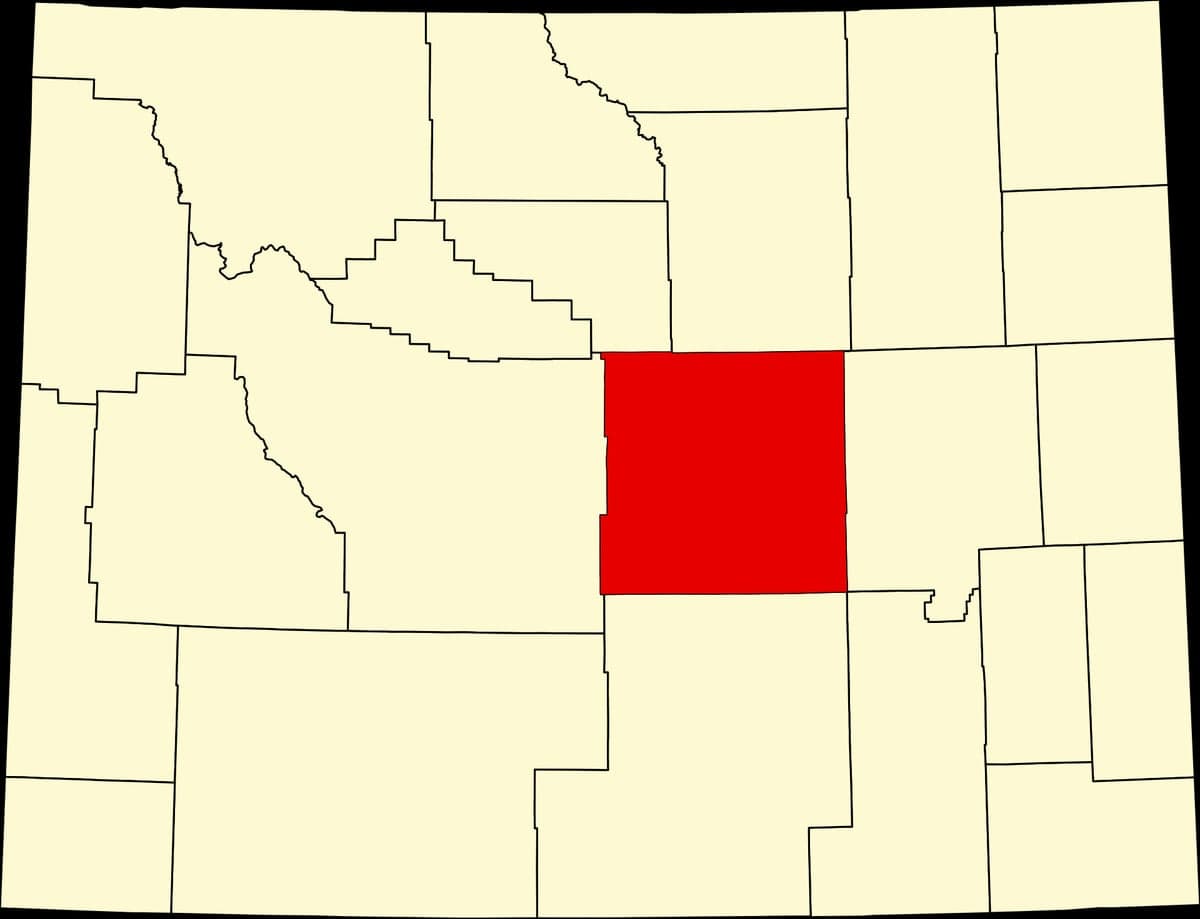
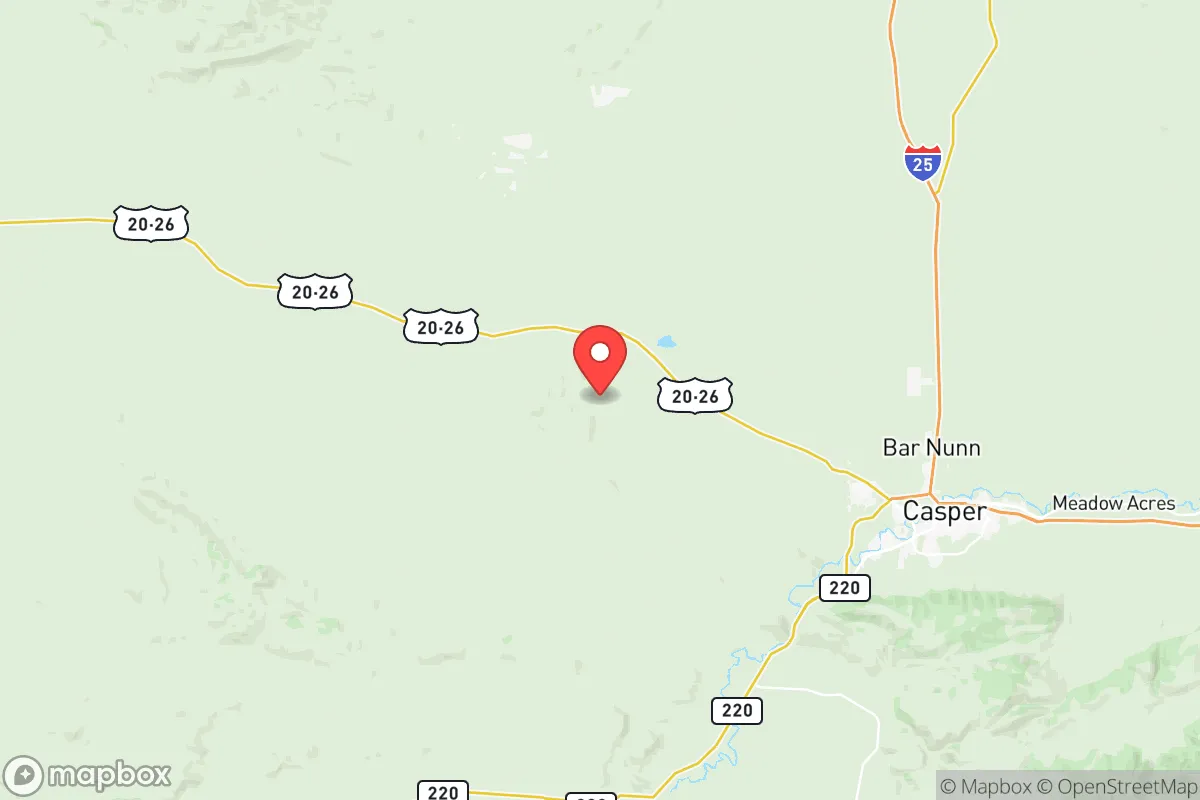
Natrona County, anchored by Casper, leans solidly Republican with a Cook PVI of R+25, making it slightly redder than the state overall (R+23). In the 2020 presidential election, Donald Trump carried the county with 69.7% of the vote, a margin that has held steady since at least 2016. However, that county-level number masks a more nuanced landscape: while Casper’s outlying suburbs and the small towns of Mills and Evansville vote overwhelmingly red, the city of Casper itself—particularly precincts around the university and downtown—tilts more competitive, sometimes within 10 points of a 50-50 split. Over the past decade, Natrona County has moved about 2 points more conservative, matching a broader rightward shift in rural Wyoming, but Casper’s urban core has seen a slight, persistent drift toward the center, largely driven by young professionals and energy transition workers moving in.
How it compares
Compared to Wyoming as a whole, Natrona County is about 2 points more conservative, placing it in the same overall bucket as the statewide average but with a sharper urban-rural divide. The state’s Cook PVI of R+23 aligns closely with Natrona’s R+25, meaning both are safely Republican in presidential and federal races. But the difference shows in local contests: in 2022, the county voted for conservative state legislative candidates by margins about 4 points higher than the statewide average, reflecting the influence of Casper’s more moderate voters being diluted by the county’s vast, rural ranching communities. Towns like Edgerton (population ~200) and Lysite turn out at 85% Republican or more, while Casper’s precincts near the Yellowstone Highway and the old oil patch neighborhoods can swing 5-7 points more centrist. That variation means the county’s primary elections are often decided in the June Republican primary, with the general election effectively a formality—a pattern shared with most of Wyoming, but sharper in Natrona due to its larger population base. For context, the state’s outlier counties are Teton (R+10, slightly bluer) and Sublette (R+40, deeply red), so Natrona sits squarely in the middle of Wyoming’s conservative spectrum.
What this means for residents
For conservative residents, Natrona County is a comfortable majority where their views align with local school boards, county commissioners, and state representatives. The crackdown on property tax increases in 2023, for instance, passed with strong local support, and the county’s zoning debates—often pitting ranchers against energy companies—tend to favor free-market solutions. Liberal and moderate residents find a smaller but active community, centered around the Casper College area and the downtown arts district. They’ll rarely win a countywide election, but they can swing school board races (in 2021, a moderate slate won two seats by focusing on curriculum transparency) and affect city-level decisions on housing and transit. Practical tradeoffs: expects to hear more conservative talk radio and see more Trump flags than in Jackson or Laramie, but the cost of living is lower, and the job market in oil, gas, and healthcare remains stable—even if it hedges against renewable energy pushes that divide the GOP locally.
Cultural and policy distinctions
The most distinctive local divide is over energy policy—Natrona County leans heavily on oil and gas, and its political oxygen is consumed by debates over federal drilling leases on BLM land. Unlike in the more agricultural counties further east, where farm subsidies and water rights dominate, Natrona’s politics revolve around the energy transition: the community has a vocal minority pushing for wind and solar development (Casper was briefly a hub for carbon capture research), but the prevailing sentiment is that the fossil fuel industry is the county’s economic backbone. This creates a cultural peculiarity: even among conservatives, there’s a pragmatic streak that sometimes backflips on free-market principles when it comes to protecting local oil jobs—it’s a place where a county commissioner can simultaneously advocate for smaller government and for federal support for coal-bed methane cleanup. For newcomers, especially those from out of state, the most immediate adjustment is the pace: political arguments here are slow, personal, and rarely make the evening news, unlike in Cheyenne or the boom-and-bust energy towns further north. It’s a place where your vote matters most in the Republican primary, but where a coffee-shop conversation can still change a neighbor’s mind on an issue as local as the new Casper recreation center.

State Political ClimatePolitical Climate in Wyoming
State Political AnalysisPolitical Environment in the State
Wyoming is arguably the most reliably Republican state in the nation, with a Cook Partisan Voting Index (PVI) of R+23 meaning it consistently votes more than twenty points to the right of the national average. This isn't a swing state or even a lean-red state; it's a deep-red stronghold where Democrats hold no statewide elected offices and the legislature has a supermajority. Over the last 10-20 years, the trajectory has been a slow but steady hardening of that conservatism, driven largely by an aging, largely white, and increasingly rural population that has drifted rightward even as national politics have polarized. What was once a pragmatic, libertarian-leaning Western independence has become a more reliably conservative, and at times populist, posture.
Urban vs. rural divide
The political map in Wyoming is simple: there isn't a real urban-rural divide because there's no real urban center. Cheyenne (Laramie County) and Casper (Natrona County) are the largest cities, but they vote Republican, just by slightly smaller margins than the rest of the state. Teton County, home to Jackson Hole, is the lone outlier: it's a wealthy, amenity-rich enclave that has consistently voted Democratic in presidential elections, driven by a mix of second-home owners, outdoor recreation professionals, and service-industry workers from more liberal states. That's it. Every other county, from the energy-driven towns of Gillette (Campbell County) and Rock Springs (Sweetwater County) to the agricultural stretches around Wheatland (Platte County) and Torrington (Goshen County), votes heavily Republican. There isn't a single "purple" county outside of Teton, and even Laramie County hasn't voted for a Democratic presidential candidate since 1964. If you're moving to any city outside of Jackson, you're living in a deeply conservative community.
Policy environment
Wyoming's policy environment is a direct reflection of its partisan makeup. The state has no personal or corporate income tax, a low 4% state sales tax (with local options pushing it to around 6%), and heavy reliance on mineral extraction revenue. Property taxes are also relatively low, though they've been a flashpoint recently as assessed values soared. The regulatory posture is business-friendly, especially for mining and agriculture. Education policy is conservative: the state has a school-choice program through the Wyoming Freedom Scholarship Account, and there are no restrictions on what teachers can say about gender identity or sexual orientation, though local districts may have their own rules. Healthcare is a mixed bag; the state didn't expand Medicaid under the Affordable Care Act until 2024, and access in rural areas is poor. Election laws have been tightened: voter ID is required, and the state purged inactive voters from rolls following the 2020 election. There's no early voting period, and absentee voting requires an excuse, though the excuse list is broad. For a conservative relocator, the tax and regulatory environment is a major draw. For a liberal one, it's an environment of limited social services and a political monoculture.
Recent policy direction
The past few years have seen Wyoming paddle hard to the right on cultural and liberty issues, often drawing national attention. On gun and self-defense law, it's one of the most permissive states: no permit required for concealed carry (constitutional carry passed in 2021), no magazine capacity limits, and "stand your ground" on the books. On parental and education rights, the state passed a law requiring schools to get parental consent for any survey or questionnaire about mental health or sexuality (the "Parents' Bill of Rights"), and a law prohibiting instruction on gender identity in grades K-3 (the "Don't Say Gay" equivalent). Speech and privacy are protected at the state level by a strong common-law tradition, though there's no specific state-level privacy law akin to California's. On medical and bodily autonomy, the state is profoundly anti-abortion: a trigger law banning abortion took effect after Dobbs, with no exceptions for rape or incest, only for life of the mother. There's also a law banning gender-affirming care for minors. Property rights are generally strong, though there's been tension with the federal government over public lands. Taxation is headed toward even more cuts: the legislature has discussed eliminating property taxes entirely, though that's a long shot due to budget reliance. Voting and ballot access are being tightened, as mentioned, with ongoing pushes to end same-day voter registration. The direction is clear: more individual liberty in terms of guns and taxes, less in terms of bodily autonomy and social expression.
Civil unrest & political movements
Wyoming is not a hotbed of civil unrest. Protests are infrequent and small. The most visible political movement in recent years has been the "Greater Idaho" secession movement, which wants five Wyoming counties (along with most of rural Oregon) to join Idaho. It's more a symbolic gesture of frustration with out-of-state governance than an active rebellion. There was a brief, tense standoff at the Bureau of Land Management office in Rawlins in 2020 over federal land management, but it fizzled. Immigration politics are largely abstract, as the state's foreign-born population is tiny. There are no sanctuary cities on offer; Jackson is the most welcoming, but even there, local politics are more about housing and tourism than immigration enforcement. Election integrity controversies are muted, largely because the state's Republican machine has been in control so long that fraud allegations don't stick. What a new resident will notice is not street protests but a quiet, pervasive distrust of the federal government, especially around public lands management and energy policy. The vibe is more "leave us alone" than "storm the barricades."
Projection
Over the next 5-10 years, the political trajectory will remain deeply conservative, but with wrinkles. In-migration is coming, driven by remote workers and retirees seeking low taxes and open space. That's bringing money and some cultural friction, especially to Teton County and satellite towns like Lander or Pinedale. But the numbers are small -- Wyoming's population hovers around 580,000 -- so the demographic impact will be slow. The real wildcard is the energy transition. As coal and natural gas decline, the state's budget will face stress, which could force tax increases or deep cuts that realign political alliances. Expect continued fights over abortion (with possible further restrictions on contraception or IVF) and more battles over public lands as the federal government pushes conservation. The GOP supermajority will hold, but internal splits between the Wyoming Freedom Caucus (more populist, more culturally aggressive) and the more traditional Chamber of Commerce Republicans will deepen. For a relocator, the state will not become purple within a decade. It will remain a place where conservative values are the baseline, and progressive views are confined to Jackson and a few scattered coffee shops in Laramie. A decade from now, the tax environment will likely be even more favorable, the gun laws will be unchanged, and the social policies will be as restrictive as ever.
Bottom line for a new resident: If you're a conservative, especially one concerned about taxes, gun rights, and local control, Wyoming is as close to your ideal as any state in the union. If you're a liberal, you are moving into a political monoculture where your vote will rarely matter in state-level races, where social services are thin, and where you will be the odd one out in most towns. The practical takeaway is: know what you're buying into. The low taxes and open land come with a specific, very consistent political culture that won't change much in the time you're living there. It's not hostile, but it is uniform, and that uniformity is the feature, not the bug.
* Values derived from national, state, county, city and local statistics and may differ in a specific area. Last updated: 2026-07-03T04:26:35.000Z
Narrative content on this page is AI-generated and may contain mistakes. Verify any details that matter before acting on them.
ReloMaps may earn a commission from affiliate links at no extra cost to you.

