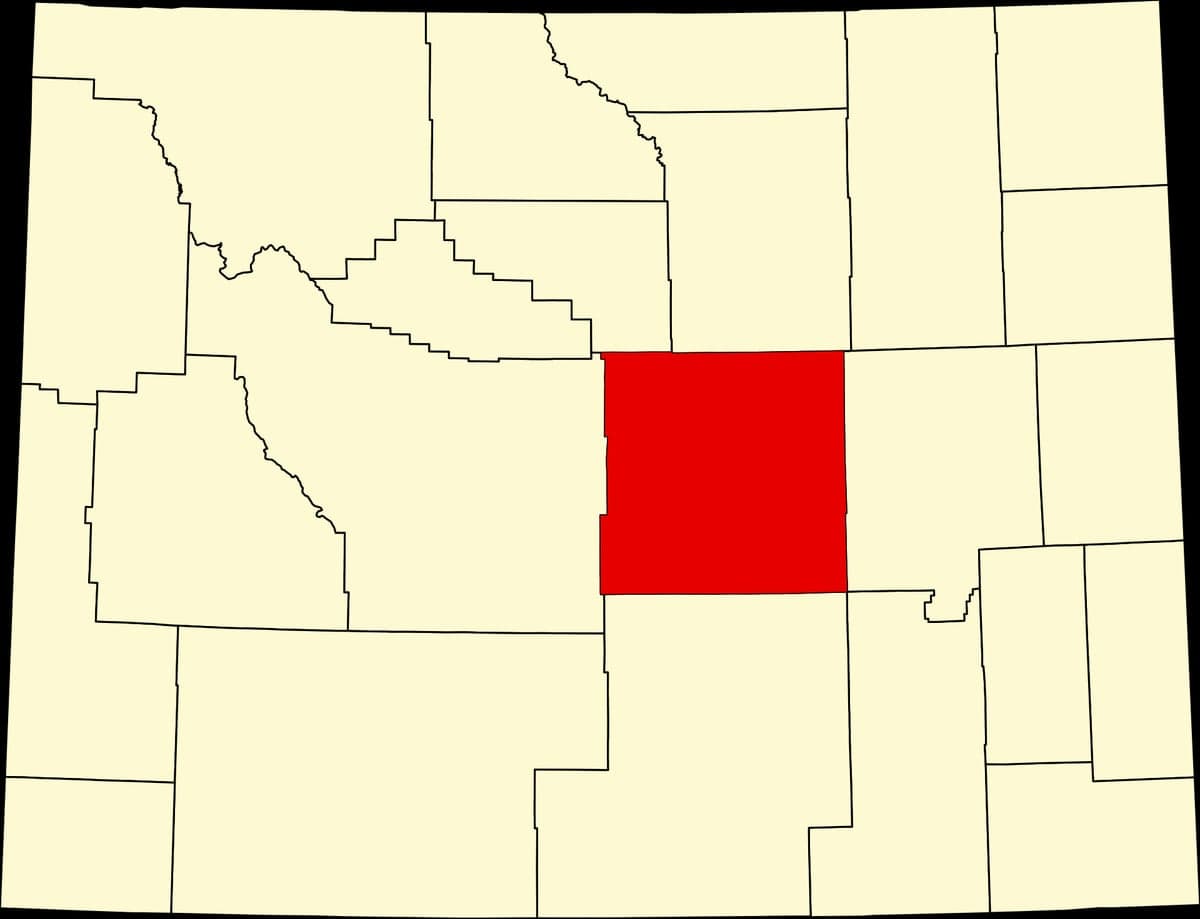
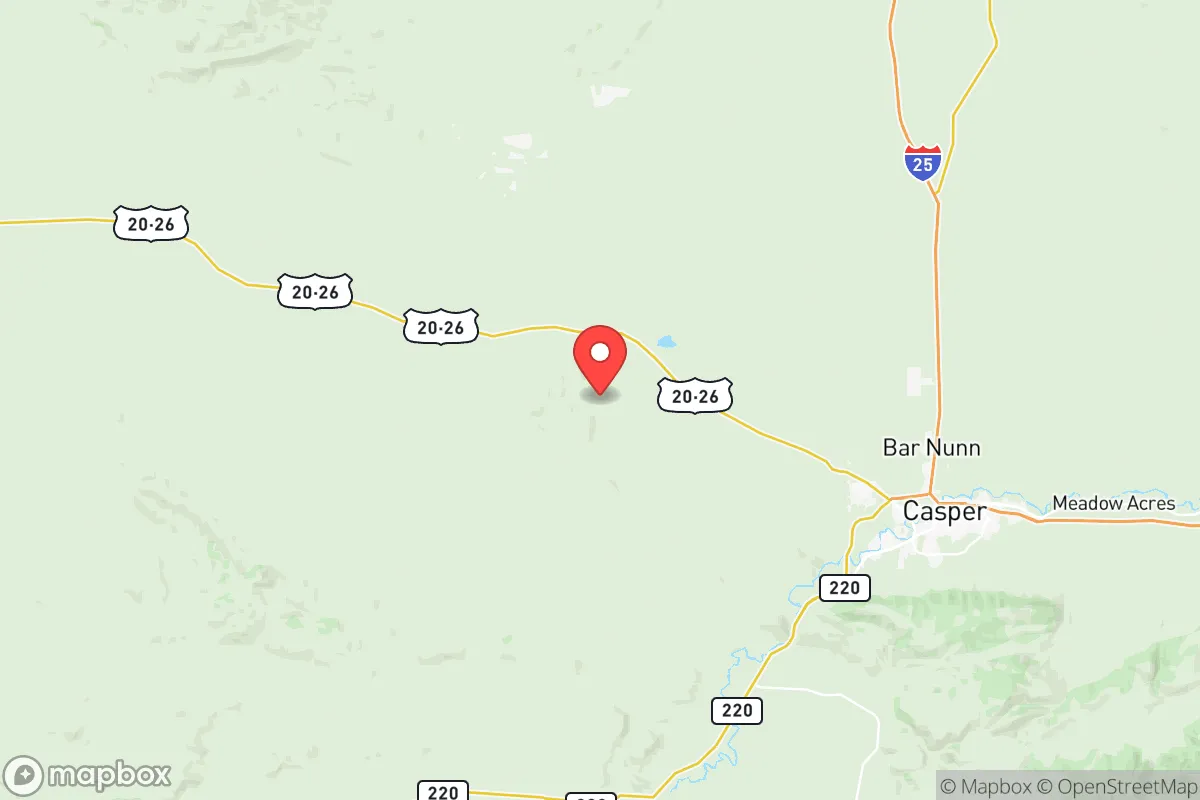
Photo: Wikipedia
Demographics of Natrona County
Affluence Level in Natrona County
A middle-class area roughly in line with national averages across income, home values, education, and employment.
People of Natrona County
The people of Natrona County, Wyoming, today number 79,735, forming a population that is predominantly white (85.1%) and significantly less diverse than the national average, with a foreign-born share of just 1.0%. With a college-educated rate of 27.4%, the county’s identity is deeply rooted in its Western heritage, energy economy, and a culture of self-reliance, concentrated in the urban hub of Casper and scattered across smaller communities like Mills, Evansville, and Bar Nunn. The population is notably older and more stable than many regions of the Mountain West, reflecting a history of boom-and-bust cycles tied to oil, coal, and ranching that have shaped who lives here and why.
Settlement & growth (pre-1960)
Before American settlement, Natrona County was the domain of several Native nations, most prominently the Shoshone, who controlled the region's river valleys and plains, and the Arapaho, who moved into the area by the early 19th century as pressure from Euro-American expansion pushed tribes westward. These groups lived a nomadic, bison-hunting existence, with seasonal camps along the North Platte River near present-day Casper. The first Euro-American presence came in the 1810s and 1820s with French-Canadian and American fur trappers—known as mountain men—who worked the streams of the North Platte and Sweetwater River valleys, establishing a rough trading network but no permanent settlements. By the 1840s, the Oregon and Mormon Trails brought thousands of westward-bound emigrants through the county, crossing the North Platte at a key ford near what is now Casper, but few stayed; the region was a transit corridor, not a destination.
Permanent settlement began in earnest after the 1868 Fort Laramie Treaty opened the area to homesteading, and the arrival of the Fremont, Elkhorn & Missouri Valley Railroad in 1888 transformed the landscape. The railroad created the town of Casper, named after an army officer, as a shipping point for cattle and sheep ranches that had spread across the shortgrass prairie. The early white settlers were overwhelmingly of Northern European stock—English, Scots-Irish, and German—drawn by the open range and the promise of cheap land under the Homestead Act of 1862. Scots-Irish families, in particular, came from the upper Midwest and Appalachia, establishing ranches along the Platte River near Evansville and Mills, where their descendants still operate cattle operations today. A smaller wave of Scandinavian immigrants, mostly Swedes and Norwegians, arrived in the 1890s-1900s, settling in the farming hamlet of Midwest (later renamed Edgerton) and the coal-mining town of Hanna, working the underground mines that fueled the railroad.
The single most transformative event for the county’s population was the 1895 discovery of oil at Shannon Field, just north of Casper. This triggered a classic Western oil boom. By the 1910s, Casper swelled with roughnecks, drillers, and speculators from oil fields in Pennsylvania, Ohio, and Texas. The Salt Creek Oil Field, one of the largest in the world, drew a notably diverse workforce for the era: Mills became home to a small enclave of Mexican laborers who worked the refineries, and a handful of Black families—migrating out of the Jim Crow South—settled in Casper’s north side, working as roustabouts and cooks. By 1930, the county’s population had surged past 24,000, with Casper at its center as the "Oil Capital of the Rockies." The Dust Bowl of the 1930s brought a smaller but notable wave of "Okies"—displaced farmers from the Southern Plains—who found work in the oilfields and on ranches around Alcova and Bessemer Bend, adding a distinctly Southern cultural flavor to the county’s otherwise Northern European base.
The post-WWII period through 1960 saw a stabilization of this population, as the oil industry matured. The natural increase of the existing white population, bolstered by returning veterans and their new families, drove growth to 49,623 by 1960. Suburbanization began around Casper, with Bar Nunn incorporated in 1960 as a bedroom community for oil workers. The county’s population at this point was overwhelmingly white (above 98%), native-born, and Protestant, with a tight-knit rural identity centered on the oil patch, the ranch, and the local school system.
Modern era (post-1965)
The Hart-Cellar Act of 1965, which opened U.S. immigration to non-European sources, had a muted effect on Natrona County compared to coastal urban areas. The county’s foreign-born population today sits at just 1.0%, the lowest of any Wyoming county with a city over 50,000. Instead, the most significant demographic shift since the 1960s has been the steady growth of Hispanic residents, driven by domestic migration from the Southwest and Mexico. From near-zero in 1960, Hispanics now make up 9.3% of the population. This community is heavily concentrated in Casper’s central and east-side neighborhoods, particularly around the oil refineries and the agricultural processing plants along the Platte River. A smaller Hispanic presence exists in Evansville, where workers in the construction and service industries have settled. The community is predominantly of Mexican ancestry, with families arriving in waves: first in the 1970s during an oil boom that needed cheap labor, and again in the 2000s as the fracking industry revived the regional economy.
The Black population, at 0.6%, has remained minuscule and static. Most Black residents are military-affiliated or connected to the energy industry, living temporarily in Casper and Mills without forming a distinct enclave. East/Southeast Asian residents make up 0.4%, with a small but established community of Filipino and Vietnamese families, many of whom arrived in the 1980s as professionals in the healthcare sector—Casper’s two hospitals recruit globally. They concentrate in Casper’s east side near Wyoming Medical Center. Indian subcontinent residents, at 0.1%, are almost entirely recent arrivals—engineers and IT professionals working for energy firms—and are scattered without a visible community hub. The county’s white population has declined slightly in share (from over 98% in 1970 to 85.1% today), but the absolute number of white residents has remained stable, reflecting low out-migration and a relatively low birth rate.
Domestic migration has been less dramatic here than in booming Western states like Colorado or Montana. The county lost population during the 1980s oil bust—dropping from 71,856 in 1982 to 61,226 by 1990—as thousands of workers, mostly white, left for Texas and Oklahoma. Recovery came with energy price hikes in the 2000s and 2010s, bringing back former residents and a smaller number of newcomers from the Rust Belt. These new arrivals, often young families seeking lower costs and outdoor recreation, have concentrated in the newer subdivisions on Casper’s south and west sides, as well as in the town of Mountain View (unincorporated) near the base of Casper Mountain. The county’s population in 2024 is 79,735, still below its 2014 peak of 82,000, as the energy industry’s automation and cyclical nature have dampened long-term growth.
The future
Natrona County’s population is projected to grow modestly over the next two decades—likely reaching 85,000-88,000 by 2040—driven primarily by domestic in-migration of retirees and remote workers seeking affordable housing and a slower pace, not by high birth rates or immigration. The county is becoming slightly more diverse, but slowly. The Hispanic share is expected to rise to 12-14% by 2040, as families in Casper’s east side anchor a growing community, and as workers in the wind and solar energy sectors (newer industries for the county) bring in younger Latino workers from Colorado and New Mexico. East/Southeast Asian and Indian populations will inch up only marginally, as recruiting for specialized healthcare and engineering roles remains niche. The white, native-born population will continue to dominate, but with an aging skew—the median age of 38.5 is already above the national median—meaning that the county will need to attract younger families to sustain its workforce.
Culturally, Natrona County is likely to become more suburbanized and less "Old West" in character, as newer residents bring expectations for services, amenities, and political diversity. However, the county’s social identity—conservative, individualistic, resource-dependent—shows little sign of fundamental change, as the vast majority of newcomers are themselves white Americans escaping high-cost states and seeking the same values that drew earlier generations. The key challenge will be economic diversification; if the energy sector contracts permanently, the county could see a net population decline, particularly from Edgerton and Mills, which depend most heavily on the oil refineries.
For someone moving into Natrona County now, the bottom line is this: you are joining a stable, overwhelmingly white, native-born population that values self-sufficiency and outdoor living, with a Hispanic minority that is integrated but not segregated, and a small patchwork of other communities. The county is becoming slightly more diverse and significantly more suburban, but it remains a place where family roots, energy jobs, and Western traditions define daily life—a slow-changing demographic that offers both predictability and a deep sense of place.

* Values derived from national, state, county, city and local statistics and may differ in a specific area. Last updated: 2026-07-03T04:26:35.000Z
Narrative content on this page is AI-generated and may contain mistakes. Verify any details that matter before acting on them.
ReloMaps may earn a commission from affiliate links at no extra cost to you.

