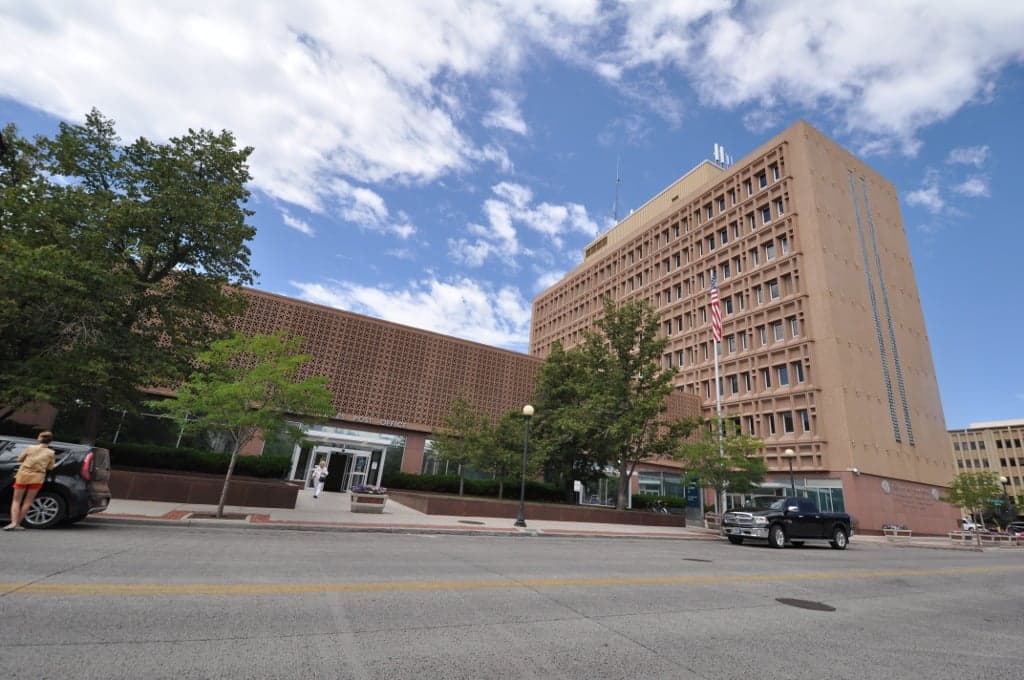
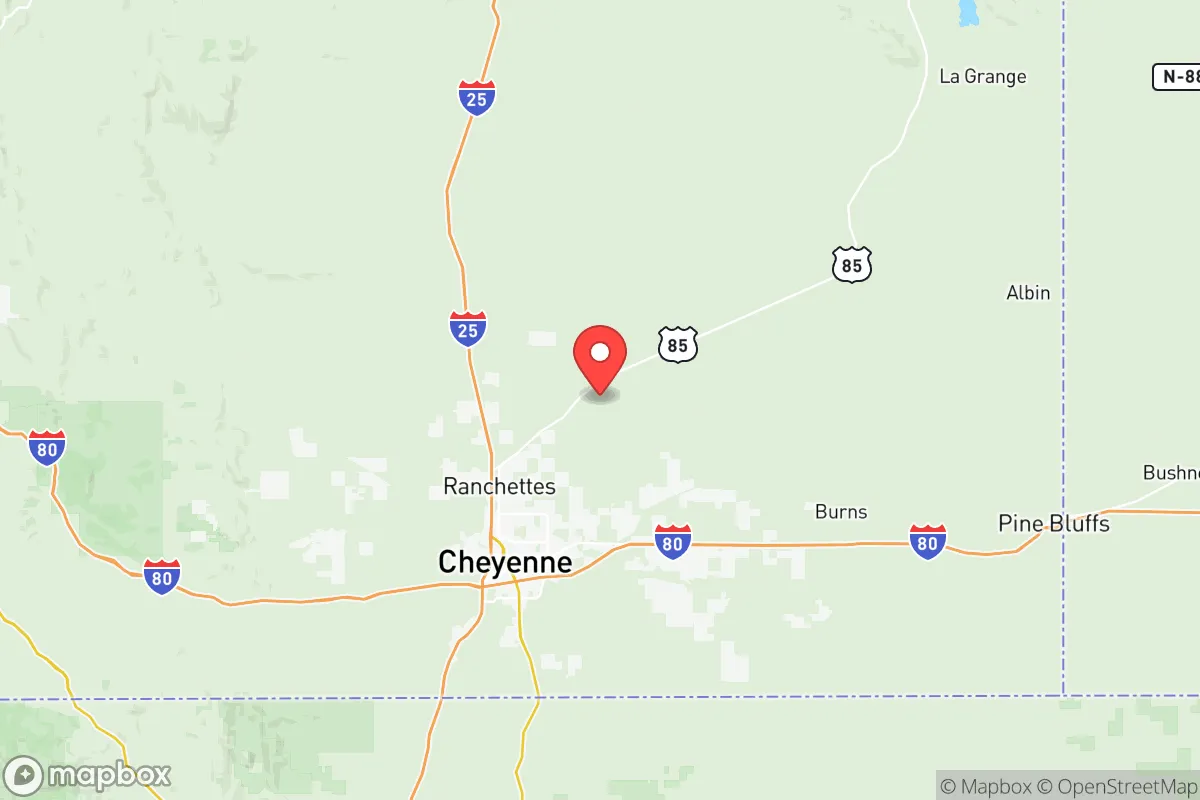
Photo: Wikipedia
Demographics of Laramie County
Affluence Level in Laramie County
A middle-class area roughly in line with national averages across income, home values, education, and employment.
People of Laramie County
Today, Laramie County’s 100,661 residents form a population that is predominantly white (75.9%) with a significant and growing Hispanic minority (15.7%), a small Black community (2.1%), and very small East/Southeast Asian (0.8%) and Indian subcontinent (0.2%) populations. The county is defined by its frontier character—low density, a strong ranching and energy heritage, and a conservative political leaning—with nearly all residents concentrated in the capital city of Cheyenne. The foreign-born share is just 1.6%, one of the lowest in the nation, reflecting a population shaped overwhelmingly by domestic migration rather than international immigration.
Settlement & growth (pre-1960)
Before American settlement, the area that is now Laramie County was part of the traditional territory of the Cheyenne, Arapaho, and Lakota peoples, who followed bison herds across the high plains. The first permanent non-Native presence came with the U.S. Army’s establishment of Fort D.A. Russell in 1867, which anchored the Union Pacific Railroad’s westward push. The railroad arrived the same year, and the town of Cheyenne was founded as a rough-and-tumble railhead and supply center for miners heading to the Black Hills gold rush. The county was formally organized in 1867, named for French-Canadian trapper Jacques La Ramee, and Cheyenne quickly became Wyoming’s largest city and territorial capital.
The first major wave of settlers were Anglo-American migrants from the Midwest and Northeast—farmers, ranchers, and railroad workers—who arrived between 1867 and 1890. The federal Homestead Act and later the Enlarged Homestead Act of 1909 drew families to claim 160- to 320-acre parcels, particularly in the county’s eastern and northern reaches around Pine Bluffs, Burns, and Albin. These towns remain small, predominantly white farming communities today. A smaller but notable group of German-Russian immigrants, fleeing conscription and land scarcity in the Volga region, settled in the Cheyenne area and in Carpenter between 1890 and 1910, working as dryland wheat farmers. Their descendants still form a visible cultural thread in the county’s rural precincts.
The early 20th century brought a second wave: workers drawn to the Union Pacific Railroad’s maintenance shops in Cheyenne, which employed thousands. This period also saw the establishment of F.E. Warren Air Force Base (originally Fort D.A. Russell) as a permanent military installation, which brought a steady influx of military personnel and their families from across the country. The Dust Bowl of the 1930s pushed a small number of displaced farmers from Oklahoma and the Texas Panhandle into Laramie County, though the county’s population grew only modestly through the Depression and war years. By 1960, the county’s population stood at roughly 60,000, overwhelmingly white, native-born, and employed in government, rail, agriculture, and the base.
Modern era (post-1965)
The 1965 Hart-Cellar Act had minimal direct impact on Laramie County, given its low foreign-born share. Instead, the county’s modern demographic story is one of domestic migration and suburbanization. The most significant shift has been the growth of the Hispanic population, which rose from under 5% in 1990 to 15.7% today. This growth is driven primarily by Mexican-American families moving from the Southwest and from rural Colorado for work in construction, meatpacking, and the energy sector. The Hispanic community is concentrated in Cheyenne’s south side and in the unincorporated community of Fox Farm-College, where a cluster of Hispanic-owned businesses and a Spanish-language church serve the population.
The Black population, at 2.1%, is small but stable, anchored by military families stationed at F.E. Warren Air Force Base and a smaller number of professionals in state government. The East/Southeast Asian community (0.8%) is almost entirely tied to the base and to the University of Wyoming’s Laramie County Community College campus in Cheyenne, with no distinct ethnic enclave. The Indian subcontinent population (0.2%) is similarly tiny and dispersed, consisting mostly of medical professionals at Cheyenne Regional Medical Center and tech workers in remote roles.
Suburbanization has been modest compared to the Front Range cities to the south. Cheyenne’s population has grown steadily but slowly, with new subdivisions spreading east toward Horse Creek and south toward Granite. The county’s rural towns—Pine Bluffs, Burns, Albin—have held steady or declined slightly, as younger residents move to Cheyenne or leave the state entirely. The college-educated share has risen to 32.0%, driven by state government employment and the base’s professional workforce, but remains below the national average.
The future
Laramie County is likely to become slightly more diverse over the next two decades, but the pace will be slow. The Hispanic share is projected to reach 20-22% by 2040, driven by natural increase and continued domestic migration from the Southwest. The white population will continue to decline as a share, but will remain the overwhelming majority. The Black, East/Southeast Asian, and Indian subcontinent populations are expected to grow only incrementally, as the county lacks the economic magnets—major universities, tech hubs, or immigrant-heavy industries—that drive rapid diversification elsewhere.
Population growth will concentrate in Cheyenne’s southern and eastern edges, where new master-planned subdivisions are absorbing families priced out of Colorado’s Front Range. The rural towns will continue to shrink or stagnate, as agriculture consolidates and young people leave. The county’s cultural identity—rooted in ranching, military service, and a live-and-let-live Western independence—will persist, but will be increasingly inflected by Hispanic traditions, particularly in food, music, and religious practice. The foreign-born share may rise to 3-4% but will remain among the lowest in the nation.
For someone moving in now, Laramie County offers a stable, low-density, conservative-leaning community where the population is slowly diversifying but remains overwhelmingly native-born and white. The county is not becoming a melting pot in the traditional sense, but it is becoming a slightly more varied version of its historic self—a place where the dominant Anglo-American ranching culture is gradually absorbing Hispanic influences without fundamental disruption. The key trend to watch is the continued growth of Cheyenne as a bedroom community for Colorado’s Front Range, which will bring more newcomers with different political and cultural expectations, potentially reshaping the county’s character over the longer term.

* Values derived from national, state, county, city and local statistics and may differ in a specific area. Last updated: 2026-07-11T13:11:11.000Z
Narrative content on this page is AI-generated and may contain mistakes. Verify any details that matter before acting on them.
ReloMaps may earn a commission from affiliate links at no extra cost to you.

